
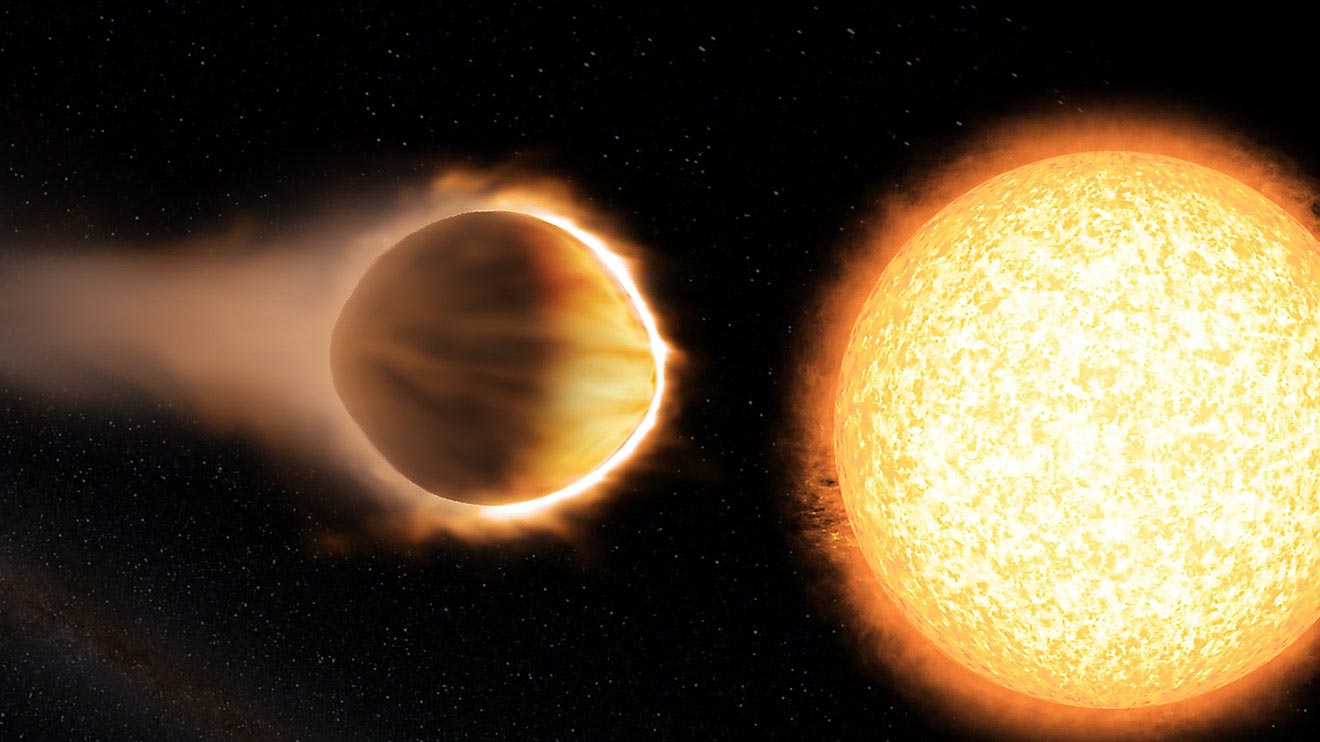
University of Chicago study finds way that hot, rocky planets in other systems could form and keep atmospheres.
An atmosphere is what makes life on Earth’s surface possible, regulating our climate and sheltering us from damaging cosmic rays. But although telescopes have counted a growing number of rocky planets, scientists had thought most of their atmospheres were long lost.
However, a new study by University of Chicago and Stanford University researchers suggests a mechanism whereby these planets could not only develop atmospheres full of water vapor, but keep them for long stretches. Published on March 15, 2021, in the Astrophysical Journal Letters, the research expands our picture of planetary formation and could help direct the search for habitable worlds in other star systems.
“Our model is saying that these hot, rocky exoplanets should have a water-dominated atmosphere at some stage, and for some planets, it may be quite a long time,” said Asst. Prof. Edwin Kite, an expert in how planetary atmospheres evolve over time.
As telescopes document more and more exoplanets, scientists are trying to figure out what they might look like. Generally, telescopes can tell you about an exoplanet’s physical size, its proximity to its star, and if you’re lucky, how much mass it has. To go much further, scientists have to extrapolate based on what we know about Earth and the other planets in our own solar system. But the most abundant planets don’t seem to be similar to the ones we see around us.
The Hydrogen Cloak Mystery and Magma Ball Hypothesis
“What we already knew from the Kepler mission is that planets a little smaller than Neptune are really abundant, which was a surprise because there are none in our solar system,” Kite said. “We don’t know for sure what they are made of, but there’s strong evidence they are magma balls cloaked in a hydrogen atmosphere.”
There’s also a healthy number of smaller rocky planets that are similar, but without the hydrogen cloaks. So scientists surmised that many planets probably start out like those larger planets that have atmospheres made out of hydrogen, but lose their atmospheres when the nearby star ignites and blows away the hydrogen.
But lots of details remain to be filled out in those models. Kite and co-author Laura Schaefer of Stanford University began to explore some of the potential consequences of having a planet covered in oceans of melted rock.
From Hydrogen to Water Vapor: A Planetary Transformation
“Liquid magma is actually quite runny,” Kite said, so it also turns over vigorously, just like oceans on Earth do. There’s a good chance these magma oceans are sucking hydrogen out of the atmosphere and reacting to form water. Some of that water escapes to the atmosphere, but much more gets slurped up into the magma.
Then, after the nearby star strips away the hydrogen atmosphere, the water gets pulled out into the atmosphere instead in the form of water vapor. Eventually, the planet is left with a water-dominated atmosphere.
This stage could persist on some planets for billions of years, Kite said.
There are several ways to test this hypothesis. The James Webb Space Telescope, the powerful successor to the Hubble Telescope, is scheduled to launch later this year; it will be able to conduct measurements of the composition of an exoplanet’s atmosphere. If it detects planets with water in their atmospheres, that would be one signal.
Another way to test is to look for indirect signs of atmosphere. Most of these planets are tidally locked; unlike Earth, they don’t spin as they move around their sun, so one side is always hot and the other cold.
Temperature Clues from Tidally Locked Planets
A pair of UChicago alumni have suggested a way to use this phenomenon to check for an atmosphere. Scientists Laura Kreidberg, PhD’16, and Daniel Koll, PhD’16 — now at the Max Planck Institute for Astronomy and MIT, respectively — pointed out that an atmosphere would moderate the temperature of the planet, so there wouldn’t be a sharp difference between the day sides and night sides. If a telescope can measure how strongly the day side glows, it should be able to tell whether there’s an atmosphere redistributing heat.
Reference: “Water on Hot Rocky Exoplanets” by Edwin S. Kite and Laura Schaefer, 15 March 2021, The Astrophysical Journal Letters.
DOI: 10.3847/2041-8213/abe7dc
Funding: NASA.
Never miss a breakthrough: Join the SciTechDaily newsletter.
Follow us on Google and Google News.
6 Comments
We are not surprised that all planets have a lot of iron oxide Fe2O3. Why are we surprised that there may be a lot of hydrogen oxide H2O on all the planets?
Many planets do not rotate around an axis because their center of mass is shifted toward the stars. In the Earth the center was centered by the Moon. Though at the Moon the center of mass is shifted towards the Earth. It is necessary to consider at launch of satellites – from the Earth the orbit should be higher.
If a body rotates, they rotate around an axis by definition.
Since planets are massive, their spin axis most often align with their center of gravity. Distant stars has nothing to do with it.
Earth is a bit different due to its massive Moon, almost but not quite a twin planet system:
“Earth and the Moon orbit about their barycentre (common center of mass), which lies about 4,600 km (2,900 mi) from Earth’s center (about 72% of its radius).”
[ https://en.wikipedia.org/wiki/Orbit_of_the_Moon ]
The easiest planets to spot and verify with our current technologies are the ones that have a big influence on their host star (e.g. big planet, tight orbit, small star). It would be hard to find a planet as small as Earth, in an orbital period as far from the star as Earth is from Sol, around a star as large as Sol. The planets we have found around other stars are therefore a very biased sampling and the data is going to be skewed. This is exactly what we’re seeing. We do not have information sufficient to suggest what is typical around other stars, it would be like turning over a four rocks on a beach, seeing two crabs, and declaring crabs as the most common form of life without looking for microscopic life. Hot sub-Neptunes are probably not the most common form of planet. But they are really easy to find with the technology we have now and would lead us to believe they are the most common form of planet, if we ignore the bias in our sampling.
I agree with your assessment on “typical”, and there have been statistical models that place Earth among the 99 % most common systems. Not a comfortable fit but not an extraordinary poor one either.
However I think they also model planet distributions with methods of observational bias removal, and the close and large terrestrial planet peak remains. For one thing, these atmosphere processes makes that mass range having several degeneracies under slightly modified mass change (say, a modicum of atmosphere loss), so there is more chance to see a planet there.
There’s so many surprises and probably many more surprises to come In the exoplanet hunt.
I’m just glad to be living in an age where we have the ability to discover life elsewhere.
If we can detect them: A H2O rich atmosphere sounds like it would support airborne and surface life.
This article describes the context of alterantive pathways for dense late atmospheres: http://astrobiology.com/2021/03/water-on-hot-rocky-exoplanets.html .
Part of the figure text: “Our proposed scenario provides an alternative route to producing high-mean-molecular-weight atmospheres on hot rocky exoplanets. The hot super-Earth population could contain both types of atmospheres.”
The first pathway is loss of primary atmosphere and generation of a secondary atmosphere, the second pathway is distillation (light gas loss) of the atmosphere.
Since the recent, first putative observation of a secondary atmosphere indicated it was hydrogen dominated, both of the above pathways may become less likely. But we’ll have to wait for more obvservations.