
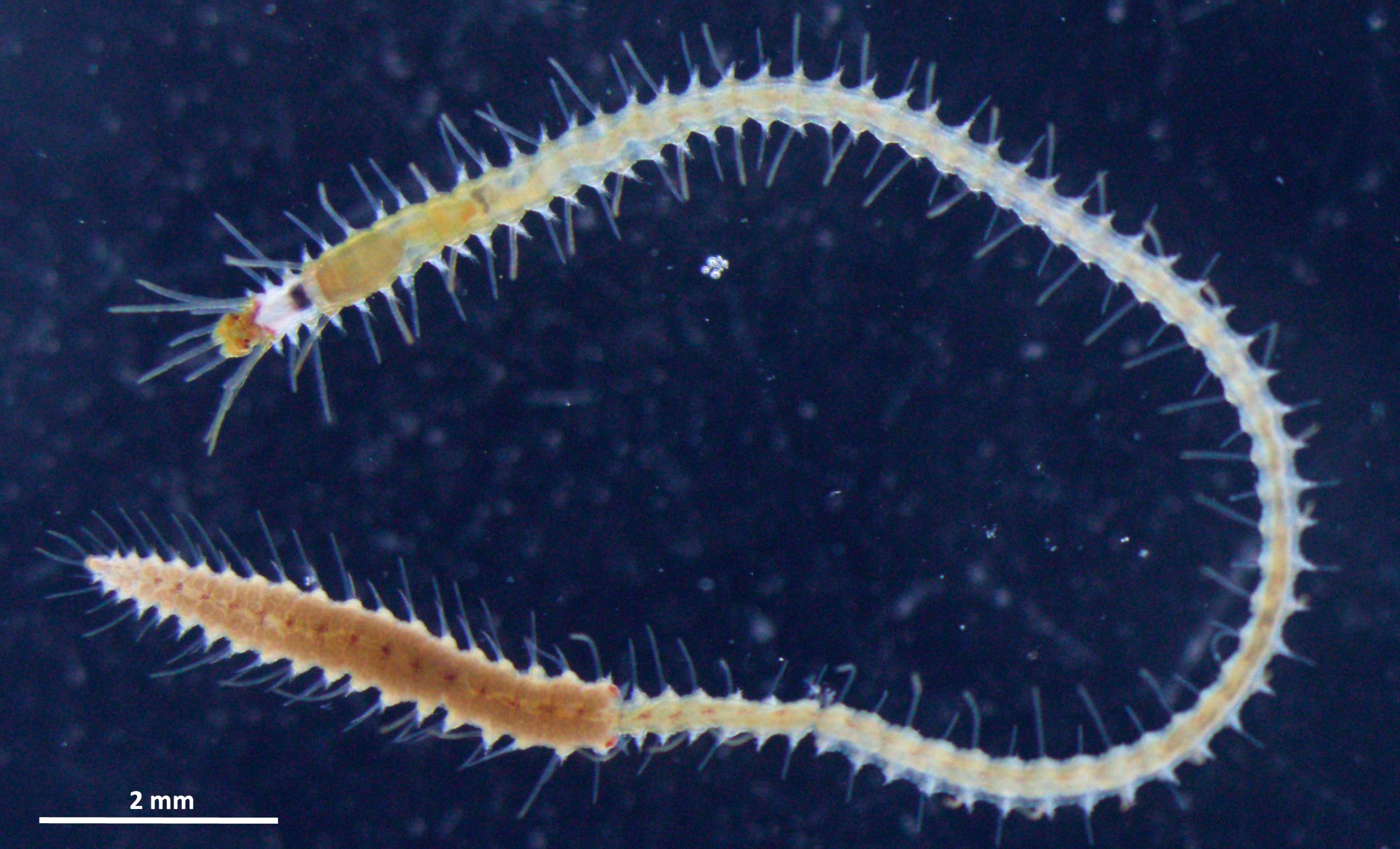
Armed with its own eyes, antennae, and swimming bristles, the posterior body part of a sea worm detaches for spawning. Scientists revealed its developmental mechanism for the first time.
A research team, led by Professor Toru Miura from the University of Tokyo, shows how the expression of developmental genes in the Japanese green syllid worms, Megasyllis nipponica, helps form their swimming reproductive unit called stolon.
The Unique Mechanism of Stolonization
Life always finds ways to surprise us. The presence of a unique reproductive mechanism of some annelid worms or segmented worms is one such surprise. In a process called stolonization, the posterior body part with gonads of the syllid worm detaches from its original body. The detached part is called the stolon, and it is full of gametes (eggs or sperm). The stolon swims around by itself and spawns when it meets the opposite sex. Swimming autonomously would not only protect the original body from environmental dangers but could also help its gametes disperse over larger distances.
A swimming Megasyllis nipponica with a stolon in its posterior end. Credit: Nakamura et al 2023
Investigating the Stolon’s Head Formation
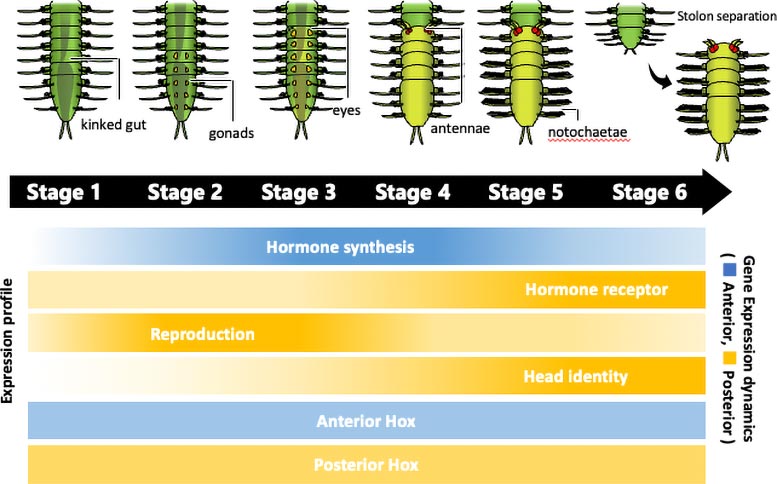
To swim autonomously, the stolons develop their own eyes, antennae, and swimming bristles while still attached to their original body. But how does the stolon head form in the middle of the original body?
The mystery surrounding the development of the stolon’s head within the original body has long perplexed scientists. Professor Miura’s research, driven by a keen interest in the evolutionary transitions of developmental systems in animal life cycles, has finally brought clarity to this intriguing phenomenon. Careful histological and morphological observations revealed that the stolon formation starts with the maturation of gonads in the posterior end. Then forms a head in the anterior part of the developing stolon. Sense organs such as eyes and antennae, and swimming bristles form soon after. Before the stolon detaches, it develops nerves and a ‘brain’ to sense and behave independently.
Gene Expression in Stolon Development
To understand the development of stolon’s head, Miura and his team investigated the developmental gene expression patterns of the sexually maturing worms. A well-known group of head formation genes are known to define the head region of various animals. Miura and team found that these genes are expressed more in the head region of the stolon. Typically, the head formation genes are not expressed as much in the middle of the body. But during gonad development in syllids, head formation genes are highly expressed in the middle of the posterior end of the original body. “This shows how normal developmental processes are modified to fit the life history of animals with unique reproductive styles,” explains Miura.
Role of Hox Genes
Hox genes determine the body segmentation along the syllids’ body. Miura and team thought that those genes would be expressed differently along the anterior-posterior axis. “Interestingly, the expressions of Hox genes that determine body-part identity were constant during the process,” says Miura. As a result, the stolons lack differentiated digestive tract and have repeated uniform body segments (except for the head and tail). “This indicates that only the head part is induced at the posterior body part to control spawning behavior for reproduction.”
Conclusions and Future Research
The study not only revealed the developmental mechanism of stolons for the first time but also sparked further inquiry into the intricacies of this bizarre reproductive method. “We would like to clarify the sex determination mechanism and the endocrine regulations underlying the reproductive cycles in syllids,” concludes Miura.
Reference: “Morphological, histological and gene-expression analyses on stolonization in the Japanese Green Syllid, Megasyllis nipponica (Annelida, Syllidae)” by Mayuko Nakamura, Kohei Oguchi, Daisuke S. Sato, Sumika Kato, Masanori Okanishi, Yoshinobu Hayashi, M. Teresa Aguado and Toru Miura, 22 November 2023, Scientific Reports.
DOI: 10.1038/s41598-023-46358-8
Never miss a breakthrough: Join the SciTechDaily newsletter.
Follow us on Google and Google News.