
Close Menu
    Facebook X (Twitter) Instagram
    SciTechDaily
    • Biology
    • Chemistry
    • Earth
    • Health
    • Physics
    • Science
    • Space
    • Technology
    Facebook X (Twitter) Pinterest YouTube RSS
    SciTechDaily
    Home»Space»Sticky Situation: Critical Antenna on ESA’s Jupiter Icy Moons Explorer Fails To Deploy
    Space

    Sticky Situation: Critical Antenna on ESA’s Jupiter Icy Moons Explorer Fails To Deploy

    By European Space Agency (ESA)April 29, 20235 Comments5 Mins Read
    Facebook Twitter Pinterest Telegram LinkedIn WhatsApp Email Reddit
    Share
    Facebook Twitter LinkedIn Pinterest Telegram Email Reddit
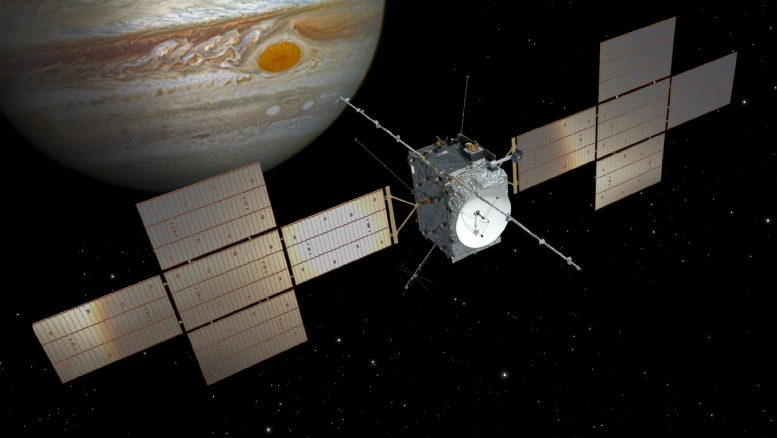
    Illustration of JUICE Spacecraft at Jupiter
    Illustration of the JUICE spacecraft at Jupiter. The Radar for Icy Moons Exploration (RIME) antenna on ESA’s Jupiter Icy Moons Explorer (Juice) spacecraft has encountered an issue preventing its deployment. The 16-meter-long antenna, crucial for studying the surface and subsurface structure of Jupiter’s icy moons, is currently stuck in its mounting bracket due to a suspected tiny pin. Despite the setback, the antenna shows signs of movement and is partially extended. Credit: ESA

    ESA’s Jupiter Icy Moons Explorer (Juice) has encountered a deployment issue with its Radar for Icy Moons Exploration (RIME) antenna. The issue, potentially caused by a stuck pin, is being addressed by ESA’s mission control teams with various strategies, including an engine burn and spacecraft rotations. Despite this, Juice’s other instruments are functioning properly, and there’s a two-month window to solve the problem.

    Juice’s ice-penetrating RIME antenna has not yet been deployed as planned. During the first week of commissioning, an issue arose with the 16-meter-long Radar for Icy Moons Exploration (RIME) antenna, which is preventing it from being released from its mounting bracket. Juice is currently 3.5 million km (2.2 million miles) from Earth.

    Work continues to free the radar and teams at ESA’s mission control center in Darmstadt, Germany, along with partners in science and industry, have lots of ideas up their sleeves.

    Every day the RIME antenna shows more signs of movement, visible in images from the Juice Monitoring Camera on board the spacecraft with a partial view of the radar and its mount. Now partially extended but still stowed away, the radar is roughly a third of its full intended length.
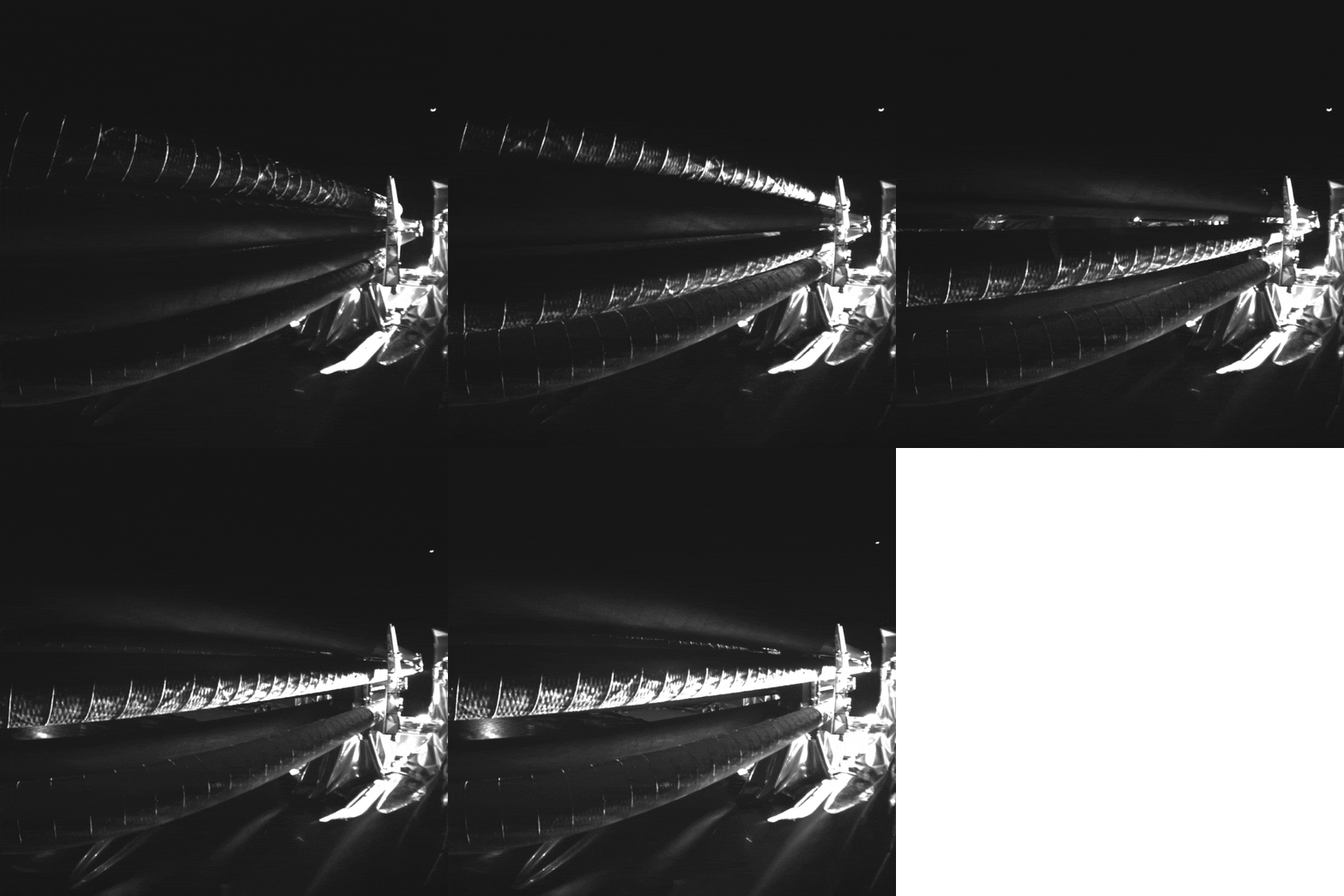
    Juice Wriggling RIME Antenna
    Juice’s stuck but moving RIME antenna is captured by the Juice Monitoring Camera on board the spacecraft. This animation shows the radar’s movements in five photos taken across April 17–21, as teams on Earth work through steps in Juice’s deployment. Four segments of the RIME antenna are visible here, folded on top of each other. This ‘stack’ of antenna elements is one half of the full antenna, next to the other half also in a folded stack. The other half has not yet begun deployment and becomes visible through the widening gaps between antenna segments. Credit: ESA/Juice/JMC, CC BY-SA 3.0 IGO

    The current leading hypothesis is that a tiny stuck pin has not yet made way for the antenna’s release. In this case, it is thought that just a matter of millimeters could make the difference to set the rest of the radar free.

    Various options are still available to nudge the important instrument out of its current position. The next steps to fully deploy the antenna include an engine burn to shake the spacecraft a little followed by a series of rotations that will turn Juice, warming up the mount and radar, which are currently in the cold shadows.
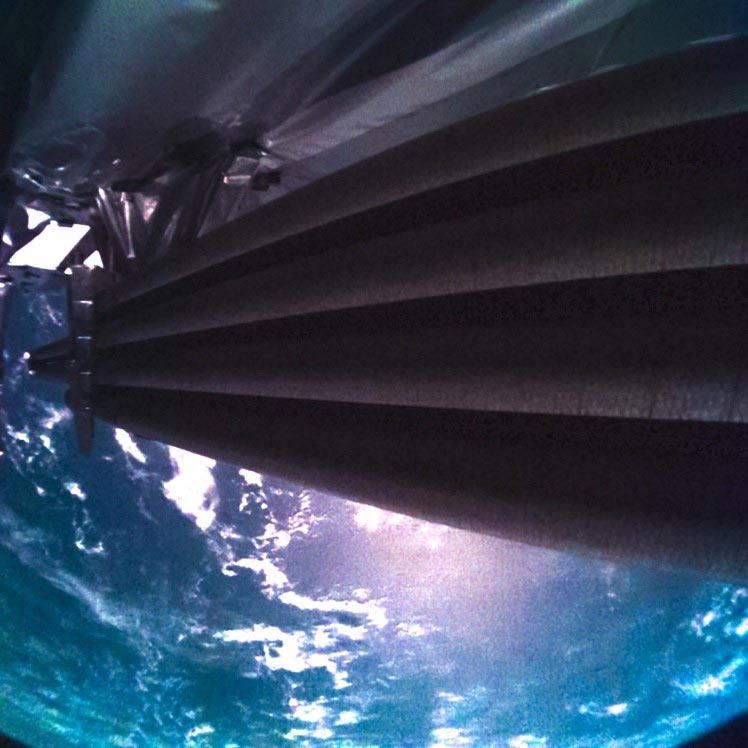
    Juice’s Longest Antenna Awaits Deployment
    Shortly after launch on April 14 , ESA’s Jupiter Icy Moons Explorer, Juice, captured this image with its Juice monitoring camera 2 (JMC2). JMC2 is located on the top of the spacecraft and is placed to monitor the multi-stage deployment of the 16 m-long Radar for Icy Moons Exploration (RIME) antenna. RIME is an ice-penetrating radar that will be used to remotely probe the subsurface structure of the large moons of Jupiter. In this image, RIME is seen in stowed configuration. Credit: ESA/Juice/JCAM, CC BY-SA 3.0 IGO

    Juice is otherwise performing excellently after the successful deployment and operation of its mission-critical solar arrays and medium gain antenna, as well as its 10.6-m magnetometer boom.

    With two months of planned commissioning remaining, there is plenty of time for teams to get to the bottom of the RIME deployment issue and continue work on the rest of the powerful suite of instruments on their way to investigate the outer Solar System.
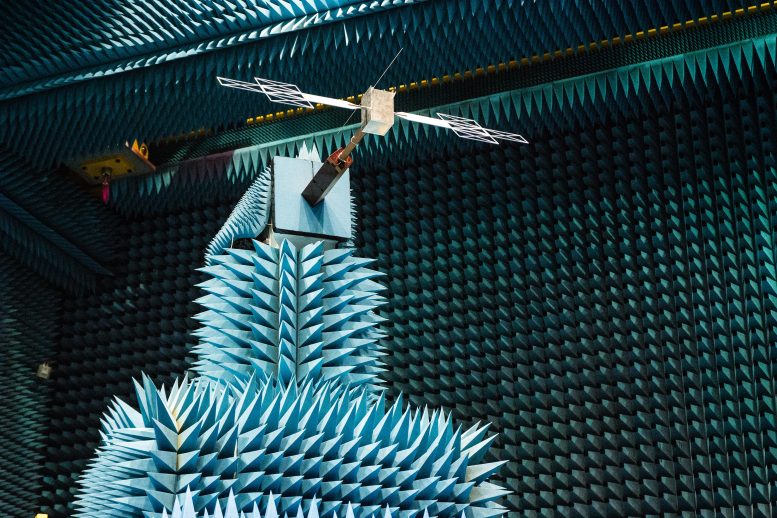
    Testing Juice RIME Antenna
    A 1:18 scale model of the Juice mission’s RIME antenna – Radar for Icy Moons Exploration, mounted on top of a simplified spacecraft model during tests in the Hertz facility at the European Space Research and Technology Centre (ESTEC) in Noordwijk, The Netherlands. RIME is an ice-penetrating radar that will be used to remotely probe the subsurface structure of the large moons of Jupiter. Emitted by a 16-m long dipole antenna, the radar signals will penetrate the icy surfaces of the moons down to a depth of 9 km, providing a vertical resolution between 50 and 140 m. Credit: ESA–M.Cowan, CC BY-SA 3.0 IGO

    Updates will be shared as new information becomes available.

    The RIME instrument is an ice-penetrating radar designed to study the surface and subsurface structure of Jupiter’s icy moons down to a depth of 9 km.

    It is one of ten instruments on board ESA’s Jupiter Icy Moons Explorer, Juice, set to investigate the emergence of habitable worlds around gas giants and the formation of our Solar System.

    Never miss a breakthrough: Join the SciTechDaily newsletter.
    Follow us on Google and Google News.

    ESA Juice European Space Agency Popular
    Share. Facebook Twitter Pinterest LinkedIn Email Reddit

    Related Articles

    Successfully Deployed: Juice Spacecraft’s RIME Antenna Finally Breaks Free

    Jupiter’s Icy Enigmas: ESA’s Juice Launches on a Cosmic Treasure Hunt

    Squeezing Secrets From Jupiter’s Moons: Juice’s Expedition to the Outer Solar System

    Juice’s Odyssey of Exploration: To Uncover the Hidden Secrets of Mysterious Worlds

    Clean Space Initiative to Target Orbital Debris

    Herschel Image of the Vela C Region

    Researchers Discover First Intermediate-Mass Black Hole

    ESA’s Vega Rocket Has Launched on Its Maiden Voyage, Carries 9 Satellites

    ESA’s Hershel Space Telescope Captures Incredible Views of Eagle Nebula

    5 Comments

    1. Gregory E Cooper on April 29, 2023 8:54 am

      Hi ESA; Just a well-wishing note to help solve the stuck pin
      debacle on you vital antena. Rotation, vibration and cycling
      the antena from open to close and closed to open positions
      should shake that pesky pin loose and restore normal operations.
      Best of Luck–Gregory

      Reply
      • Roy Trenneman on April 29, 2023 11:11 am

        Have they tried turning it off, and on again? Are they certain it’s plugged in?

        Reply
    2. TERENCE DONOVAN on April 29, 2023 11:58 am

      Picturing this satellite shaking all over like a dog to get its antenna loose…Isn’t science amazing ??….

      Reply
    3. Charles Riviere on April 30, 2023 5:55 am

      There are smart people working on this. The best laid plans….
      Space is hard, very hard as Bill Nelson is fond of saying. Space is hard.

      Reply
    4. Elon on April 30, 2023 5:01 pm

      “There are smart people working on this. The best laid plans….
      Space is hard, very hard as Bill Nelson is fond of saying. Space is hard.”

      Don’t you mean the “best laid PINS” ??? 🙂

      Reply
    Leave A Reply Cancel Reply

    • Facebook
    • Twitter
    • Pinterest
    • YouTube

    Don't Miss a Discovery

    Subscribe for the Latest in Science & Tech!

    Trending News

    What Causes Chronic Pain? Scientists Identify Key Culprit in the Brain

    Semaglutide Shows Surprising Mental Health Benefits in Massive 100,000-Person Study

    This Liquid Snapped Instead of Flowing and Scientists Were Shocked

    Breakthrough Alzheimer’s Drug Rewires the Brain Instead of Just Clearing Plaques

    Scientists Discover Hidden “Footprint of Death” That Could Transform How We Fight Disease

    A Simple Nose Swab Could Detect Alzheimer’s Years Before Symptoms Appear

    Scientists Just Rewrote the Timeline of Complex Life on Earth

    Teenager’s Fossil Find Leads to Discovery of Shark Teeth in 5 Million-Year-Old Whale Skull

    Follow SciTechDaily
    • Facebook
    • Twitter
    • YouTube
    • Pinterest
    • Newsletter
    • RSS
    SciTech News
    • Biology News
    • Chemistry News
    • Earth News
    • Health News
    • Physics News
    • Science News
    • Space News
    • Technology News
    Recent Posts
    • Even “Failed” Diets May Deliver Long-Term Health Gains, Study Finds
    • Childhood Junk Food May Rewire the Brain for Life
    • NIH Scientists Discover Powerful New Opioid That Relieves Pain Without Dangerous Side Effects
    • Breakthrough Study Reveals Why Damaged Nerves Struggle To Heal
    • 20-Year Study Reveals Cholera’s Surprising Weakness
    Copyright © 1998 - 2026 SciTechDaily. All Rights Reserved.
    • Science News
    • About
    • Contact
    • Editorial Board
    • Privacy Policy
    • Terms of Use

    Type above and press Enter to search. Press Esc to cancel.