
Close Menu
    Facebook X (Twitter) Instagram
    SciTechDaily
    • Biology
    • Chemistry
    • Earth
    • Health
    • Physics
    • Science
    • Space
    • Technology
    Facebook X (Twitter) Pinterest YouTube RSS
    SciTechDaily
    Home»Space»Herschel Image of the Vela C Region
    Space

    Herschel Image of the Vela C Region

    By European Space AgencyJuly 9, 2012No Comments3 Mins Read
    Facebook Twitter Pinterest Telegram LinkedIn WhatsApp Email Reddit
    Share
    Facebook Twitter LinkedIn Pinterest Telegram Email Reddit
    Vela C Region
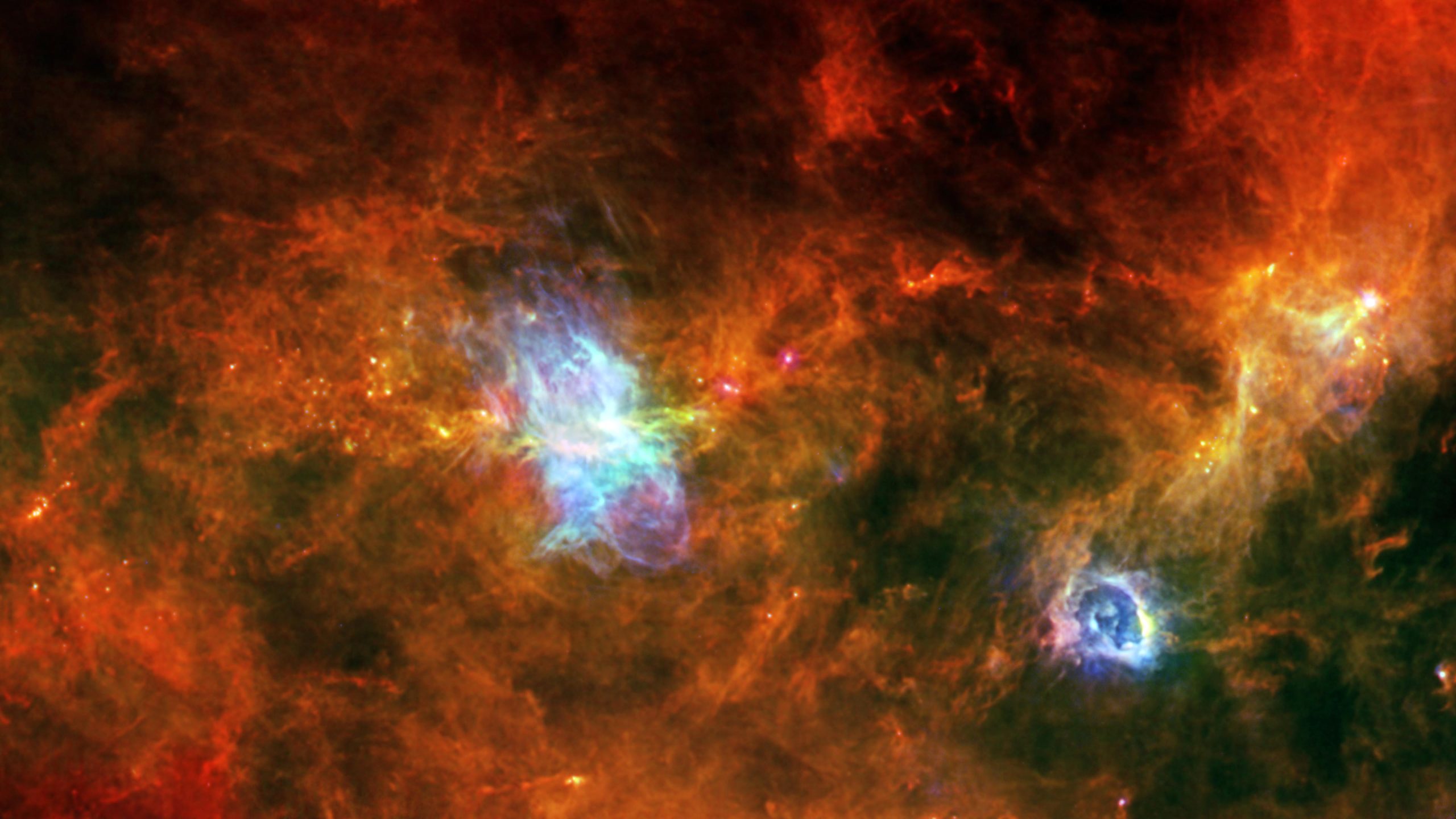
    The Vela C region, part of the Vela complex, by ESA’s Herschel space observatory. The image demonstrates Herschel’s ability to trace both high- and low-mass star formation at a range of evolutionary stages, from cool filaments, pre-stellar cores and protostars to more evolved regions containing dust that has been gently heated by hot stars. The image was mapped using Herschel instruments PACS and SPIRE at wavelengths of 70, 160, and 250 microns, corresponding to the blue, green, and red channels, respectively. North is to the right and east is up. Credit: ESA/PACS & SPIRE Consortia, T. Hill, F. Motte, Laboratoire AIM Paris-Saclay, CEA/IRFU – CNRS/INSU – Uni. Paris Diderot, HOBYS Key Program Consortium

    A new image from the European Space Agency’s Herschel Space Observatory shows Vela C, a massive star nursery that is 2,300 light-years from the Sun and part of the Vela complex.

    A beautiful blue butterfly flutters towards a nest of warm dust and gas, above an intricate network of cool filaments in this image of the Vela C region by ESA’s Herschel space observatory.

    Vela C is the most massive of the four parts of the Vela complex, a massive star nursery just 2300 light-years from the Sun. It is an ideal natural laboratory for us to study the birth of stars.

    Herschel’s far-infrared detectors can spot regions where young high- and low-mass stars have heated dense clumps of gas and dust, where new generations of stars may be born.

    The eye is immediately drawn to two prominent features in this image: a delicate blue and yellow butterfly shape just right of center that appears to be flying towards a nest of coiled blue material in the lower right.

    These regions stand out from their surroundings because their dust has been heated by young hot stars. A cluster of very hot, massive stars are strung out along the butterfly’s ‘body’, their radiation heating up the surrounding dust seen as yellow in this scene.

    These heavy stars will follow ‘live fast, die young’, burning brightly for only a short time in cosmic terms. Those with more than eight times the mass of our own Sun will explode as cataclysmic supernovas within 10 million years of forming.

    A particularly dense trunk of cool gas and dust weaves its way through the center of the image, surrounded by a complex network of wispy red filaments.

    Deeply embedded inside the filaments are numerous point-like sources, particularly evident towards the left of the scene: these are protostars, the seeds of new stars that will soon also light up the Vela region of the sky.

    Never miss a breakthrough: Join the SciTechDaily newsletter.
    Follow us on Google and Google News.

    Astronomy European Space Agency Galaxy Evolution Herschel Space Observatory Popular Stars
    Share. Facebook Twitter Pinterest LinkedIn Email Reddit

    Related Articles

    Cosmic Record Broken: Hubble Finds the Most Distant Star Ever Seen

    Hubble Find Surprises Astronomers: White Dwarfs Can Still Undergo Stable Thermonuclear Activity

    Cosmic Neon Lights: Strange New Type of Star Revealed in X-ray Light

    Herschel Detects Water Vapor on Dwarf Planet Ceres

    Astronomers Detect Subtle Twist in the Relic Radiation from the Big Bang

    Herschel Discovers a Newfound Reservoir of Stellar Fuel

    Herschel Makes Detailed Observations of a Hot Molecular Gas at the Center of the Milky Way

    Astronomers Discover Earliest Starburst Galaxy Ever Observed

    VLT Reveals That O Stars, Which Drive the Evolution of Galaxies, Don’t Live Alone

    Leave A Reply Cancel Reply

    • Facebook
    • Twitter
    • Pinterest
    • YouTube

    Don't Miss a Discovery

    Subscribe for the Latest in Science & Tech!

    Trending News

    The Universe Is Expanding Too Fast and Scientists Can’t Explain Why

    “Like Liquid Metal”: Scientists Create Strange Shape-Shifting Material

    Early Warning Signals of Esophageal Cancer May Be Hiding in Plain Sight

    Common Blood Pressure Drug Shows Surprising Power Against Deadly Antibiotic-Resistant Superbug

    Scientists Uncover Dangerous Connection Between Serotonin and Heart Valve Disease

    Scientists Discover a “Protector” Protein That Could Help Reverse Hair Loss

    Bone-Strengthening Discovery Could Reverse Osteoporosis

    Scientists Uncover Hidden Trigger Behind Stem Cell Aging

    Follow SciTechDaily
    • Facebook
    • Twitter
    • YouTube
    • Pinterest
    • Newsletter
    • RSS
    SciTech News
    • Biology News
    • Chemistry News
    • Earth News
    • Health News
    • Physics News
    • Science News
    • Space News
    • Technology News
    Recent Posts
    • A Common Diabetes Drug May Hold the Key to Stopping HIV From Coming Back
    • Ancient “Syphilis-Like” Disease in Vietnam Challenges Key Scientific Assumptions
    • Drinking Alcohol To Cope in Your 20s Could Damage Your Brain for Life
    • Scientists Crack Alfalfa’s Chromosome Mystery After Decades of Debate
    • Ancient Ant-Plant Alliance Collapses As Predatory Wasps Move In
    Copyright © 1998 - 2026 SciTechDaily. All Rights Reserved.
    • Science News
    • About
    • Contact
    • Editorial Board
    • Privacy Policy
    • Terms of Use

    Type above and press Enter to search. Press Esc to cancel.