
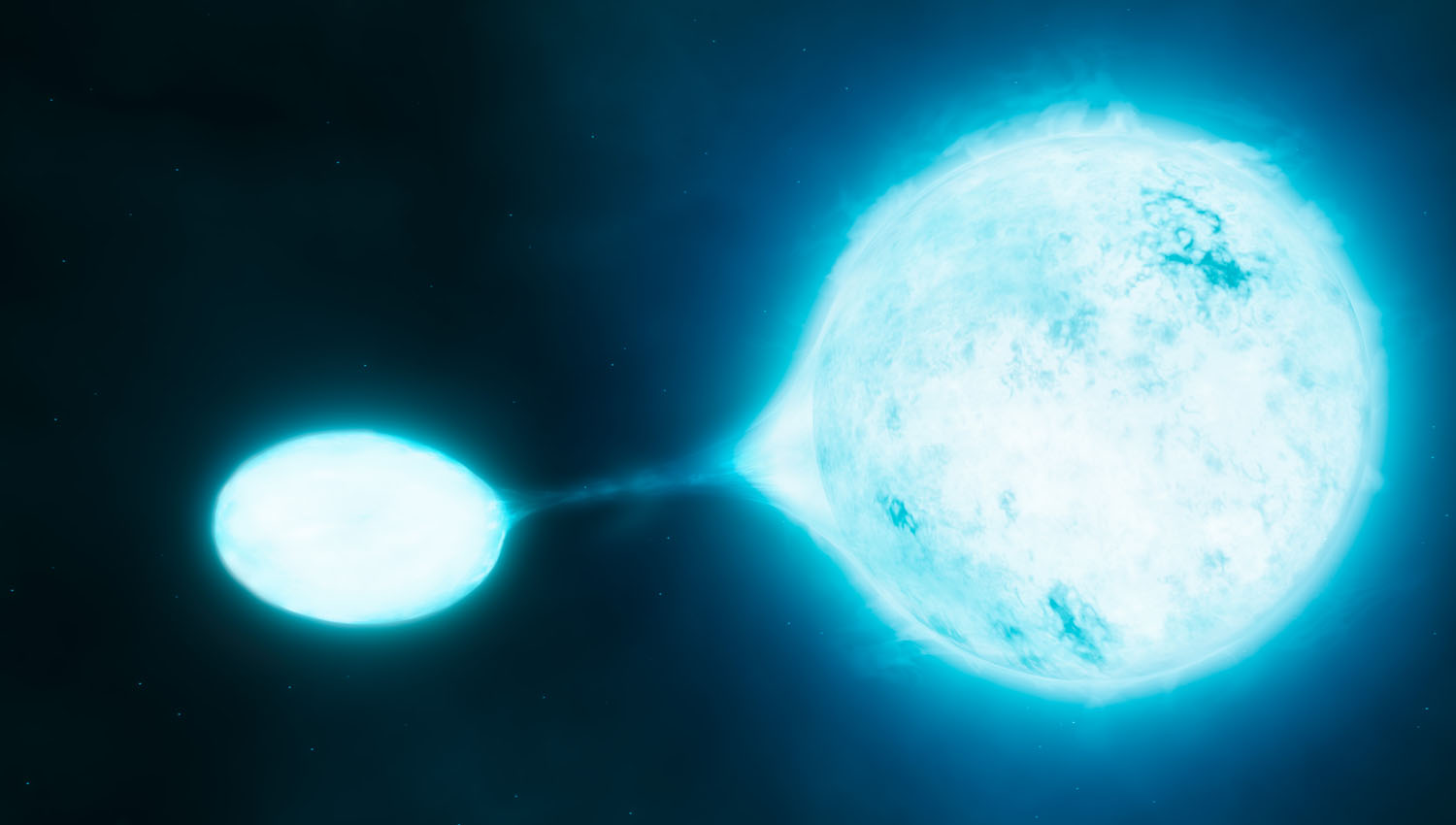
Using ESO’s Very Large Telescope to study a sample of 71 O-type single stars and stars in pairs in six nearby young star clusters in the Milky Way, astronomers discovered that 75% of all O-type stars exist inside binary systems and found that the proportion of these pairs that are close enough to interact (through stellar mergers or transfer of mass by so-called vampire stars) is far higher than anyone had previously thought.
A new study using ESO’s Very Large Telescope (VLT) has shown that most very bright high-mass stars, which drive the evolution of galaxies, do not live alone. Almost three-quarters of these stars are found to have a close companion star, far more than previously thought. Surprisingly most of these pairs are also experiencing disruptive interactions, such as mass transfer from one star to the other, and about one-third are even expected to ultimately merge to form a single star. The results are published in the July 27, 2012, issue of the journal Science.
The Universe is a diverse place, and many stars are quite unlike the Sun. An international team has used the VLT to study what are known as O-type stars, which have very high temperature, mass, and brightness. These stars have short and violent lives and play a key role in the evolution of galaxies. They are also linked to extreme phenomena such as “vampire stars”, where a smaller companion star sucks matter off the surface of its larger neighbor, and gamma-ray bursts.
“These stars are absolute behemoths,” says Hugues Sana (University of Amsterdam, Netherlands), the lead author of the study. “They have 15 or more times the mass of our Sun and can be up to a million times brighter. These stars are so hot that they shine with a brilliant blue-white light and have surface temperatures over 30,000 degrees Celsius (54,000 degrees Fahrenheit).”
The astronomers studied a sample of 71 O-type single stars and stars in pairs (binaries) in six nearby young star clusters in the Milky Way. Most of the observations in their study were obtained using ESO telescopes, including the VLT.
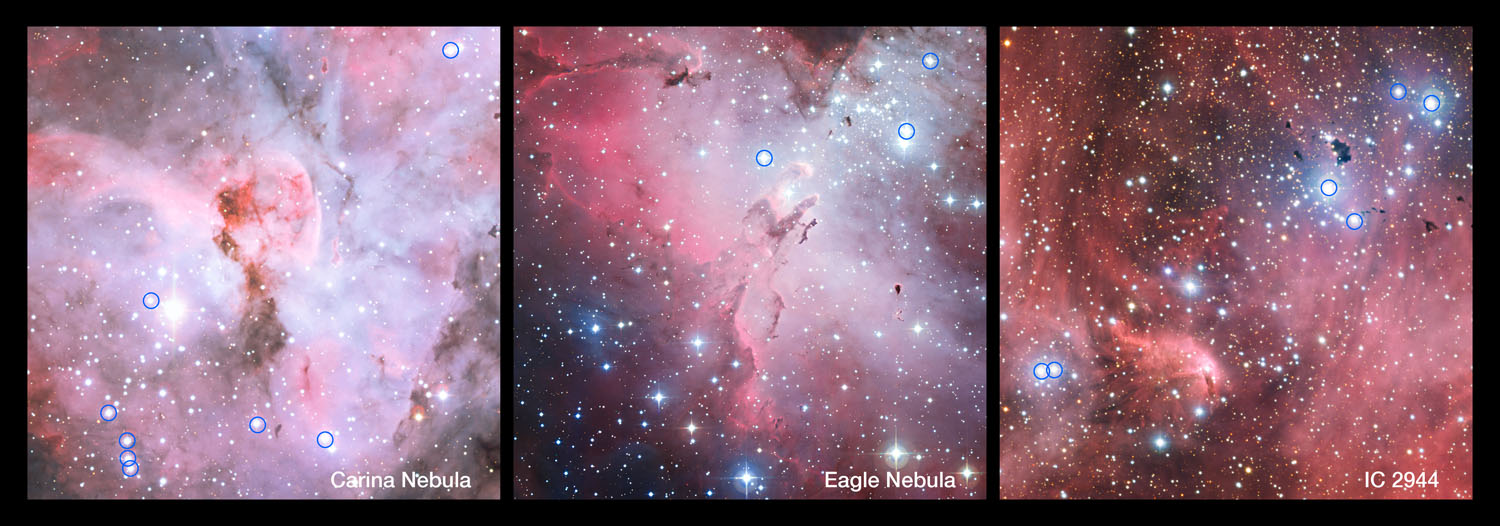
By analyzing the light coming from these targets in greater detail than before, the team discovered that 75% of all O-type stars exist inside binary systems, a higher proportion than previously thought, and the first precise determination of this number. More importantly, though, they found that the proportion of these pairs that are close enough to interact (through stellar mergers or transfer of mass by so-called vampire stars) is far higher than anyone had thought, which has profound implications for our understanding of galaxy evolution.
O-type stars make up just a fraction of a percent of the stars in the Universe, but the violent phenomena associated with them mean they have a disproportionate effect on their surroundings. The winds and shocks coming from these stars can both trigger and stop star formation, their radiation powers the glow of bright nebulae, their supernovae enrich galaxies with the heavy elements crucial for life, and they are associated with gamma-ray bursts, which are among the most energetic phenomena in the Universe. O-type stars are therefore implicated in many of the mechanisms that drive the evolution of galaxies.
“The life of a star is greatly affected if it exists alongside another star,” says Selma de Mink (Space Telescope Science Institute, USA), a co-author of the study. “If two stars orbit very close to each other they may eventually merge. But even if they don’t, one star will often pull matter off the surface of its neighbor.”
Mergers between stars, which the team estimates will be the ultimate fate of around 20–30% of O-type stars, are violent events. But even the comparatively gentle scenario of vampire stars, which accounts for a further 40–50% of cases, has profound effects on how these stars evolve.
Until now, astronomers mostly considered that closely-orbiting massive binary stars were the exception, something that was only needed to explain exotic phenomena such as X-ray binaries, double pulsars, and black hole binaries. The new study shows that to properly interpret the Universe, this simplification cannot be made: these heavyweight double stars are not just common, their lives are fundamentally different from those of single stars.
This artist’s impression shows how hot, brilliant and high-mass stars evolve.
For instance, in the case of vampire stars, the smaller, lower-mass star is rejuvenated as it sucks the fresh hydrogen from its companion. Its mass will increase substantially and it will outlive its companion, surviving much longer than a single star of the same mass would. The victim star, meanwhile, is stripped of its envelope before it has a chance to become a luminous red supergiant. Instead, its hot, blue core is exposed. As a result, the stellar population of a distant galaxy may appear to be much younger than it really is: both the rejuvenated vampire stars, and the diminished victim stars become hotter, and bluer in color, mimicking the appearance of younger stars. Knowing the true proportion of interacting high-mass binary stars is therefore crucial to correctly characterize these faraway galaxies.
“The only information astronomers have on distant galaxies is from the light that reaches our telescopes. Without making assumptions about what is responsible for this light we cannot draw conclusions about the galaxy, such as how massive or how young it is. This study shows that the frequent assumption that most stars are single can lead to the wrong conclusions,” concludes Hugues Sana.
Understanding how big these effects are, and how much this new perspective will change our view of galactic evolution, will need further work. Modeling binary stars is complicated, so it will take time before all these considerations are included in models of galaxy formation.
Reference: “Binary Interaction Dominates the Evolution of Massive Stars” by H. Sana, S. E. de Mink, A. de Koter, N. Langer, C. J. Evans, M. Gieles, E. Gosset, R. G. Izzard, J.-B. Le Bouquin and F. R. N. Schneider, 27 July 2012, Science.
DOI: 10.1126/science.1223344
Never miss a breakthrough: Join the SciTechDaily newsletter.
Follow us on Google and Google News.