
Close Menu
    Facebook X (Twitter) Instagram
    SciTechDaily
    • Biology
    • Chemistry
    • Earth
    • Health
    • Physics
    • Science
    • Space
    • Technology
    Facebook X (Twitter) Pinterest YouTube RSS
    SciTechDaily
    Home»Space»Astronomers View the Aftermath of Supernova SN 1999em and Its Host Galaxy
    Space

    Astronomers View the Aftermath of Supernova SN 1999em and Its Host Galaxy

    By European Southern ObservatoryMarch 20, 2013No Comments4 Mins Read
    Facebook Twitter Pinterest Telegram LinkedIn WhatsApp Email Reddit
    Share
    Facebook Twitter LinkedIn Pinterest Telegram Email Reddit
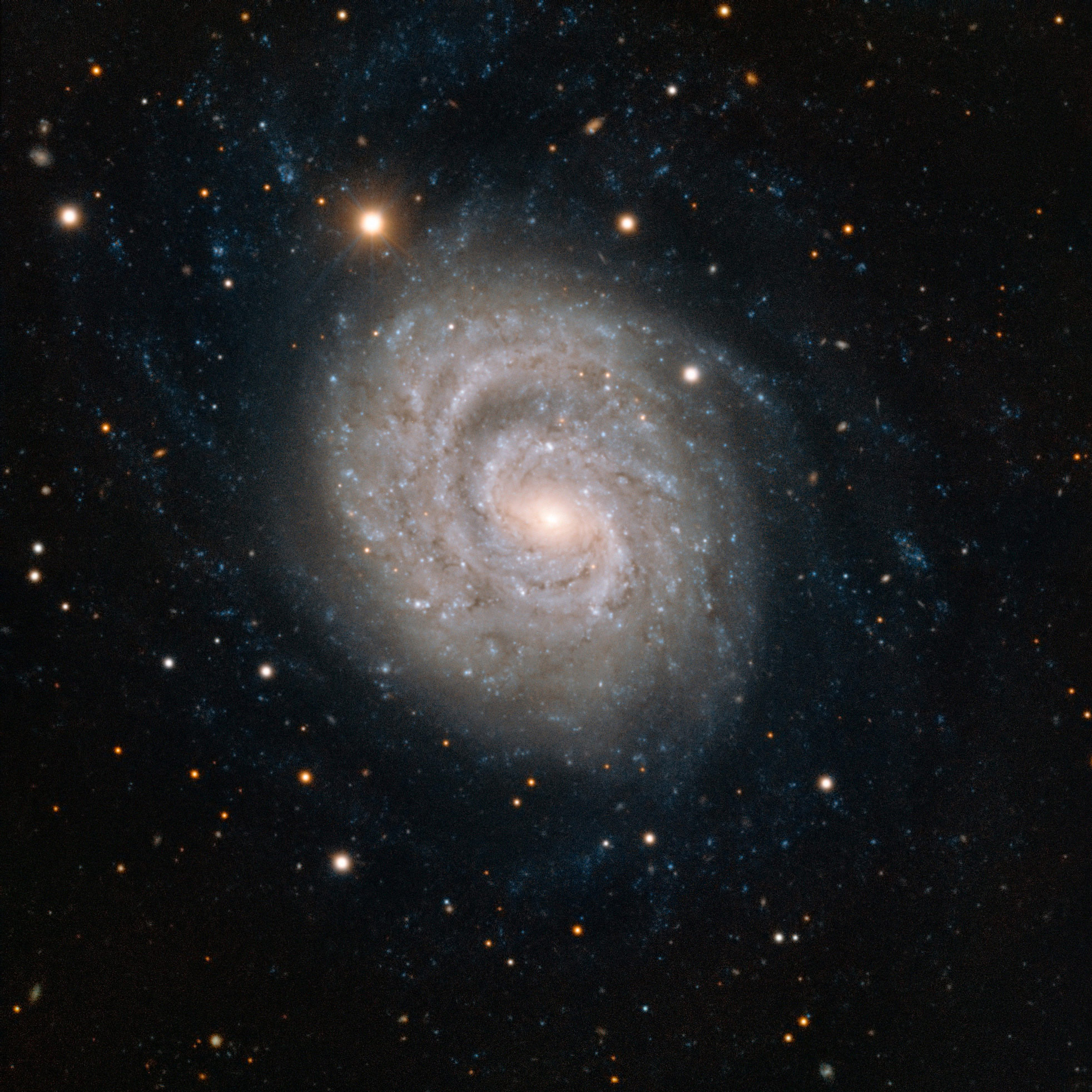
    Image of Spiral Galaxy NGC 1637
    This image from ESO’s Very Large Telescope at the Paranal Observatory in Chile shows NGC 1637, a spiral galaxy located about 35 million light-years away in the constellation of Eridanus (The River). In 1999 scientists discovered a Type II supernova in this galaxy and followed its slow fading over the following years. Credit: ESO

    Using ESO’s Very Large Telescope, astronomers view the aftermath of supernova SN 1999em and its host galaxy, NGC 1637.

    About 35 million light-years from Earth, in the constellation of Eridanus (The River), lies the spiral galaxy NGC 1637. Back in 1999, the serene appearance of this galaxy was shattered by the appearance of a very bright supernova. Astronomers studying the aftermath of this explosion with ESO’s Very Large Telescope at the Paranal Observatory in Chile have provided us with a stunning view of this relatively nearby galaxy.

    Supernovae are amongst the most violent events in nature. They mark the dazzling deaths of stars and can outshine the combined light of the billions of stars in their host galaxies.

    In 1999 the Lick Observatory in California reported the discovery of a new supernova in the spiral galaxy NGC 1637. It was spotted using a telescope that had been specially built to search for these rare, but important cosmic objects.[1] Follow-up observations were requested so that the discovery could be confirmed and studied further. This supernova was widely observed and was given the name SN 1999em. After its spectacular explosion in 1999, the supernova’s brightness has been tracked carefully by scientists, showing its relatively gentle fading through the years.


    This video sequence starts with a view of the bright constellation of Orion (The Hunter). As we zoom in, we focus on an adjacent region of the constellation of Eridanus (The River) and a faint glow appears. This is the spiral galaxy NGC 1637, which appears in all its glory in the final view from ESO’s Very Large Telescope. In 1999 scientists discovered a Type II supernova in this galaxy and followed its slow fading over the following years. Credit: ESO/Nick Risinger (skysurvey.org). Music: movetwo

    The star that became SN 1999em was very massive — more than eight times the mass of the Sun — before its death. At the end of its life its core collapsed, which then created a cataclysmic explosion.[2]

    When they were making follow-up observations of SN 1999em astronomers took many pictures of this object with the VLT, which were combined to provide us with this very clear image of its host galaxy, NGC 1637. The spiral structure shows up in this image as a very distinct pattern of bluish trails of young stars, glowing gas clouds and obscuring dust lanes.


    This pan sequence takes a close look at a new image of the spiral galaxy NGC 1637 from ESO’s Very Large Telescope at the Paranal Observatory in Chile. In 1999 scientists discovered a Type II supernova in this galaxy and followed its slow fading over the following years. Credit: ESO. Music: movetwo

    Although at first glance NGC 1637 appears to be a fairly symmetrical object it has some interesting features. It is what astronomers classify as a lopsided spiral galaxy: the relatively loosely wound spiral arm at the top left of the nucleus stretches around it much further than the more compact and shorter arm at the bottom right, which appears dramatically slashed midway through its course.

    Elsewhere in the image the view is scattered with much closer stars and more distant galaxies that happen to lie in the same direction.

    Notes

    1. The supernova was discovered by the Katzman Automatic Imaging Telescope, at Lick Observatory on Mount Hamilton, California.
    2. SN 1999em is a core-collapse supernova classified more precisely as a Type IIp. The “p” stands for plateau, meaning supernovae of this type remain bright (on a plateau) for a relatively long period of time after maximum brightness.

    Never miss a breakthrough: Join the SciTechDaily newsletter.
    Follow us on Google and Google News.

    Astronomy European Southern Observatory Popular Supernova Very Large Telescope
    Share. Facebook Twitter Pinterest LinkedIn Email Reddit

    Related Articles

    Star Explodes Twice: Astronomers Capture Stunning Supernova Remains

    Surprise Planet Discovered Around Extreme Star Pair

    Supermassive Black Holes on a Collision Course: Closest Pair of Supermassive Black Holes to Earth Ever Discovered

    Strange 160 Mile-Long “Dog-Bone” Asteroid Kleopatra Captured in Detailed Images

    Astronomers Find Small Rocky Planet – Just Half the Mass of Venus

    Stunning Galactic Fireworks: New ESO Images Reveal Spectacular Features of Nearby Galaxies

    Mysterious Interstellar Visitor May Be the Most Pristine Comet Ever Found

    Astronomers Have Discovered the Most Distant Source of Radio Emission Ever Known – 13 Billion Light-Years Away

    Puzzling Six-Exoplanet System Discovered With Resonant Rhythmic Movement

    Leave A Reply Cancel Reply

    • Facebook
    • Twitter
    • Pinterest
    • YouTube

    Don't Miss a Discovery

    Subscribe for the Latest in Science & Tech!

    Trending News

    The Universe Is Expanding Too Fast and Scientists Can’t Explain Why

    “Like Liquid Metal”: Scientists Create Strange Shape-Shifting Material

    Early Warning Signals of Esophageal Cancer May Be Hiding in Plain Sight

    Common Blood Pressure Drug Shows Surprising Power Against Deadly Antibiotic-Resistant Superbug

    Scientists Uncover Dangerous Connection Between Serotonin and Heart Valve Disease

    Scientists Discover a “Protector” Protein That Could Help Reverse Hair Loss

    Bone-Strengthening Discovery Could Reverse Osteoporosis

    Scientists Uncover Hidden Trigger Behind Stem Cell Aging

    Follow SciTechDaily
    • Facebook
    • Twitter
    • YouTube
    • Pinterest
    • Newsletter
    • RSS
    SciTech News
    • Biology News
    • Chemistry News
    • Earth News
    • Health News
    • Physics News
    • Science News
    • Space News
    • Technology News
    Recent Posts
    • Scientists Overcome Major Quantum Bottleneck, Potentially Transforming Teleportation and Computing
    • Quantum Physics’ Strangest Problem May Hold the Key to Time Itself
    • Scientists Create “Liquid Gears” That Spin Without Touching
    • The Simple Habit That Could Help Prevent Cancer
    • Forgotten Medicinal Plant Shows Promise in Fighting Dangerous Superbugs
    Copyright © 1998 - 2026 SciTechDaily. All Rights Reserved.
    • Science News
    • About
    • Contact
    • Editorial Board
    • Privacy Policy
    • Terms of Use

    Type above and press Enter to search. Press Esc to cancel.