
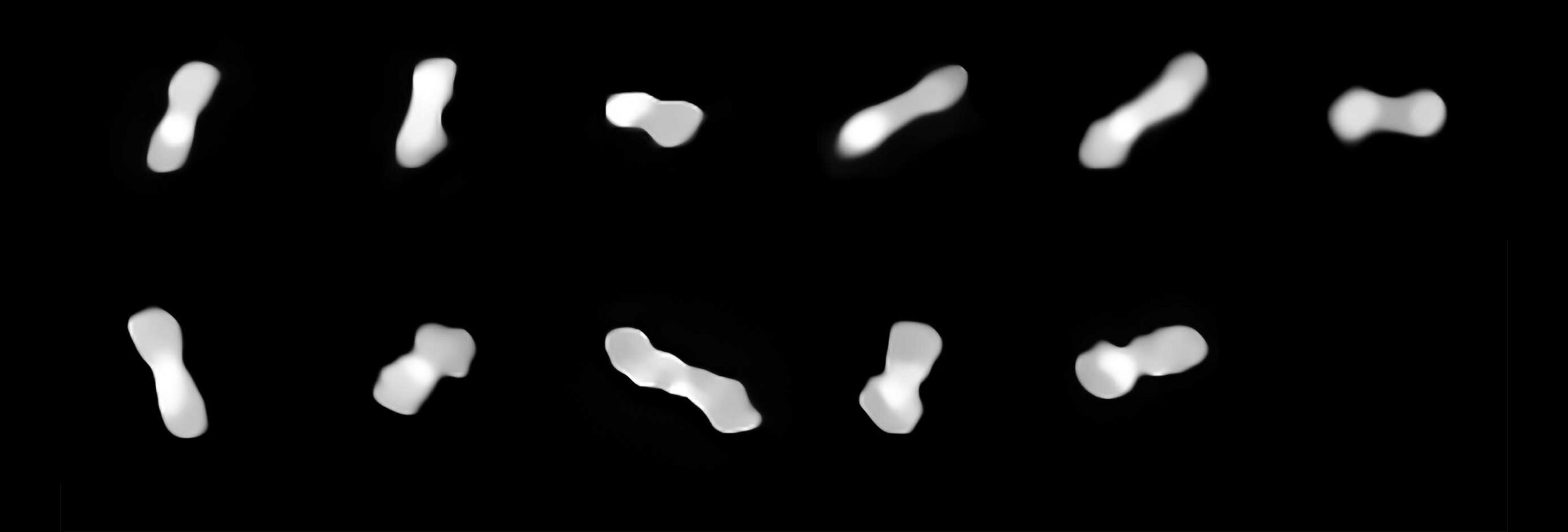
Sharper images reveal Kleopatra’s “rubble pile” nature and moon-birthing mysteries.
Using the European Southern Observatory’s Very Large Telescope (ESO’s VLT), a team of astronomers has obtained the sharpest and most detailed images yet of the asteroid Kleopatra. The observations have allowed the team to constrain the 3D shape and mass of this peculiar asteroid, which resembles a dog bone, to a higher accuracy than ever before. Their research provides clues as to how this asteroid and the two moons that orbit it formed.
“Kleopatra is truly a unique body in our Solar System,” says Franck Marchis, an astronomer at the SETI Institute in Mountain View, USA and at the Laboratoire d’Astrophysique de Marseille, France, who led a study on the asteroid — which has moons and an unusual shape — published today (September 9, 2021) in Astronomy & Astrophysics. “Science makes a lot of progress thanks to the study of weird outliers. I think Kleopatra is one of those and understanding this complex, multiple asteroid system can help us learn more about our Solar System.”
Kleopatra orbits the Sun in the Asteroid Belt between Mars and Jupiter. Astronomers have called it a “dog-bone asteroid” ever since radar observations around 20 years ago revealed it has two lobes connected by a thick “neck.” In 2008, Marchis and his colleagues discovered that Kleopatra is orbited by two moons, named AlexHelios and CleoSelene, after the Egyptian queen’s children.
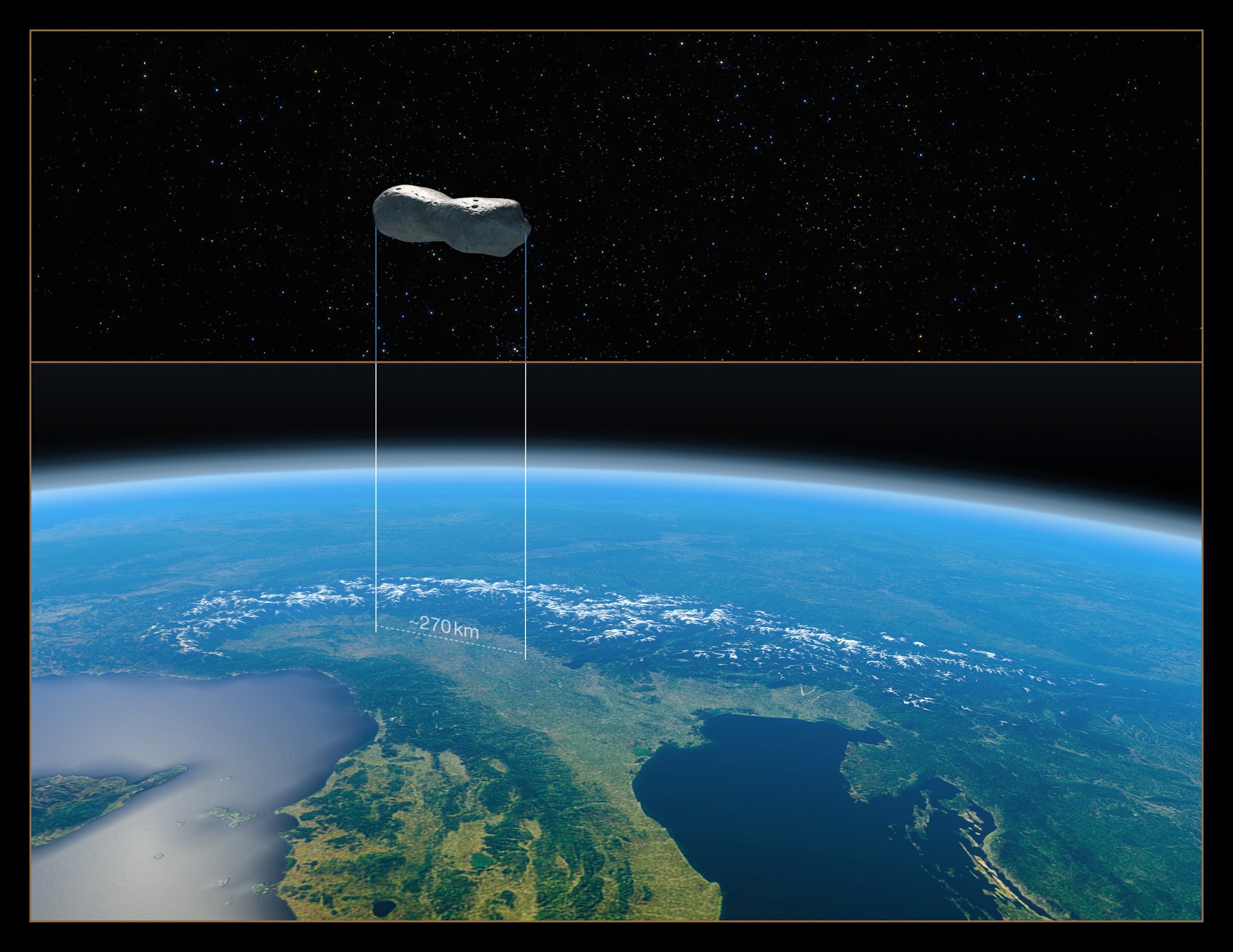
To find out more about Kleopatra, Marchis and his team used snapshots of the asteroid taken at different times between 2017 and 2019 with the Spectro-Polarimetric High-contrast Exoplanet REsearch (SPHERE) instrument on ESO’s VLT. As the asteroid was rotating, they were able to view it from different angles and to create the most accurate 3D models of its shape to date. They constrained the asteroid’s dog-bone shape and its volume, finding one of the lobes to be larger than the other, and determined the length of the asteroid to be about 270 kilometers (~168 miles) or about half the length of the English Channel.

In a second study, also published in Astronomy & Astrophysics and led by Miroslav Brož of Charles University in Prague, Czech Republic, the team reported how they used the SPHERE observations to find the correct orbits of Kleopatra’s two moons. Previous studies had estimated the orbits, but the new observations with ESO’s VLT showed that the moons were not where the older data predicted them to be.
“This had to be resolved,” says Brož. “Because if the moons’ orbits were wrong, everything was wrong, including the mass of Kleopatra.” Thanks to the new observations and sophisticated modeling, the team managed to precisely describe how Kleopatra’s gravity influences the moons’ movements and to determine the complex orbits of AlexHelios and CleoSelene. This allowed them to calculate the asteroid’s mass, finding it to be 35% lower than previous estimates.

Combining the new estimates for volume and mass, astronomers were able to calculate a new value for the density of the asteroid, which, at less than half the density of iron, turned out to be lower than previously thought.[1] The low density of Kleopatra, which is believed to have a metallic composition, suggests that it has a porous structure and could be little more than a “pile of rubble.” This means it likely formed when material reaccumulated following a giant impact.
Kleopatra’s rubble-pile structure and the way it rotates also give indications as to how its two moons could have formed. The asteroid rotates almost at a critical speed, the speed above which it would start to fall apart, and even small impacts may lift pebbles off its surface. Marchis and his team believe that those pebbles could subsequently have formed AlexHelios and CleoSelene, meaning that Kleopatra has truly birthed its own moons.
This animation shows where the orbit of the asteroid Kleopatra (in red) is in our Solar System. Kleopatra orbits the Sun in the Asteroid Belt, which is located between the orbits of Mars and Jupiter. Credit: ESO/spaceengine.org
The new images of Kleopatra and the insights they provide are only possible thanks to one of the advanced adaptive optics systems in use on ESO’s VLT, which is located in the Atacama Desert in Chile. Adaptive optics help to correct for distortions caused by the Earth’s atmosphere which cause objects to appear blurred — the same effect that causes stars viewed from Earth to twinkle. Thanks to such corrections, SPHERE was able to image Kleopatra — located 200 million kilometers away from Earth at its closest — even though its apparent size on the sky is equivalent to that of a golf ball about 40 kilometers away.
ESO’s upcoming Extremely Large Telescope (ELT), with its advanced adaptive optics systems, will be ideal for imaging distant asteroids such as Kleopatra. “I can’t wait to point the ELT at Kleopatra, to see if there are more moons and refine their orbits to detect small changes,” adds Marchis.
Notes
- The newly calculated density is 3.4 grams per cubic centimeter, while previously Kleopatra was believed to have a mean density of about 4.5 grams per cubic centimeter.
References:
“(216) Kleopatra, a low density critically rotating M-type asteroid” by F. Marchis, L. Jorda, P. Vernazza, M. Brož, J. Hanuš, M. Ferrais, F. Vachier, N. Rambaux, M. Marsset, M. Viikinkoski, E. Jehin, S. Benseguane, E. Podlewska-Gaca, B. Carry, A. Drouard, S. Fauvaud, M. Birlan, J. Berthier, P. Bartczak, C. Dumas, G. Dudzinski, J. Durech, J. Castillo-Rogez, F. Cipriani, F. Colas, R. Fetick, T. Fusco, J. Grice, A. Kryszczynska, P. Lamy, A. Marciniak, T. Michalowski, P. Michel, M. Pajuelo, T. Santana-Ros, P. Tanga, A. Vigan, O. Witasse and B. Yang, 9 September 2021, Astronomy & Astrophysics.
DOI: 10.1051/0004-6361/202140874
arXiv:2108.07207
“An advanced multipole model for (216) Kleopatra triple system” by M. Brož, F. Marchis, L. Jorda, J. Hanuš, P. Vernazza, M. Ferrais, F. Vachier, N. Rambaux, M. Marsset, M. Viikinkoski, E. Jehin, S. Benseguane, E. Podlewska-Gaca, B. Carry, A. Drouard, S. Fauvaud, M. Birlan, J. Berthier, P. Bartczak, C. Dumas, G. Dudzinski, J. Durech, J. Castillo-Rogez, F. Cipriani, F. Colas, R. Fetick, T. Fusco, J. Grice, A. Kryszczynska, P. Lamy, A. Marciniak, T. Michalowski, P. Michel, M. Pajuelo, T. Santana-Ros, P. Tanga, A. Vigan, D. Vokrouhlický, O. Witasse and B. Yang, 9 September 2021, Astronomy & Astrophysics.
DOI: 10.1051/0004-6361/202140901
arXiv:2105.09134
More information
This research, based on observations with SPHERE on ESO’s VLT (Principal Investigator: Pierre Vernazza), was presented in two papers to appear in Astronomy & Astrophysics.
The team of the paper entitled “(216) Kleopatra, a low density critically rotating M-type asteroid” is composed of F. Marchis (SETI Institute, Carl Sagan Center, Mountain View, USA and Aix Marseille University, CNRS, Laboratoire d’Astrophysique de Marseille, France [LAM]), L. Jorda (LAM), P. Vernazza (LAM), M. Brož (Institute of Astronomy, Faculty of Mathematics and Physics, Charles University, Prague, Czech Republic [CU]), J. Hanuš (CU), M. Ferrais (LAM), F. Vachier (Institut de mécanique céleste et de calcul des éphémérides, Observatoire de Paris, PSL Research University, CNRS, Sorbonne Universités, UPMC University Paris 06 and Université de Lille, France [IMCCE]), N. Rambaux (IMCCE), M. Marsset (Department of Earth, Atmospheric and Planetary Sciences, MIT, Cambridge, USA [MIT]), M. Viikinkoski (Mathematics & Statistics, Tampere University, Finland [TAU]), E. Jehin (Space sciences, Technologies and Astrophysics Research Institute, Université de Liège, Belgium [STAR]), S. Benseguane (LAM), E. Podlewska-Gaca (Faculty of Physics, Astronomical Observatory Institute, Adam Mickiewicz University, Poznan, Poland [UAM]), B. Carry (Université Côte d’Azur, Observatoire de la Côte d’Azur, CNRS, Laboratoire Lagrange, France [OCA]), A. Drouard (LAM), S. Fauvaud (Observatoire du Bois de Bardon, Taponnat, France [OBB]), M. Birlan (IMCCE and Astronomical Institute of Romanian Academy, Bucharest, Romania [AIRA]), J. Berthier (IMCCE), P. Bartczak (UAM), C. Dumas (Thirty Meter Telescope, Pasadena, USA [TMT]), G. Dudzinski (UAM), J. Durech (CU), J. Castillo-Rogez (Jet Propulsion Laboratory, California Institute of Technology, Pasadena,USA [JPL]), F. Cipriani (European Space Agency, ESTEC – Scientific Support Office, Noordwijk, The Netherlands [ESTEC]??), F. Colas (IMCCE), R. Fetick (LAM), T. Fusco (LAM and The French Aerospace Lab BP72, Chatillon Cedex, France [ONERA]??), J. Grice (OCA and School of Physical Sciences, The Open University, Milton Keynes, UK [OU]), A. Kryszczynska (UAM), P. Lamy (Laboratoire Atmosphères, Milieux et Observations Spatiales, CNRS [CRNS] and Université de Versailles Saint-Quentin-en-Yvelines, Guyancourt, France [UVSQ]), A. Marciniak (UAM), T. Michalowski (UAM), P. Michel (OCA), M. Pajuelo (IMCCE and Sección Física, Departamento de Ciencias, Pontificia Universidad Católica del Perú, Lima, Perú [PUCP]), T. Santana-Ros (Departamento de Física, Ingeniería de Sistemas y Teoría de la Señal, Universidad de Alicante, Spain [UA] and Institut de Ciéncies del Cosmos, Universitat de Barcelona, Spain [UB]), P. Tanga (OCA), A. Vigan (LAM), O. Witasse (ESTEC), and B. Yang (European Southern Observatory, Santiago, Chile [ESO]).
The team of the paper entitled “An advanced multipole model for (216) Kleopatra triple system” is composed of M. Brož (CU), F. Marchis (SETI and LAM), L. Jorda (LAM), J. Hanuš (CU), P. Vernazza (LAM), M. Ferrais (LAM), F. Vachier (IMCCE), N. Rambaux (IMCCE), M. Marsset (MIT), M. Viikinkoski (TAU), E. Jehin (STAR), S. Benseguane (LAM), E. Podlewska-Gaca (UAM), B. Carry (OCA), A. Drouard (LAM), S. Fauvaud (OBB), M. Birlan (IMCCE and AIRA), J. Berthier (IMCCE), P. Bartczak (UAM), C. Dumas (TMT), G. Dudzinski (UAM), J. Durech (CU), J. Castillo-Rogez (JPL), F. Cipriani (ESTEC??), F. Colas (IMCCE), R. Fetick (LAM), T. Fusco (LAM and ONERA), J. Grice (OCA and OU), A. Kryszczynska (UAM), P. Lamy (CNRS and UVSQ), A. Marciniak (UAM), T. Michalowski (UAM), P. Michel (OCA), M. Pajuelo (IMCCE and PUCP), T. Santana-Ros (UA and UB), P. Tanga (OCA), A. Vigan (LAM), O. Witasse (ESTEC), and B. Yang (ESO).
ESO is the foremost intergovernmental astronomy organization in Europe and the world’s most productive ground-based astronomical observatory by far. It has 16 Member States: Austria, Belgium, the Czech Republic, Denmark, France, Finland, Germany, Ireland, Italy, the Netherlands, Poland, Portugal, Spain, Sweden, Switzerland and the United Kingdom, along with the host state of Chile and with Australia as a Strategic Partner. ESO carries out an ambitious program focused on the design, construction and operation of powerful ground-based observing facilities enabling astronomers to make important scientific discoveries. ESO also plays a leading role in promoting and organizing cooperation in astronomical research. ESO operates three unique world-class observing sites in Chile: La Silla, Paranal and Chajnantor. At Paranal, ESO operates the Very Large Telescope and its world-leading Very Large Telescope Interferometer as well as two survey telescopes, VISTA working in the infrared and the visible-light VLT Survey Telescope. Also at Paranal ESO will host and operate the Cherenkov Telescope Array South, the world’s largest and most sensitive gamma-ray observatory. ESO is also a major partner in two facilities on Chajnantor, APEX, and ALMA, the largest astronomical project in existence. And on Cerro Armazones, close to Paranal, ESO is building the 39-meter Extremely Large Telescope, the ELT, which will become “the world’s biggest eye on the sky.”
Never miss a breakthrough: Join the SciTechDaily newsletter.
Follow us on Google and Google News.
42 Comments
DOg Bone! Are ye blind!?! IT’s a Monkey Nut!
Looks like a big jobbie.
Would adaptive optics be additionally aided by sending down a beam from a satellite in fixed orbit above the telescope?
Looks like the “Satellite of Love” from MST3K.
Those comparisons to random spots on Earth don’t really help at all. It would even be better to say how many asteroids it would take to reach Venus, if laid end to end.
It’s the Satellite of Love!
“Science makes a lot of progress…” As a scientist myself, I think our focus should be almost entirely on early detection right now. We’re still flying through the universe blissfully unaware of extinction-level objects that remain undiscovered. There will be plenty of time for future generations to study the esoteric nature of our universe. Our job should be trying to increase the likelihood that those generations live to do so. Doing anything else points to our own vainglory.
Looks like a giant 🥜
U ask me it’s a space ship’how els would a it’s so close to Earth without hitting like that
Looks more like a peanut 🥜 the a dog bone 🦴
It’s our distance relatives coming to say hello
So how long is the asteroid? Please use feet and inches.
Miles would be more useful to you, no?
It’s 2021 and you’re a science site. Make your site mobile friendly.
Y’all scientists are smart as hell but you missed a great opportunity to name this asteroid kleopawtra
Kind of looks like a “tic tac” or even Oumuamua… but hey if the government wants us to see a dog bone… we shouldn’t see anything other than said dog bone…
I think it is possibly God saying I feces towards you because I am in outerspace..
It’s the peanut guy.
Oh come on, God dropped a peanut. Definitely not a dog bone.
I second Daniel Lauer
If the calculated density is 3.4 grams cubic centimeter, are there theories of composition to follow? Will this analysis be used to locate other asteroids for possible mining?
It’s 168 miles long, for those lazy metric-phobes.
Its either a Tesla…. Or Shiba Inu $Bone.
Who thinks this looks like a dog bone? It’s clearly shaped like a peanut.
I have to agree with the peanut assessment. How does a pile of rubble have gravity?
Keep feeding useless news. No breakthrough in teleportation, planet in action, or even free energy..just useless photoshp pics.
It’s a space turd!
Miles is not a caluable when finding cubic matrix, meteric is machine coded computation for natural orders of physics.
Inside that peanut shape asteroid are two giants nuts! I tell you!
That’s quite a bit of curvature for a small fraction of land mass.
Seen it before lol it’s not new it’s been here before it’s just a piece of bacon from Creators pan that was left over for us to have to eat but it’s not too burnt. I prefer my bacon crisp and burnt but not too burnt like this Gee thanks Creator send this leftover bacon to the Grey’s or little green men or Martians not us Earthlings lol. Maybe next time if it’s not burnt all the way thru lol love you still Creator and keep up those pop up planets love how those work! Don’t get rid of them!
The may be two pods inside. Quick! Send up the giant squirrel!
Are we sure it’s not Dr. Evil’s rocket ship?
By golly, Joe Dirt was right. Space peanuts do exist
Wow if that’s the bone How big is the dog ?😱
Newsflash…an astronaut accidentally dropped a peanut so close to the camera lens perspective that made it looks larger than life.
It’s a peanut
Must have been considere, but. Couldn’t the low density be because the object is hollow.
And the spin be to induce an artificial gravity at the ends, innternally.
Space nut
It’s Possibly a cosmic thingy
A divine bogie!
From the almighty creator of the Universe. A sign, at last! Haleloopa! Haleloopa!
4/3/2…two energies double (push and pull from two directions) divided over three perpendicular angles from two directions (in and out)..1and1/32 to 1 you get light…