
Close Menu
    Facebook X (Twitter) Instagram
    SciTechDaily
    • Biology
    • Chemistry
    • Earth
    • Health
    • Physics
    • Science
    • Space
    • Technology
    Facebook X (Twitter) Pinterest YouTube RSS
    SciTechDaily
    Home»Space»Astronomy & Astrophysics 101: Asteroids
    Space

    Astronomy & Astrophysics 101: Asteroids

    By ESA/HubbleApril 6, 2022No Comments4 Mins Read
    Facebook Twitter Pinterest Telegram LinkedIn WhatsApp Email Reddit
    Share
    Facebook Twitter LinkedIn Pinterest Telegram Email Reddit
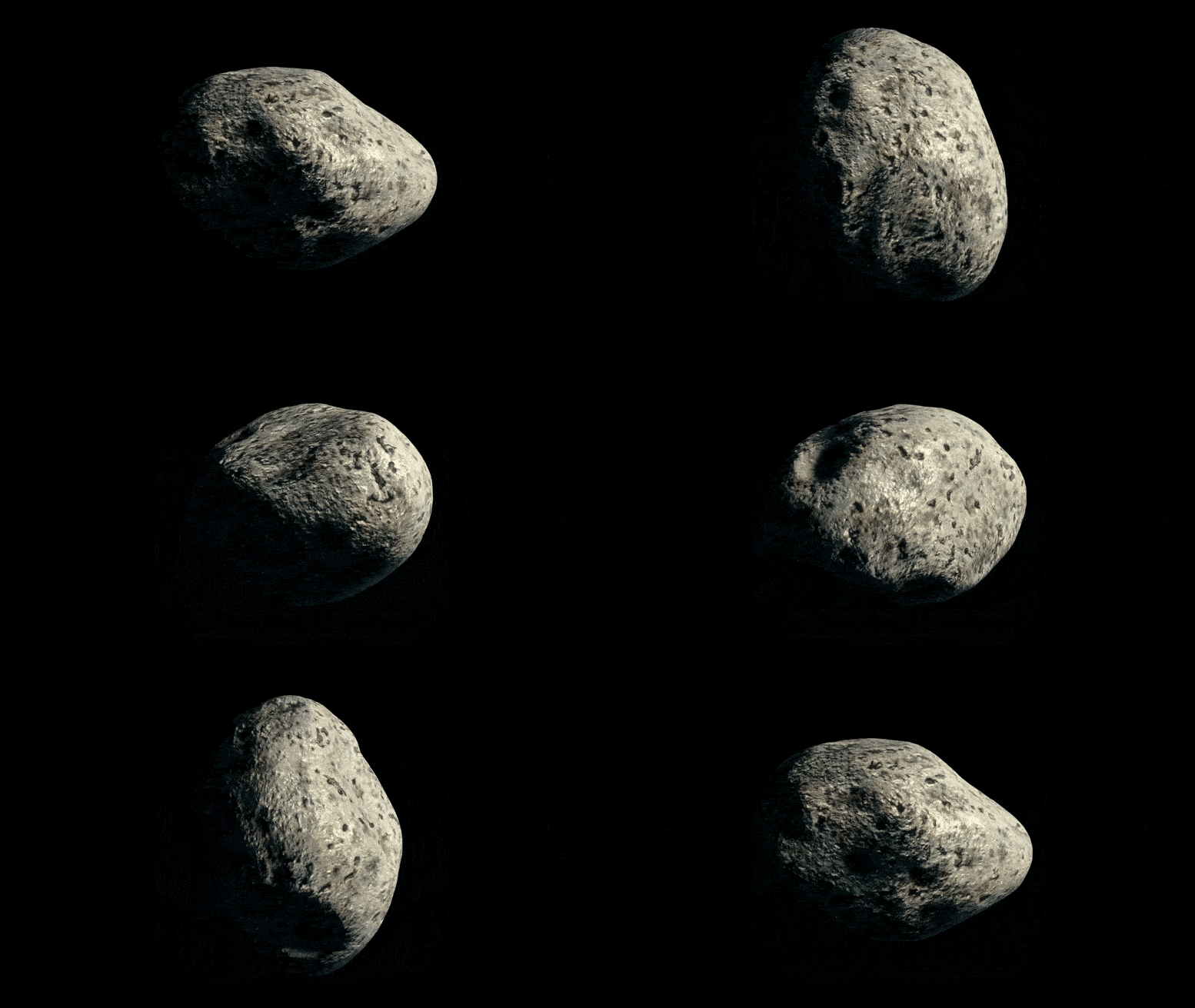
    Animation Asteroid Rotating
    Animation of an asteroid rotating in space.

    What Is an Asteroid?

    Asteroids are rocky celestial bodies that orbit the Sun, but do not meet the requirements to be classified as a planet.

    The term asteroid covers a very broad range of Solar System objects, including debris left behind by objects that did not successfully grow into planets. They are irregularly shaped, which disqualifies them from being classified as planets or dwarf planets. The asteroid belt is a region of space between the orbits of Mars and Jupiter that is densely populated with asteroids. The majority of known asteroids are found within the asteroid belt. Asteroids and comets are partially distinguished from one another by their composition: asteroids are rocky, whereas comets comprise dust and ice. When comets pass close to the Sun, some of their icy composition heats up sufficiently to be released as gas. This gas forms a loosely bound atmosphere known as a ‘coma’, and this gives comets their distinctive appearance of having a tail streaming behind them. In contrast, asteroids tend to remain solid. In practice, however, the distinction between asteroids and comets can be rather arbitrary.
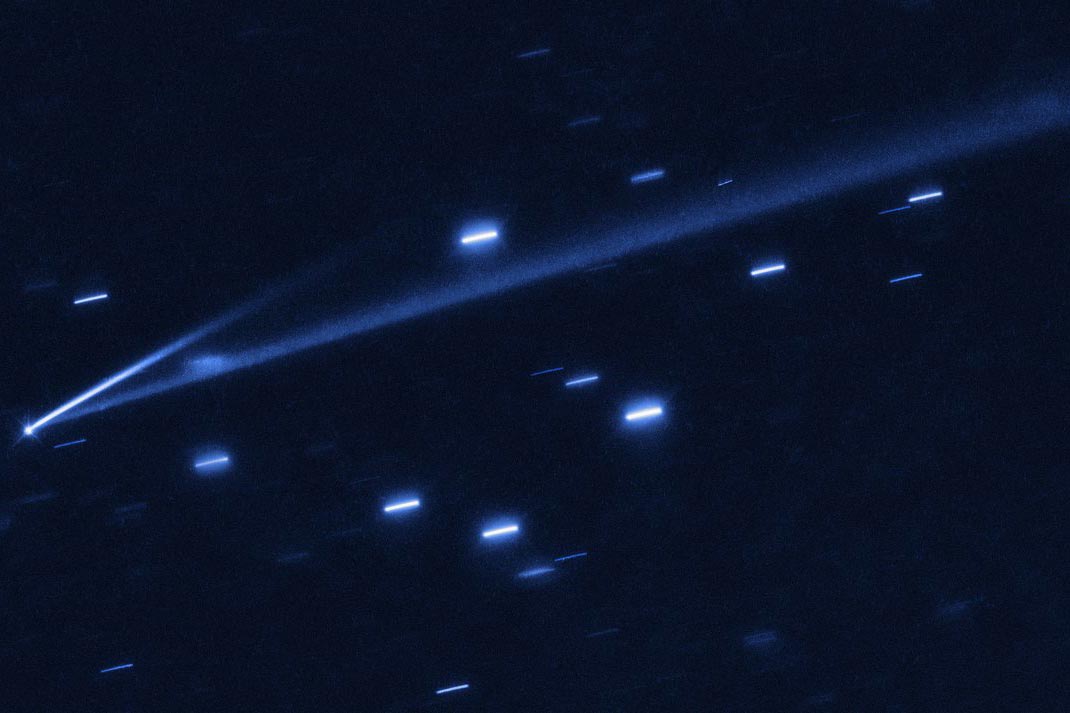
    Asteroid 6478 Gault
    The asteroid 6478 Gault is seen with the NASA/ESA Hubble Space Telescope, showing two narrow, comet-like tails of debris that tell us that the asteroid is slowly undergoing self-destruction. The bright streaks surrounding the asteroid are background stars. The Gault asteroid is located between the orbits of Mars and Jupiter. Credit: NASA, ESA, K. Meech and J. Kleyna, O. Hainaut

    Hubble has observed various asteroids over the course of more than three decades of observations. For example, in 2017 Hubble studied the asteroid Vesta — which is only 500 km (310 mi) in diameter — from a distance of 250 million kilometers (155 million miles). The observations created a map of its surface and were even able to capture the asteroid’s changing appearance as it rotated.

    Hubble also observed the spectacular asteroid collision P2010/A2 in 2010. Using Hubble to study the aftermath of the collision over five months, astronomers watched a strange, comet-like debris trail slowly evolve as the collision site orbited the Sun. This research gave clues about how asteroids behave when they collide, and how the fall-out from these impacts contributes to the dust that pervades the Solar System.


    Asteroids are rocky celestial bodies that orbit the Sun, but do not meet the requirements to be classified as a planet. Credit: NASA & ESA

    In 2017 a German-led group of astronomers used Hubble to observe two asteroids, orbiting each other in the asteroid belt between Mars and Jupiter, that exhibited comet-like features, including a bright coma and a long tail. This was the first known binary asteroid to also be classified as a comet. It was Hubble’s images that revealed that it was actually not a single object, but two asteroids of almost the same mass and size, orbiting each other at a distance of about 100 kilometers (62 miles). That discovery was in itself an important find; because they orbit each other, the masses of the objects in such systems can be measured. Understanding the origin and evolution of main-belt comets — asteroids orbiting between Mars and Jupiter that show comet-like activity — is a crucial element in our understanding of the formation and evolution of the whole Solar System.
    Word Bank Asteroid
    Credit: ESA/Hubble, NASA, ESA, K. Meech and J. Kleyna (University of Hawaii), O. Hainaut (European Southern Observatory)

    In 2019, Hubble observed a rare self-destructing asteroid called 6478 Gault. The images provided new insights into the asteroid’s past: the object was 4–9 kilometers (2.5-5.6 miles) wide and had two narrow, comet-like tails of debris that indicated that the asteroid was slowly undergoing self-destruction. Each tail is evidence of an active event that released material into space. The direct observation of this activity by the Hubble Space Telescope provided astronomers with a special opportunity to study the composition of asteroids. By researching the material that this unstable asteroid releases into space, astronomers can get a glimpse into the history of planet formation in the early Solar System.

    Never miss a breakthrough: Join the SciTechDaily newsletter.
    Follow us on Google and Google News.

    Asteroid Astronomy Astrophysics European Space Agency
    Share. Facebook Twitter Pinterest LinkedIn Email Reddit

    Related Articles

    Feared Apophis Impact Ruled Out – Asteroid Will Pass Close Enough to Earth to See With Naked Eye

    Unexpected Discovery: Hubble Space Telescope Uncovers Concentration of Small Black Holes

    Unique Planetary System With Rhythmic Orbital Resonance Revealed by Exoplanet Watcher Cheops

    Cosmic Neon Lights: Strange New Type of Star Revealed in X-ray Light

    “Unprecedented” – Unusual Planetary Nebula Fades Mere Decades After It Arrived

    Next Target Asteroid for Hayabusa2 Photographed by Subaru Telescope

    Hubble Captures Unprecedented Fading of Stingray Nebula – “This Is Very, Very Dramatic, and Very Weird”

    To the Milky Way’s Anticenter and Beyond: Gaia’s New Detailed Data From More Than 1.8 Billion Stars

    Einstein’s General Theory of Relativity: Contorting Giants

    Leave A Reply Cancel Reply

    • Facebook
    • Twitter
    • Pinterest
    • YouTube

    Don't Miss a Discovery

    Subscribe for the Latest in Science & Tech!

    Trending News

    First-of-Its-Kind Discovery: Homer’s Iliad Found Embedded in a 1,600-Year-Old Egyptian Mummy

    Beyond Inflammation: Scientists Uncover New Cause of Persistent Rheumatoid Arthritis

    A Simple Molecule Could Unlock Safer, Easier Weight Loss

    Scientists Just Built a Quantum Battery That Charges Almost Instantly

    Researchers Unveil Groundbreaking Sustainable Solution to Vitamin B12 Deficiency

    Millions of People Have Osteopenia Without Realizing It – Here’s What You Need To Know

    Researchers Discover Boosting a Single Protein Helps the Brain Fight Alzheimer’s

    World-First Study Reveals Human Hearts Can Regenerate After a Heart Attack

    Follow SciTechDaily
    • Facebook
    • Twitter
    • YouTube
    • Pinterest
    • Newsletter
    • RSS
    SciTech News
    • Biology News
    • Chemistry News
    • Earth News
    • Health News
    • Physics News
    • Science News
    • Space News
    • Technology News
    Recent Posts
    • Scientists Discover New Way To Make Drug-Resistant Cancer Treatable Again
    • This Simple Exercise Trick Builds Muscle With Less Effort, Study Finds
    • Middle Age Is Becoming a Breaking Point in America, Study Reveals
    • Scientists Discover How Coffee Impacts Memory, Mood, and Gut Health
    • How Cells Copy DNA Might Matter More Than We Ever Realized
    Copyright © 1998 - 2026 SciTechDaily. All Rights Reserved.
    • Science News
    • About
    • Contact
    • Editorial Board
    • Privacy Policy
    • Terms of Use

    Type above and press Enter to search. Press Esc to cancel.