
Close Menu
    Facebook X (Twitter) Instagram
    SciTechDaily
    • Biology
    • Chemistry
    • Earth
    • Health
    • Physics
    • Science
    • Space
    • Technology
    Facebook X (Twitter) Pinterest YouTube RSS
    SciTechDaily
    Home»Physics»Scientists Replicate Surface Structures at the Atomic Scale
    Physics

    Scientists Replicate Surface Structures at the Atomic Scale

    By School of Engineering & Applied Science, Yale UniversityNovember 7, 2018No Comments5 Mins Read
    Facebook Twitter Pinterest Telegram LinkedIn WhatsApp Email Reddit
    Share
    Facebook Twitter LinkedIn Pinterest Telegram Email Reddit
    Yale Researchers Replicate Surface Structures at the Atomic Scale
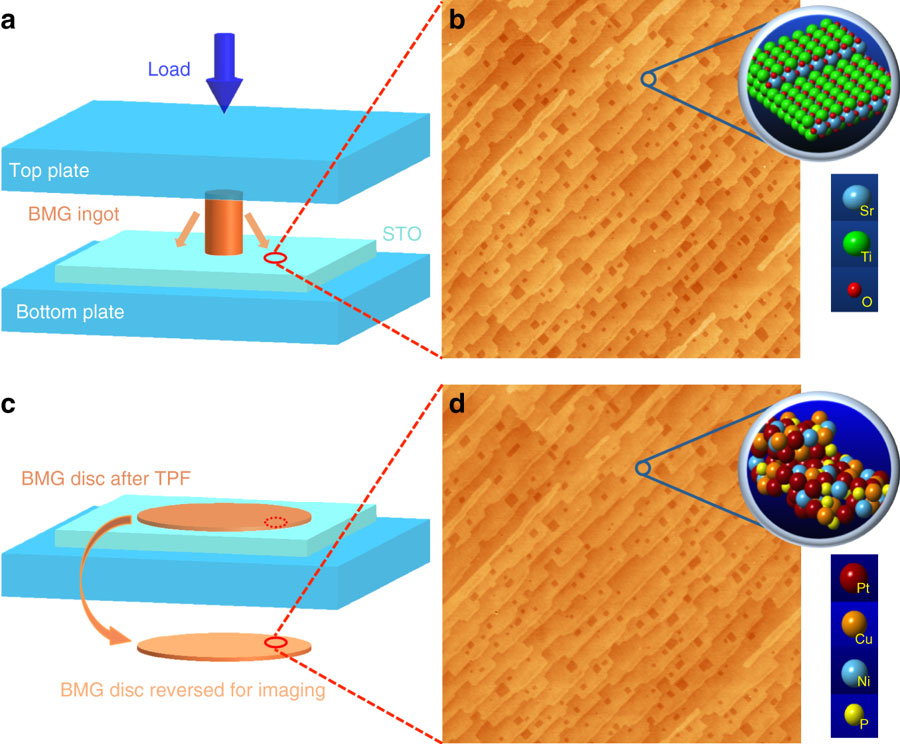
    Thermoplastic imprinting with atomic precision. a Schematic representation of the geometric arrangement of the press used for the hot embossing, where a cylindrical ingot of bulk metallic glass (BMG) about 2.5 mm in height and 2 mm in diameter is placed on the surface of a strontium titanate (STO) single crystal that has been prepared to feature individual atomically flat terraces separated by steps of unit cell (0.39 nm) height. b Atomic force microscopy (AFM) image of the surface of an STO crystal used as a mold, revealing the aforementioned terraced surface structure. Inset: Structural model of the crystal’s titanium dioxide (TiO2) terminated, stepped (001) planes. c After imprinting is complete, the upper plate is removed and the formed BMG disc is separated from the STO template and turned over for AFM inspection. d Mirrored and z-inverted AFM image of the exact location that has been shaped by contact with the area of the STO crystal displayed in (a). Comparison with the template’s original morphology shows that all details of the structure are reproduced with sub-ångstrom precision. Image size is in both cases 5 μm × 5 μm. The cartoon in the magnifier highlights the disordered (i.e. glassy) structure of the Pt57.5Cu14.7Ni5.3P22.5 alloy used for replication.

    Yale researchers have developed a procedure that can replicate surface structures at the atomic scale – a breakthrough that could lead to better catalysts, improved data storage, and other novel applications. It could also aid in unlocking some long-standing mysteries about the nature of the glassy-liquid state of certain materials.

    Led by Udo Schwarz, professor and chair of mechanical engineering & materials science, the research team demonstrated the ability to reliably and repeatedly replicate the terraced surface structure of strontium titanate (SrTiO3) single crystals, which serve as a mold, by embossing it into a metallic glass. In doing so, they were able to recreate all the details of the mold’s surface, right down to minute atomic-scale features, such as surface steps, kinks, and depressions featuring dimensions of only one unit cell of the original SrTiO3 crystal. The results are published today in Communications Physics, a Nature journal.

    The process involves heating a metallic glass alloy predominantly containing platinum and then compressing it so that it flows into the mold. It’s similar to routine molding techniques used with polymer-based plastics to make things such as toys and casings, but on a much smaller scale. The work builds on previous research led by co-author Jan Schroers, professor of mechanical engineering & materials science, an expert in metallic glass alloys that can be produced in bulk quantities.

    Key to the breakthrough was the choice of strontium titanate for the mold’s material.

    “It took us a couple of years to figure out what type of mold is well-suited to this,” Schwarz said. Other materials, such as sodium chloride and graphite would stick together or transfer material to the object it was replicating. Strontium titanate, a brittle oxide-based crystal, has the perfect properties for the project.

    “When you cool the crystal/glass stack down after the imprinting, it falls apart right along its interface and you have a 100% accurate copy of your mold’s surface structure,” Schwarz said. “Every last detail is exactly the same. For example, there are often small unit-cell deep depressions on the crystal’s surface and they replicate perfectly. The resulting surface of the metallic glass then looks like a reflecting crystal with all the usual features, such as atomically flat terraces, even though it’s glass.”

    The other critical component is the choice to form the replica from bulk metallic glass, a material with the strength of metal, but with the pliability of plastics when heated above its glass transition temperature. Schwarz said polymer-based plastics have worked “relatively well” for similar projects, but because their atoms move together in chains, there’s a limit to how much detail can be achieved. “In metallic glass, each atom moves on its own. That’s why you can replicate anything with such precision.”

    There are numerous potential applications for the technology, such as surface functionalization through atomically precise surface patterning. “With this, you could create just the right surface for maximum adhesion, or perhaps for minimal adhesion,” Schwarz said.

    By maximizing the surface area of metals to its theoretical limit, it also opens a wide range of potential breakthroughs in the fields of sensors, catalysts, and batteries. It could also shed some light on the mysterious structure of metallic glass. Schwarz notes that so far, no one has been able to directly visualize the atomic structure of three-dimensional glass – this includes both metallic glass and the conventional kind, such as those used in windows. In 2005, Science Magazine included the question “What is the nature of the glassy state?” in its list of “100 fundamental questions we don’t know.” Little progress has been achieved since, but being able to replicate at this level of detail could go a long way to better understand these materials.

    Reference: “Atomic imprinting into metallic glasses” by Rui Li, Zheng Chen, Amit Datye, Georg H. Simon, Jittisa Ketkaew, Emily Kinser, Ze Liu, Chao Zhou, Omur E. Dagdeviren, Sungwoo Sohn, Jonathan P. Singer, Chinedum O. Osuji, Jan Schroers and Udo D. Schwarz, 5 November 2018, Communications Physics.
    DOI: 10.1038/s42005-018-0076-6

    Never miss a breakthrough: Join the SciTechDaily newsletter.
    Follow us on Google and Google News.

    Materials Science Yale School of Engineering & Applied Science Yale University
    Share. Facebook Twitter Pinterest LinkedIn Email Reddit

    Related Articles

    The Amazing Properties of Cornstarch and Water

    Researchers Find a Way to Tap into Long-Lived Sound Waves in Glass

    Yale Engineers Advance Quantum Technology With Photon Control

    Yale Engineers Believe Cornstarch Could Lead To Better Protective Gear

    Orbital Engineering, Yale Engineers Change Electron Trajectories

    A New Understanding of How to Trap Light

    Engineers Show Tiny Liquid Drops Can Make Solids Stiffer

    Chip-Scale Device Enables Yale Engineers to ‘See Without Looking’

    Yale Engineers Develop Hybrid System for Quantum Communication

    Leave A Reply Cancel Reply

    • Facebook
    • Twitter
    • Pinterest
    • YouTube

    Don't Miss a Discovery

    Subscribe for the Latest in Science & Tech!

    Trending News

    The Universe Is Expanding Too Fast and Scientists Can’t Explain Why

    “Like Liquid Metal”: Scientists Create Strange Shape-Shifting Material

    Early Warning Signals of Esophageal Cancer May Be Hiding in Plain Sight

    Common Blood Pressure Drug Shows Surprising Power Against Deadly Antibiotic-Resistant Superbug

    Scientists Uncover Dangerous Connection Between Serotonin and Heart Valve Disease

    Scientists Discover a “Protector” Protein That Could Help Reverse Hair Loss

    Bone-Strengthening Discovery Could Reverse Osteoporosis

    Scientists Uncover Hidden Trigger Behind Stem Cell Aging

    Follow SciTechDaily
    • Facebook
    • Twitter
    • YouTube
    • Pinterest
    • Newsletter
    • RSS
    SciTech News
    • Biology News
    • Chemistry News
    • Earth News
    • Health News
    • Physics News
    • Science News
    • Space News
    • Technology News
    Recent Posts
    • A Common Diabetes Drug May Hold the Key to Stopping HIV From Coming Back
    • Ancient “Syphilis-Like” Disease in Vietnam Challenges Key Scientific Assumptions
    • Drinking Alcohol To Cope in Your 20s Could Damage Your Brain for Life
    • Scientists Crack Alfalfa’s Chromosome Mystery After Decades of Debate
    • Ancient Ant-Plant Alliance Collapses As Predatory Wasps Move In
    Copyright © 1998 - 2026 SciTechDaily. All Rights Reserved.
    • Science News
    • About
    • Contact
    • Editorial Board
    • Privacy Policy
    • Terms of Use

    Type above and press Enter to search. Press Esc to cancel.