
Close Menu
    Facebook X (Twitter) Instagram
    SciTechDaily
    • Biology
    • Chemistry
    • Earth
    • Health
    • Physics
    • Science
    • Space
    • Technology
    Facebook X (Twitter) Pinterest YouTube RSS
    SciTechDaily
    Home»Space»Astronomy & Astrophysics 101: Comet
    Space

    Astronomy & Astrophysics 101: Comet

    By ESA/HubbleMay 27, 2022No Comments4 Mins Read
    Facebook Twitter Pinterest Telegram LinkedIn WhatsApp Email Reddit
    Share
    Facebook Twitter LinkedIn Pinterest Telegram Email Reddit
    NEOWISE Comet Ground Based Image
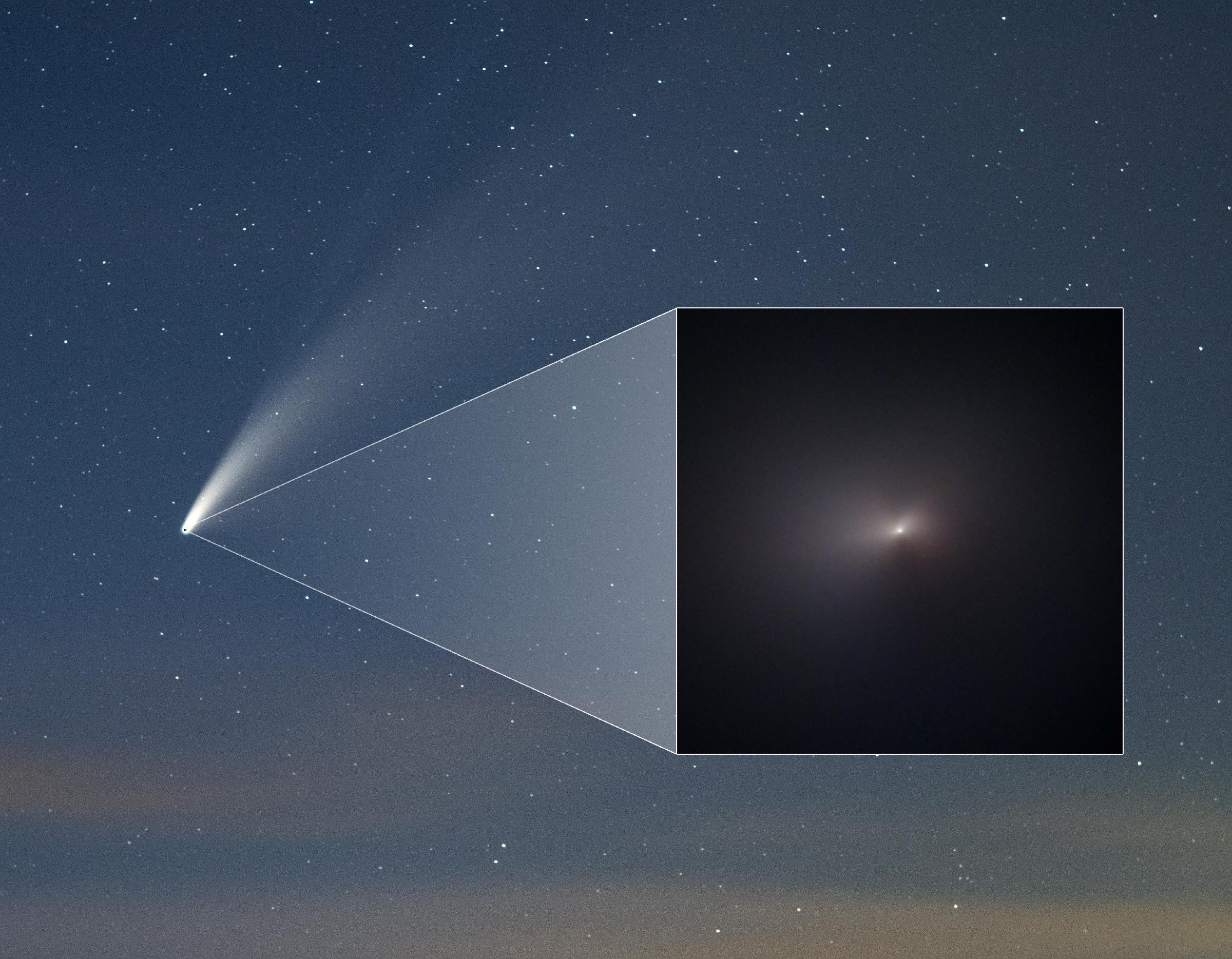
    This ground-based image of comet C/2020 F3 (NEOWISE) was taken on July 16, 2020, from the Northern Hemisphere. The inset image, taken on August 8, 2020, by the Hubble Space Telescope, reveals a close-up of the comet after its pass by the Sun. Hubble’s image zeroes in on the comet’s nucleus, which is too small to be seen. It’s estimated to measure no more than 3 miles (4.8 kilometers) across. Instead, the image shows a portion of the comet’s coma, the fuzzy glow, which measures about 11,000 miles (18,000 kilometers) across in this image. Comet NEOWISE won’t pass through the inner solar system for another nearly 7,000 years. Credit: NASA, ESA, STScI, Q. Zhang (Caltech); ground-based image copyright © 2020 by Zoltan G. Levay, used with permission

    What Is a Comet?

    A comet is an icy, rocky mass that has passed close by the Sun within our Solar System, and has thus warmed up and begun to release gases, resulting in a visible atmosphere — and sometimes a “tail” — to form.

    Comets are small celestial bodies that have highly eccentric orbits around our Sun, which means that their orbital paths take them close past the Sun, and then hurl them out deep into the Solar System, beyond Neptune’s orbit. This means that the amount of light that they receive from the Sun varies considerably.

    Comets have small cores or “nuclei,” made up of rock, dust, and ice, with diameters between a few hundred meters and a few tens of kilometers. For most of a comet’s orbit, it only comprises its core. However, after a comet has passed close by the Sun, the solar wind causes the ice to warm up and the comet begins to release gases, a process known as outgassing. The gases form a visible atmosphere around the comet which is not bound by gravity. This unbound atmosphere is called a “coma.”

    Sometimes, the coma trails behind the comet, forming a distinctive comet tail. Comets can orbit the Sun for millennia, but eventually, the regular process of heating, outgassing, and cooling may cause them to break up.


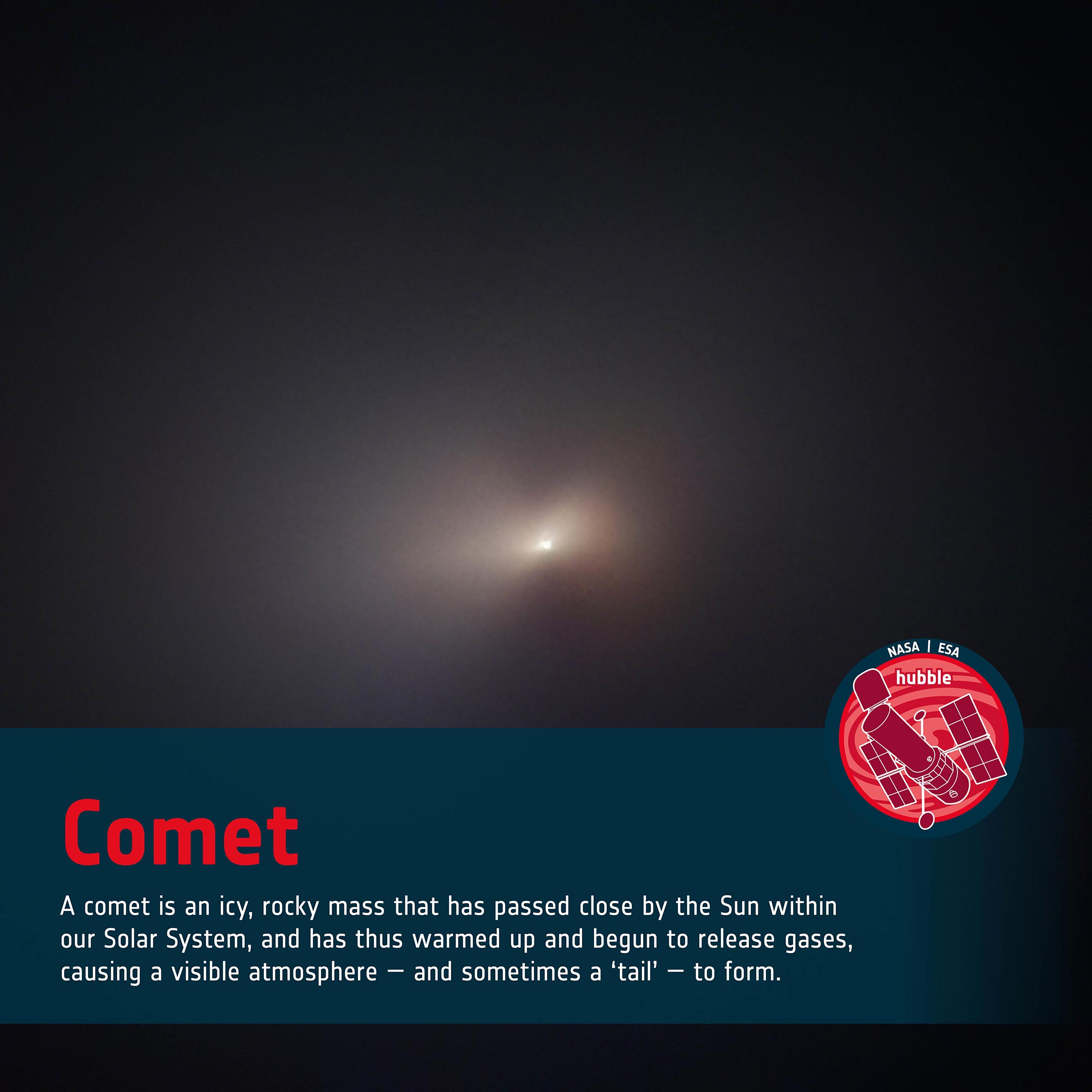
    A comet is an icy, rocky mass that has passed close by the Sun within our Solar System, and has thus warmed up and begun to release gases, causing a visible atmosphere — and sometimes a “tail” — to form. Credit: NASA & ESA

    In contrast to probes that have to travel vast distances and require years of planning to visit the planets, Hubble is also able to turn its attention quickly to sudden dramatic events occurring in the Solar System. This allowed it to witness the stunning plunge of comet Shoemaker-Levy 9 into Jupiter’s atmosphere in July 1994. Hubble followed the comet fragments on their last journey and delivered high-resolution images of the impact scars, from which important new information on conditions in the Jovian atmosphere was obtained. The consequences of the impact could be seen for several days afterward, and by studying the Hubble data, astronomers were able to gain fundamental information about the composition and density of the giant planet’s atmosphere.
    Word Bank Comet
    Comet. Credit: ESA/Hubble, NASA, ESA, Q. Zhang (California Institute of Technology), A. Pagan (STScI)

    Hubble has also observed spectacular comet breakups. This includes the breakup of comet 73P/Schwassmann-Wachmann 3 in 2006 as it visited the inner Solar System. The Hubble images uncovered many more fragments than were reported by ground-based observers and provided an unprecedented opportunity to study the demise of a comet nucleus. Hubble also observed the breakup of comet ATLAS in 2020, providing astronomers with the sharpest view yet of the breakup of a comet. The telescope resolved roughly 30 fragments of the fragile comet. These Hubble images provided further evidence that comet fragmentation is probably common and might even be the dominant mechanism by which the solid, icy nuclei of comets die.

    Also in 2020 Hubble captured the closest images yet of the popular comet C/2020 F3 NEOWISE, after it passed by the Sun. The telescope’s images resolved the visitor’s coma, the fine shell that surrounds its nucleus, and its dusty output.

    Never miss a breakthrough: Join the SciTechDaily newsletter.
    Follow us on Google and Google News.

    Astronomy Astrophysics Comet European Space Agency Hubble Space Telescope
    Share. Facebook Twitter Pinterest LinkedIn Email Reddit

    Related Articles

    Hubble Captures a Dangerous Dance Over 100 Million Light-Years From Earth

    Hubble Captures the Final Acts of a Monster Star

    Hubble Find Surprises Astronomers: White Dwarfs Can Still Undergo Stable Thermonuclear Activity

    First Evidence of Water Vapor at Jupiter’s Moon Ganymede – May Hold More Water Than All of Earth’s Oceans

    Our Giant Universe: Hubble Spots Massive Galaxy Cluster With a Wealth of Exciting Possibilities

    Tantrums of a Baby Star: Herbig-Haro Objects

    Unexpected Discovery: Hubble Space Telescope Uncovers Concentration of Small Black Holes

    “Unprecedented” – Unusual Planetary Nebula Fades Mere Decades After It Arrived

    Hubble Captures Unprecedented Fading of Stingray Nebula – “This Is Very, Very Dramatic, and Very Weird”

    Leave A Reply Cancel Reply

    • Facebook
    • Twitter
    • Pinterest
    • YouTube

    Don't Miss a Discovery

    Subscribe for the Latest in Science & Tech!

    Trending News

    Largest-Ever Study Finds Medicinal Cannabis Ineffective for Anxiety, Depression, PTSD

    250-Million-Year-Old Egg Solves One of Evolution’s Biggest Mysteries

    Living With Roommates Might Be Changing Your Gut Microbiome Without You Knowing

    Century-Old Cleaning Chemical Linked to 500% Increased Risk of Parkinson’s Disease

    What if Your Memories Never Happened? Physicists Take a New Look at the Boltzmann Brain Paradox

    One of the Universe’s Largest Stars May Be Getting Ready To Explode

    Scientists Discover Enzyme That Could Supercharge Ozempic-Like Weight Loss Drugs

    Popular Sweetener Linked to DNA Damage – “It’s Something You Should Not Be Eating”

    Follow SciTechDaily
    • Facebook
    • Twitter
    • YouTube
    • Pinterest
    • Newsletter
    • RSS
    SciTech News
    • Biology News
    • Chemistry News
    • Earth News
    • Health News
    • Physics News
    • Science News
    • Space News
    • Technology News
    Recent Posts
    • Want Less Stress? Landmark Study Points to a Simple Habit
    • Scientists Reveal Eating Fruits and Vegetables May Increase Your Risk of Lung Cancer
    • AI Reveals Explosive Growth of Floating Algae Across the World’s Oceans
    • 5.5 Million Bees Discovered Living Beneath a New York Cemetery
    • Scientists Reverse Brain Aging With Simple Nasal Spray
    Copyright © 1998 - 2026 SciTechDaily. All Rights Reserved.
    • Science News
    • About
    • Contact
    • Editorial Board
    • Privacy Policy
    • Terms of Use

    Type above and press Enter to search. Press Esc to cancel.