

Now is the time to start tracking Comet C/2021 A1 Leonard, as it starts its dawn dive sunward.
The days following New Year’s 2021 saw a comet discovery with potential. On the night of January 3rd, exactly one year to the day prior to perihelion, astronomer Gregory J. Leonard working at the Mount Lemmon Observatory near Tucson Arizona discovered the first long-period comet of the year, C/2021 A1 Leonard. Shining at magnitude +19 and 5 Astronomical Units (AU) distant (about the distance of Jupiter from the Sun) at the time of discovery, early indications hinted that comet A1 Leonard might prove to be something special, come the end of 2021.
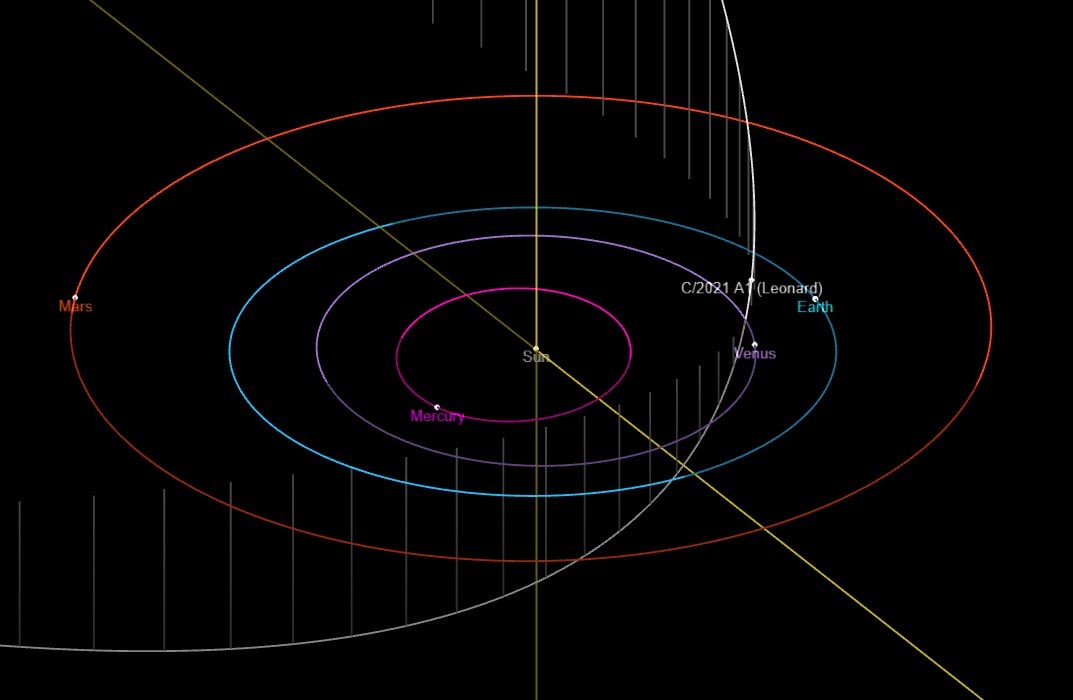
On an 80,000 year orbit inbound, Comet A1 Leonard is due for ejection from the solar system after its perihelion passage early next year. The comet reached aphelion 3,500 AU distant in the Oort Cloud about 35,000 years ago. The upcoming perihelion pass on January 3rd, 2022 will be 0.62 AU from the Sun, interior to the orbit of Venus.
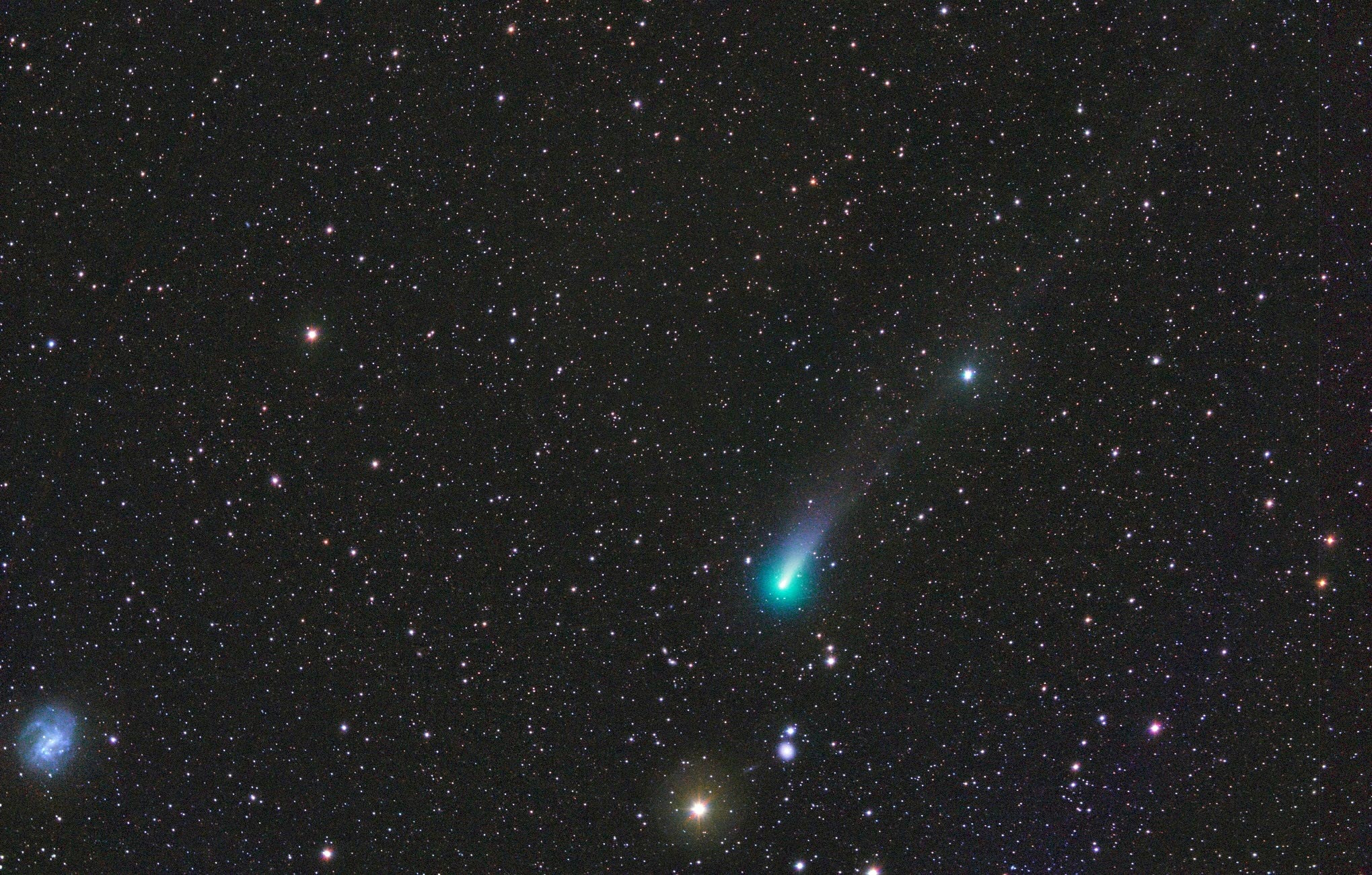
Keep in mind, A1 Leonard may be a seasoned long-term visitor to the inner solar system with a potential to over-perform as it nears the Sun. Current predictions have the comet reaching +4th magnitude, and it may flirt with naked-eye brightness. The comet passes just 0.233 AU (21.7 million miles or 34.9 million kilometers) from the Earth on December 12th, another plus.
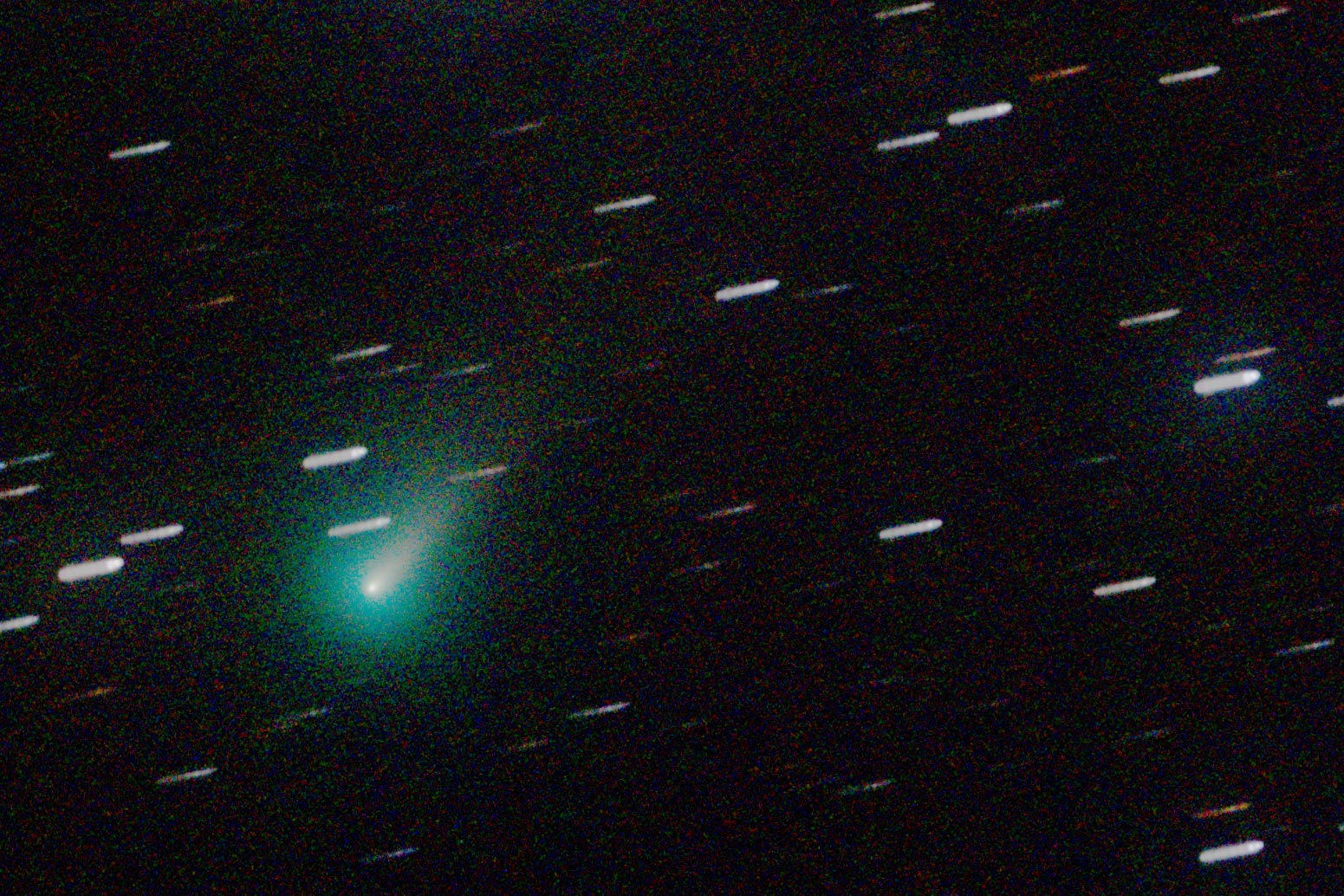
Often, dynamically new comets exhibit a burst of activity as they approach the inner solar system for the first time, heat up, and sublimate their outer layers. This can also fake out observers initially, leading to overly optimistic predictions. We all remember the Great Comet that wasn’t during the 1973 passage of C/1973 E1 Kohoutek. A comet such as A1 Leonard has survived a perihelion passage before without disintegrating… though this one will be its last.
Currently, A1 Leonard is located high at dawn for northern hemisphere observers in the constellation Canes Venatici, and begins the plunge sunward during the first half of the month. We actually cross the plane of the comet’s orbit on December 8th, and the comet may exhibit a sharp ‘anti-tail’ spike sunward around this time.
Another intriguing effect may also come into play during the December apparition of Comet A1 Leonard. The Sun-Earth-Comet phase-angle for the tail will sit at greater than 120 degrees from December 9th to December 22nd, and reach a maximum of 160 degrees on December 14th just after it passes closest to the Earth on December 12th. This sets up conditions ideal for a possible surge in brightness, adding the brightness of the tail to the coma of the comet itself.
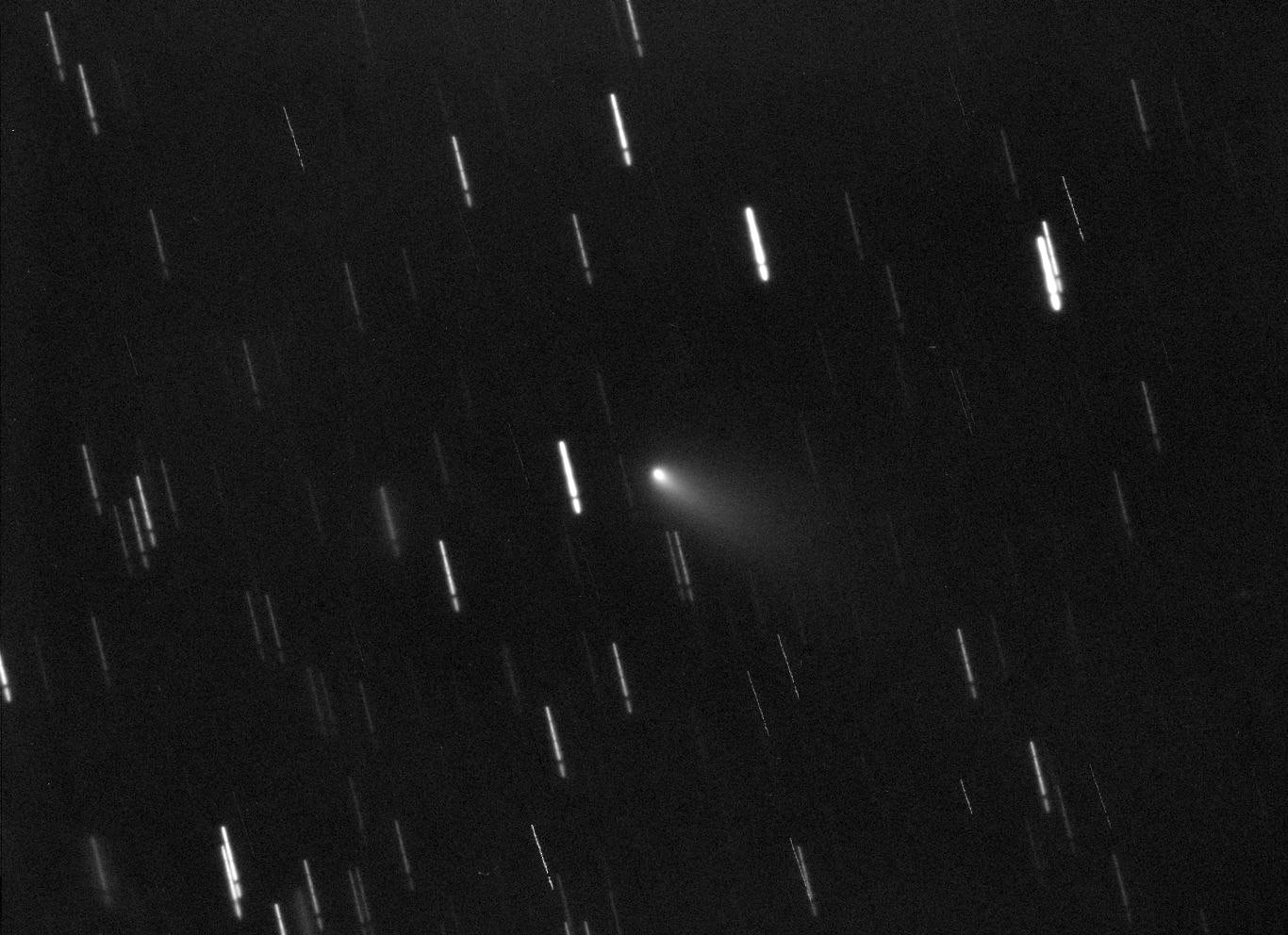
It’s always tough to know exactly what comets will do. The planet Venus actually passes through the tail of Comet A1 Leonard on December 19th, possibly creating a Venusian meteor shower in the process. Currently, only JAXA’s Akatsuki mission in on-hand and active in orbit around Venus.
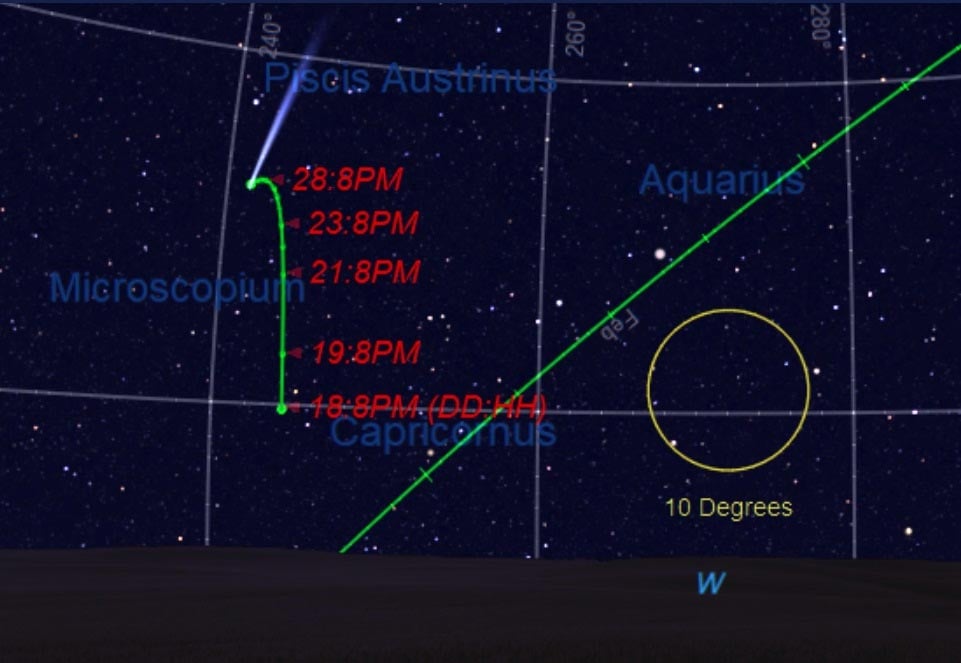
Unfortunately, the evening apparition for Comet A1 Leonard will be a bashful one after it flips from morning to the dusk sky around December 15th. For northern hemisphere observers the comet stays low in the dusk. Southern hemisphere viewers will, however, get a better view as the comet fades, receding in the direction of the constellation of Piscis Austrinus in early 2022.
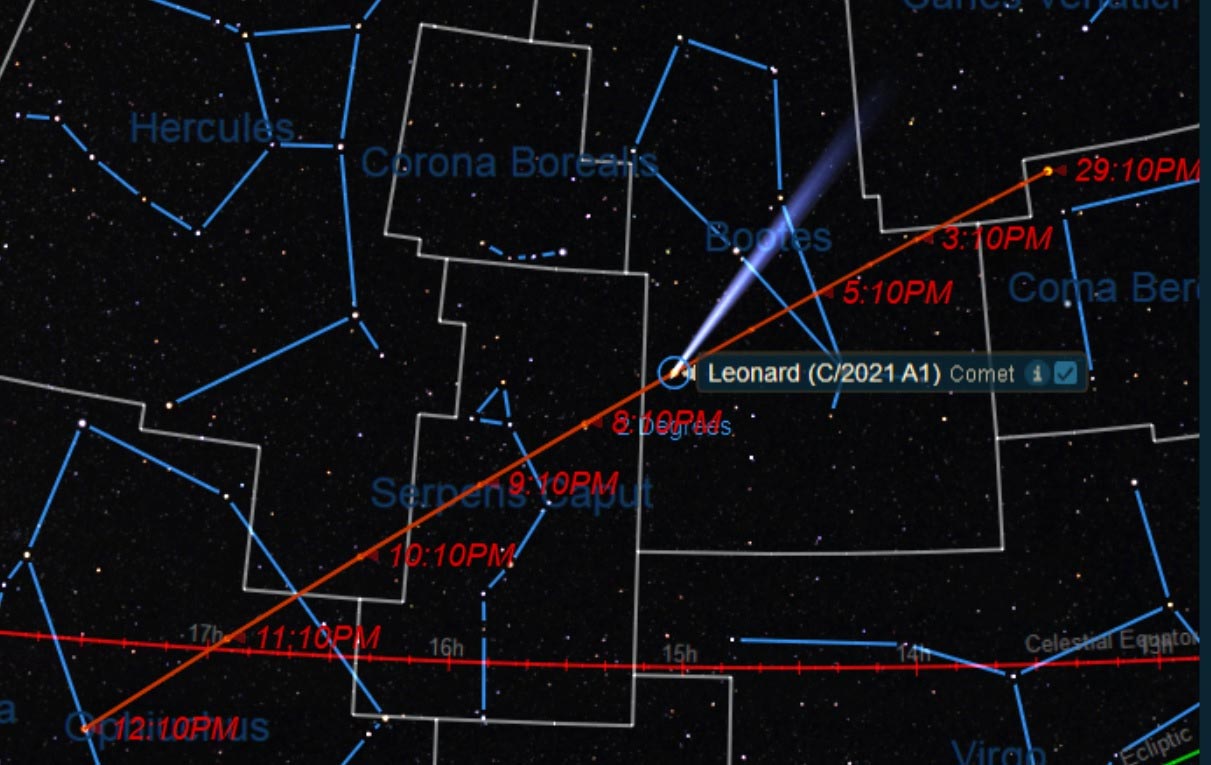
Here are some key celestial dates with destiny for Comet A1 Leonard (note ‘close’ means within a degree, unless otherwise indicated):
November
28-Crosses into Coma Berenices

December
1-Crosses into Canes Venatici
3-Photo op: passes very near the globular cluster Messier 3
4-Crosses into Boötes
6-Passes 4 degrees from the bright star Arcturus
8-Orbit edge-on as seen from Earth
9-Crosses into Serpens Caput
10-Crosses into Hercules
11-Crosses into Ophiuchus
12-Crosses the celestial equator southward, and passes 0.233 AU (34.9 million km or 21.7 million mi) from the Earth, moving half a degree (the span of a Full Moon) per hour.
13-Flips over from the morning to evening sky, and may top out at +4th magnitude.
14-Passes near +3.3 magnitude star Nu Ophiuchi, and into Serpens Cauda
14-Transits Messier 16, and passes 15 degrees from the Sun.
15-Crosses the galactic plane southward
15-Briefly crosses into Scutum, passes near comet 252P LINEAR, passes 1.5 degrees from Messier 17, and crosses into Sagittarius
16-Passes near the stars: +3.5 magnitude Xi^2 Sagittarii, +3.8 Omicron Sagittarii, and +2.8 Albaldah, and crosses the ecliptic southward
17-Passes five degrees from Venus
18-Passes just 0.028 AU (4.2 million km or 2.6 million mi) from Venus
21-Crosses into Microscopium
30-Passes into Piscis Austrinus
January
3-Reaches perihelion at 0.62 AU from the Sun
February
1-Drops back down below +10th magnitude
As you can see, mid-December is a busy one for Comet A1 Leonard, as it nears the bustling galactic plane.

Binoculars are your best friend when it comes to sweeping up a comet: simply scan the suspect target field, and look for the faint fuzzy that refuses to snap into focus. At this stage, comets frequently look like globular clusters that refuse to resolve into individual stars. ‘If’ Comet A1 Leonard over-performs and breaks into naked eye territory, things could get really interesting. Like Comet F3 NEOWISE, A1 Leonard would then have the potential to pose with foreground objects in the dawn, making for a truly photogenic comet.
Plan on braving the morning of December cold to capture the sight of Comet A1 Leonard at dawn.
Adapted from an article originally published on Universe Today.
Never miss a breakthrough: Join the SciTechDaily newsletter.
Follow us on Google and Google News.
1 Comment
Got a good view of Comet Leonard, with binoculars, last night.
Incredible to think that last time around here it may have been seen by both humans and neanderthals.
Do we know if it was very favourably positioned for earth that time round? This time it seems to have been more just beyond easy viewing with the naked eye.