
Close Menu
    Facebook X (Twitter) Instagram
    SciTechDaily
    • Biology
    • Chemistry
    • Earth
    • Health
    • Physics
    • Science
    • Space
    • Technology
    Facebook X (Twitter) Pinterest YouTube RSS
    SciTechDaily
    Home»Earth»Mount Michael, Volcano Track or Plume? 1,000-Meter-Tall Active Stratovolcano Puts On a Show
    Earth

    Mount Michael, Volcano Track or Plume? 1,000-Meter-Tall Active Stratovolcano Puts On a Show

    By Kathryn Hansen, NASA Earth ObservatoryDecember 6, 2021No Comments3 Mins Read
    Facebook Twitter Pinterest Telegram LinkedIn WhatsApp Email Reddit
    Share
    Facebook Twitter LinkedIn Pinterest Telegram Email Reddit
    Mount Michael Volcano 2021 Annotated
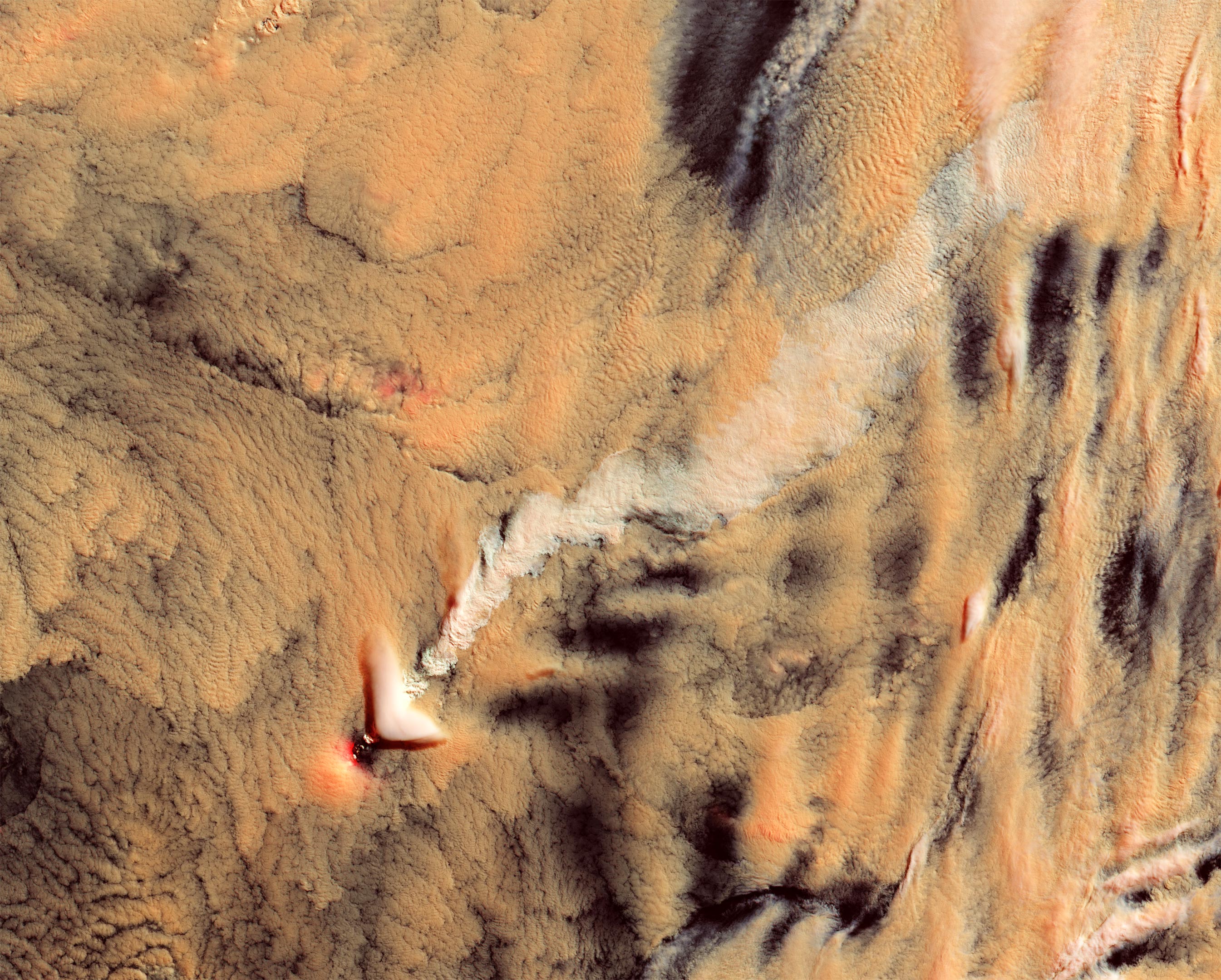
    Mount Michael Volcano in the South Sandwich Islands, November 7, 2021

    The nearly 1,000-meter-tall volcano in the South Sandwich Islands frequently finds a way to put on a show.

    Mount Michael, an active stratovolcano in the South Sandwich Islands, is viewed more often by penguins than by people. It is located on Saunders Island, about 1,600 kilometers (1,000 miles) from Antarctica and 2,400 kilometers (1,500 miles) from South America, and there are no permanent human residents nearby. For satellites looking down from space, the mountain is usually obscured by clouds. Still, the nearly 1,000-meter-tall (3,300-foot-tall) volcano frequently finds a way to put on a show.

    Some of the most common displays are wave clouds—the triangular, banded patterns of clouds that result from the disrupted flow of air around the volcano. But in this image, acquired on November 7, 2021, with the Operational Land Imager (OLI) on Landsat 8, the more compelling feature is the bright white stream visible downwind of the island.

    Volcano Tracks: Imprints in Passing Clouds

    The feature is possibly a type of cloud known as a volcano track. These “tracks” occur when passing clouds interact with the gases and particles from a volcano. The extra particles from the volcano produce more and smaller cloud droplets, which make the cloud appear brighter. “As the cloud moves over the volcano, the imprint of those smaller droplets stay in the cloud, resembling a stream or a track of different texture when seen from above,” said NASA atmospheric scientist Santiago Gassó, who spotted the feature and routinely hunts for volcano tracks in satellite images.

    Volcano tracks can be difficult to discern in natural-color images. This image is false color, composed with a combination of shortwave infrared and blue light (OLI bands 7-6-2) to help distinguish the track from the rest of the cloud deck. Also notice the striking lenticular cloud. Unrelated to the volcanic activity, these clouds can develop at the crest of atmospheric waves that form when wind encounters a topographic barrier and is forced up.

    Volcano tracks are a useful tool for scientists trying to spot cases of less intense volcanic activity. Such activity—the simple “puffs” of water vapor, particles, and gases—is common, but often goes unreported because the emissions usually stay below (or within) the clouds. By studying the clouds around these volcanic puffs, scientists have been gaining insight into how clouds form and evolve.

    There is also the chance that the plume from Mount Michael on November 7 rose above the cloud deck, meaning the feature would be a typical volcanic plume, and not a volcano track. “The Landsat image has so much detail. I can see several shadows suggesting that what I called a volcano track is actually a plume positioned immediately above the cloud deck—low enough to cast a small shadow,” Gassó said. “But at the same time, it is unusual to have such an organized plume above the cloud deck without dissipating or thinning out more readily.”

    Without lidar data to measure the feature’s height, it is not possible to know if the feature is volcano track or a plume. Either way, Gassó notes: “There is some beauty in it, right? In that same way, it triggers curiosity to find more.”

    NASA Earth Observatory image by Lauren Dauphin, using Landsat data from the U.S. Geological Survey.

    Never miss a breakthrough: Join the SciTechDaily newsletter.
    Follow us on Google and Google News.

    NASA NASA Earth Observatory Popular Volcano
    Share. Facebook Twitter Pinterest LinkedIn Email Reddit

    Related Articles

    Sharkcano! – NASA Satellite Catches Submarine Eruption of Kavachi Volcano

    Massive Tonga Volcano Plume Reached the Mesosphere – 36 Miles Into the Atmosphere

    Island Obliterated: Dramatic Changes at Hunga Tonga-Hunga Ha’apai

    Hunga Tonga Island Obliterated – NASA Satellites Capture Massive Blast

    A Wolf Awakens in the Galápagos Islands at Night

    Volcanic Eruption Continues at La Palma – Effects Being Felt From Above and Below

    “Smoking Mountain” – An Outburst From Popocatépetl Volcano in Mexico

    Young Volcanic Island Nishinoshima Belches Ash and Lava As It Grows in the Pacific

    Unusual “Volcano Track” Clouds Investigated

    Leave A Reply Cancel Reply

    • Facebook
    • Twitter
    • Pinterest
    • YouTube

    Don't Miss a Discovery

    Subscribe for the Latest in Science & Tech!

    Trending News

    Millions Take These IBS Drugs, But a New Study Finds Serious Risks

    Scientists Unlock Hidden Secrets of 2,300-Year-Old Mummies Using Cutting-Edge CT Scanner

    Bread Might Be Making You Gain Weight Even Without Eating More Calories

    Scientists Discover Massive Magma Reservoir Beneath Tuscany

    Europe’s Most Active Volcano Just Got Stranger – Here’s Why Scientists Are Rethinking It

    Alzheimer’s Symptoms May Start Outside the Brain, Study Finds

    Millions Take This Popular Supplement – Scientists Discover a Concerning Link to Heart Failure

    The Universe Is Expanding Too Fast and Scientists Can’t Explain Why

    Follow SciTechDaily
    • Facebook
    • Twitter
    • YouTube
    • Pinterest
    • Newsletter
    • RSS
    SciTech News
    • Biology News
    • Chemistry News
    • Earth News
    • Health News
    • Physics News
    • Science News
    • Space News
    • Technology News
    Recent Posts
    • Doctors Surprised by the Power of a Simple Drug Against Colon Cancer
    • Why Popular Diabetes Drugs Like Ozempic Don’t Work for Everyone: The “Genetic Glitch”
    • Scientists Create Improved Insulin Cells That Reverse Diabetes in Mice
    • Scientists Stunned After Finding Plant Thought Extinct for 60 Years
    • A Common Diabetes Drug May Hold the Key to Stopping HIV From Coming Back
    Copyright © 1998 - 2026 SciTechDaily. All Rights Reserved.
    • Science News
    • About
    • Contact
    • Editorial Board
    • Privacy Policy
    • Terms of Use

    Type above and press Enter to search. Press Esc to cancel.