
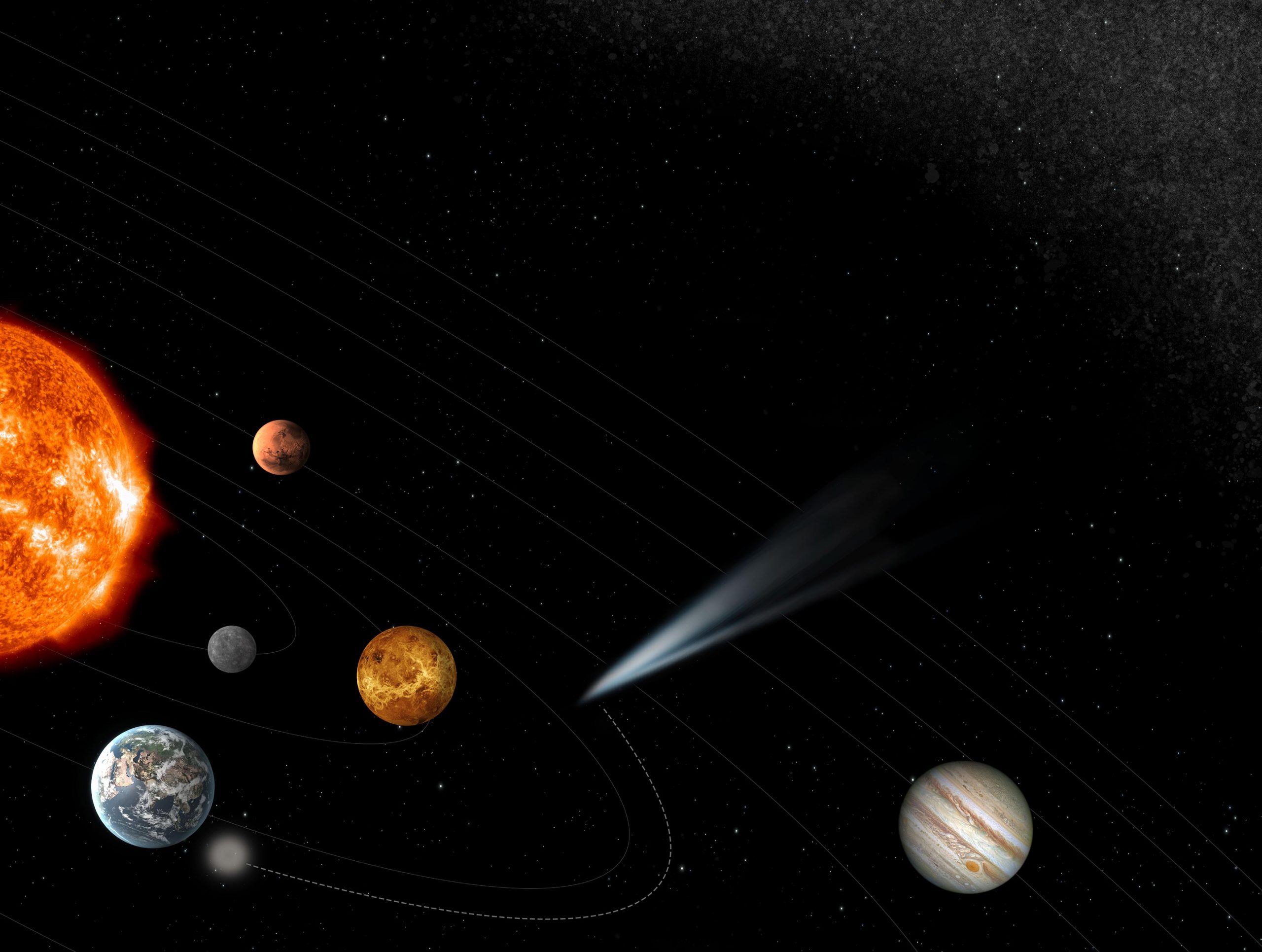
Comet Interceptor, launching in 2029, will explore a pristine comet, revealing its composition and structure, while also supporting planetary defense.
In 2019, the European Space Agency (ESA) selected Comet Interceptor as a new fast-class (F-class) mission. These missions, where “fast” refers to development speed, are missions that take about 8 years to fully implement. The mission’s primary science goal is to characterize, for the first time, a truly pristine comet or other interstellar object.
Three Spacecraft, One Target
Comet Interceptor comprises three spacecraft, with the main craft and two smaller probes. Each will be outfitted with different suites of science instruments to thoroughly analyze the target. For example, Spacecraft A will feature CoCa (Comet Camera) to obtain high-resolution images of the target’s nucleus at several wavelengths. Spacecraft B1 will have HI (Hydrogen Imager) an ultraviolet camera devoted to studying the cloud of hydrogen gas surrounding the comet. On Spacecraft B2, the main instrument will be OPIC (Optical Imager for Comets) for mapping of the nucleus and its dust jets at different visible and infrared wavelengths.
ESA’s Comet Interceptor mission has just been ‘adopted’; the study phase is complete and, following selection of the spacecraft prime contractor, work will soon begin to build the project, whose mission is to visit a pristine comet or other interstellar object just starting its journey into the inner Solar System.
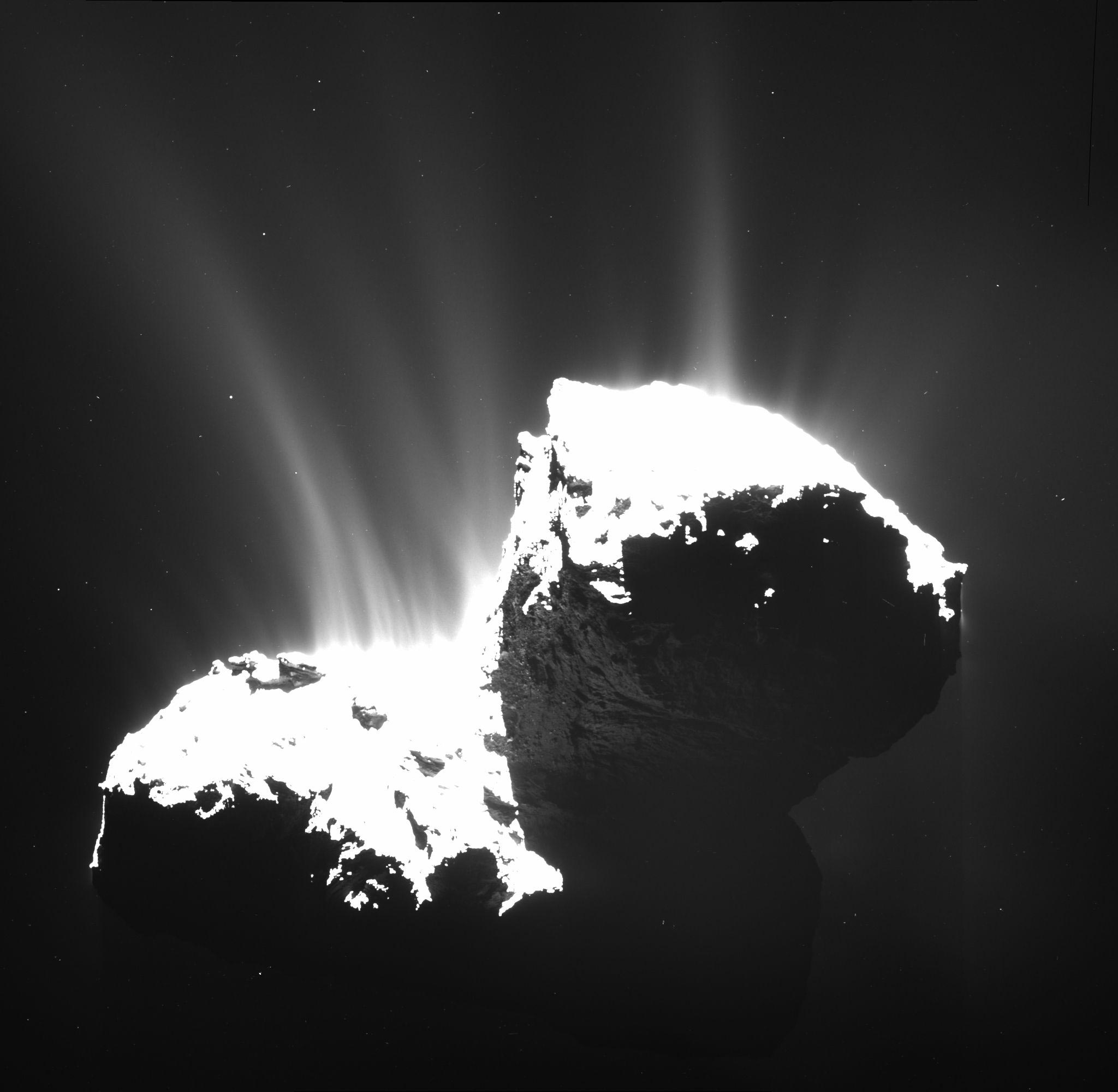
Comet Interceptor will share a ride into space with ESA’s Ariel exoplanet mission in 2029. The mission will build upon the successes of Rosetta and Giotto, ESA missions that both visited ‘short-period’ comets. Though these missions completely transformed our understanding of comets, their targets had already swung around the Sun many times and had therefore changed significantly since their creation.
Unique Scientific Goals: Visiting a Pristine Comet
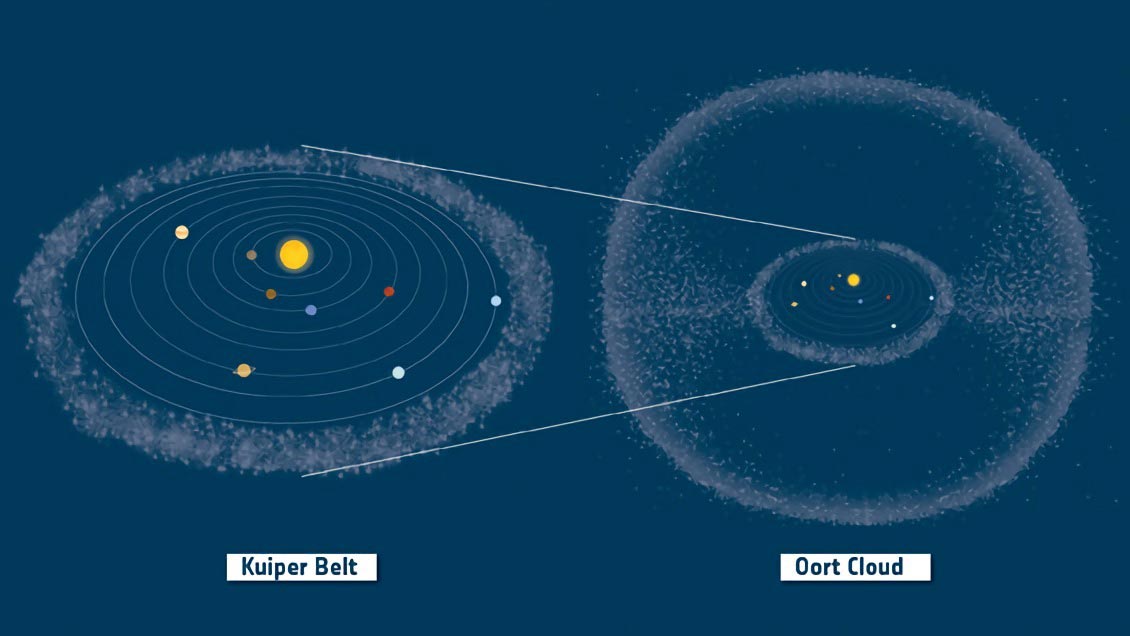
Comet Interceptor aims to scrutinize a comet that has spent little time in the inner Solar System, or is possibly visiting it for the first time. Whilst Rosetta’s target hailed from the rocky Kuiper Belt just beyond Neptune, Comet Interceptor’s could originate from the vast Oort Cloud, over a thousand times further from the Sun.
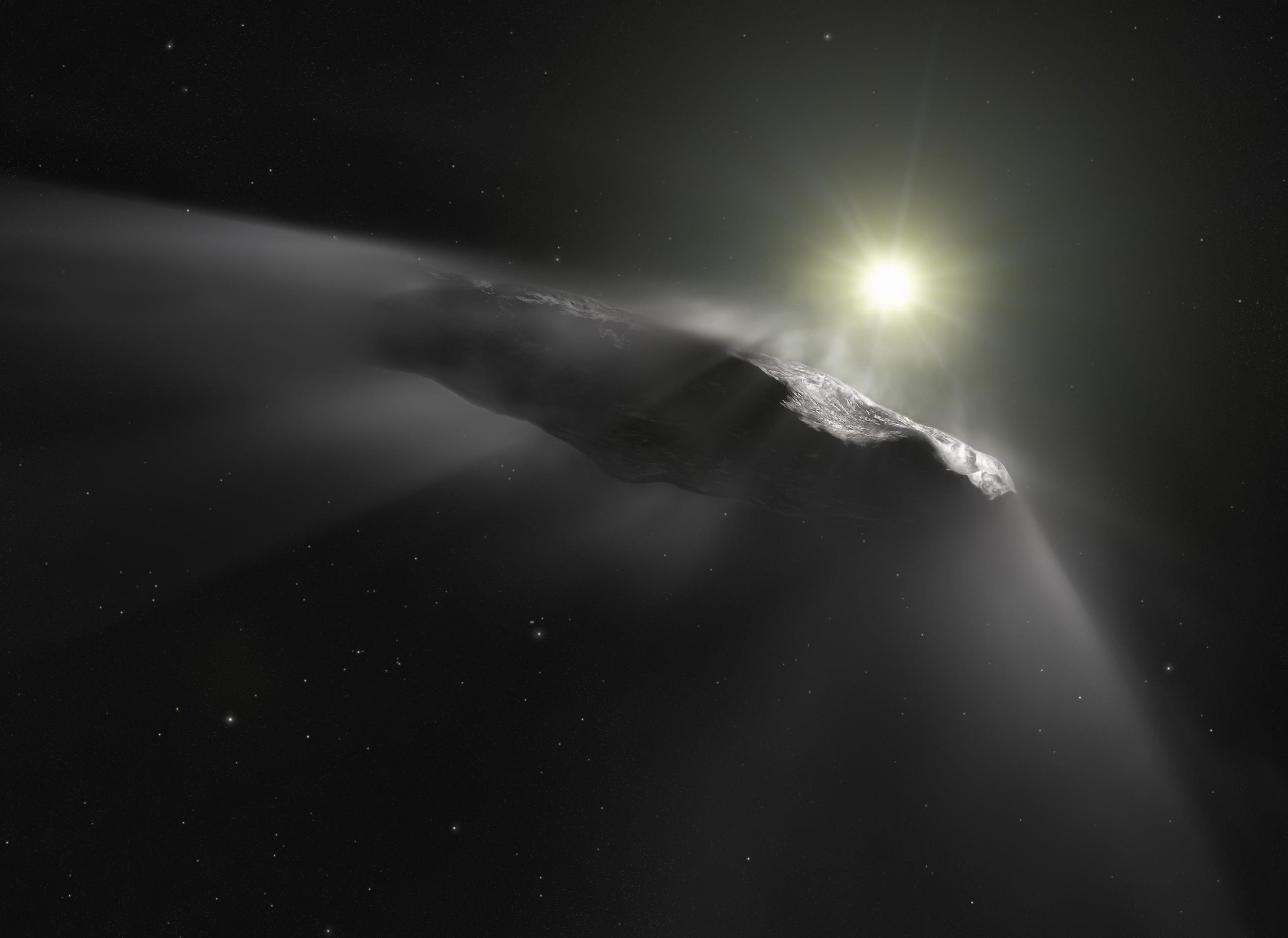
Although they’re much rarer, a different potential target could be an ‘interstellar interloper’ from outside the Solar System – something similar to ‘Oumuamua that unexpectedly flew past the Sun in 2017. Studying such an object could offer the chance to explore how comet-like bodies form and evolve in other star systems.
Comet Interceptor was adopted by ESA during the Agency’s Science Program Committee meeting on June 8, 2022. The mission is led by ESA with support from the Japanese Space Agency (JAXA).
“The adoption of Comet Interceptor builds upon the breakthroughs of our visionary Giotto and Rosetta missions, accelerating us towards next-level comet science,” says Günther Hasinger ESA’s Director of Science. “It will keep European scientists at the forefront of cometary research and position ESA as a leader in this exciting field.”
Comet Interceptor will be made up of a main spacecraft and two probes, which will surround the comet to observe it from multiple angles. In this way, the innovative mission will build up a 3D profile of its as-yet-undiscovered target. ESA is responsible for the main spacecraft and one of the probes, while JAXA is responsible for the second probe.
“A comet on its first orbit around the Sun would contain unprocessed material from the dawn of the Solar System,” explains ESA’s Comet Interceptor study scientist Michael Küppers. “Studying such an object and sampling this material will help us understand not only more about comets, but also how the Solar System formed and evolved over time.”

Journey to a Comet
Comet Interceptor was proposed to ESA in July 2018 and selected in June 2019. It is an example of a ‘fast’ or F-class mission, which only takes about eight years from selection to launch. These smaller missions weigh less than 2200 lbs (1000 kg).
The mission is expected to launch together with ESA’s exoplanet-studying Ariel mission in 2029. The two missions will travel together to L2 – a location 1.5 million km ‘behind’ Earth as viewed from the Sun. There, Comet Interceptor will wait for a suitable target. Once one is spotted and selected, the mission will continue its journey.
With recent advancements in ground-based telescopes, ‘new’ comets are now typically detected more than a year before their closest approach to the Sun. This is still too short notice to plan, build, and launch a dedicated space mission. But it is enough time for the ready-and-waiting Comet Interceptor to travel from L2 to the comet’s location.
Operating spacecraft across millions of kilometers of space is always a challenge, but Comet Interceptor has a truly unique flight profile. Navigating the spacecraft towards the target comet, releasing the probes at the right time, and performing a flyby will require steady hands and calm heads from ESA’s mission operations team.
A Visionary Mission – With Benefits in Space and on Earth
The three flight elements – the main spacecraft and two smaller probes – that make up Comet Interceptor will each be equipped with different high-tech instruments that will help us discover more about the dynamic nature of a pristine comet. ESA will lead the development of the main spacecraft and one of the probes, both carrying unique instruments built mainly by European industry. The other probe will be developed by JAXA.
Comet Interceptor has ground-breaking aims to characterize the surface composition, shape, and structure of a pristine comet for the first time ever, and investigate the composition of its gas and dust coma. In some cases, this will require existing technologies to be refined, boosting the space and engineering industries in many ESA Member States.
“As with most ESA missions, Comet Interceptor will motivate collaboration between different companies, institutes, and countries, and will accelerate the development of innovative technologies that may have completely different applications in the future,” says ESA’s Comet Interceptor project manager Nicola Rando.
Comet Interceptor is also contributing to ESA’s planetary defense efforts. We know of almost 120 comets and more than 29,000 asteroids that come close to Earth in their orbit around the Sun. By studying these objects, we not only uncover secrets of the Solar System but also become better equipped to protect our planet if and when one is discovered on a collision course with Earth. Comet Interceptor joins a fleet of worldwide missions related to planetary defense, including ESA’s Hera mission, which is involved in the world’s first asteroid deflection test.
Nicola concludes: “Having spent the last few years devising and developing the Comet Interceptor concept, we are now ready to take the mission to the next stage, selecting the prime contractor and then starting the implementation phase.”
Never miss a breakthrough: Join the SciTechDaily newsletter.
Follow us on Google and Google News.