
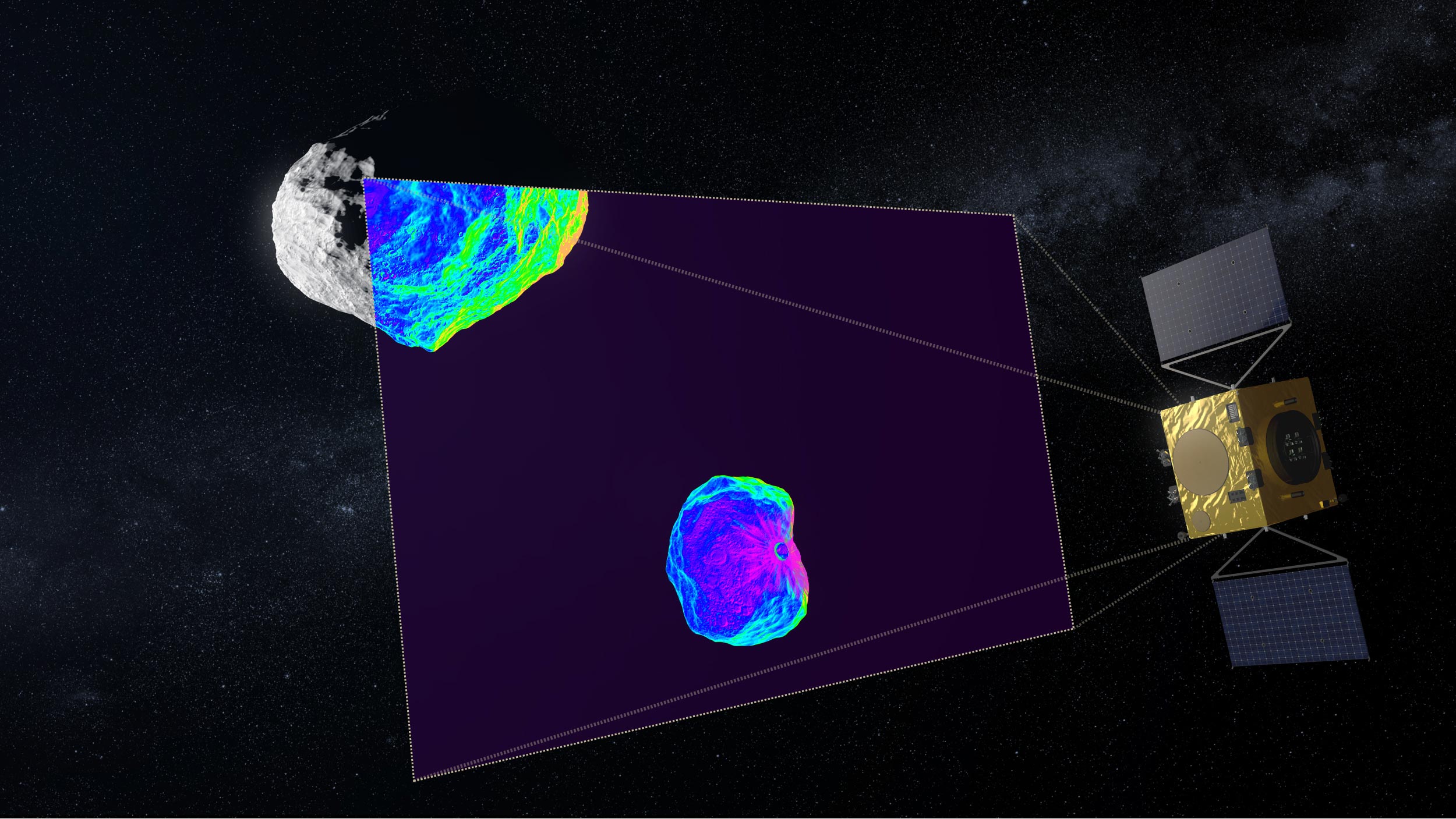
Today ESA awarded a €129.4 million (US $153.4 million) contract covering the detailed design, manufacturing, and testing of Hera, the Agency’s first mission for planetary defense. This ambitious mission will be Europe’s contribution to an international asteroid deflection effort, set to perform sustained exploration of a double asteroid system.
Hera – named after the Greek goddess of marriage – will be, along with NASA’s Double Asteroid Redirect Test (DART) spacecraft, humankind’s first probe to rendezvous with a binary asteroid system, a little understood class making up around 15% of all known asteroids.
The contract was signed today by Franco Ongaro, ESA Director of Technology, Engineering and Quality, and Marco Fuchs, CEO of Germany space company OHB, prime contractor of the Hera consortium. The signing took place at ESA’s ESOC center in Germany, which will serve as mission control for the 2024-launched Hera.
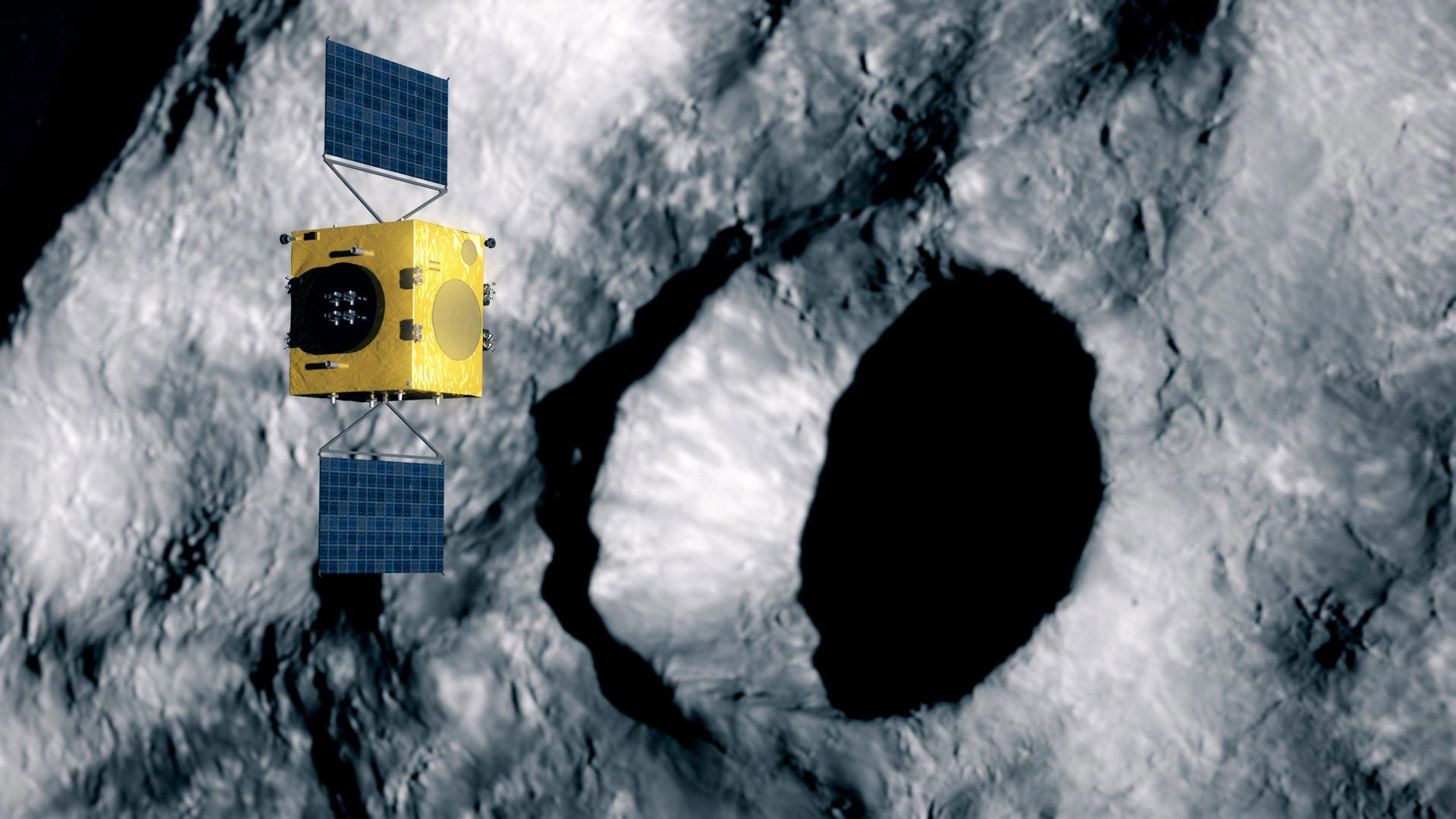
Hera is the European contribution to an international planetary defense collaboration among European and US scientists called the Asteroid Impact & Deflection Assessment, AIDA. The DART spacecraft – due for launch in July 2021 – will first perform a kinetic impact on the smaller of the two bodies. Hera will follow-up with a detailed post-impact survey to turn this grand-scale experiment into a well-understood and repeatable asteroid deflection technique.
While doing so, the desk-sized Hera will also demonstrate multiple novel technologies, such as autonomous navigation around the asteroid – like modern driverless cars on Earth – while gathering crucial scientific data, to help scientists and future mission planners better understand asteroid compositions and structures.
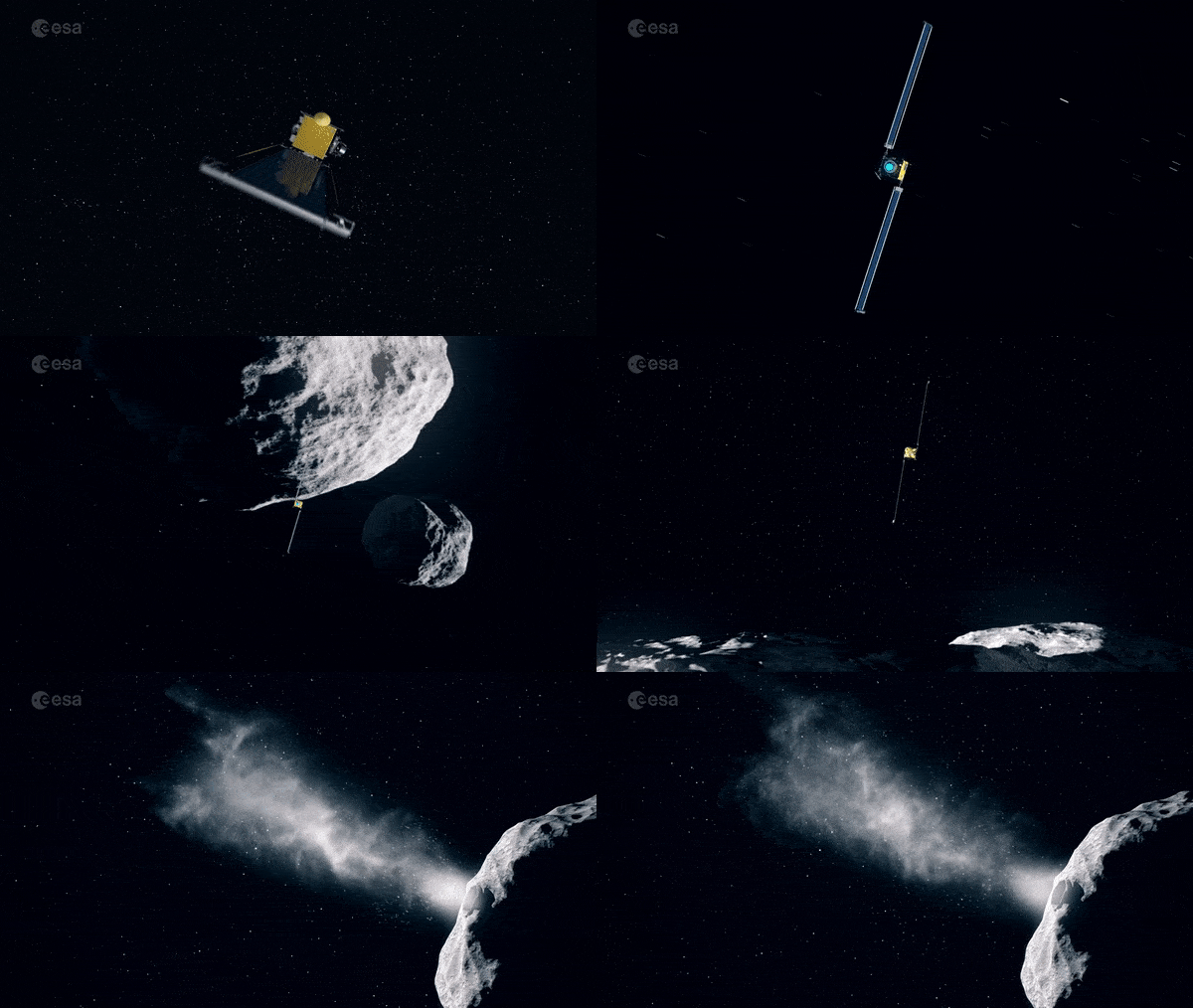
Hera will also deploy Europe’s first ‘CubeSats’ (miniature satellites built up from 10 cm boxes) into deep space for close-up asteroid surveying, including the very first radar probe of an asteroid’s interior – using an updated version of the radar system carried on ESA’s Rosetta comet mission.
Due to launch in October 2024, Hera will travel to a binary asteroid system – the Didymos pair of near-Earth asteroids. The 780 m-diameter mountain-sized main body is orbited by a 160 m moon, formally christened ‘Dimorphos’ in June 2020, about the same size as the Great Pyramid of Giza.
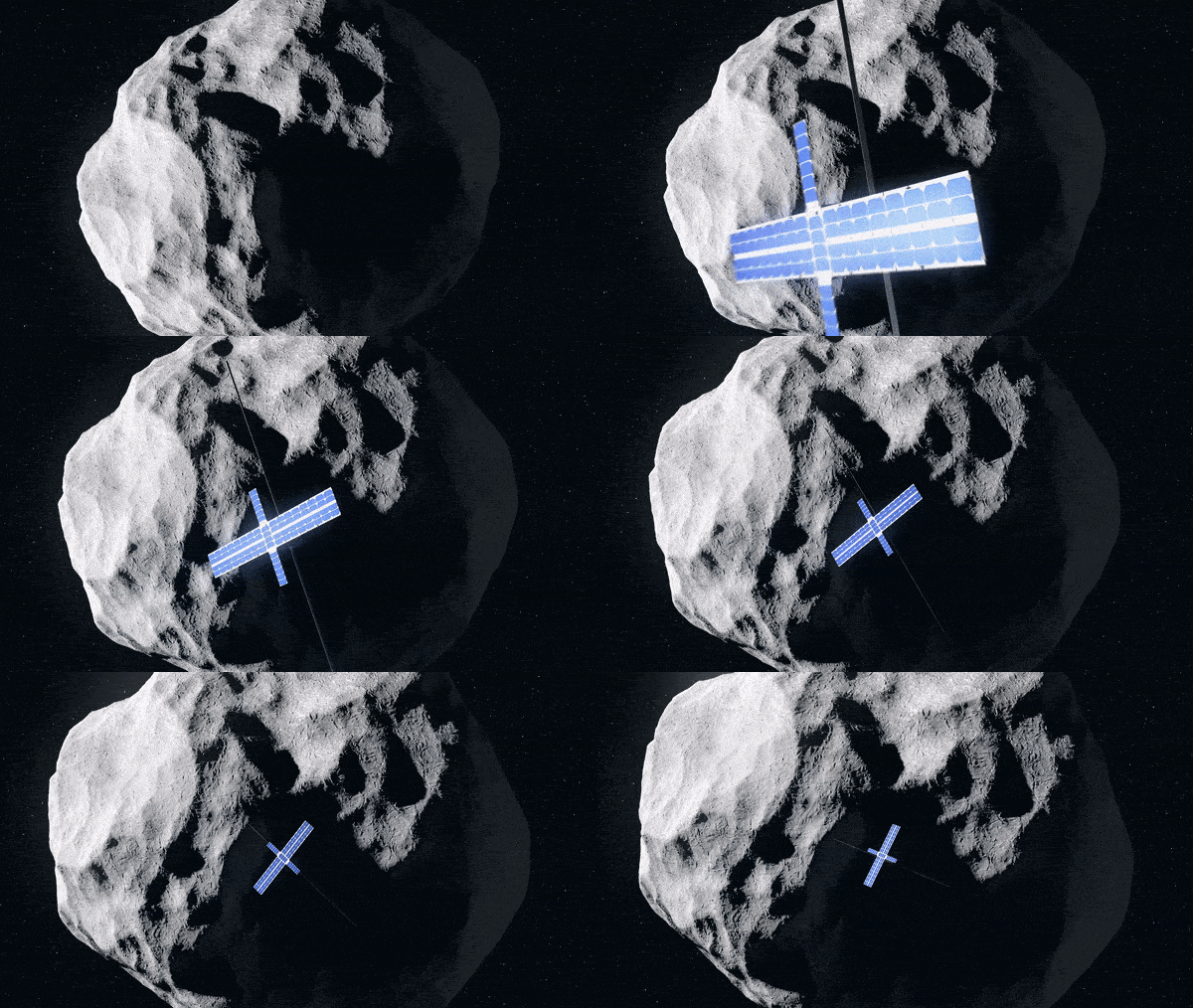
DART’s kinetic impact into Dimorphos in September 2022 is expected to alter its orbit around Didymos as well as create a substantial crater. This moonlet asteroid will become unique, as the first celestial body to have its orbital and physical characteristics intentionally altered by human intervention. Hera will arrive at the Didymos system at the end of 2026, to perform at least six months of close-up study.
Hera’s mission control will be based at ESA’s ESOC center in Darmstadt, Germany, also the home of ESA’s new Space Safety and Security program, of which Hera is a part.
This contract signing covers the full Hera satellite development, integration and test, including its advanced guidance, navigation and control (GNC) system. Contracts for Hera’s two hosted CubeSats and relevant technology developments are already ongoing.
Hera’s European partners
The contract has been awarded to a consortium led by prime contractor OHB System AG in Bremen.
Of 17 ESA Member States contributing to Hera, Germany is in the forefront, tasked with the overall Hera spacecraft design and integration, main navigation cameras, tanks, thrusters, high-gain antenna, reaction wheels, and mass memory unit.
Italy is leading the mission’s power and propulsion subsystems, and is providing the deep-space transponder that will enable the mission’s radioscience experiment. In addition, Italy is leading the dust and mineral prospecting CubeSat, named after the late Andrea Milani, distinguished professor and leading asteroid scientist.
Belgium is developing Hera’s on-board computer and software, the brain of the spacecraft, plus its power conditioning and distribution unit – the heart of its electrical subsystem. It is also contributing to Hera’s Japanese-developed thermal imager and CubeSats operations center at ESA/ESEC.
Luxembourg is leading the radar-hosting ‘Juventas’ CubeSat and the inter-satellite communication system allowing the two Hera CubeSats to communicate with Earth through an innovative network using Hera as data relay.
Portugal and Romania are developing the laser altimeter which will provide crucial information for the autonomous navigation functions. In addition, Romania is developing the image processing unit, harness and the electrical test equipment (while also contributing to its GNC development).
The Czech Republic is responsible for the full satellite structure, payload software (to command the instruments), independent software validation and ground support equipment for pre-flight satellite testing. It is also providing components for Juventas’ low-frequency radar and data processing software on the second CubeSat.
And Spain is developing Hera’s advanced guidance, navigation and control system as well as the deep-space communication system. It is also providing the Juventas gravimeter instrument.
- Austria is supporting with mission data analysis and processing
- Denmark is contributing to the Juventas CubeSat and remote terminal unit
- France is providing Juventas’ low-frequency radar, as well as star trackers and support to the CubeSats’ payload operations planning and close-proximity trajectories
- Hungary is supporting scientific calibration of the cameras
- The Netherlands is developing the new deep-space CubeSat deployment system and providing Hera’s Sun sensors
- Switzerland is contributing with structural elements and mechanisms for the solar arrays
- Finland is providing the second CubeSats’ multi-spectral imager and onboard equipment. It is also providing the data processing unit
- Poland is contributing with Juventas’ low-frequency radar deployable antennas
- Ireland is providing an innovative inertial measurement unit for the Hera spacecraft to support deep-space navigation
- ESA Associate Member State Latvia is contributing a time-of-flight detector for the mission’s laser altimeter.
Never miss a breakthrough: Join the SciTechDaily newsletter.
Follow us on Google and Google News.
3 Comments
We still haven’t figured this out yet. Hope we do soon.
Not thinking big enough, yet. Can’t hit what you can’t see.
How about a U.N. treaty preserving the radio quiet of the dark side of the moon, so we can build a 2000 mile wide phased array active/passive radar/radiotelescope?
Wouldn’t be very impressive to begin with. Like black & white TV. But after 100 years of gradual development we could track loose change orbiting Mars and take pictures that make full grown astronemers act like children on chritsmas day. The database of asteroid orbits is fundamental to the concept of planetary defence. There is only one practical way to get it. That’s look.
Unfortunately it will be “lost money and wasted work”. Any «impulse» methods (impact, blast) are neither effective nor scalable even to asteroids capable of country-wide destruction due to crumbly internal structure of NEAs (see recent publication of the NASA’s Planetary Defense Coordination Office: https://www.nasa.gov/feature/predicting-the-unpredictable-the-dynamics-of-dart-s-dive-into-an-asteroid ). Such an internal structure will completely block momentum delivery to the asteroid. It is because the shock wave decays quickly, wasting all its energy on heating and redistribution of different sized rock fragments.
As of now, based on system analysis, it is clear that asteroid ablation using highly concentrated sunlight is the only method that meets all of the following criteria: scalability up to global-threat sizes and any type of hazardous bodies as well as low cost and environmental friendliness. This method converts the asteroid to a “natural rocket”, providing more than enough thrust without fuel and energy concerns and therefore its deflection at shortest warning time.
An improved concept for such solar-based deflection using an innovative solar collector was proposed and substantiated back in 2013 – see https://link.springer.com/article/10.1007%2Fs11038-012-9410-2
as well as relevant section in the Wikipedia (“Asteroid impact avoidance – Use of focused solar energy”).