
Close Menu
    Facebook X (Twitter) Instagram
    SciTechDaily
    • Biology
    • Chemistry
    • Earth
    • Health
    • Physics
    • Science
    • Space
    • Technology
    Facebook X (Twitter) Pinterest YouTube RSS
    SciTechDaily
    Home»Space»ESA’s Planetary Defense Mission: Time of Trial for Hera Spacecraft
    Space

    ESA’s Planetary Defense Mission: Time of Trial for Hera Spacecraft

    By European Space Agency (ESA)January 22, 2023No Comments4 Mins Read
    Facebook Twitter Pinterest Telegram LinkedIn WhatsApp Email Reddit
    Share
    Facebook Twitter LinkedIn Pinterest Telegram Email Reddit
    ESA Hera Spacecraft Asteroids
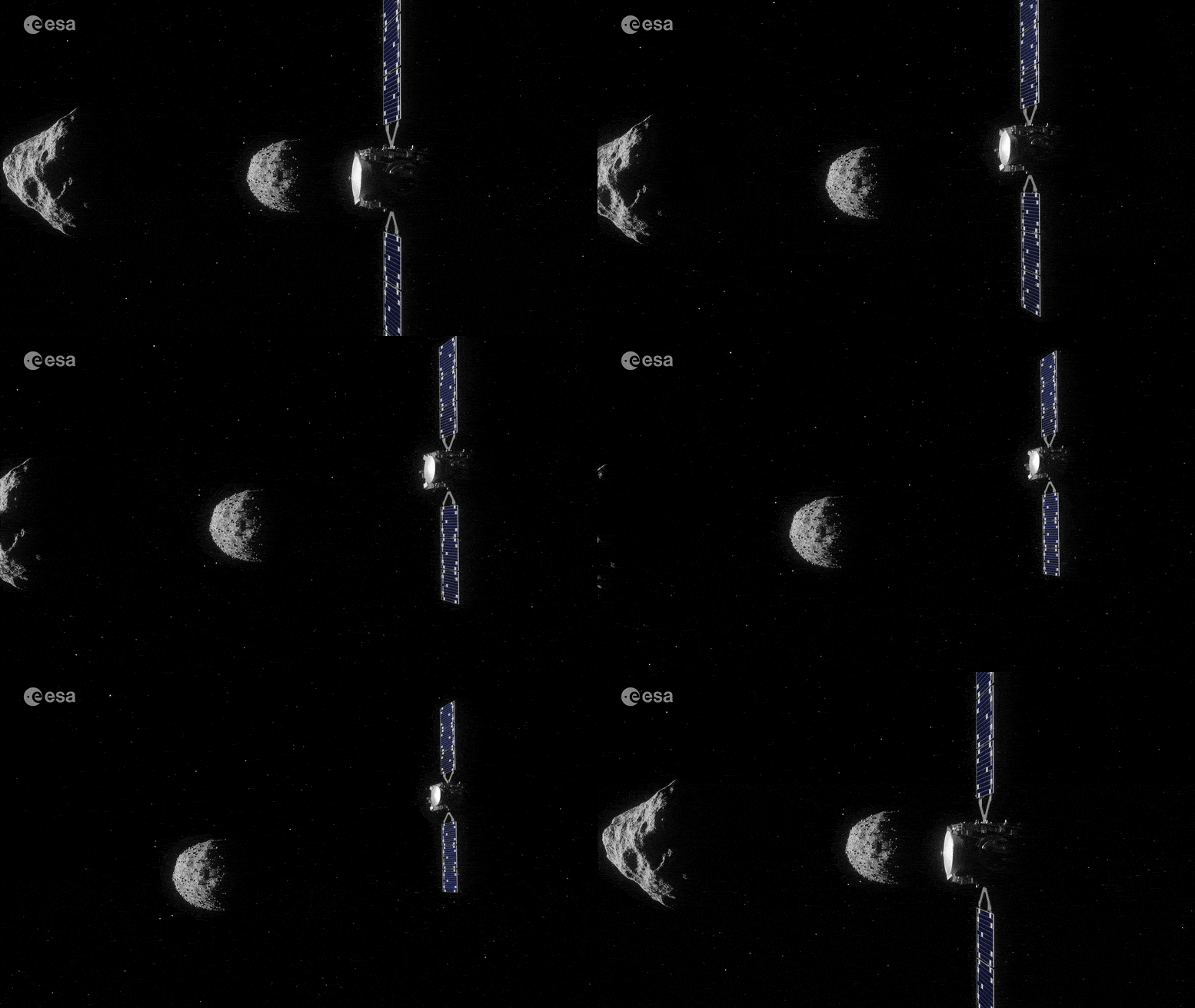
    In the world’s first test of asteroid deflection, Hera will perform a detailed post-impact survey of the target asteroid, Dimorphos – the orbiting Moonlet in a binary asteroid system known as Didymos. Now that NASA’s DART mission has impacted the moonlet, Hera will turn the grand-scale experiment into a well-understood and repeatable planetary defense technique. Demonstrating new technologies from autonomous navigation around an asteroid to low gravity proximity operations, Hera will be humankind’s first probe to rendezvous with a binary asteroid system and Europe’s flagship Planetary Defender. Credit: ESA-Science Office

    ESA’s Hera mission, launching in 2024, will study Dimorphos after NASA’s DART impact.

    One of last year’s space highlights was the NASA DART mission’s collision with Dimorphos (seen right in the animation above), the small moon of the binary asteroid Didymos (seen left). The impact measurably shifted the target asteroid’s orbit around its primary while casting a plume of debris thousands of kilometers out into space.

    Next comes ESA’s Hera spacecraft which will return to the binary asteroid to perform a close-up survey of the crater left by DART, as well as measuring Dimorphos’ mass and make-up, along with that of its central body.

    “Hera is due to be launched in October 2024,” explains Ian Carnelli, heading the mission. “In order to make that deadline our team has been working hard during the last year to finalize and test the various spacecraft subsystems – including the two CubeSats that will be deployed from Hera itself in the vicinity of Dimorphos. Meanwhile, the overall mission passed its system Critical Design Review at the end of 2022, at the same time as Hera received funding for its launcher and operations.

    “This coming year is when everything comes together: all elements of the Hera flight model are due to be integrated so that we can perform a full campaign of environmental testing on the spacecraft at ESA’s ESTEC Test Centre in the Netherlands. So this is going to be another extremely busy year, but at the end of it we aim to be well on track for launch.”
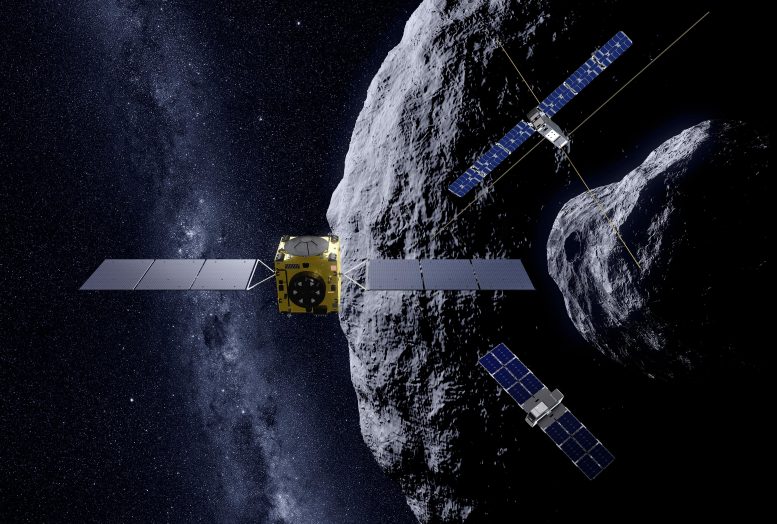
    Hera Mission Family Portrait
    Hera mission family portrait. Credit: ESA/Science Office

    The ESTEC Test Center is the largest satellite test facility in Europe, equipped with facilities to simulate every aspect of the launch and space environment. Hera’s spacecraft-level test campaign is forecast to begin in the autumn.

    Hera will be equipped with automated guidance, navigation, and control to allow it to safely navigate the double-asteroid system, akin in function to a self-driving car. Its desk-sized body will carry instruments including an optical Asteroid Framing Camera, supplemented by thermal and spectral imagers, as well as a laser altimeter for surface mapping. Hera is also three spacecraft in one, because it will also deliver a pair of shoebox-sized CubeSats to the vicinity of Dimorphos.

    The Juventas CubeSat will perform the first-ever radar probe of an asteroid interior, while also carrying a gravimeter and accelerometer to measure the body’s ultra-low gravity and surface mechanical response. The other CubeSat, Milani – named after the mission’s original inventor – will perform near-infrared spectral imaging and sample asteroid dust.

    The CubeSat pair will remain in contact with their Hera mothership and each other through a novel inter-satellite link system, to build up experience of overseeing multiple spacecraft in exotic near-weightlessness, before eventually touching down on Dimorphos.

    NASA’s DART and ESA’s Hera missions have been supported by the same international teams of scientists and astronomers, and take place through an international collaboration called AIDA – the Asteroid Impact and Deflection Assessment. Planetary defense has no borders and is a great example of what international collaboration can achieve.

    Never miss a breakthrough: Join the SciTechDaily newsletter.
    Follow us on Google and Google News.

    Asteroid ESA's Hera European Space Agency Planetary Defense
    Share. Facebook Twitter Pinterest LinkedIn Email Reddit

    Related Articles

    Planetary Defense Mission: Hera Launches for Asteroid Crash Scene Investigation

    ESA’s Planetary Defense Mission: Hera Asteroid Spacecraft Is Complete

    ESA’s Hera Mission: Mini-Radar Will Probe Asteroid’s Heart

    How Asteroids Go From Threat to No Sweat [Video]

    Catching DART Asteroid Deflection Mission’s First Words

    Huge Region of Europe Destroyed by Asteroid Impact in Planetary Defense Exercise

    Hera Team Congratulates Japan Aerospace Exploration Agency on Hayabusa2’s Asteroid Sample Return

    ESA’s Ambitious Hera Planetary Defense Mission Awards $153 Million Contract

    Asteroid Deflection Planetary Defense Mission Target: “Dimorphos”

    Leave A Reply Cancel Reply

    • Facebook
    • Twitter
    • Pinterest
    • YouTube

    Don't Miss a Discovery

    Subscribe for the Latest in Science & Tech!

    Trending News

    Your Blood Pressure Reading Could Be Wrong Because of One Simple Mistake

    Astronomers Stunned by Ancient Galaxy With No Spin

    Physicists May Be on the Verge of Discovering “New Physics” at CERN

    Scientists Solve 320-Million-Year Mystery of Reptile Skin Armor

    Scientists Say This Daily Walking Habit May Be the Secret to Keeping Weight Off After Dieting

    New Therapy Rewires the Brain To Restore Joy in Depression Patients

    Giant Squid Detected off Western Australia in Stunning Deep-Sea Discovery

    Popular Sugar-Free Sweetener Linked to Liver Disease, Study Warns

    Follow SciTechDaily
    • Facebook
    • Twitter
    • YouTube
    • Pinterest
    • Newsletter
    • RSS
    SciTech News
    • Biology News
    • Chemistry News
    • Earth News
    • Health News
    • Physics News
    • Science News
    • Space News
    • Technology News
    Recent Posts
    • Scientists Reverse Stroke Damage Using Stem Cells in Breakthrough Study
    • Eating One Egg a Day Could Cut Alzheimer’s Risk by 27%
    • Hidden Warm Water Beneath Antarctica Could Rapidly Raise Global Sea Levels
    • Scientists Revive Ancient Chemistry Trick To Engineer Next-Generation Glass
    • Scientists Use AI To Supercharge Ultrafast Laser Simulations by More Than 250x
    Copyright © 1998 - 2026 SciTechDaily. All Rights Reserved.
    • Science News
    • About
    • Contact
    • Editorial Board
    • Privacy Policy
    • Terms of Use

    Type above and press Enter to search. Press Esc to cancel.