
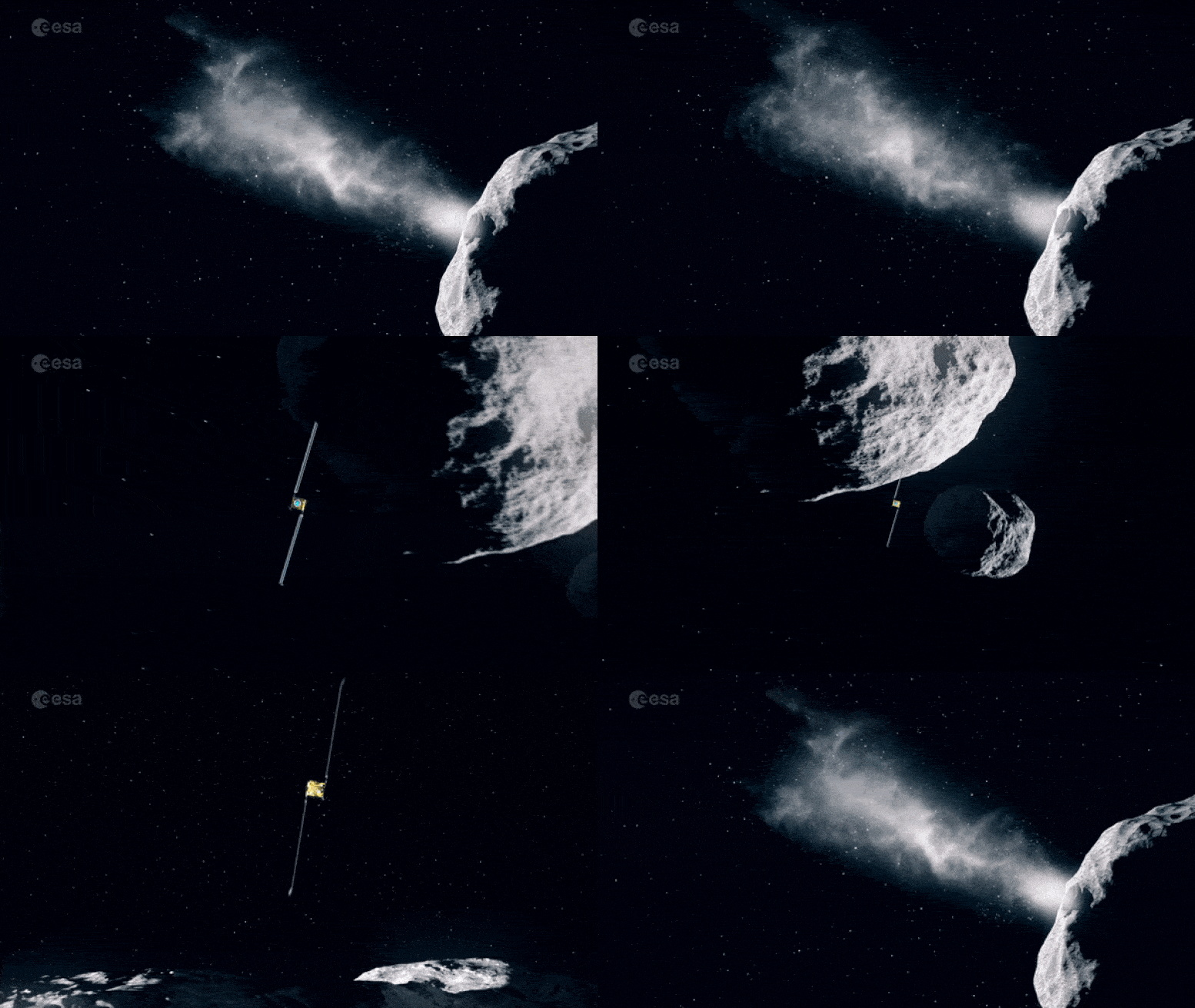
NASA’s First Planetary Defense Mission Succeeds
After 10 months of flying through space, NASA’s Double Asteroid Redirection Test (DART) successfully impacted its asteroid target on Monday, September 26, 2022. It was NASA’s first attempt to move an asteroid in space and the world’s first planetary defense technology demonstration.
Mission control at the Johns Hopkins Applied Physics Laboratory (APL) in Laurel, Maryland, announced the successful impact at 7:14 p.m. EDT (4:14 p.m. PDT).
As a part of NASA’s overall planetary defense strategy, DART’s collision with the asteroid Dimorphos demonstrates a feasible mitigation technique for protecting the planet from an Earth-bound asteroid or comet, if one were discovered.
“At its core, DART represents an unprecedented success for planetary defense, but it is also a mission of unity with a real benefit for all humanity,” said NASA Administrator Bill Nelson. “As NASA studies the cosmos and our home planet, we’re also working to protect that home, and this international collaboration turned science fiction into science fact, demonstrating one way to protect Earth.”
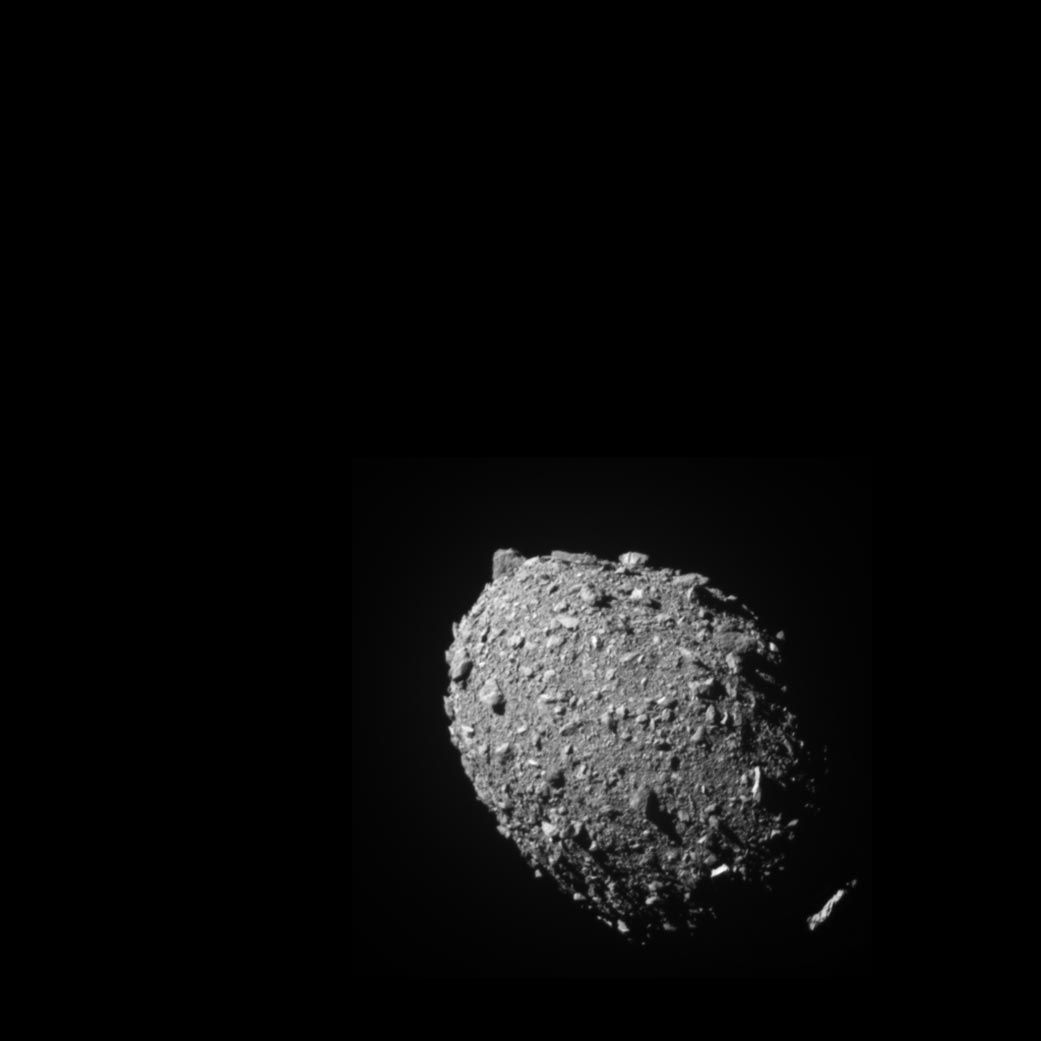
DART targeted the asteroid moonlet Dimorphos. It’s a small body just 530 feet (160 meters) in diameter that orbits a larger, 2,560-foot (780-meter) asteroid called Didymos. Neither asteroid poses a threat to Earth.
The mission’s one-way trip verified that NASA can successfully navigate a spacecraft to intentionally crash into an asteroid to deflect it. This technique is known as kinetic impact.
Now the investigation team will observe Dimorphos using ground-based telescopes to verify that DART’s impact altered the asteroid’s orbit around Didymos. Scientists expect the impact to shorten Dimorphos’ orbit by about 1%, or roughly 10 minutes. One of the primary purposes of the full-scale test is to precisely measure how much the asteroid was deflected.
This video shows the final five-and-a-half minutes of images leading up to the DART spacecraft’s intentional collision with asteroid Dimorphos. As it approached the asteroid, the DART spacecraft streamed these images from its DRACO camera back to Earth in real time. This replay movie is 10 times faster than reality, except for the last six images, which are shown at the same rate that the spacecraft returned them. Both Didymos and its moonlet Dimorphos are visible at the start of the video. At the end, Dimorphos fills the entire field of view. The final image in the movie shows a patch of Dimorphos that is 51 feet (16 meters) across. DART’s impact occurred during the transmission of the final image to Earth, resulting in a partial picture at the end of this movie. Didymos is roughly 2,500 feet (780 meters) in diameter; Dimorphos is about 525 feet (160 meters) in length. Credit: NASA/Johns Hopkins APL
“Planetary Defense is a globally unifying effort that affects everyone living on Earth,” said Thomas Zurbuchen. He is the associate administrator for the Science Mission Directorate at NASA Headquarters in Washington. “Now we know we can aim a spacecraft with the precision needed to impact even a small body in space. Just a small change in its speed is all we need to make a significant difference in the path an asteroid travels.”
The spacecraft only has a single instrument, the Didymos Reconnaissance and Asteroid Camera for Optical navigation (DRACO). However, together with a sophisticated guidance, navigation, and control system that works in tandem with Small-body Maneuvering Autonomous Real Time Navigation (SMART Nav) algorithms, DART was able to identify and distinguish between the two asteroids, targeting the smaller body.
These systems guided the 1,260-pound (570-kilogram) box-shaped spacecraft through the final 56,000 miles (90,000 kilometers) of space into Dimorphos, intentionally crashing into it at approximately 14,000 miles (22,530 kilometers) per hour to slightly slow the asteroid’s orbital speed. DRACO’s final images, obtained by the spacecraft seconds before impact, revealed the surface of Dimorphos in close-up detail.
Countdown to impact as NASA’s Double Asteroid Redirection Test (DART) attempts humanity’s first-ever test of planetary defense! The DART spacecraft will intentionally crash into asteroid Dimorphos at 7:14 p.m. ET on Monday, September 26, 2022 to see if kinetic force can change its orbit. Why? If this test is successful, the same technique could be used to deflect an Earth-threatening asteroid in the future, should one ever be discovered. Credit: NASA
CubeSat Companion LICIACube Captures the Impact
DART’s CubeSat companion Light Italian CubeSat for Imaging of Asteroids (LICIACube), deployed from the spacecraft fifteen days before impact. Provided by the Italian Space Agency, LICIACube’s mission was to capture images of DART’s impact and of the asteroid’s resulting cloud of ejected matter. In tandem with the images returned by DRACO, LICIACube’s images are expected to provide a view of the collision’s effects to help investigators better characterize the effectiveness of kinetic impact in deflecting an asteroid. However, LICIACube doesn’t carry a large antenna, so images will be downlinked to Earth one by one in the coming weeks.
“DART’s success provides a significant addition to the essential toolbox we must have to protect Earth from a devastating impact by an asteroid,” said Lindley Johnson, NASA’s Planetary Defense Officer. “This demonstrates we are no longer powerless to prevent this type of natural disaster. Coupled with enhanced capabilities to accelerate finding the remaining hazardous asteroid population by our next Planetary Defense mission, the Near-Earth Object (NEO) Surveyor, a DART successor could provide what we need to save the day.”
With the asteroid pair within 7 million miles (11 million kilometers) of Earth, a global team is using dozens of telescopes stationed around the world and in space to observe the asteroid system. Over the coming weeks, astronomers will characterize the ejecta produced and precisely measure Dimorphos’ orbital change to determine how effectively DART deflected the asteroid. The results will help validate and improve scientific computer models critical to predicting the effectiveness of this technique as a viable method for asteroid deflection.
“This first-of-its-kind mission required incredible preparation and precision, and the team exceeded expectations on all counts,” said APL Director Ralph Semmel. “Beyond the truly exciting success of the technology demonstration, capabilities based on DART could one day be used to change the course of an asteroid to protect our planet and preserve life on Earth as we know it.”
Around four years from now, the European Space Agency’s Hera project will conduct detailed surveys of both Dimorphos and Didymos, with a special focus on the crater left by DART’s collision and a precise measurement of Dimorphos’ mass.
Johns Hopkins APL manages the DART mission for NASA’s Planetary Defense Coordination Office as a project of the agency’s Planetary Missions Program Office.
See DART’s final images before DART’s impact.
Never miss a breakthrough: Join the SciTechDaily newsletter.
Follow us on Google and Google News.
2 Comments
jgbhjg
OK – I’m tryin’ to do the Math here and I’m a little confused.
1. Earth and Didymos are both orbiting the Sun, presumably traveling in the same direction, albeit not necessarily same speed.
2. We know Didymos will be at a certain place 11.2 million kms from Earth on 26 Sept 2022.
3. For DART to escape Earth’s gravitational pull it needed a minimum velocity of 40,200 km/h.
4. To travel 11.2 mill kms at escape velocity takes 278 hours or a little under 12 days.
5. Yet we send it on a 10 month, 85% of Earth orbit travel, to let DART ‘back up’ into the onrushing Didmous ‘moon’? (DART was traveling roughly the same speed as Earth in a nearly identical orbit, ie. 66000 mph or 107,000 km/h while Didymos must have been traveling at roughly 130,000 km/h to get the stated impact velocity of 22,530 km/h).
6. Surely a better strategy would have been to slingshot DART ‘behind’ the Earth, at a slower velocity after reaching escape velocity, so as to be in Didymos’s orbit when Earth again catches up to Didymos to best observe the collision?
7. This way the impact velocity would have been that of Didymos’s (near maximum) orbital speed plus DART’s reduced escape velocity resulting in something approaching 150,000km/h and not just 22,500 km/h.
Now THAT would have been one hell of a Bang!
Side note: The video of the impact was VERY misleading. We all got the impression Didymos was standing still and DART was rushing in to smash into it’s surface under a crushing approach speed.
In actual fact DART was running AWAY from Didymos as fast as it’s little rockets could send it and Didymos was the one doing the chasing/crashing into!!!
It was a little like a cyclist trying not to be run over by a maniac truck driver on a highway.