
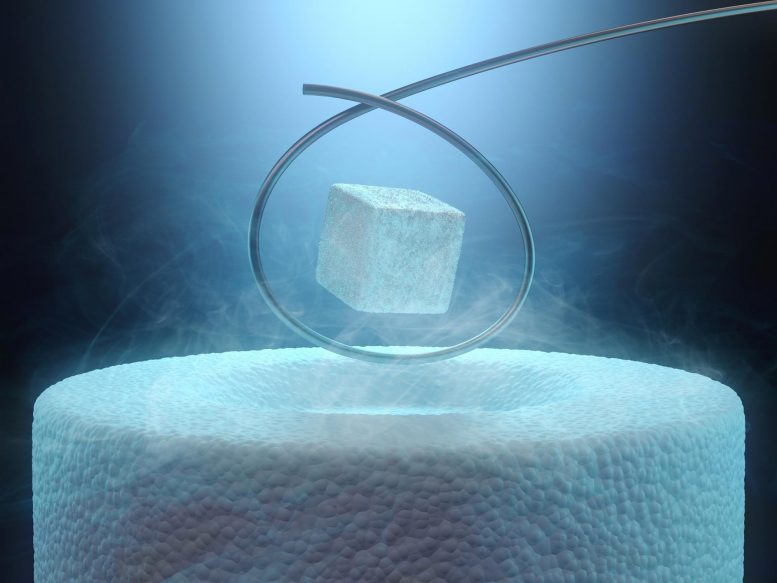
Rotation of electron spins in superconductors of atomic-scale thickness may be used to make qubits for quantum computing.
Superconductivity is known to be easily destroyed by strong magnetic fields. NIMS, Osaka University and Hokkaido University have jointly discovered that a superconductor with atomic-scale thickness can retain its superconductivity even when a strong magnetic field is applied to it. The team has also identified a new mechanism behind this phenomenon. These results may facilitate the development of superconducting materials resistant to magnetic fields and topological superconductors composed of superconducting and magnetic materials.
Superconductivity has been used in various technologies, such as magnetic resonance imaging (MRI) and highly sensitive magnetic sensors. Topological superconductors, a special type of superconductor, have been attracting great attention in recent years. They are able to retain quantum information for a long time and can be used in combination with magnetic materials to form qubits that may enable quantum computers to perform very complex calculations. However, superconductivity is easily destroyed by strong magnetic fields or magnetic materials in close proximity. It is therefore desirable to develop a topological superconducting material resistant to magnetic fields.
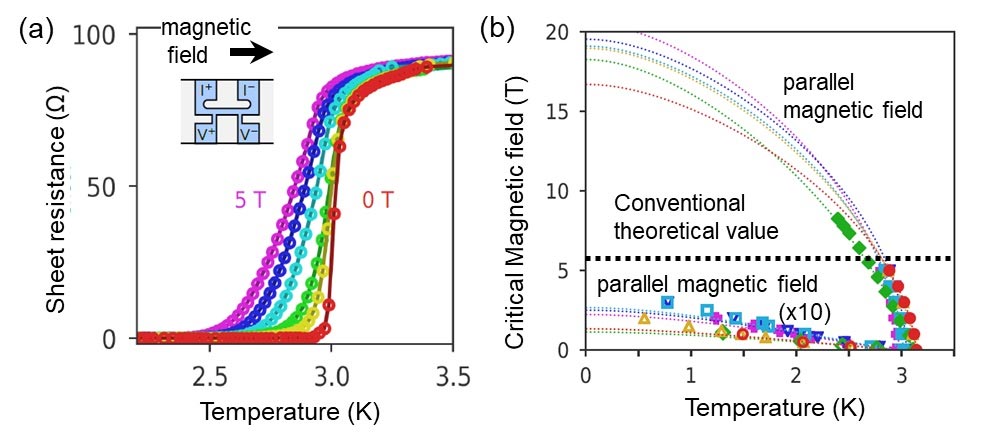
The research team recently fabricated crystalline films of indium, a common superconducting material, with atomic-scale thickness. The team then discovered a new mechanism that prevents the superconductivity of these films from being destroyed by a strong magnetic field. When a magnetic field is applied to a superconducting material, the magnetic field interacts with electron spins. It causes the electronic energy of the material to change and destroys its superconductivity. However, when a superconducting material is thinned to a two-dimensional atomic layer, the spin and the momentum of the electrons in the layer are coupled, causing the electron spins to frequently rotate. This offsets the effect of the changes in electronic energy induced by the magnetic field and thus preserves superconductivity. This mechanism can enhance the critical magnetic field — the maximum magnetic field strength above which superconductivity disappears — up to 16-20 Tesla, which is approximately triple the generally accepted theoretical value. It is expected to have a wide range of applications as it was observed for an ordinary superconducting material and does not require either special crystalline structures or strong electronic correlations.
Based on these results, we plan to develop superconducting thin films capable of resisting even stronger magnetic fields. We also intend to create a hybrid device composed of superconducting and magnetic materials that is needed for the development of topological superconductors: a vital component in next-generation quantum computers.
Reference: “Atomic-layer Rashba-type superconductor protected by dynamic spin-momentum locking” by Shunsuke Yoshizawa, Takahiro Kobayashi, Yoshitaka Nakata, Koichiro Yaji, Kenta Yokota, Fumio Komori, Shik Shin, Kazuyuki Sakamoto and Takashi Uchihashi, 5 March 2021, Nature Communications.
DOI: 10.1038/s41467-021-21642-1
This project was carried out by a research team led by Takashi Uchihashi (Group Leader, Surface Quantum Phase Materials Group, International Center for Materials Nanoarchitectonics, NIMS; also Visiting Professor Department of Condensed Matter Physics, Graduate School of Science, Hokkaido University), Shunsuke Yoshizawa (Senior Researcher, Nanoprobe Group, Research Center for Advanced Measurement and Characterization (RCAMC), NIMS), Koichiro Yaji (Research Associate, Institute for Solid State Physics, University of Tokyo; currently Senior Researcher, Synchrotron X-ray Group, RCAMC, NIMS) and Kazuyuki Sakamoto (Professor, Department of Applied Physics, Osaka University).
This study was conducted in conjunction with other projects, including the one entitled “Real spatial spectroscopic measurement of superconducting state where spatiotemporal inverted symmetry is broken” supported by the JSPS Grant-in-Aid for Scientific Research (B) (project number: 18H01876).
Never miss a breakthrough: Join the SciTechDaily newsletter.
Follow us on Google and Google News.
1 Comment
See ROOM TEMPERATURE SUPERCONDUCTORS at aesopinstitute.org for polymer thin films that may be of interest. They were tested in magnetic fields up to 9 or 10 Tesla at the Bar Ilan University in Israel some years ago. That was the limit of their equipment.