
This three minute video from NASA details and explains the journey of sungrazing comets, like comet ISON, as they round the sun.
Comet ISON, which will round the sun on November 28, 2013, at a distance of just 730,000 miles from the sun, is what’s known as a sungrazing comet, due to its close approach. Credit: NASA/Goddard Space Flight Center
A comet’s journey through the solar system is perilous and violent. A giant ejection of solar material from the sun could rip its tail off. Before it reaches Mars — at some 230 million miles away from the sun — the radiation of the sun begins to boil its water, the first step toward breaking apart. And, if it survives all this, the intense radiation and pressure as it flies near the surface of the sun could destroy it altogether.
Right now, Comet ISON is making that journey. It began its trip from the Oort cloud region of our solar system and is now traveling toward the sun. The comet will reach its closest approach to the sun on Thanksgiving Day — November 28, 2013 — skimming just 730,000 miles above the sun’s surface. If it comes around the sun without breaking up, the comet will be visible in the Northern Hemisphere with the naked eye, and from what we see now, ISON is predicted to be a particularly bright and beautiful comet.
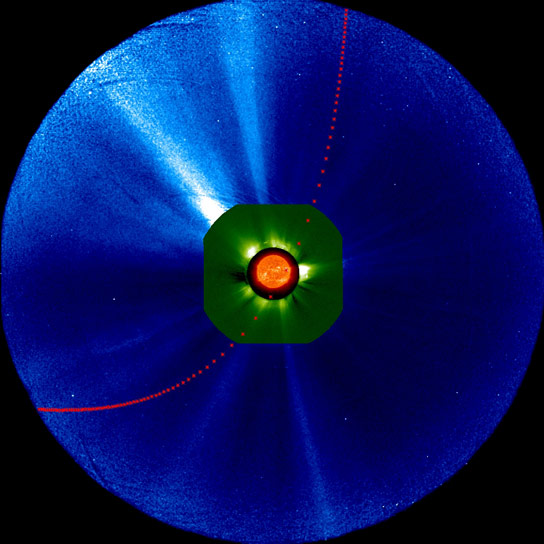
Cataloged as C/2012 S1, Comet ISON was first spotted 585 million miles (940 million kilometers) away in September 2012. This is its very first trip around the sun, which means it is still made of pristine matter from the earliest days of the solar system’s formation, its top layers never having been lost by a trip near the sun. Scientists will point as many ground-based observatories as they can and at least 15 space-based assets towards the comet along the way, in order to learn more about this time capsule from when the solar system first formed.
Even if the comet does not survive, tracking its journey will help scientists understand what the comet is made of, how it reacts to its environment, and what this explains about the origins of the solar system. Closer to the sun, watching how the comet and its tail interact with the vast solar atmosphere can teach scientists more about the sun itself.
NASA has initiated a Comet ISON Observing Campaign to facilitate a massive global observation campaign incorporating both space-based and ground-based telescopes and encouraging citizen scientists and both professional and amateur astronomers to participate.
Read on for a timeline of observations expected of Comet ISON on its perilous journey.
| Date | Comet ISON Journey |
|---|---|
| 10,000 years ago | The comet began its journey from the Oort cloud, a swath of icy objects that orbit far beyond Neptune. This is Comet ISON’s first trip through the inner solar system. |
| September 2012 | Comet ISON was first discovered by Russian astronomers, Vitali Nevski and Artyom Novichonok, using the International Scientific Optical Network in Kislovodsk, Russia. |
| Jan. 17–18, 2013 | NASA’s Deep Impact acquired images of Comet ISON. The observations were unable to detect whether carbon monoxide or carbon dioxide was present. |
| January-March 2013 | For two months, NASA’s Swift mission observed ISON when it was around 460 million miles (740 million kilometers) away from the sun. Observations showed that ISON was shedding about 112,000 pounds (50,800 kilograms) of dust and 130 pounds (59 kilograms) of water every minute. The lower amount of water represents the fact that the comet was too far away from the sun for its water ice to have begun evaporating. Instead, other materials such as carbon dioxide or carbon monoxide ice were boiling off. |
| April-July 2013 | NASA’s Hubble Space Telescope observed Comet ISON at 386 million miles (621 million kilometers) away from the sun on April 10, 2013. Preliminary Hubble observations provided surprising results: The nucleus of the comet appeared to be no larger than 3 to 4 miles (4.8 to 6.4 kilometers) across. Since the comet was so bright and so active, scientists had assumed the nucleus was larger. Hubble found the dusty coma, or head of the comet, to be around 3,100 miles (50,000 kilometers) across and the tail to be more than 57,000 miles (92,000 kilometers) long. HST also observed the comet on May 2 and May 7, and produced an upper limit on how fast the comet was producing carbon monoxide. Hubble observed the comet again in early July. |
| June 13, 2013 | NASA’s Spitzer Space Telescope observed Comet ISON at 310 million miles (500 million kilometers) away from the Sun. The data are still being processed and no results have been announced yet. |
| July-August 2013 | Sometime in late July or early August, the comet will pass what’s called the frost line, some 230 to 280 million miles (370 to 450 million kilometers) away from the sun, when it will feel enough radiation from the sun that water will begin to evaporate and the comet will appear brighter. Some comets have broken up upon crossing the frost line. |
| August-November 2013 | Beginning in August, astronomers will be able to observe the comet through ground-based telescopes once again. From early June through late August, ISON was almost directly behind the sun as viewed from Earth, and thus could not be observed from the ground. |
| September 2013 | In September, the comet will be visible near dawn in the Southern Hemisphere with binoculars. |
| September 17-October 15, 2013 | Launch window for the Balloon Rapid Response for ISON, or BRRISON. This balloon, which with its payload will be 671 feet (205 meters) tall, taller than the Washington Monument, will launch from NASA’s Scientific Balloon Flight Facility in Fort Sumner, N.M. for a single day, carrying a 2.6-foot telescope and other science equipment. It will soar up to 23 miles (37 kilometers) above Earth’s surface, where it can observe the comet largely unhindered by Earth’s atmosphere.BRRISON will observe ISON in the near-infrared, near-ultraviolet, and visible wavelength ranges, and will measure the ratio of carbon dioxide to water emissions from the comet. This ratio will be a vital diagnostic of the comet’s origins. These emissions are blocked by Earth’s atmosphere and cannot be measured from the ground. BRRISON is an unprecedented quick-reaction project to take advantage of the opportunity presented by the discovery of comet ISON, and is the first NASA Planetary Science Division balloon mission to observe a comet. |
| October 2013 | Mars Curiosity and Opportunity will have a view of ISON in October, with October 1, 2013, being the comet’s closest approach to Mars. Comet ISON will be close enough to the sun, as of October 10 that it will be visible by an instrument with an extremely wide view on one of the solar observatories: the HI 2 instrument on one of NASA’s Solar Terrestrial Relations Observatories, STEREO-A. At that point the comet will be around 94.5 million miles (152 million kilometers) away from the sun. Additional Hubble observations are planned to provide new estimates on nucleus size and composition as well as to search for any fragments that have broken off. |
| November 2013 (November 16-19 and 21-26) | Comet ISON will be visible to MESSENGER, which is near Mercury. The closest approach will be on November 19. Once the comet passes Mercury, it will be on the most perilous part of its journey. The intense radiation of the sun causes material to evaporate quickly off the comet. Moreover, the very pressure of the solar particles on the comet can cause it to break up. A slew of space and ground-based telescopes will watch the comet as it makes its slingshot around the sun. |
| November 18-24, 2013 | Launch window for NASA’s FORTIS (short for Far-ultraviolet Off Rowland-Circle for Imaging and Spectroscopy) sounding rocket, which will measure ultraviolet light from Comet ISON as it nears the sun. Such light can help scientists determine the production rate of volatile chemicals leaving the comet surface and also can be used to search for previously undetected types of atoms or molecules on the comet. |
| November 21-30, 2013 | As of November 21, Comet ISON will begin to enter the fields of view of NASA’s space-based solar observatories. Comet ISON will be viewed first in what’s called coronagraphs, images that block the brighter view of the sun itself in order to focus on the solar atmosphere, the corona. Such images – from STEREO and the joint European Space Agency/NASA Solar Heliospheric Observatory, or SOHO — will likely be quite visually compelling. NASA’s Solar Dynamics Observatory, or SDO, will view the comet for a few hours around perihelion. SDO’s imagery should be detailed enough to gather information about how the comet evolves through the radiation and pressure of the sun’s atmosphere.All of these observatories will have different views. STEREO-A will be the only one that sees the comet transit across the face of the sun. In SDO’s view, the comet will appear to travel above the sun. The exact dates of view for these observatories is as follows:
In addition, ground-based solar telescopes – observing in optical, infrared and radio wavelengths – will all be able to observe the comet during perihelion. Such observations will provide additional information about the composition of the comet and how material evaporates off it, fueling the dusty cloud that surrounds the nucleus. One last solar effect could impact the comet at this stage in its journey. If the sun coincidentally sends out a giant cloud of solar particles, known as a coronal mass ejection, at the right time and direction to pass the comet, it could pull the comet’s tail right off. |
| December 2013 – January 2014 | If Comet ISON survives its trip around the sun, there’s a good chance that it will be incredibly bright and easily visible with the naked eye in the Northern Hemisphere. In early December, it will be seen in the morning, low on the horizon to the east-southeast. In late December and early January, it will be visible all night long. |
| December 26, 2013 | Closest approach to Earth, approximately 40 million miles (64 million kilometers) away. |
Never miss a breakthrough: Join the SciTechDaily newsletter.
Follow us on Google and Google News.