
Close Menu
    Facebook X (Twitter) Instagram
    SciTechDaily
    • Biology
    • Chemistry
    • Earth
    • Health
    • Physics
    • Science
    • Space
    • Technology
    Facebook X (Twitter) Pinterest YouTube RSS
    SciTechDaily
    Home»Space»Astronomers Measure a Black Hole’s “Point of No Return”
    Space

    Astronomers Measure a Black Hole’s “Point of No Return”

    By Harvard-Smithsonian Center for Astrophysics; Harvard GazetteOctober 2, 2012No Comments4 Mins Read
    Facebook Twitter Pinterest Telegram LinkedIn WhatsApp Email Reddit
    Share
    Facebook Twitter LinkedIn Pinterest Telegram Email Reddit
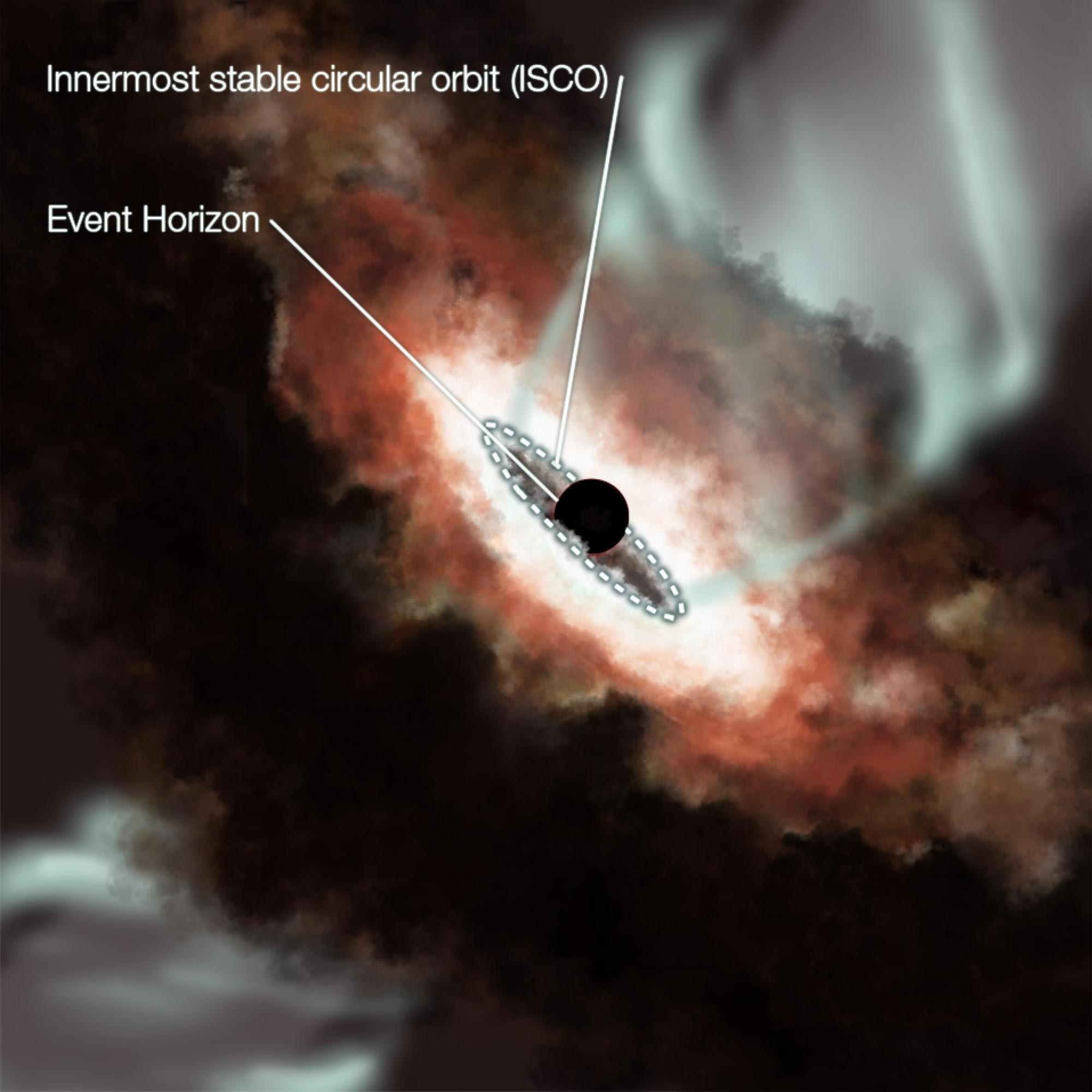
    Region Immediately Surrounding a Supermassive Black Hole
    This artist’s conception shows the region immediately surrounding a supermassive black hole (the black spot near the center). The black hole is orbited by a thick disk of hot gas. The center of the disk glows white-hot, while the edge of the disk is shown in dark silhouette. Magnetic fields channel some material into a jet-like outflow – the greenish wisps that extend to upper right and lower left. A dotted line marks the innermost stable circular orbit, which is the closest distance that material can orbit before becoming unstable and plunging into the black hole. Credit: Chris Fach (Perimeter Institute & University of Waterloo)

    For the first time, international team of astronomers has measured a black hole’s “point of no return,” the closest distance that matter can approach before being irretrievably pulled into the black hole.

    Using a continent-spanning telescope, an international team of astronomers has peered to the edge of a black hole at the center of a distant galaxy. For the first time, they have measured the black hole’s “point of no return” — the closest distance that matter can approach before being irretrievably pulled into the black hole.

    A black hole is a region in space where the pull of gravity is so strong that nothing, not even light, can escape. Its boundary is known as the event horizon.

    “Once objects fall through the event horizon, they’re lost forever,” says lead author Shep Doeleman, assistant director at the MIT Haystack Observatory and research associate at the Harvard-Smithsonian Center for Astrophysics (CfA). “It’s an exit door from our universe. You walk through that door, you’re not coming back.”

    The team examined the black hole at the center of a giant elliptical galaxy called Messier 87 (M87), which is located about 50 million light-years from Earth. The black hole is 6 billion times more massive than the sun. It’s surrounded by an accretion disk of gas swirling toward the black hole’s maw. Although the black hole is invisible, the accretion disk is hot enough to glow.

    “Even though this black hole is far away, it’s so big that its apparent size on the sky is about the same as the black hole at the center of the Milky Way,” says co-author Jonathan Weintroub of the CfA. “That makes it an ideal target for study.”

    According to Einstein’s theory of general relativity, a black hole’s mass and spin determine how close material can orbit before becoming unstable and falling in toward the event horizon. The team was able to measure this innermost stable orbit and found that it’s only 5.5 times the size of the black hole’s event horizon. This size suggests that the accretion disk is spinning in the same direction as the black hole.

    Galaxy M87 Cosmic Searchlight
    Streaming out from the center of the galaxy M87 like a cosmic searchlight is one of nature’s most amazing phenomena, a black-hole-powered jet of electrons and other sub-atomic particles traveling at nearly the speed of light. In this Hubble telescope image, the blue jet contrasts with the yellow glow from the combined light of billions of unseen stars and the yellow, point-like clusters of stars that make up this galaxy. Lying at the center of M87, the monstrous black hole has swallowed up matter equal to 2 billion times our Sun’s mass. M87 is 50 million light-years from Earth. Credit: The Hubble Heritage Team (STScI/AURA) and NASA/ESA

    The observations were made by linking together radio telescopes in Hawaii, Arizona, and California to create a virtual telescope called the Event Horizon Telescope, or EHT. The EHT is capable of seeing details 2,000 times finer than the Hubble Space Telescope.

    The team plans to expand its telescope array, adding radio dishes in Chile, Europe, Mexico, Greenland, and the South Pole, in order to obtain even more detailed pictures of black holes in the future.

    The work is published in the journal Science.

    Reference: “Jet-Launching Structure Resolved Near the Supermassive Black Hole in M87” by Sheperd S. Doeleman, Vincent L. Fish, David E. Schenck, Christopher Beaudoin, Ray Blundell, Geoffrey C. Bower, Avery E. Broderick, Richard Chamberlin, Robert Freund, Per Friberg, Mark A. Gurwell, Paul T. P. Ho, Mareki Honma, Makoto Inoue, Thomas P. Krichbaum, James Lamb, Abraham Loeb, Colin Lonsdale, Daniel P. Marrone, James M. Moran, Tomoaki Oyama, Richard Plambeck, Rurik A. Primiani, Alan E. E. Rogers, Daniel L. Smythe, Jason SooHoo, Peter Strittmatter, Remo P. J. Tilanus, Michael Titus, Jonathan Weintroub, Melvyn Wright, Ken H. Young and Lucy M. Ziurys, 27 September 2012, Science.
    DOI: 10.1126/science.1224768

    Never miss a breakthrough: Join the SciTechDaily newsletter.
    Follow us on Google and Google News.

    Astronomy Astrophysics Black Hole Harvard University Harvard-Smithsonian Center for Astrophysics
    Share. Facebook Twitter Pinterest LinkedIn Email Reddit

    Related Articles

    Black Hole Lights Up Years After Ripping Star to Shreds – “We’ve Never Seen Anything Like This Before”

    Scientists Have Spotted the Farthest Galaxy Ever – It May Be Home to the Oldest Stars in the Universe

    Astronomers Discover Four Enormous Bubbles Caused by Giant Black Holes

    Astronomers Spy Quartet of Enormous Cavities From Giant Black Holes

    Astronomers Use “X-Ray Magnifying Glass” To Enhance View of Distant Black Holes

    Astronomers Spot Unusual, Enormous Rings Around a Black Hole

    Telescopes Unite in Unprecedented Observations of Famous Black Hole Across the Entire Electromagnetic Spectrum

    Massive X-ray Jet – Extending for 160,000 Light-Years – Spied From Supermassive Black Hole in Early Universe

    Astronomers Detect a Supermassive Black Hole on the Move – Unusual Motion Thus Far Unexplained

    Leave A Reply Cancel Reply

    • Facebook
    • Twitter
    • Pinterest
    • YouTube

    Don't Miss a Discovery

    Subscribe for the Latest in Science & Tech!

    Trending News

    Largest-Ever Study Finds Medicinal Cannabis Ineffective for Anxiety, Depression, PTSD

    250-Million-Year-Old Egg Solves One of Evolution’s Biggest Mysteries

    Living With Roommates Might Be Changing Your Gut Microbiome Without You Knowing

    Century-Old Cleaning Chemical Linked to 500% Increased Risk of Parkinson’s Disease

    What if Your Memories Never Happened? Physicists Take a New Look at the Boltzmann Brain Paradox

    One of the Universe’s Largest Stars May Be Getting Ready To Explode

    Scientists Discover Enzyme That Could Supercharge Ozempic-Like Weight Loss Drugs

    Popular Sweetener Linked to DNA Damage – “It’s Something You Should Not Be Eating”

    Follow SciTechDaily
    • Facebook
    • Twitter
    • YouTube
    • Pinterest
    • Newsletter
    • RSS
    SciTech News
    • Biology News
    • Chemistry News
    • Earth News
    • Health News
    • Physics News
    • Science News
    • Space News
    • Technology News
    Recent Posts
    • Challenging the Narrative: New Study Shows U.S. Life Expectancy Is Rising Across All States
    • Mystery Illness Kills 5 in Burundi As Doctors Scramble for Answers
    • Bone-Strengthening Discovery Could Reverse Osteoporosis
    • The Most Elusive Number in Physics Just Got Even More Mysterious
    • Scientists Uncover Hidden Trigger Behind Stem Cell Aging
    Copyright © 1998 - 2026 SciTechDaily. All Rights Reserved.
    • Science News
    • About
    • Contact
    • Editorial Board
    • Privacy Policy
    • Terms of Use

    Type above and press Enter to search. Press Esc to cancel.