
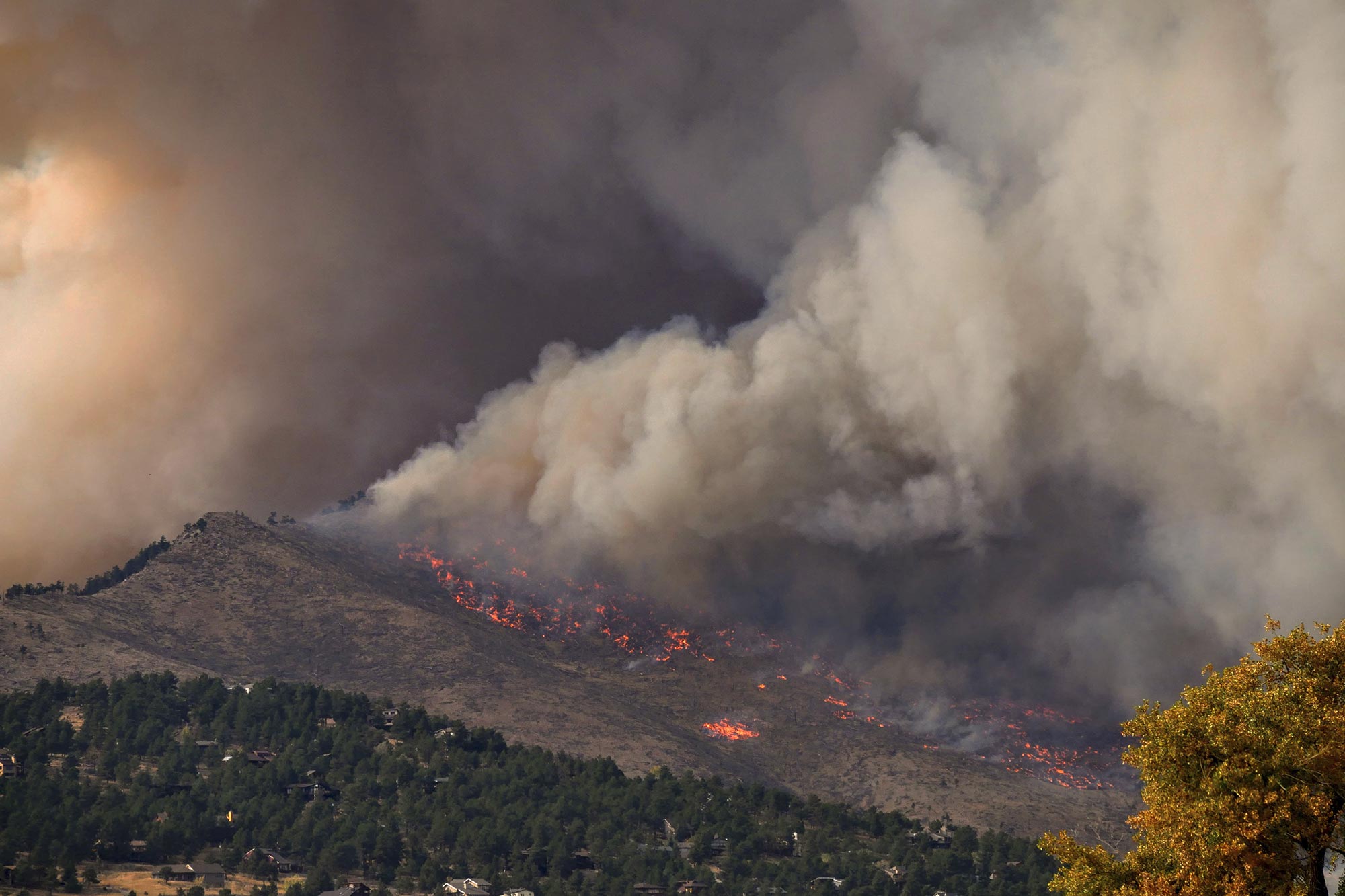
Rising Temperatures and Risky Development Contribute to Heightened Exposure to Earthquakes, Flooding, Tornadoes, Hurricanes and Wildfire
More than half of the structures in the contiguous United States are exposed to potentially devastating natural hazards—such as floods, tornadoes and wildfires—according to a new study in the AGU journal Earth’s Future, which publishes interdisciplinary research on the past, present and future of our planet and its inhabitants.
Increasing temperatures and environmental changes contribute to this trend, and the research also shines the light on another culprit: the way humans develop open land, towns and cities.
“We know that climate change is increasing the risk of damage from some natural hazards,” said Virginia Iglesias, a research scientist with the University of Colorado Boulder Earth Lab and lead author of the paper. “But are losses also increasing because of the way that we are developing our cities, our towns?”
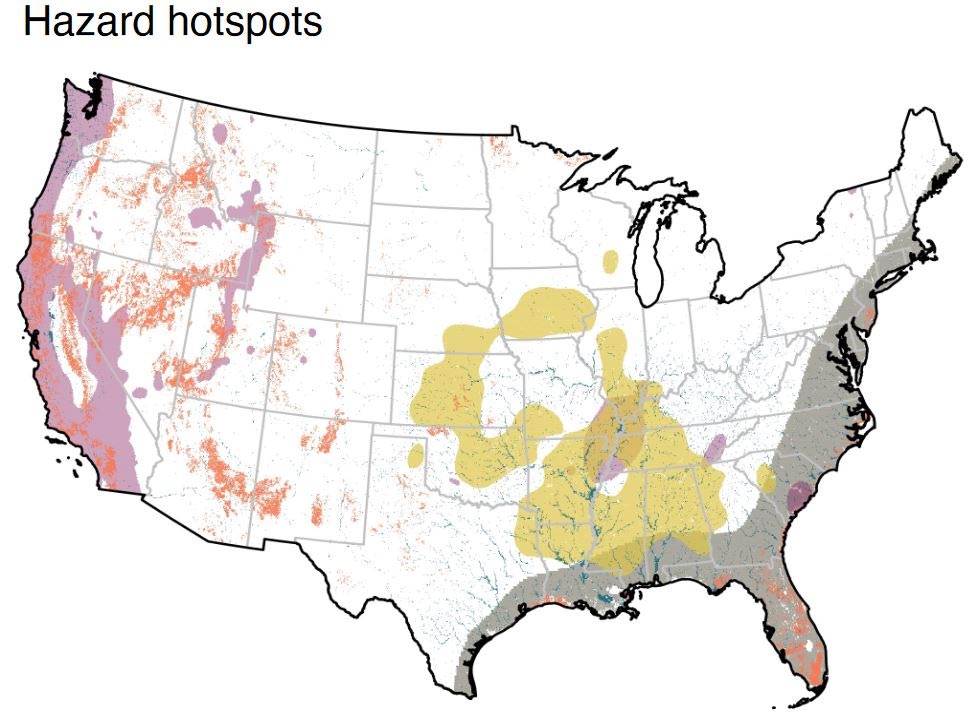
Yes, the new analysis found. To evaluate the impact of development on natural hazard risk, Iglesias and her colleagues built maps of earthquake, flood, hurricane, tornado and wildfire hazards and compared them to a unique dataset of historical land-use derived from Zillow’s housing and property database. The team identified natural hazard “hotspots” by mapping where the probability or magnitude of an individual natural hazard event fell in the top 10 percent.
“Since development patterns drive exposure and loss, more detailed mapping can improve national-scale risk assessments,” Iglesias said. “This study fills a gap by exploring changes in hazard exposure across the country, at fine resolution, for multiple hazards, and over long periods.”
Development Outpaces Safety
The study shows that 57% of the structures in the contiguous United States are in natural hazard hotspots; these hotspots make up only about a third of the total land. About 1.5 million structures are in hotspots of two or more natural hazards. Despite a national slowdown in development over the last decade, the number of structures in natural hazard hotspots is still increasing, the authors found.
In some hotspots, people have built protections like levees and floodwalls, the authors noted in the new assessment. This becomes an interesting question for further research: can that infrastructure protect properties from hazardous events in the future?
The study also investigated regional development patterns that affect hazard risk. In hurricane and earthquake hotspots, for example, the primary driver for an increase in risk was the fact that people were adding buildings, homes, and other structures to already developed areas in cities and suburbs. In wildfire, flood, and tornado hotspots, it was the expansion of new buildings in rural areas and wildlands that increased risk of damage.
Recommendations for Risk Assessment and Policy
Iglesias and her colleagues suggest that local decision makers could use the methods innovated in this study to improve risk assessments in their purview and to better understand the socio-economic variables that might increase the risk exposure of neighborhoods or communities.
“Vulnerability matters. There’s evidence that natural disasters exacerbate socioeconomic inequality,” Iglesias said. “If we want to make decisions that effectively increase the ability of communities to cope with natural hazards, we need to know where vulnerable populations live, and the specific hazards they’re exposed to.”
Reference: “Risky Development: Increasing Exposure to Natural Hazards in the United States” by Virginia Iglesias, Anna E. Braswell, Matthew W. Rossi, Maxwell B. Joseph, Caitlin McShane, Megan Cattau, Michael J. Koontz, Joe McGlinchy, R. Chelsea Nagy, Jennifer Balch, Stefan Leyk and William R. Travis, 8 June 2021, Earth’s Future.
DOI: 10.1029/2020EF001795
Authors:
- Virginia Iglesias, Anna E. Braswell, Matthew W. Rossi, Maxwell B. Joseph: Earth Lab, Cooperative Institute for Research in Environmental Sciences (CIRES), University of Colorado, Boulder, Colorado, USA;
- Caitlin McShane: Department of Geography, University of Colorado, Boulder, Colorado, USA;
- Megan Cattau: Human‐ Environment Systems, Boise State University, Boise, Idaho, USA;
- Michael J. Koontz, Joe McGlinchy, R. Chelsea Nagy: Earth Lab, Cooperative Institute for Research in Environmental Sciences (CIRES), University of Colorado, Boulder, Colorado, USA;
- Jennifer Balch: Earth Lab, Cooperative Institute for Research in Environmental Sciences (CIRES), and Department of Geography, University of Colorado, Boulder, Colorado, USA;
- Stefan Leyk: Earth Lab, Cooperative Institute for Research in Environmental Sciences (CIRES), University of Colorado, Boulder, Colorado, USA;
- William R. Travis: Earth Lab, Cooperative Institute for Research in Environmental Sciences (CIRES), and Department of Geography, University of Colorado, Boulder, Colorado, USA.
Never miss a breakthrough: Join the SciTechDaily newsletter.
Follow us on Google and Google News.
1 Comment
“RISING TEMPERATURES and Risky Development Contribute to Heightened Exposure to EARTHQUAKES, Flooding, Tornadoes, Hurricanes and Wildfire.
We should be afraid — very afraid — of thermo-seismicity!
Seriously, a very weak case is made for the role of climate change in ANY of these risks, except possibly floods. Although, it is more likely that the locations of flooding are shifting, rather than increasing universally. However, the obligatory “climate change” got included, increasing the probability of being published.