
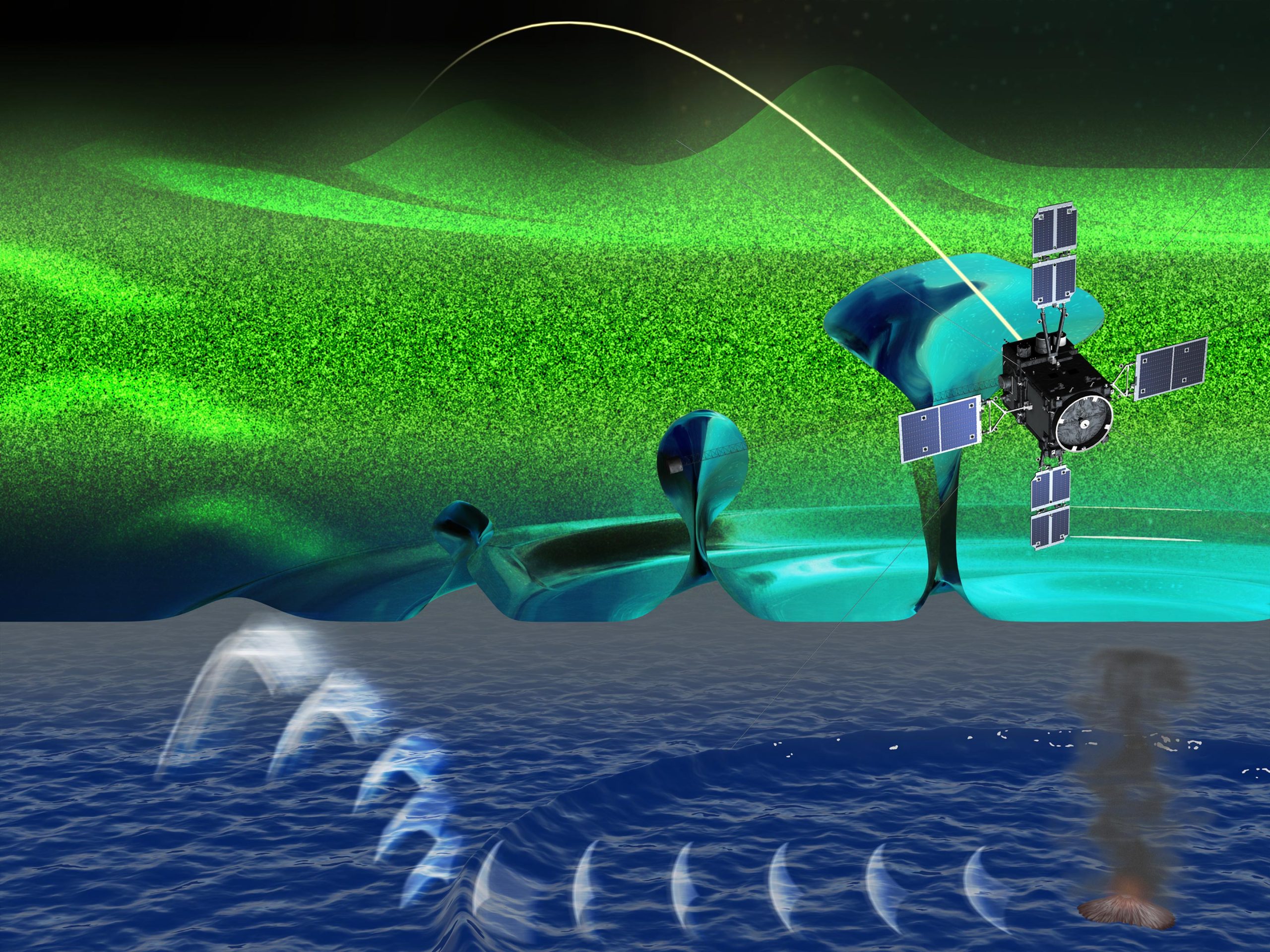
Research shows that volcanic eruptions can create plasma bubbles in the ionosphere, significantly disrupting satellite communication. These findings prompt revisions to the current models on atmospheric and ionospheric interactions.
An international team has used satellite- and ground-based ionospheric observations to demonstrate that an air pressure wave triggered by volcanic eruptions could produce an equatorial plasma bubble (EPB) in the ionosphere, severely disrupting satellite-based communications. Their findings will be published today (May 22) in the journal Scientific Reports.
The ionosphere is the region of the Earth’s upper atmosphere where molecules and atoms are ionized by solar radiation, creating positively charged ions. The area with the highest concentration of ionized particles is called the F-region, an area 150 to 800 km (90 to 500 mi) above the Earth’s surface. The F-region plays a crucial role in long-distance radio communication, reflecting and refracting radio waves used by satellite and GPS tracking systems back to the Earth’s surface.
These important transmissions can be disrupted by irregularities in the F-region. During the day, the ionosphere is ionized by the Sun’s ultraviolet radiation, creating a density gradient of electrons with the highest density near the equator. However, disruptions to this, such as the movement of plasma, electric fields, and neutral winds, can cause the formation of a localized irregularity of enhanced plasma density. This region can grow and evolve, creating a bubble-like structure called an EPB. EPB can delay radio waves and degrade the performance of GPS.
Volcanic Eruptions and Ionospheric Disruptions
Since these density gradients can be affected by atmospheric waves, it has long been hypothesized that they are formed by terrestrial events such as volcanic activity. For an international team led by Designated Assistant Professor Atsuki Shinbori (he, him) and Professor Yoshizumi Miyoshi (he, him) of the Institute for Space–Earth Environmental Research (ISEE), Nagoya University, in collaboration with NICT, The University of Electro-Communications, Tohoku University, Kanazawa University, Kyoto University and ISAS, the Tonga volcano eruption offered them a perfect opportunity to test this theory.
The Tonga volcano eruption was the biggest submarine eruption in history. This allowed the team to test their theory using the Arase satellite to detect EPB occurrences, the Himawari-8 satellite to check the initial arrival of air pressure waves and ground-based ionospheric observations to track the motion of the ionosphere. They observed an irregular structure of the electron density across the equator that occurred after the arrival of pressure waves generated by the volcanic eruption.
“The results of this study showed EPBs generated in the equatorial to low-latitude ionosphere in Asia in response to the arrival of pressure waves caused by undersea volcanic eruptions off Tonga,” Shinbori said.
Unexpected Early Ionospheric Disturbances
The group also made a surprising discovery. For the first time, they showed that ionospheric fluctuations start a few minutes to a few hours earlier than the atmospheric pressure waves involved in the generation of plasma bubbles. This could have important implications because it suggests that the long-held model of geosphere-atmosphere-cosmosphere coupling, which states that ionospheric disturbances only happen after the eruption, needs revision.
“Our new finding is that the ionospheric disturbances are observed several minutes to hours before the initial arrival of the shock waves triggered by the Tonga volcanic eruption,” Shinbori said. “This suggests that the propagation of the fast atmospheric waves in the ionosphere triggered the ionospheric disturbances before the initial arrival of the shock waves. Therefore, the model needs to be revised to account for these fast atmospheric waves in the ionosphere.”
They also found that the EPB extended much further than predicted by the standard models. “Previous studies have shown that the formation of plasma bubbles at such high altitudes is a rare occurrence, making this a very unusual phenomenon,” Shinbori said. “We found that the EPB formed by this eruption reached space even beyond the ionosphere, suggesting that we should pay attention to the connection between the ionosphere and the cosmosphere when extreme natural phenomenon, such as the Tonga event, occur.”
“The results of this research are significant not only from a scientific point of view but also from the point of view of space weather and disaster prevention,” he said. “In the case of a large-scale event, such as the Tonga volcano eruption, observations have shown that a hole in the ionosphere can form even under conditions that are considered unlikely to occur under normal circumstances. Such cases have not been incorporated into space weather forecast models. This study will contribute to the prevention of satellite broadcasting and communication failures associated with ionospheric disturbances caused by earthquakes, volcanic eruptions, and other events.”
Reference: “Generation of equatorial plasma bubble after the 2022 Tonga volcanic eruption” by Atsuki Shinbori, Takuya Sori, Yuichi Otsuka, Michi Nishioka, Septi Perwitasari, Takuo Tsuda, Atsushi Kumamoto, Fuminori Tsuchiya, Shoya Matsuda, Yoshiya Kasahara, Ayako Matsuoka, Satoko Nakamura, Yoshizumi Miyoshi and Iku Shinohara, 22 May 2023, Scientific Reports.
DOI: 10.1038/s41598-023-33603-3
Never miss a breakthrough: Join the SciTechDaily newsletter.
Follow us on Google and Google News.