
Breathing? Thank Volcanoes, Tectonics and Bacteria
Earth’s breathable atmosphere is key for life, and a new study suggests that the first burst of oxygen was added by a spate of volcanic eruptions brought about by tectonics.
The study by geoscientists at Rice University offers a new theory to help explain the appearance of significant concentrations of oxygen in Earth’s atmosphere about 2.5 billion years ago, something scientists call the Great Oxidation Event (GOE). The research appears this week in the journal Nature Geoscience.
“What makes this unique is that it’s not just trying to explain the rise of oxygen,” said study lead author James Eguchi, a NASA postdoctoral fellow at the University of California, Riverside who conducted the work for his Ph.D. dissertation at Rice. “It’s also trying to explain some closely associated surface geochemistry, a change in the composition of carbon isotopes, that is observed in the carbonate rock record a relatively short time after the oxidation event. We’re trying to explain each of those with a single mechanism that involves the deep Earth interior, tectonics, and enhanced degassing of carbon dioxide from volcanoes.”

Eguchi’s co-authors are Rajdeep Dasgupta, an experimental and theoretical geochemist and professor in Rice’s Department of Earth, Environmental and Planetary Sciences, and Johnny Seales, a Rice graduate student who helped with the model calculations that validated the new theory.
Scientists have long pointed to photosynthesis — a process that produces waste oxygen — as a likely source for increased oxygen during the GOE. Dasgupta said the new theory doesn’t discount the role that the first photosynthetic organisms, cyanobacteria, played in the GOE.
“Most people think the rise of oxygen was linked to cyanobacteria, and they are not wrong,” he said. “The emergence of photosynthetic organisms could release oxygen. But the most important question is whether the timing of that emergence lines up with the timing of the Great Oxidation Event. As it turns out, they do not.”
Cyanobacteria were alive on Earth as much as 500 million years before the GOE. While a number of theories have been offered to explain why it might have taken that long for oxygen to show up in the atmosphere, Dasgupta said he’s not aware of any that have simultaneously tried to explain a marked change in the ratio of carbon isotopes in carbonate minerals that began about 100 million years after the GOE. Geologists refer to this as the Lomagundi Event, and it lasted several hundred million years.
One in a hundred carbon atoms is the isotope carbon-13, and the other 99 are carbon-12. This 1-to-99 ratio is well documented in carbonates that formed before and after Lomagundi, but those formed during the event have about 10% more carbon-13.
Eguchi said the explosion in cyanobacteria associated with the GOE has long been viewed as playing a role in Lomagundi.
“Cyanobacteria prefer to take carbon-12 relative to carbon-13,” he said. “So when you start producing more organic carbon, or cyanobacteria, then the reservoir from which the carbonates are being produced is depleted in carbon-12.”
Eguchi said people tried using this to explain Lomagundi, but the timing was again a problem.

“When you actually look at the geologic record, the increase in the carbon-13-to-carbon-12 ratio actually occurs up to 10s of millions of years after oxygen rose,” he said. “So then it becomes difficult to explain these two events through a change in the ratio of organic carbon to carbonate.”
The scenario Eguchi, Dasgupta, and Seales arrived at to explain all of these factors is:
- A dramatic increase in tectonic activity led to the formation of hundreds of volcanoes that spewed carbon dioxide into the atmosphere.
- The climate warmed, increasing rainfall, which in turn increased “weathering,” the chemical breakdown of rocky minerals on Earth’s barren continents.
- Weathering produced a mineral-rich runoff that poured into the oceans, supporting a boom in both cyanobacteria and carbonates.
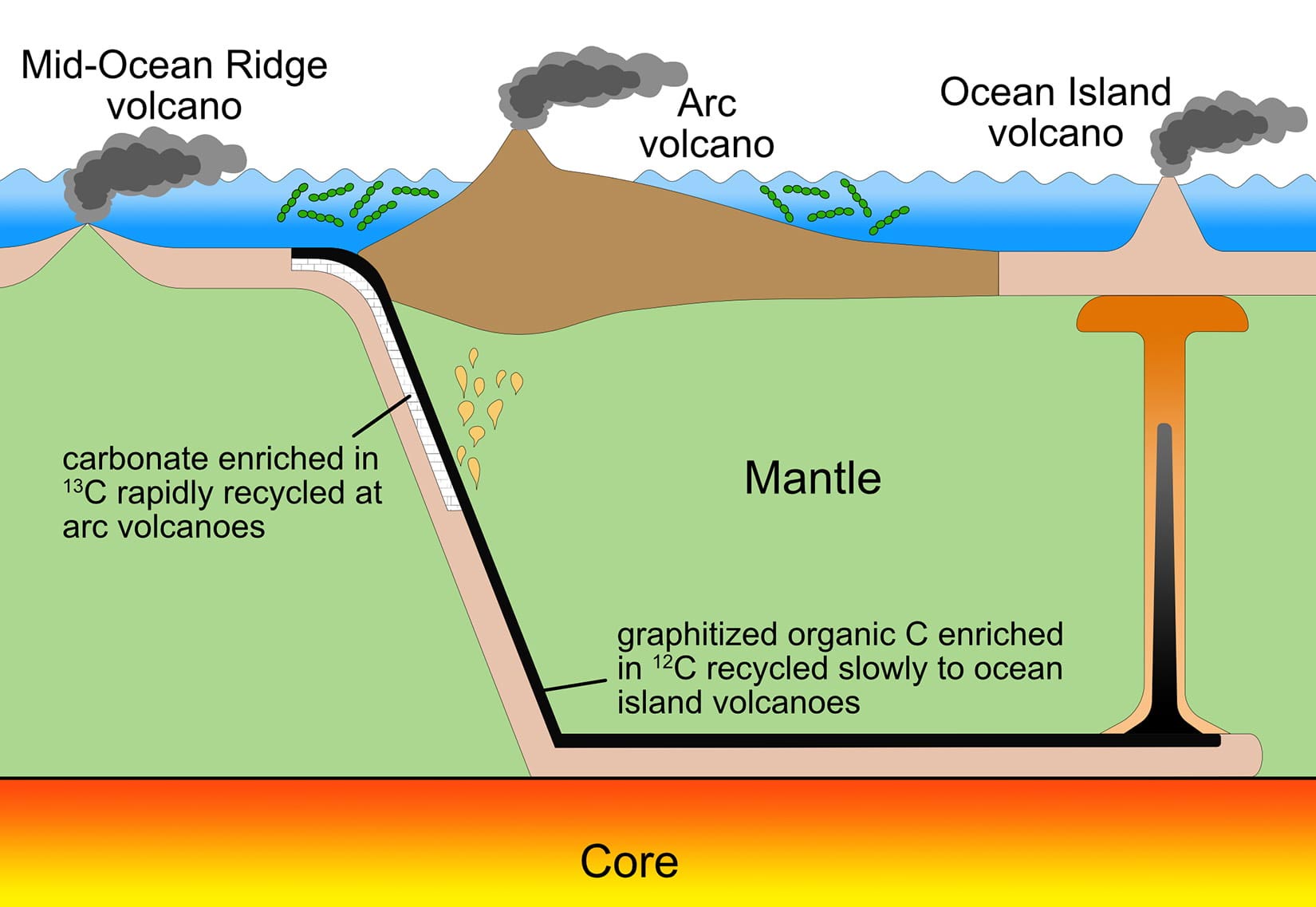
- The organic and inorganic carbon from these wound up on the seafloor and was eventually recycled back into Earth’s mantle at subduction zones, where oceanic plates are dragged beneath continents.
- When sediments remelted into the mantle, inorganic carbon, hosted in carbonates, tended to be released early, re-entering the atmosphere through arc volcanoes directly above subduction zones.
- Organic carbon, which contained very little carbon-13, was drawn deep into the mantle and emerged hundreds of millions of years later as carbon dioxide from island hotspot volcanoes like Hawaii.
“It’s kind of a big cyclic process,” Eguchi said. “We do think the amount of cyanobacteria increased around 2.4 billion years ago. So that would drive our oxygen increase. But the increase of cyanobacteria is balanced by the increase of carbonates. So that carbon-12-to-carbon-13 ratio doesn’t change until both the carbonates and organic carbon, from cyanobacteria, get subducted deep into the Earth. When they do, geochemistry comes into play, causing these two forms of carbon to reside in the mantle for different periods of time. Carbonates are much more easily released in magma and are released back to the surface in a very short period. Lomagundi starts when the first carbon-13-enriched carbon from carbonates returns to the surface, and it ends when the carbon-12-enriched organic carbon returns much later, rebalancing the ratio.”
Eguchi said the study emphasizes the importance of the role that deep Earth processes can play in the evolution of life at the surface.
“We’re proposing that carbon dioxide emissions were very important to this proliferation of life,” he said. “It’s really trying to tie in how these deeper processes have affected surface life on our planet in the past.”
Dasgupta is also the principal investigator on a NASA-funded effort called CLEVER Planets that is exploring how life-essential elements might come together on distant exoplanets. He said a better understanding of how Earth became habitable is important for studying habitability and its evolution on distant worlds.
“It looks like Earth’s history is calling for tectonics to play a big role in habitability, but that doesn’t necessarily mean that tectonics is absolutely necessary for oxygen build up,” he said. “There might be other ways of building and sustaining oxygen, and exploring those is one of the things we’re trying to do in CLEVER Planets.”
Reference: “Great Oxidation and Lomagundi events linked by deep cycling and enhanced degassing of carbon” by James Eguchi, Johnny Seales and Rajdeep Dasgupta, 2 December 2019, Nature Geoscience.
DOI: 10.1038/s41561-019-0492-6
The research was supported by the National Science Foundation, NASA, and the Deep Carbon Observatory.
Never miss a breakthrough: Join the SciTechDaily newsletter.
Follow us on Google and Google News.