
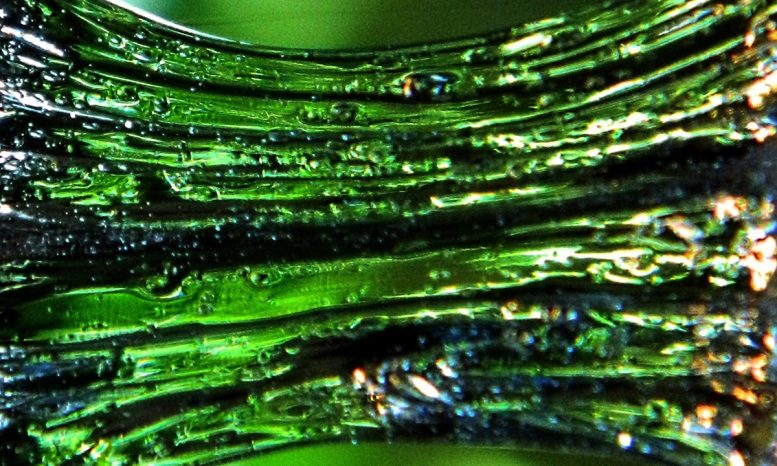
Cross-Linking Technology Tightly Binds Where Commercial Glues Cannot
With many of the products we use every day held together by adhesives, researchers from UBC’s Okanagan campus and the University of Victoria hope to make everything from protective clothing to medical implants and residential plumbing stronger and more corrosion resistant thanks to a newly-developed ‘hyper glue’ formula.
“Imagine paints that never peel or waterproof coatings that never need to be resealed.” — Professor Abbas Milani
The team of chemists and composite materials researchers discovered a broadly applicable method of bonding plastics and synthetic fibers at the molecular level in a procedure called cross-linking. The cross-linking takes effect when the adhesive is exposed to heat or long-wave UV light making strong connections that are both impact-resistant and corrosion-resistant. Even with a minimal amount of cross-linking, the materials are tightly bonded.
“It turns out the adhesive is particularly effective in high-density polyethylene, which is an important plastic used in bottles, piping, geomembranes, plastic lumber, and many other applications,” says Professor Abbas Milani, director of UBC’s Materials and Manufacturing Research Institute, and the lead researcher at the Okanagan node of the Composite Research Network. “In fact, commercially available glues didn’t work at all on these materials, making our discovery an impressive foundation for a wide range of important uses.”

UVic Organic Chemistry Professor Jeremy Wulff, whose team led the design of the new class of cross-linking materials, collaborated with the UBC Survive and Thrive Applied Research to explore how it performed in real-world applications.
“The UBC STAR team was able to put the material through its paces and test its viability in some incredible applications, including ballistic protection for first responders,” says Wulff.
The discovery, he says, is already playing an important role in the Comfort-Optimized Materials for Operational Resilience, Thermal-transport and Survivability (COMFORTS) network, a team of researchers from UBC, UVic and the University of Alberta who are collaborating to create high-performance body armor.
“By using this cross-linking technology, we’re better able to strongly fuse together different layers of fabric types to create the next generation of clothing for extreme environments,” says Wulff. “At the same time, the cross-linker provides additional material strength to the fabric itself.”
Milani is quick to point out that an incredibly strong bonding agent is just the beginning of what it can do.
“Imagine paints that never peel or waterproof coatings that never need to be resealed,” says Milani. “We’re even starting to think about using it as a way to bond lots of different plastic types together, which is a major challenge in the recycling of plastics and their composites.”
“There is real potential to make some of our everyday items stronger and less prone to failure, which is what many chemists and composite materials engineers strive for.”
The research was published recently in the journal Science and was co-sponsored by Victoria-based company Epic Ventures and Mitacs Canada.
Reference: “A broadly applicable cross-linker for aliphatic polymers containing C–H bonds” by Mathieu L. Lepage, Chakravarthi Simhadri, Chang Liu, Mahdi Takaffoli, Liting Bi, Bryn Crawford, Abbas S. Milani and Jeremy E. Wulff, 15 November 2019, Science.
DOI: 10.1126/science.aay6230
Never miss a breakthrough: Join the SciTechDaily newsletter.
Follow us on Google and Google News.
6 Comments
How toxic is it? Will it be discovered to cause cancer?
I’ve long said that the modern industrial society would fall apart if it weren’t for glue and tape. So taken for granted…
Cross linking isn’t exactly a new discovery… perhaps they found a new way to use cross linking? Cross linking is the fundamental thing that makes rubbers and plastics function. It also fundamentally alters the mechanical properties of the materials in question. Not always in ways that are desirable. Without cross linking glass and carbon composites couldn’t even exist.
Coming from the hardwood flooring industry. I can see how this would make an impact on adhesives being used. Giving it better a bond from substate to material long term.
Measure the new cross linked adhesive with what 3M has to offer. You will than know if you have developed a new adhesive system. The adhesive find my be a start of a relationship.
I am looking for researchers for glue for eyelashes that stays on for 3 weeks that dries slowly so the person has the time to put the eyelashes on. Glue that last for 3 weeks. I’m ready to pay you.
Please get back to me.
Thanks.