

A new study shows oxygenic photosynthesis likely evolved between 3.4 and 2.9 billion years ago.
Some time in Earth’s early history, the planet took a turn toward habitability when a group of enterprising microbes known as cyanobacteria evolved oxygenic photosynthesis — the ability to turn light and water into energy, releasing oxygen in the process.
This evolutionary moment made it possible for oxygen to eventually accumulate in the atmosphere and oceans, setting off a domino effect of diversification and shaping the uniquely habitable planet we know today.
Now, MIT scientists have a precise estimate for when cyanobacteria, and oxygenic photosynthesis, first originated. Their results were published on September 29, 2021, in the Proceedings of the Royal Society B.
They developed a new gene-analyzing technique that shows that all the species of cyanobacteria living today can be traced back to a common ancestor that evolved around 2.9 billion years ago. They also found that the ancestors of cyanobacteria branched off from other bacteria around 3.4 billion years ago, with oxygenic photosynthesis likely evolving during the intervening half-billion years, during the Archean Eon.
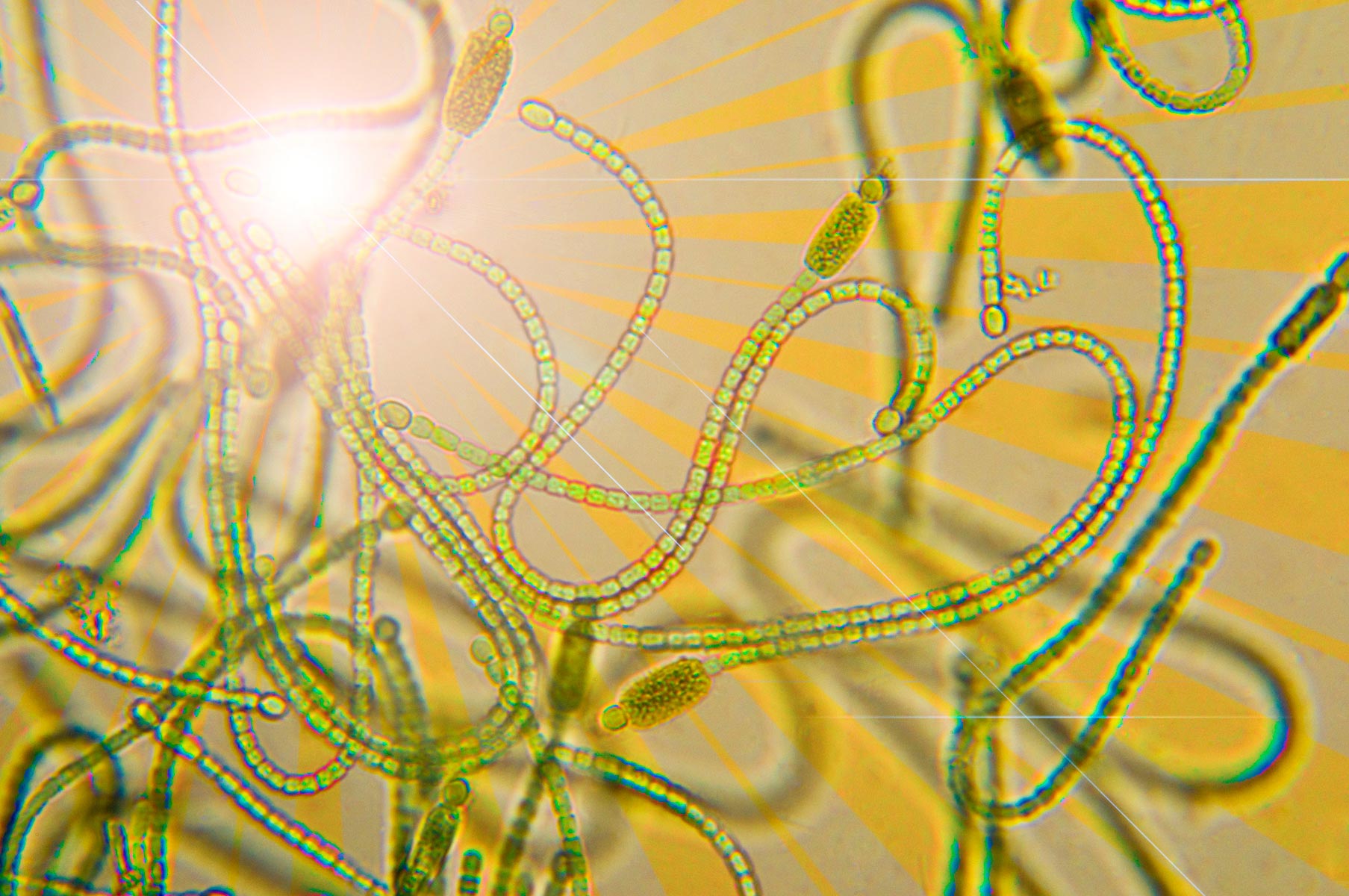
Interestingly, this estimate places the appearance of oxygenic photosynthesis at least 400 million years before the Great Oxidation Event, a period in which the Earth’s atmosphere and oceans first experienced a rise in oxygen. This suggests that cyanobacteria may have evolved the ability to produce oxygen early on, but that it took a while for this oxygen to really take hold in the environment.
“In evolution, things always start small,” says lead author Greg Fournier, associate professor of geobiology in MIT’s Department of Earth, Atmospheric and Planetary Sciences. “Even though there’s evidence for early oxygenic photosynthesis — which is the single most important and really amazing evolutionary innovation on Earth — it still took hundreds of millions of years for it to take off.”
Fournier’s MIT co-authors include Kelsey Moore, Luiz Thiberio Rangel, Jack Payette, Lily Momper, and Tanja Bosak.
Slow Fuse, or Wildfire?
Estimates for the origin of oxygenic photosynthesis vary widely, along with the methods to trace its evolution.
For instance, scientists can use geochemical tools to look for traces of oxidized elements in ancient rocks. These methods have found hints that oxygen was present as early as 3.5 billion years ago — a sign that oxygenic photosynthesis may have been the source, although other sources are also possible.
Researchers have also used molecular clock dating, which uses the genetic sequences of microbes today to trace back changes in genes through evolutionary history. Based on these sequences, researchers then use models to estimate the rate at which genetic changes occur, to trace when groups of organisms first evolved. But molecular clock dating is limited by the quality of ancient fossils, and the chosen rate model, which can produce different age estimates, depending on the rate that is assumed.
Fournier says different age estimates can imply conflicting evolutionary narratives. For instance, some analyses suggest oxygenic photosynthesis evolved very early on and progressed “like a slow fuse,” while others indicate it appeared much later and then “took off like wildfire” to trigger the Great Oxidation Event and the accumulation of oxygen in the biosphere.
“In order for us to understand the history of habitability on Earth, it’s important for us to distinguish between these hypotheses,” he says.
Horizontal Genes
To precisely date the origin of cyanobacteria and oxygenic photosynthesis, Fournier and his colleagues paired molecular clock dating with horizontal gene transfer — an independent method that doesn’t rely entirely on fossils or rate assumptions.
Normally, an organism inherits a gene “vertically,” when it is passed down from the organism’s parent. In rare instances, a gene can also jump from one species to another, distantly related species. For instance, one cell may eat another, and in the process incorporate some new genes into its genome.
When such a horizontal gene transfer history is found, it’s clear that the group of organisms that acquired the gene is evolutionarily younger than the group from which the gene originated. Fournier reasoned that such instances could be used to determine the relative ages between certain bacterial groups. The ages for these groups could then be compared with the ages that various molecular clock models predict. The model that comes closest would likely be the most accurate, and could then be used to precisely estimate the age of other bacterial species — specifically, cyanobacteria.
Following this reasoning, the team looked for instances of horizontal gene transfer across the genomes of thousands of bacterial species, including cyanobacteria. They also used new cultures of modern cyanobacteria taken by Bosak and Moore, to more precisely use fossil cyanobacteria as calibrations. In the end, they identified 34 clear instances of horizontal gene transfer. They then found that one out of six molecular clock models consistently matched the relative ages identified in the team’s horizontal gene transfer analysis.
Fournier ran this model to estimate the age of the “crown” group of cyanobacteria, which encompasses all the species living today and known to exhibit oxygenic photosynthesis. They found that, during the Archean eon, the crown group originated around 2.9 billion years ago, while cyanobacteria as a whole branched off from other bacteria around 3.4 billion years ago. This strongly suggests that oxygenic photosynthesis was already happening 500 million years before the Great Oxidation Event (GOE), and that cyanobacteria were producing oxygen for quite a long time before it accumulated in the atmosphere.
The analysis also revealed that, shortly before the GOE, around 2.4 billion years ago, cyanobacteria experienced a burst of diversification. This implies that a rapid expansion of cyanobacteria may have tipped the Earth into the GOE and launched oxygen into the atmosphere.
“This new paper sheds essential new light on Earth’s oxygenation history by bridging, in novel ways, the fossil record with genomic data, including horizontal gene transfers,” says Timothy Lyons, professor of biogeochemistry at the University of California at Riverside. “The results speak to the beginnings of biological oxygen production and its ecological significance, in ways that provide vital constraints on the patterns and controls on the earliest oxygenation of the oceans and later accumulations in the atmosphere.”
Fournier plans to apply horizontal gene transfer beyond cyanobacteria to pin down the origins of other elusive species.
“This work shows that molecular clocks incorporating horizontal gene transfers (HGTs) promise to reliably provide the ages of groups across the entire tree of life, even for ancient microbes that have left no fossil record … something that was previously impossible,” Fournier says.
Reference: “The Archean origin of oxygenic photosynthesis and extant cyanobacterial lineages” by G. P. Fournier, K. R. Moore, L. T. Rangel, J. G. Payette, L. Momper and T. Bosak, 29 September 2021, Proceedings of the Royal Society B.
DOI: 10.1098/rspb.2021.0675
This research was supported, in part, by the Simons Foundation and the National Science Foundation.
Never miss a breakthrough: Join the SciTechDaily newsletter.
Follow us on Google and Google News.
7 Comments
Fortunately there were no terrestrial ecologists to object to the poisoning of Earth’s atmosphere by toxic oxygen.
“photosynthesis — the ability to turn light and water into energy, releasing oxygen in the process.”
wut?
Two building were demolished this summer dur to Black Algae taking hold of the interior.
The older species are still out there and the survivors are tough, very tough. It was cheaper and easier to take down a pair of four plexes than kill the algae. Minor worry that the day may come where we need that destructive ability.
“Interestingly, this estimate places the appearance of oxygenic photosynthesis at least 400 million years before the Great Oxidation Event, a period in which the Earth’s atmosphere and oceans first experienced a rise in oxygen.”
It is hard to accept that MIT scientists don’t know that the GOE DEPRNDS on oxygenic photosynthesis. The GOE requires that oxygen to oxidize all the ferrous iron supposedly in the Archean oceans.This is supposed to account for the delay. Something else these authors fail to understand is that if the oxygen was used to oxidize iron that same oxygen cannot be used by the carbon cycle to oxidize the organic matter (aerobic respiration). Accordingly, organic carbon would necessarily build up and it’s not there where the oxidized iron is. This whole article is pretty bad science.
No. The novel genetic material required for this new ability is staggeringly huge. Random chemistry cannot explain it any more than it can explain a first living cell with resorting to miracles. Wake up. The king has no clothes on. There is something other-worldly going on here.
So….in essence, this means oxygen, as well as water, is a requirement for life to proliferate.
If the Big Bang can suddenly produce a universe from nothing, if nothing can be understood before the Big Bang, why do we need a miracle to produce the first living cell? That is merely chemistry.
With the Great Oxygenation Event dated at 2.33 billion years ago, the partial pressure of oxygen in the atmosphere then being 10 power minus 5 that of the present, it took more or less 800 million years for eukaryotic cells to evolve, the best evidence to date being that it had occurred by 1.5 billion years BP. As for the prokaryotic beasts that are alleged to have produced the GOE, they appear to have kicked off at around 3.8 billion years BP. All fascinatingly slow when compared with what came next.