

Most of the viruses were previously unknown to humans, study finds.
Scientists who study glacier ice have found viruses nearly 15,000 years old in two ice samples taken from the Tibetan Plateau in China. Most of those viruses, which survived because they had remained frozen, are unlike any viruses that have been cataloged to date.
The findings, published on July 20, 2021, in the journal Microbiome, could help scientists understand how viruses have evolved over centuries. For this study, the scientists also created a new, ultra-clean method of analyzing microbes and viruses in ice without contaminating it.
“These glaciers were formed gradually, and along with dust and gases, many, many viruses were also deposited in that ice,” said Zhi-Ping Zhong, lead author of the study and a researcher at The Ohio State University Byrd Polar and Climate Research Center who also focuses on microbiology. “The glaciers in western China are not well-studied, and our goal is to use this information to reflect past environments. And viruses are a part of those environments.”
High-Altitude Ice Cores Offer Atmospheric Time Capsules
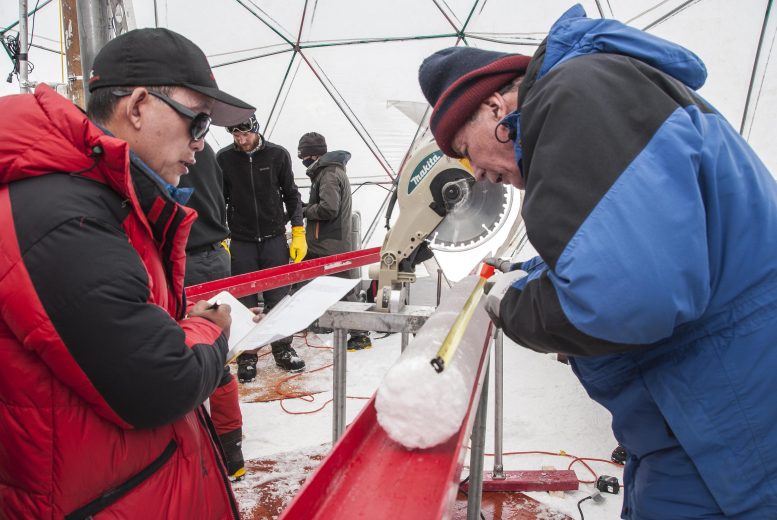
The researchers analyzed ice cores taken in 2015 from the Guliya ice cap in western China. The cores are collected at high altitudes – the summit of Guliya, where this ice originated, is 22,000 feet (6,700 meters) above sea level. The ice cores contain layers of ice that accumulate year after year, trapping whatever was in the atmosphere around them at the time each layer froze. Those layers create a timeline of sorts, which scientists have used to understand more about climate change, microbes, viruses, and gases throughout history.
Researchers determined that the ice was nearly 15,000 years old using a combination of traditional and new, novel techniques to date this ice core.
When they analyzed the ice, they found genetic codes for 33 viruses. Four of those viruses have already been identified by the scientific community. But at least 28 of them are novel. About half of them seemed to have survived at the time they were frozen not in spite of the ice, but because of it.
Researchers determined that the ice was nearly 15,000 years old using a combination of traditional and new, novel techniques to date this ice core.
When they analyzed the ice, they found genetic codes for 33 viruses. Four of those viruses have already been identified by the scientific community. But at least 28 of them are novel. About half of them seemed to have survived at the time they were frozen not in spite of the ice, but because of it.
Frozen to Survive: Extremophile Virus Adaptations
“These are viruses that would have thrived in extreme environments,” said Matthew Sullivan, co-author of the study, professor of microbiology at Ohio State and director of Ohio State’s Center of Microbiome Science. “These viruses have signatures of genes that help them infect cells in cold environments – just surreal genetic signatures for how a virus is able to survive in extreme conditions. These are not easy signatures to pull out, and the method that Zhi-Ping developed to decontaminate the cores and to study microbes and viruses in ice could help us search for these genetic sequences in other extreme icy environments – Mars, for example, the moon, or closer to home in Earth’s Atacama Desert.”
Viruses do not share a common, universal gene, so naming a new virus – and attempting to figure out where it fits into the landscape of known viruses – involves multiple steps. To compare unidentified viruses with known viruses, scientists compare gene sets. Gene sets from known viruses are cataloged in scientific databases.
Ancient Viruses Likely Originated From Soil and Plants
Those database comparisons showed that four of the viruses in the Guliya ice cap cores had previously been identified and were from virus families that typically infect bacteria. The researchers found the viruses in concentrations much lower than have been found to exist in oceans or soil.
The researchers’ analysis showed that the viruses likely originated with soil or plants, not with animals or humans, based on both the environment and the databases of known viruses.
The study of viruses in glaciers is relatively new: Just two previous studies have identified viruses in ancient glacier ice. But it is an area of science that is becoming more important as the climate changes, said Lonnie Thompson, senior author of the study, distinguished university professor of earth sciences at Ohio State and senior research scientist at the Byrd Center.
“We know very little about viruses and microbes in these extreme environments, and what is actually there,” Thompson said. “The documentation and understanding of that is extremely important: How do bacteria and viruses respond to climate change? What happens when we go from an ice age to a warm period like we’re in now?”
Reference: “Glacier ice archives nearly 15,000-year-old microbes and phages” by Zhi-Ping Zhong, Funing Tian, Simon Roux, M. Consuelo Gazitúa, Natalie E. Solonenko, Yueh-Fen Li, Mary E. Davis, James L. Van Etten, Ellen Mosley-Thompson, Virginia I. Rich, Matthew B. Sullivan and Lonnie G. Thompson, 20 July 2021, Microbiome.
DOI: 10.1186/s40168-021-01106-w
This study was an interdisciplinary effort between Ohio State’s Byrd Center and its Center for Microbiome Science. The 2015 Guliya ice cores were collected and analyzed as part of a collaborative program between the Byrd Polar and Climate Research Center and the Institute of Tibetan Plateau Research of the Chinese Academy of Sciences, funded by the U.S. National Science Foundation and the Chinese Academy of Sciences. Funding also came from the Gordon and Betty Moore Foundation and the U.S. Department of Energy.
Never miss a breakthrough: Join the SciTechDaily newsletter.
Follow us on Google and Google News.
10 Comments
What could possibly go wrong?!!!
Determined to continue this aren’t they; striving for knowledge.
Why are these fools messing with contaminated ground without any protection at all! No masks; nothing obvious of a protective nature.
Give it to Fauci, we’ll have that pandemic ready in no time.
If this was weaponized in its early stages it could be very lethal. finding a vaccine would be like walking from the US to Africa with no food due to the fact that there is no information abt the virus.!!!!May luck be on our side!!!
@Francis Grant they are not messing with it,theyre finding means to counter it in case it gets out
If this was weaponized in its early stages it could be very lethal. finding a vaccine would be like walking from the US to Africa with no food due to the fact that there is no information abt the virus.!!!!May luck be on our side!!!
@Francis Grant they are not messing with it,theyre finding means to counter it in case it gets out.
It’s something we have not seen or even understand at this point. These viruses have been absent for 15,000 years, does anyone think this is a bad idea to start bringing them back? We have all seen what happens when you play with fire
Yeah this is what we need more illnesses and viruses I’m so sick of stuff like this I’m sure it’s gonna be on the news soon one of those fools got sick 😂
With all of the glacial ice melting there is no wonder new viruses etc. are emerging. It’s been there for thousands of years. If they continue to melt, who knows what will emerge next and how it will affect/infect us. We are killing ourselves. Stop global warming. Which in turn melts these glaciers…
It’s going to melt anyways and the people who can spot it are proactive in finding it.
That sounds like the best option in a list of mostly bad options. It’s definitely better than being a petulant emotional shrimp about denying it’s happening for a few decades and then being a complete limp wimp about it saying it’s just nature and there’s nothing we can do and such as blah blah blah