

Solar Orbiter’s recent flythrough of Comet Leonard’s tail provided key data on particles and magnetic fields, enhancing our knowledge of comet-solar wind interactions and aiding future missions.
For the second time in its mission so far, the ESA/NASA Solar Orbiter spacecraft has flown through the tail of a comet. Predicted in advance by astronomers at University College London, UK, the spacecraft collected a wealth of scientific data that now awaits full analysis.
For a spacecraft designed to conduct unique studies of the Sun, Solar Orbiter is also making a name for itself exploring comets. For several days centered on 1200-1300 UT on December 17, 2021, the spacecraft found itself flying through the tail of Comet C/2021 A1 Leonard.
The encounter captured information about the particles and magnetic field present in the tail of the comet. This will allow astronomers to study the way the comet interacts with the solar wind, a variable wind of particles and magnetic field that emanate from the Sun and sweep through the solar system.
The crossing had been predicted by Samuel Grant, a post graduate student at University College London’s Mullard Space Science Laboratory. He adapted an existing computer program that compared spacecraft orbits with comet orbits to include the effects of the solar wind and its ability to shape a comet’s tail.
“I ran it with Comet Leonard and Solar Orbiter with a few guesses for the speed of the solar wind. And that’s when I saw that even for quite a wide range of solar wind speeds it seemed like there would be a crossing,” he says.
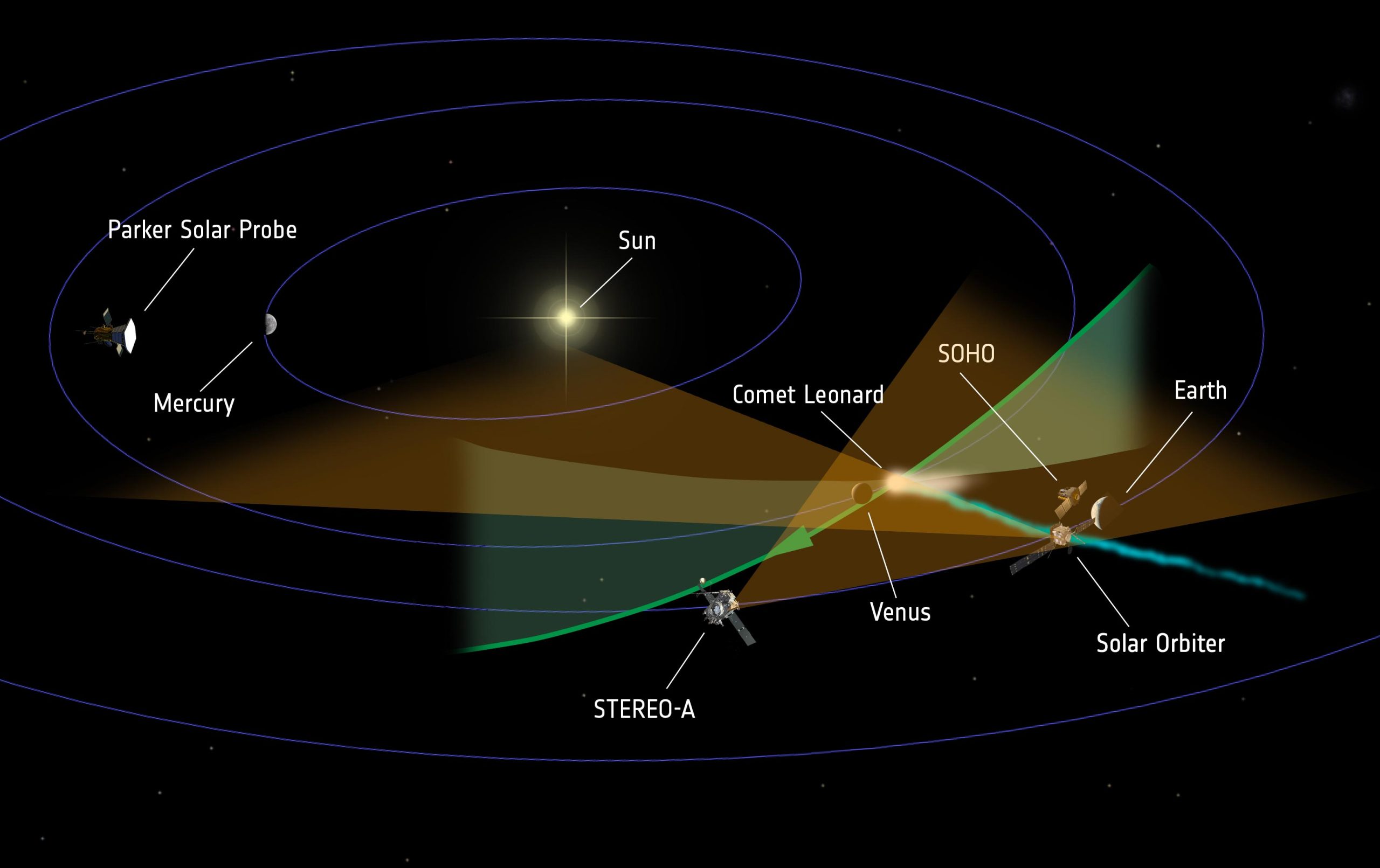
At the time of the crossing, Solar Orbiter was relatively close to the Earth having passed by on November 27, 2021, for a gravity assist maneuver that marked the beginning of the mission’s science phase, and placed the spacecraft on course for its March 2022 close approach to the Sun. The comet’s nucleus was 44.5 million kilometers (27.7 million miles) away, near to the planet Venus, but its giant tail stretched across space to Earth’s orbit and beyond.
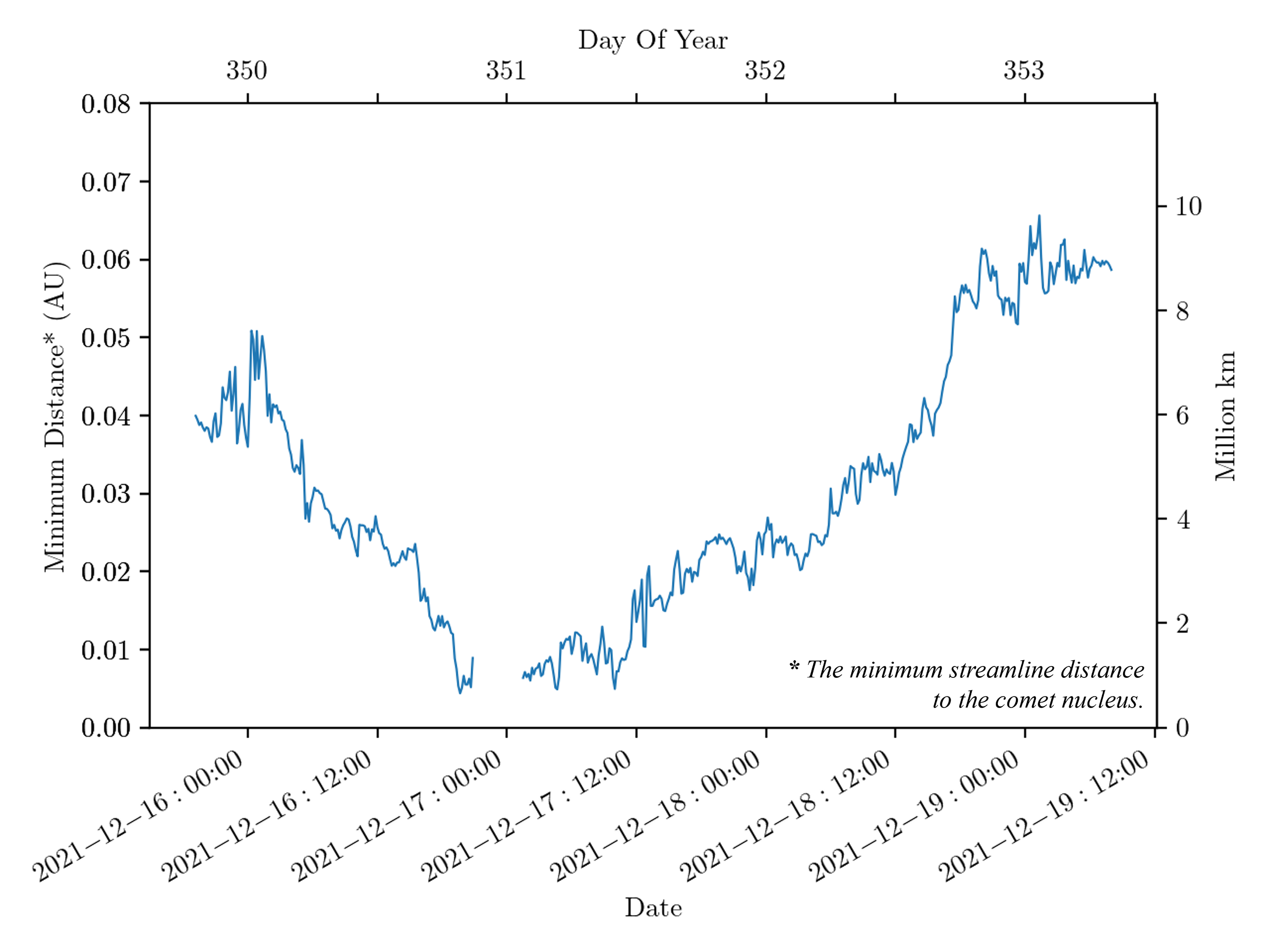
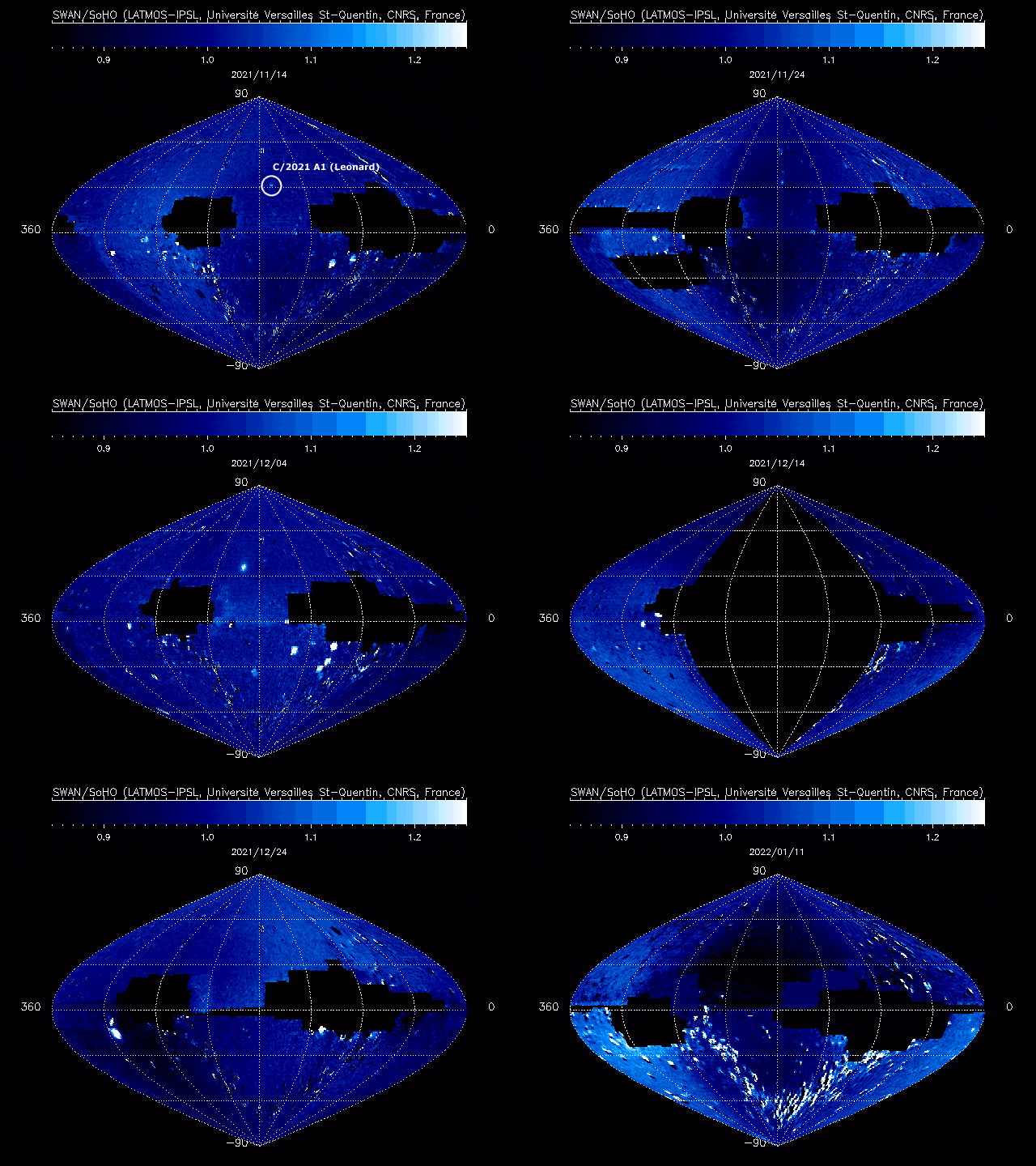
Changes in the solar wind flow speed and direction are responsible for the variations in the plotted distance. There are short data acquisition gaps on December 15 and 17. Credit: ESA/Solar Orbiter/SWA team & S. Grant (UCL)
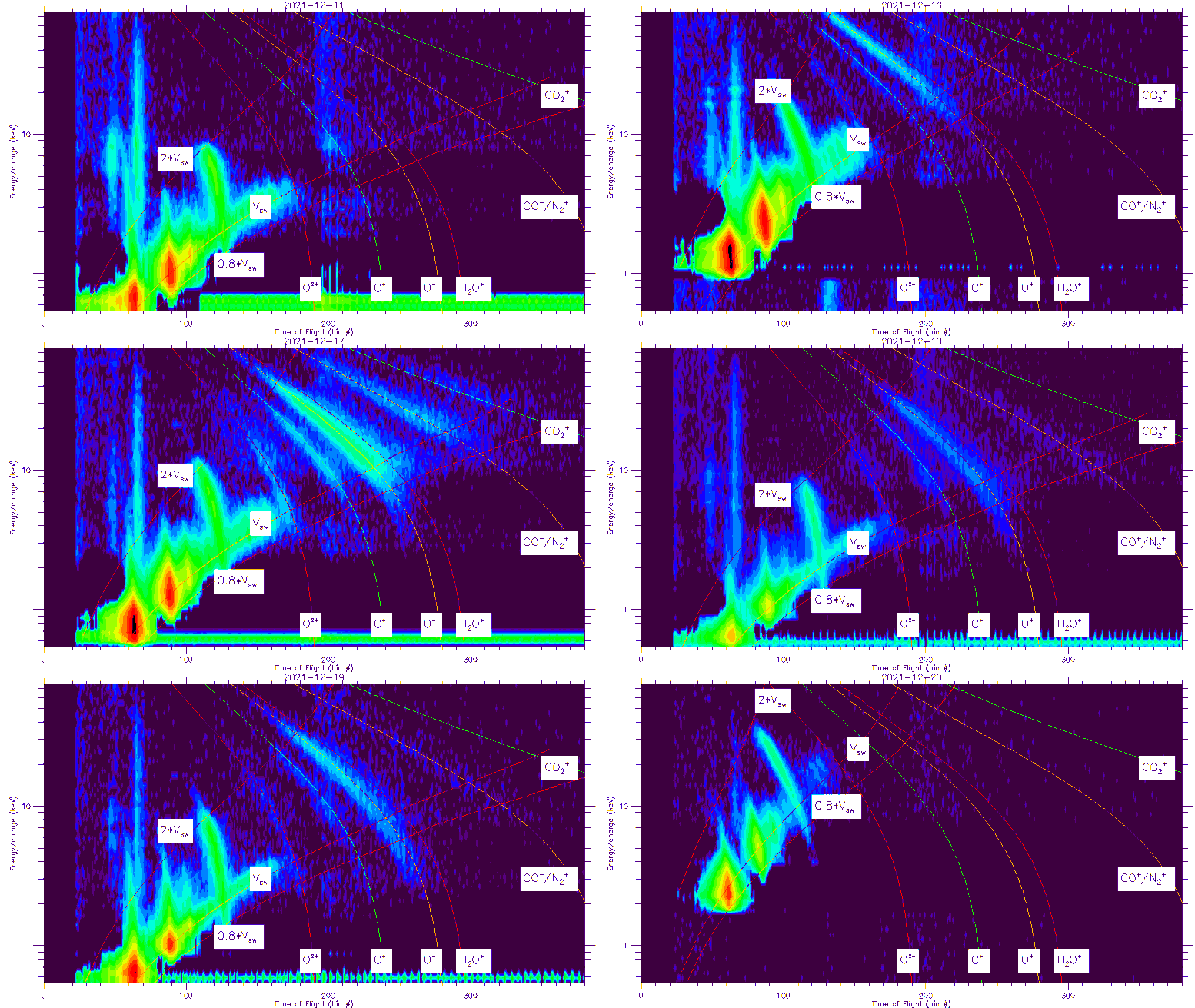
So far, the best detection of the comet’s tail from Solar Orbiter has come from the Solar Wind Analyser (SWA) instrument suite. Its Heavy Ion Sensor (HIS) clearly measured atoms, ions, and even molecules that are attributable to the comet rather than the solar wind.
Ions are atoms or molecules that have been stripped of one or more electron and now carry a net positive electrical charge. SWA-HIS detected ions of oxygen, carbon, molecular nitrogen, and molecules of carbon monoxide, carbon dioxide and possibly water. “Because of their small charge, these ions are all clearly of cometary origin,” says Stefano Livi, Lead Investigator of SWA-HIS from Southwest Research Institute, Texas.

As a comet moves through space, it tends to drape the Sun’s magnetic field around it. This magnetic field is being carried by the solar wind, and the draping creates discontinuities where the polarity of the magnetic field changes sharply from north to south and vice versa.
The magnetometer instrument (MAG) data does indeed suggest the presence of such draped magnetic field structures but there is more analysis to be done to be absolutely sure. “We are in the process of investigating some smaller scale magnetic perturbations seen in our data and combining them with measurements from Solar Orbiter’s particle sensors to understand their possible cometary origin,” says Lorenzo Matteini, a co-investigator on MAG from Imperial College, London.
In addition to the particle data, Solar Orbiter also acquired images.
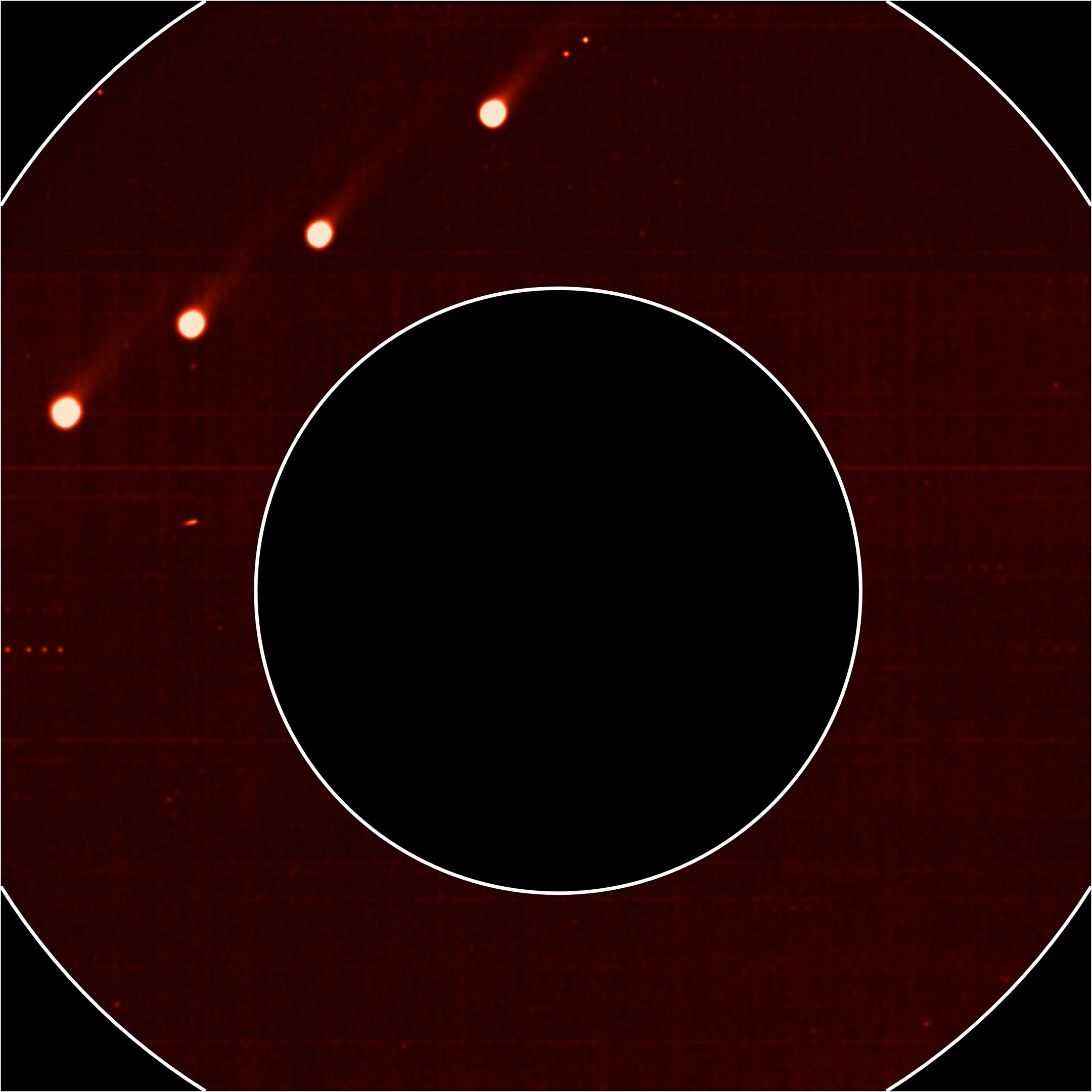
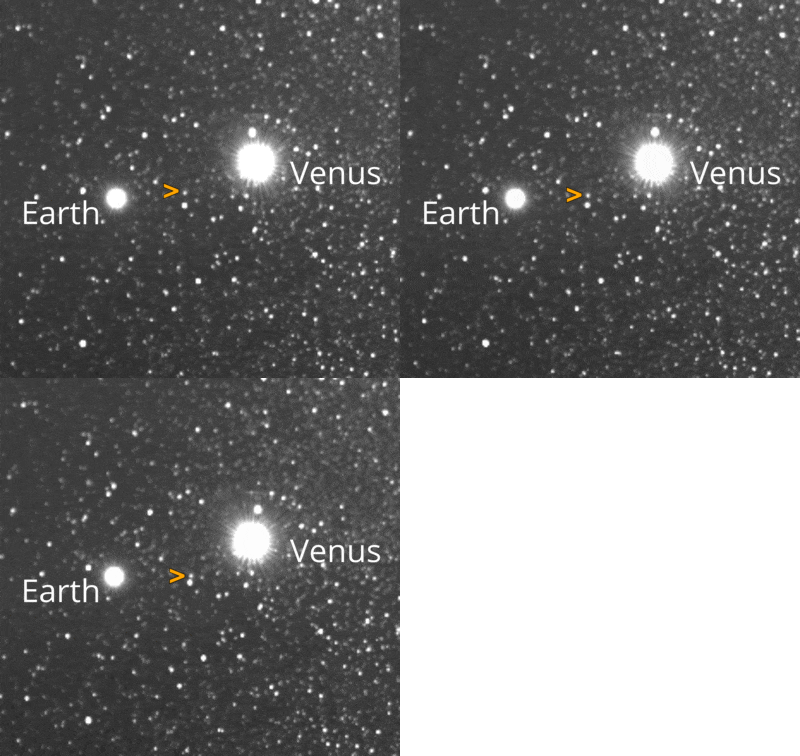
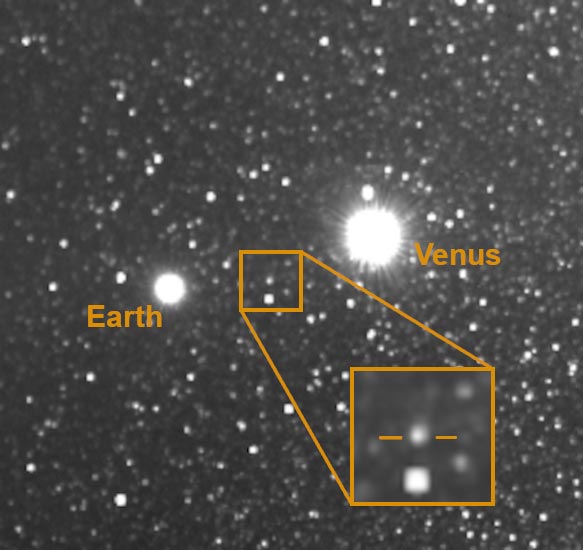
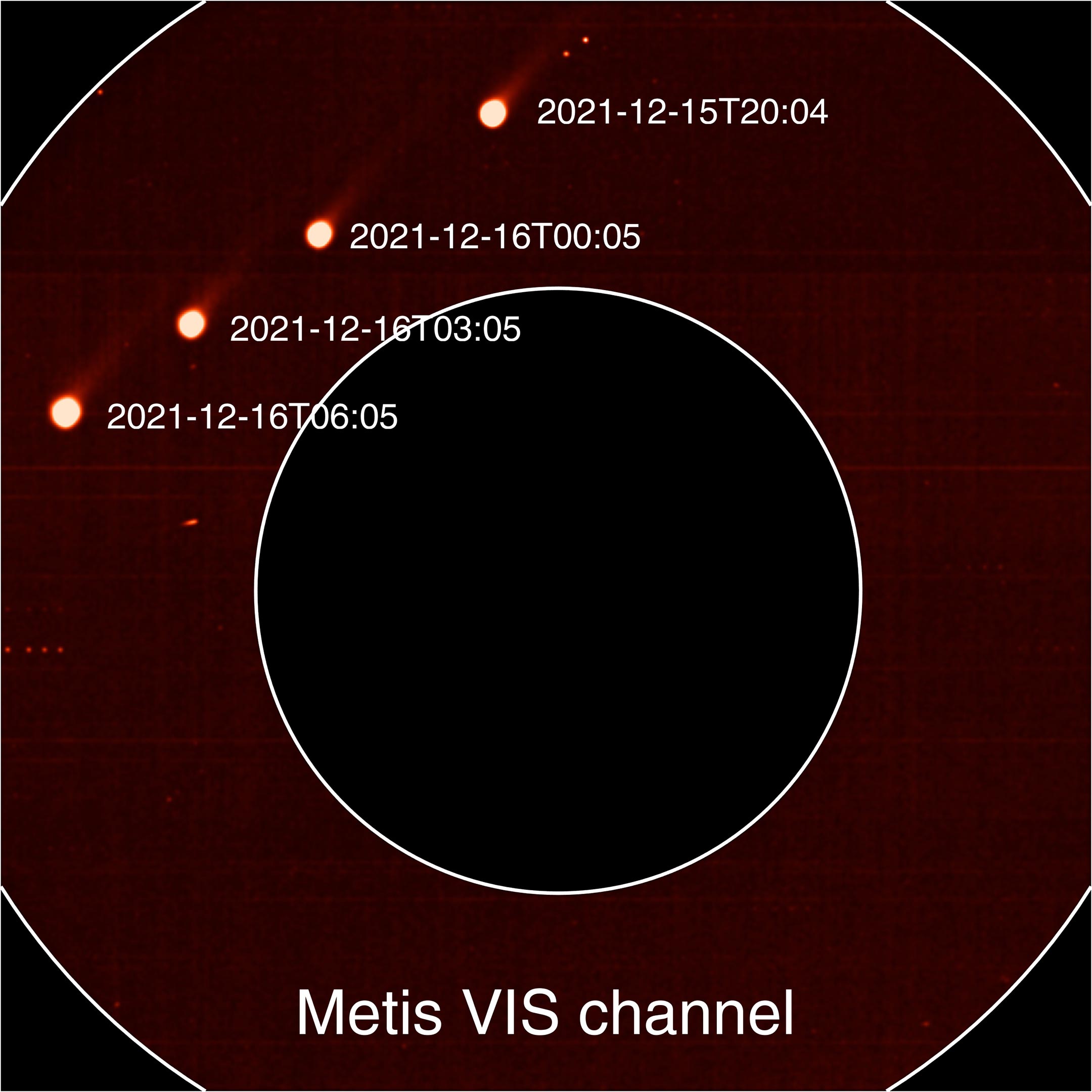
Metis is Solar Orbiter’s multi-wavelength coronagraph. It can perform ultraviolet observations that see the Lyman alpha emission given out by hydrogen, and it can measure the polarisation of visible light. During December 15 and 16, it captured the distant head of the comet simultaneously in both visible and ultraviolet light. These images are now being analyzed by the instrument team. “The visible light images can hint at the rate at which the comet is ejecting dust, while the ultraviolet images can give the water production rate,” says Alain Corso, a Metis co-investigator at the CNR-Istituto di Fotonica e Nanotecnologie, Padova, Italy.
The Solar Orbiter Heliospheric Imager (SoloHI) also captured data. These images show large parts of the comet’s ion tail taken while the spacecraft itself was inside the tail. As the image sequence progresses, changes in the tail can be seen in response to variations in the solar wind speed and direction.
And it was not just Solar Orbiter that was watching the crossing. The ESA/NASA SOHO mission and NASA’s STEREO-A and Parker Solar Probe spacecraft were observing from afar. This means that not only do astronomers now have data from inside the tail, they also have contextual images from these other spacecraft (see images above).
Comet tail crossings are relatively rare events. Of those that have been detected, most have been noticed only after the event. The ESA/NASA Ulysses mission encountered three comet ion tails, including that of C/1996 B2 Hyakutake in May 1996, and C/2006 P1 McNaught in early 2007. Solar Orbiter itself crossed the tail of fragmenting comet C/2019 Y4 ATLAS in May and June 2020, shortly after launching.
Whereas the early crossings were a surprise, both of Solar Orbiter’s encounters were predicted in advance thanks to the computer code developed by Geraint Jones, University College London Mullard Space Science Laboratory, and extended by Samuel.
“The big advantage is that for basically no effort on the spacecraft’s part, you get to sample a comet at a massive distance. That’s pretty exciting,” says Samuel, who is now looking at archive data from other spacecraft looking for comet tail crossings that have so far gone unnoticed.
The work also helps build experience for ESA’s Comet Interceptor mission, for which Geraint is the Science Team Lead. The mission will visit an as-yet undiscovered comet, making a flyby of the target with three spacecraft to create a 3D profile of a ‘dynamically new’ object that contains unprocessed material surviving from the dawn of the Solar System.
In the meantime, the instrument teams on Solar Orbiter are busy analyzing the Comet Leonard data not only for what it can tell them about the comet but about the solar wind as well.
“This kind of additional science is always an exciting part of a space mission,” says Daniel Müller, ESA Project Scientist for Solar Orbiter. “When the comet ATLAS crossing was predicted, we were still calibrating the spacecraft and its instruments. Also, the comet fragmented just before we got there. But with Comet Leonard we were totally ready – and the comet didn’t fall apart.”
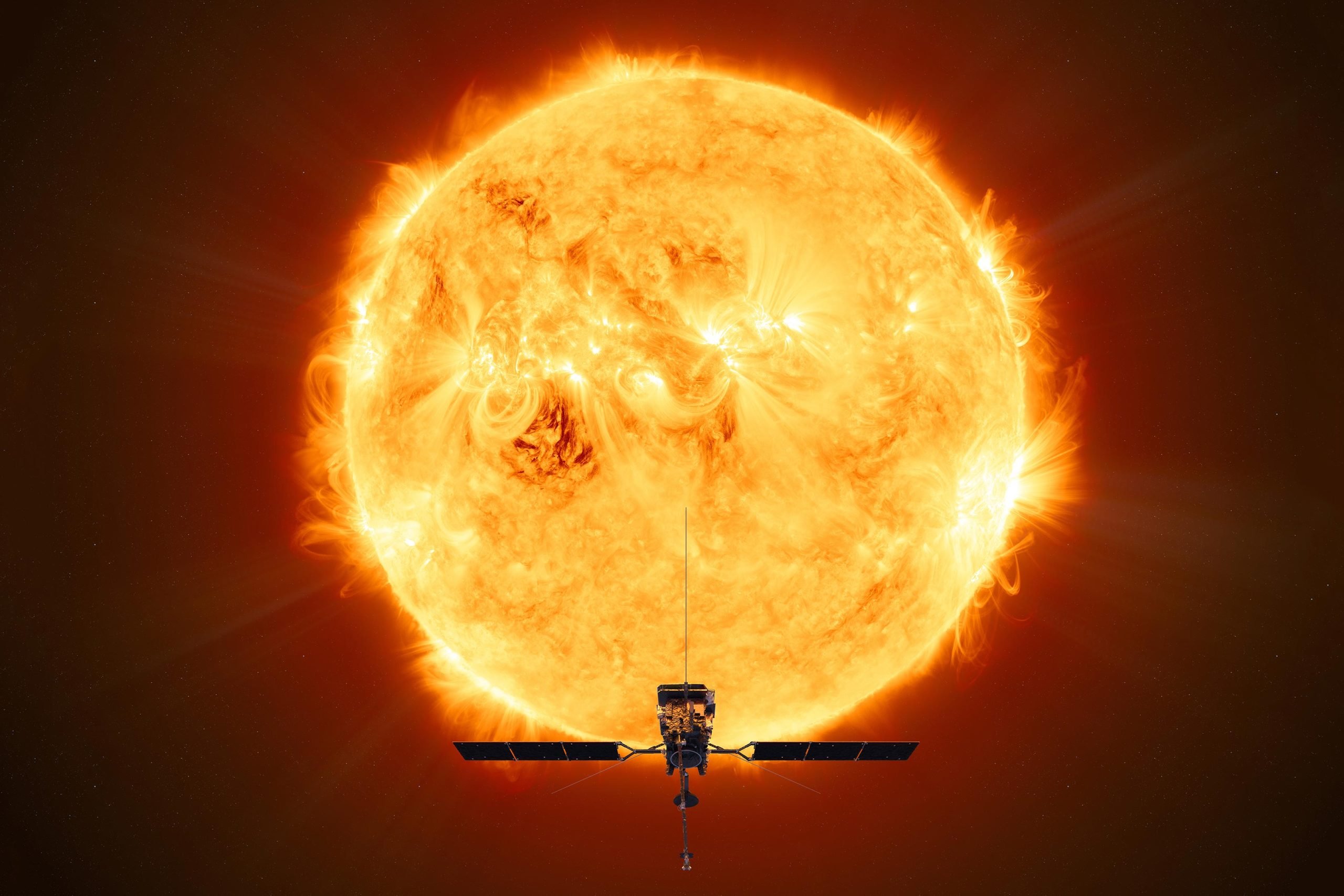
In March, Solar Orbiter makes its closest pass to the Sun yet at a distance of 0.32 au (approximately one-third of the Earth-Sun distance, or about 50 million kilometers). It is one of almost 20 close passes to the Sun that will occur during the next decade. These will result in unprecedented images and data, not only from close up, but also from the Sun’s never-before-seen polar regions.
“There is so much to look forward to with Solar Orbiter, we’re only just getting started,” says Daniel.
Never miss a breakthrough: Join the SciTechDaily newsletter.
Follow us on Google and Google News.
1 Comment
Very Interesting
Well done on the prediction front Samuel Grant.
Here aresome way out thoughts for consideration.
1. Catching a Tiger or Snake by the tail is interesting but fraught with risk!
2. I have always wondered if we can build a Robotic Facility or device with appropriate detection devvices embedded and ride the Tiger/Snake Itself and hitch a Ride to see the Universe and send back up close information of the vaarious stars and planets , moons and other such visible objects like asteroids which are at the Matter end of the Matter-Energy Spectrum.
3. There is one which arrives like clockwork every 86 years. Target to getsuch devices on the tiger/snake and ensureit can survive and send back information for Scientific community to analyse usingArtificial Intelligence.
In other matters:
It occured to me that at the hydrogen end of the Spectrum of the periodic Table , the Energy Release being attempted from Fusion Experiments is the stable variety,
Whereas enrgy from fission of like Uranium , Polonium, Thorium are at the Heavy Elements end of the of the spectrum of the Periodic Table. The thresh-hold for Energy released from these heavy elements due to Fission is at the unstable end of the specturm , and fissionable material needs to be packed together tightly to create an implosion which produces Radioactive elements (Nuclear “Waste” ) and a great deal of energy. The reason we have been able to build Nuclear Fission Reactors much more easily than reactors at the fusion end of the spectrum is probably on account of Unstable tending towards stability and assisting us.
That the Nuclear wsate can last for a very long time and remain radioactive is an expected result based on the elements of the periodic table.
Views expressed and suggestions made are not binding on anyone.