
Close Menu
    Facebook X (Twitter) Instagram
    SciTechDaily
    • Biology
    • Chemistry
    • Earth
    • Health
    • Physics
    • Science
    • Space
    • Technology
    Facebook X (Twitter) Pinterest YouTube RSS
    SciTechDaily
    Home»Space»Lucky Encounter: Solar Orbiter Spacecraft Flies Through the Tail of a Disintegrated Comet
    Space

    Lucky Encounter: Solar Orbiter Spacecraft Flies Through the Tail of a Disintegrated Comet

    By Royal Astronomical SocietyJuly 20, 20212 Comments3 Mins Read
    Facebook Twitter Pinterest Telegram LinkedIn WhatsApp Email Reddit
    Share
    Facebook Twitter LinkedIn Pinterest Telegram Email Reddit
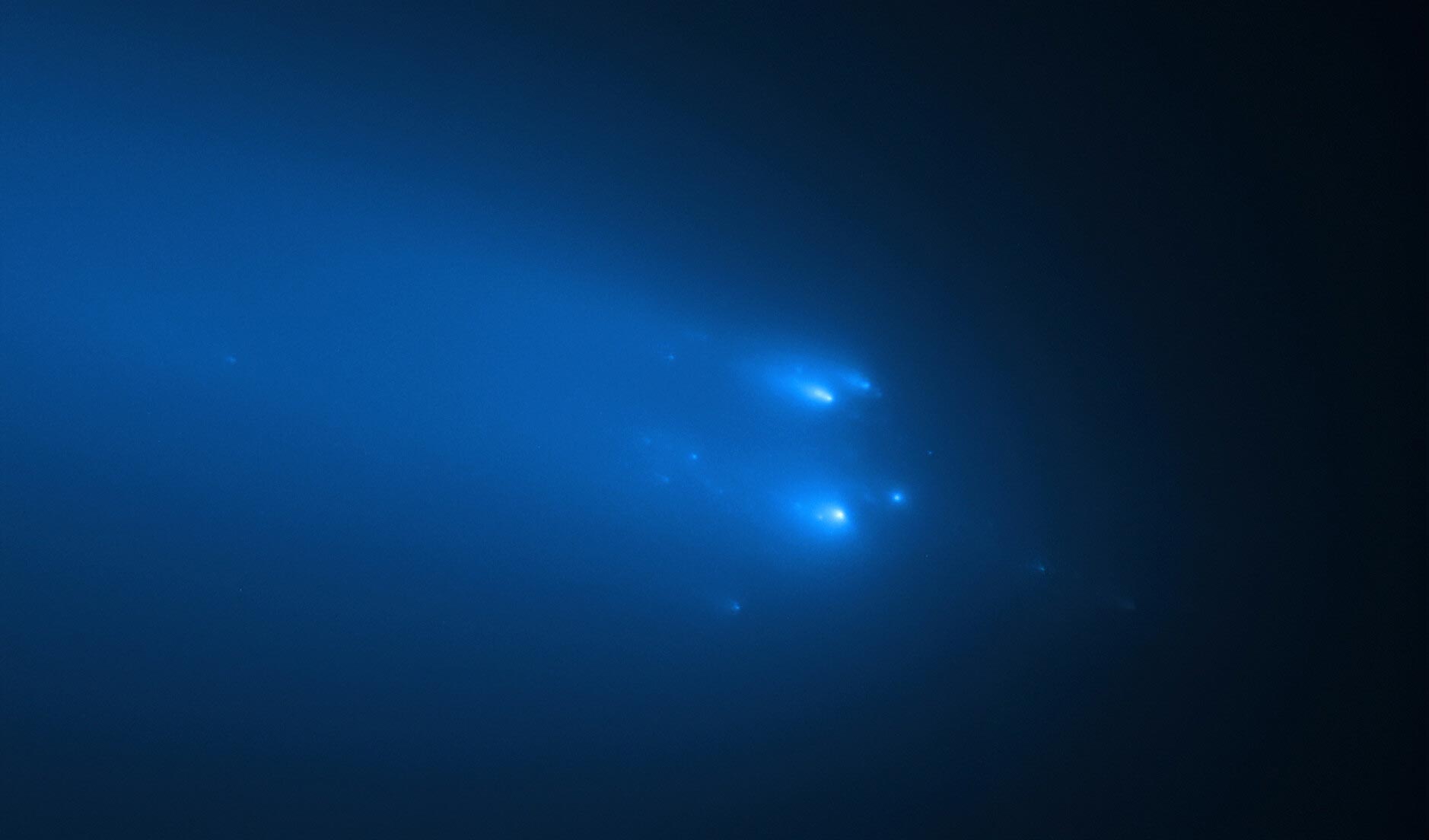
    Hubble Observation of ATLAS Comet on April 20, 2020
    Hubble Space Telescope image of comet C/2019 Y4 (ATLAS), taken on April 20 2020, providing the sharpest view to date of the breakup of the solid nucleus of the comet. Hubble’s eagle-eye view identifies as many as 30 separate fragments, and distinguishes pieces that are roughly the size of a house. Before the breakup, the entire nucleus of the comet may have been the length of one or two football fields. The comet was approximately 91 million miles (146 million kilometers) from Earth when the image was taken. Credit: NASA / ESA / STScI / D. Jewitt (UCLA)

    ESA’s Solar Orbiter unexpectedly flew through the ion tail of the disintegrated Comet ATLAS, offering a rare glimpse into the magnetic and particle dynamics of a fragmented comet. 

    A serendipitous flythrough of the tail of a disintegrated comet has offered scientists a unique opportunity to study these remarkable structures, in new research presented today at the National Astronomy Meeting 2021.

    Comet ATLAS fragmented just before its closest approach to the Sun last year, leaving its former tail trailing through space in the form of wispy clouds of dust and charged particles. The disintegration was observed by the Hubble Space Telescope in April 2020, but more recently the ESA spacecraft Solar Orbiter has flown close to the tail remnants in the course of its ongoing mission.

    This lucky encounter has presented researchers with a unique opportunity to investigate the structure of an isolated cometary tail. Using combined measurements from all of Solar Orbiter’s in-situ instruments, the scientists have reconstructed the encounter with ATLAS’s tail. The resulting model indicates that the ambient interplanetary magnetic field carried by the solar wind ‘drapes’ around the comet, and surrounds a central tail region with a weaker magnetic field.
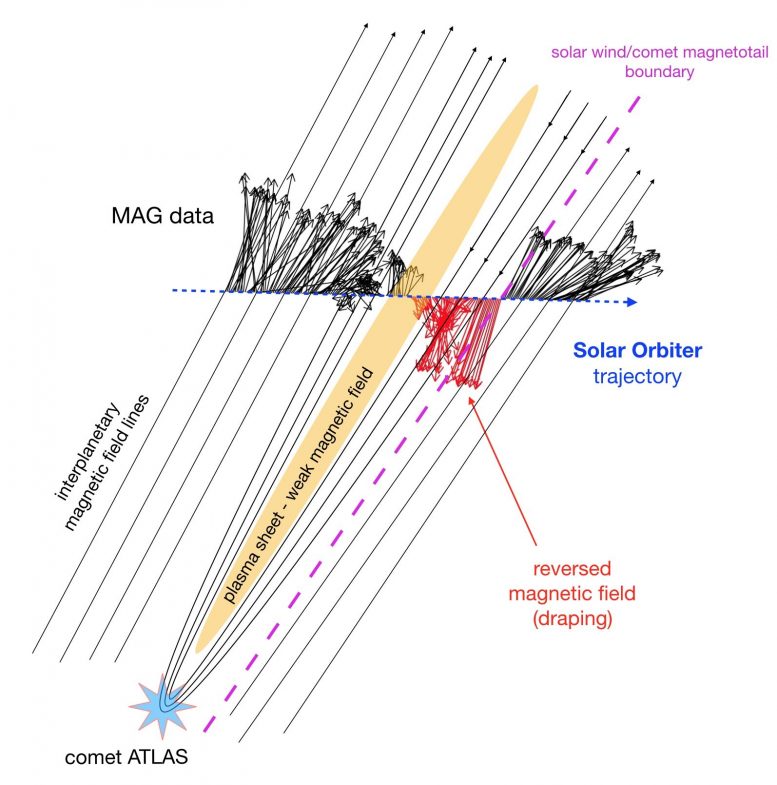
    Fragmented Comet C/2019 Y4 Schematic Reconstruction

    Comets are typically characterized by two separate tails; one is the well-known bright and curved dust tail, the other — typically fainter — is the ion tail. The ion tail originates from the interaction between the cometary gas and the surrounding solar wind, the hot gas of charged particles that constantly blows from the Sun and permeates the whole Solar System.

    How Solar Wind Shapes a Comet’s Ion Tail

    When the solar wind interacts with a solid obstacle, like a comet, its magnetic field is thought to bend and ‘drape’ around it. The simultaneous presence of magnetic field draping and cometary ions released by the melting of the icy nucleus then produces the characteristic second ion tail, which can extend for large distances downstream from the comet’s nucleus.

    Lorenzo Matteini, a solar physicist at Imperial College London and leader of the work, says: “This is quite a unique event, and an exciting opportunity for us to study the makeup and structure of comet tails in unprecedented detail. Hopefully, with the Parker Solar Probe and Solar Orbiter now orbiting the Sun closer than ever before, these events may become much more common in the future!”

    This is the first comet tail detection occurring so close to the Sun — well inside the orbit of Venus. It is also one of the very few cases where scientists have been able to make direct measurements from a fragmented comet. Data from this encounter is expected to contribute greatly to our understanding of the interaction of comets with the solar wind and the structure and formation of their ion tails.

    Meeting: Royal Astronomical Society National Astronomy Meeting

    Never miss a breakthrough: Join the SciTechDaily newsletter.
    Follow us on Google and Google News.

    Astronomy Astrophysics Comet Popular Royal Astronomical Society
    Share. Facebook Twitter Pinterest LinkedIn Email Reddit

    Related Articles

    “Project Hail Mary” – These 45 Exoplanets Could Be Home to Alien Life, Scientists Say

    The Center of Our Galaxy May Not Be a Black Hole

    Breaking a 50-Year Law: New Evidence Challenges Fundamental Black Hole Physics

    Astronomers Uncover Hidden Rings of Light in the Deep Universe

    Webb Telescope Spots Sparkling Crystals and Life’s Ingredients in the Butterfly Nebula

    New e-MERLIN Image of Betelgeuse Reveals Mysterious Hot Spots

    Gravitational Microlensing Could Lead to the Discovery of 100 Billion Earth-Like Planets

    Astronomers Believe a Gamma-Ray Burst Hit Earth in the 8th Century

    Trajectory Models of Refractory Particles Help Solve Two Solar System Puzzles

    2 Comments

    1. Jy on July 24, 2021 9:04 am

      Another picture of something. And we are just supposed to beleive it

      Reply
    2. L. Evans on July 25, 2021 5:58 am

      Hard to support any new like this without the proper visual evidence. Everyone knows the saying… ,”Pics or it never happened.

      Reply
    Leave A Reply Cancel Reply

    • Facebook
    • Twitter
    • Pinterest
    • YouTube

    Don't Miss a Discovery

    Subscribe for the Latest in Science & Tech!

    Trending News

    Why Popular Diabetes Drugs Like Ozempic Don’t Work for Everyone: The “Genetic Glitch”

    Scientists Stunned After Finding Plant Thought Extinct for 60 Years

    Scientists Discover Tiny New Spider That Hunts Prey 6x Its Size

    Natural Component From Licorice Shows Promise for Treating Inflammatory Bowel Disease

    Scientists Warn: Popular Sweetener Linked to Dangerous Metabolic Effects

    Monster Storms on Jupiter Unleash Lightning Beyond Anything on Earth

    Scientists Create “Liquid Gears” That Spin Without Touching

    The Simple Habit That Could Help Prevent Cancer

    Follow SciTechDaily
    • Facebook
    • Twitter
    • YouTube
    • Pinterest
    • Newsletter
    • RSS
    SciTech News
    • Biology News
    • Chemistry News
    • Earth News
    • Health News
    • Physics News
    • Science News
    • Space News
    • Technology News
    Recent Posts
    • 100,000-Year-Old Neanderthal Fossils in Poland Reveal Unexpected Genetic Connections
    • Unexpected Hormone Discovery Could Change How We Treat Arthritis
    • Scientists Supercharge “Natural Killer” Cells To Break Through Cancer’s Defenses
    • Simple “Gut Reset” May Prevent Weight Gain After Ozempic or Wegovy
    • 2.8 Days to Disaster: Scientists Warn Low Earth Orbit Could Suddenly Collapse
    Copyright © 1998 - 2026 SciTechDaily. All Rights Reserved.
    • Science News
    • About
    • Contact
    • Editorial Board
    • Privacy Policy
    • Terms of Use

    Type above and press Enter to search. Press Esc to cancel.