
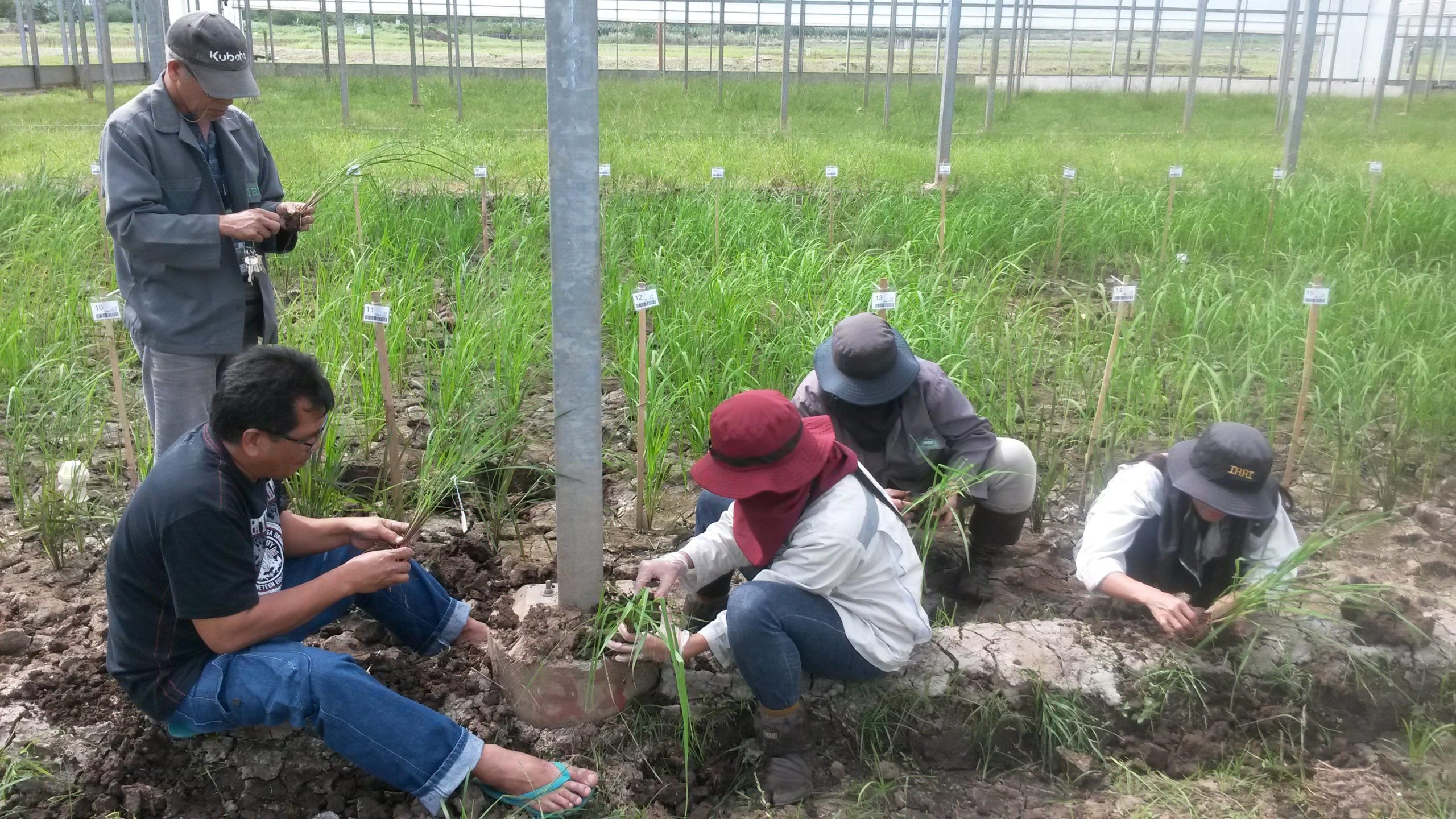
Study links gene expression patterns to traits that improve drought tolerance in rice plants.
For many smallholder farmers in South and Southeast Asia, rice is more than a staple food—it’s a livelihood. Generations of smallholder farmers have relied solely on rainfall to irrigate their crops, but the increasing frequency and severity of dry spells caused by climate change are putting rice production under extreme pressure. Some traditional rice varieties grown in these regions have adapted to dry conditions, and may hold the key to developing strategies to boost rice production under drought: “If we can identify the genes involved in drought resistance of traditional rice varieties, we can use this knowledge for breeding new, more stable-yielding, drought-resistant rice varieties,” says Dr. Simon “Niels” Groen, first author of an exciting new study published in The Plant Cell.
In a field experiment conducted in the Philippines, spanning two years and involving thousands of rice plants, Dr. Groen and his colleagues set out to do just that. Using a panel of 20 different rice varieties, some of which were known to stand up well to drought, the team explored how dry conditions affect gene expression patterns in rice, how drought-stressed rice plants coordinate gene expression between their roots and shoots, and how these gene expression patterns are linked to traits that make plants more resilient in dry conditions.
To obtain root material for their study, the team had to crack open rock-hard soil using pickaxes and hammers. As Dr. Groen puts it, “It was like searching for gold!” Their efforts paid off. The team identified a series of traits linked to rice plant fitness under drought, such as increased crown root density. Drought had a greater effect on gene expression patterns in the roots than in the shoots, but the team identified modules of co-expressed genes linked to drought tolerance in both the roots and the shoots. Many of these modules included genes that had previously been linked to improved drought tolerance, such as those involved in root-to-shoot water transport and photosynthesis, and one module contained genes known to be involved in interactions with soil-dwelling arbuscular mycorrhizal fungi. Interactions between the roots and beneficial soil organisms might enhance drought tolerance by improving access to nutrients and the authors are eager to explore this possibility further.
The team hopes that the gene modules identified in their study will guide efforts to breed resilient rice varieties, easing some of the pressures of a hotter, drier world: “We could see with our own eyes how drought can affect rice production and, most importantly, the lives of smallholder farmers in the area. This brought into perspective why we are doing the research that we are doing.”
Reference: “Evolutionary systems biology reveals patterns of rice adaptation to drought-prone agro-ecosystems Get access Arrow” by Simon C Groen, Zoé Joly-Lopez, Adrian E Platts, Mignon Natividad, Zoë Fresquez, William M Mauck, III, Marinell R Quintana, Carlo Leo U Cabral, Rolando O Torres, Rahul Satija, Michael D Purugganan and Amelia Henry, 15 November 2021, The Plant Cell.
DOI: 10.1093/plcell/koab275
Funding: National Science Foundation Plant Genome Research Program, NYU Abu Dhabi Research Institute, University of California at Riverside
Never miss a breakthrough: Join the SciTechDaily newsletter.
Follow us on Google and Google News.