
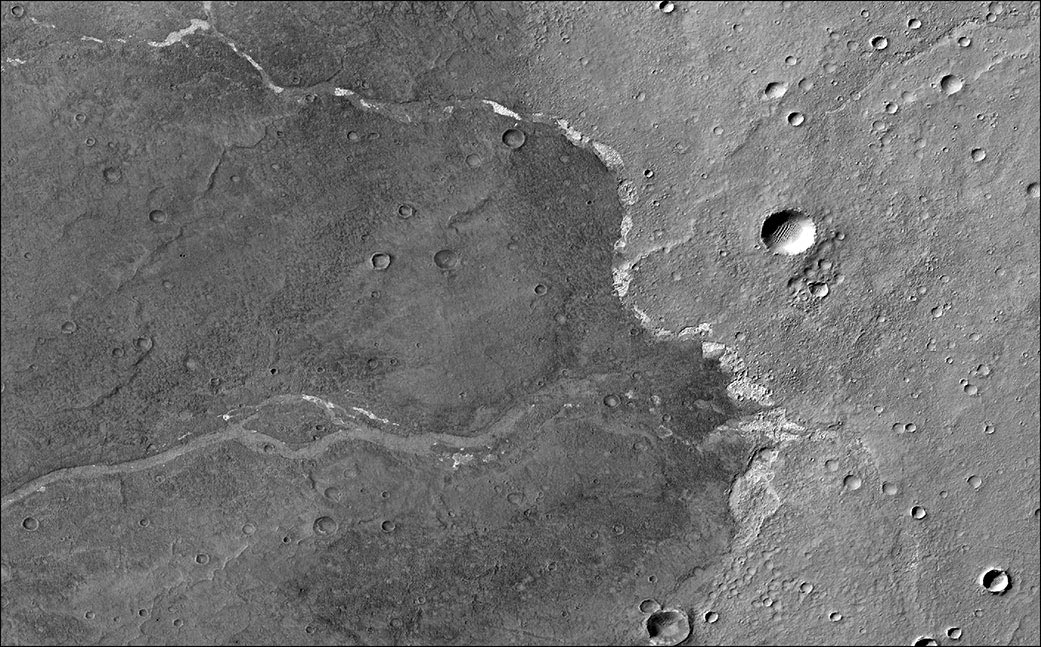
Caltech researchers used the Mars Reconnaissance Orbiter to determine that surface water left salt minerals behind as recently as 2 billion years ago.
Mars once rippled with rivers and ponds billions of years ago, providing a potential habitat for microbial life. As the planet’s atmosphere thinned over time, that water evaporated, leaving the frozen desert world that NASA’s Mars Reconnaissance Orbiter (MRO) studies today.
It’s commonly believed that Mars’ water evaporated about 3 billion years ago. But two scientists studying data that MRO has accumulated at Mars over the last 15 years have found evidence that reduces that timeline significantly: Their research reveals signs of liquid water on the Red Planet as recently as 2 billion to 2.5 billion years ago, meaning water flowed there about a billion years longer than previous estimates.
The findings – published in AGU Advances on December 27, 2021 – center on the chloride salt deposits left behind as icy meltwater flowing across the landscape evaporated.
While the shape of certain valley networks hinted that water may have flowed on Mars that recently, the salt deposits provide the first mineral evidence confirming the presence of liquid water. The discovery raises new questions about how long microbial life could have survived on Mars, if it ever formed at all. On Earth, at least, where there is water, there is life.
Mapping and Dating Mars’ Salt Deposits
The study’s lead author, Ellen Leask, performed much of the research as part of her doctoral work at Caltech in Pasadena. She and Caltech professor Bethany Ehlmann used data from the MRO instrument called the Compact Reconnaissance Imaging Spectrometer for Mars (CRISM) to map the chloride salts across the clay-rich highlands of Mars’ southern hemisphere – terrain pockmarked by impact craters. These craters were one key to dating the salts: The fewer craters a terrain has, the younger it is. By counting the number of craters on an area of the surface, scientists can estimate its age.
MRO has two cameras that are perfect for this purpose. The Context Camera, with its black-and-white wide-angle lens, helps scientists map the extent of the chlorides. To zoom in, scientists turn to the High-Resolution Imaging Science Experiment (HiRISE) color camera, allowing them to see details as small as a Mars rover from space. (See image below for an example.)

Using both cameras to create digital elevation maps, Leask and Ehlmann found that many of the salts were in depressions – once home to shallow ponds – on gently sloping volcanic plains. The scientists also found winding, dry channels nearby – former streams that once fed surface runoff (from the occasional melting of ice or permafrost) into these ponds. Crater counting and evidence of salts on top of volcanic terrain allowed them to date the deposits.
“What is amazing is that after more than a decade of providing high-resolution image, stereo, and infrared data, MRO has driven new discoveries about the nature and timing of these river-connected ancient salt ponds,” said Ehlmann, CRISM’s deputy principal investigator. Her co-author, Leask, is now a post-doctoral researcher at Johns Hopkins University’s Applied Physics Laboratory, which leads CRISM.
Implications for Past Life and Future Mars Missions
The salt minerals were first discovered 14 years ago by NASA’s Mars Odyssey orbiter, which launched in 2001. MRO, which has higher-resolution instruments than Odyssey, launched in 2005 and has been studying the salts, among many other features of Mars, ever since. Both are managed by NASA’s Jet Propulsion Laboratory in Southern California.
“Part of the value of MRO is that our view of the planet keeps getting more detailed over time,” said Leslie Tamppari, the mission’s deputy project scientist at JPL. “The more of the planet we map with our instruments, the better we can understand its history.”
Reference: “Evidence for Deposition of Chloride on Mars From Small-Volume Surface Water Events Into the Late Hesperian-Early Amazonian” by Ellen K. Leask and Bethany L. Ehlmann, 27 December 2021, AGU Advances.
DOI: 10.1029/2021AV000534
More About the Mission
JPL, a division of Caltech in Pasadena, California, manages the MRO mission for NASA’s Science Mission Directorate in Washington. The University of Arizona, in Tucson, operates HiRISE, which was built by Ball Aerospace & Technologies Corp., in Boulder, Colorado. MARCI and the Context Camera were both built and are operated by Malin Space Science Systems in San Diego.
Never miss a breakthrough: Join the SciTechDaily newsletter.
Follow us on Google and Google News.
3 Comments
Babu G. Ranganathan*
(B.A. Bible/Biology)
THE CELL could not have evolved. A partially evolved cell would quickly disintegrate under the effects of random forces of the environment, especially without the protection of a complete and fully functioning cell membrane. A partially evolved cell cannot wait millions of years for chance to make it complete and living! In fact, it couldn’t have even reached the partially evolved state.
CATCH-22 FOR EVOLUTIONARY ORIGIN OF LIFE
Just having the right materials, elements, and conditions do not mean that life can arise by chance.
Miller, in his famous experiment in 1953 showed that individual amino acids (the building blocks of life) could come into existence by chance. But, it’s not enough just to have amino acids. The various amino acids that make-up life must link together in a precise sequence, just like the letters in a sentence, to form functioning protein molecules. If they’re not in the right sequence the protein molecules won’t work. It has never been shown that various amino acids can bind together into a sequence by chance to form protein molecules. Even the simplest cell is made up of many millions of various protein molecules.
What many don’t realize is that although oxygen is necessary for life’s processes, the presence of oxygen would prevent life from coming into being. This is because oxygen is destructive unless there are mechanisms already in place to control, direct, and regulate it, such as what we find in already existing forms of life.
RNA and DNA are made up of molecules (nucleic acids) that must also exist in the right sequence. Furthermore, none of these sequential molecules, proteins, DNA, RNA, can function outside of a complete and living cell and all are mutually dependent on one another. One cannot come into existence without the other.
Mathematicians have said any event in the universe with odds of 10 to 50th power or greater is impossible! The probability of just a single average size protein molecule arising by chance is 10 to the 65th power. The late great British scientist Sir Frederick Hoyle calculated that the odds of even the simplest cell coming into existence by chance is 10 to the 40,000th power! How large is this? Consider that the total number of atoms in our universe is 10 to the 82nd power.
The cell could not have evolved. A partially evolved cell would quickly disintegrate under the effects of random forces of the environment, especially without the protection of a complete and fully functioning cell membrane. A partially evolved cell cannot wait millions of years for chance to make it complete and living! In fact, it couldn’t have even reached the partially evolved state.
Alien beings, even if they do exist, could not have evolved. How could they have survived millions of years while the very biological structures, organs, and systems necessary for their survival were supposedly still evolving? Life, in any form (even a single-celled organism), must be complete, fully integrated, and fully-functioning from the very start to be fit for survival.
Of course, once there is a complete and living cell then the code and mechanisms exist to direct the formation of more cells. The problem for evolutionists is how did the cell originate when there were no directing code and mechanisms in nature. Natural laws may explain how a cell or airplane works but mere undirected natural laws could not have brought about the existence of either.
What about synthetic life? Scientists didn’t create life itself. What they’ve done is, by using intelligent design and sophisticated technology, scientists built DNA code from scratch and then they implanted that man-made DNA into an already existing living cell and alter that cell. That’s what synthetic life is.
Through genetic engineering scientists have been able to produce new forms of life by altering already existing forms of life, but they have never created life from non-living matter. Even if they do, it won’t be by chance but by intelligent design. That doesn’t help the theory of evolution.
What about natural selection? Natural selection doesn’t create or produce anything. It can only “select” from biological variations that are possible and which have survival value. If a variation occurs that helps a species survive, that survival is called ” natural selection.” It’s a passive process. There’s no conscious selection by nature, and natural selection only operates in nature once there is life and reproduction and not before, so it would not be of assistance to the origin of life.
Science can’t prove we’re here by chance or design. Neither was observed. Both are positions of faith. The issue is which faith is best supported by science. Let the scientific arguments of both sides be presented.
Read my popular Internet articles:
THE NATURAL LIMITS TO EVOLUTION
ANY LIFE ON MARS CAME FROM EARTH
Visit my Internet site: THE SCIENCE SUPPORTING CREATION
Author of the popular Internet article, TRADITIONAL DOCTRINE OF HELL EVOLVED FROM GREEK ROOTS
*I have given successful lectures (with question and answer period afterwards) defending creation before evolutionist science faculty and students at various colleges and universities. I’ve been privileged to be recognized in the 24th edition of Marquis “Who’s Who in The East” for my writings on religion and science.
@ Babu G. Ranganathan
🤣🤣🤣
Hydrogen separated from Mars water then oxygen remains on the surface to oxidize the raining trojan debris from the asteroid belt. BA on physics and MS in astronomy and teacher, professor for forty five years. Prove me wrong…
[email protected] or r