
Close Menu
    Facebook X (Twitter) Instagram
    SciTechDaily
    • Biology
    • Chemistry
    • Earth
    • Health
    • Physics
    • Science
    • Space
    • Technology
    Facebook X (Twitter) Pinterest YouTube RSS
    SciTechDaily
    Home»Space»Spectacular Disintegration of Comet ATLAS Captured by Hubble Space Telescope
    Space

    Spectacular Disintegration of Comet ATLAS Captured by Hubble Space Telescope

    By ESA/HubbleApril 29, 2020No Comments4 Mins Read
    Facebook Twitter Pinterest Telegram LinkedIn WhatsApp Email Reddit
    Share
    Facebook Twitter LinkedIn Pinterest Telegram Email Reddit
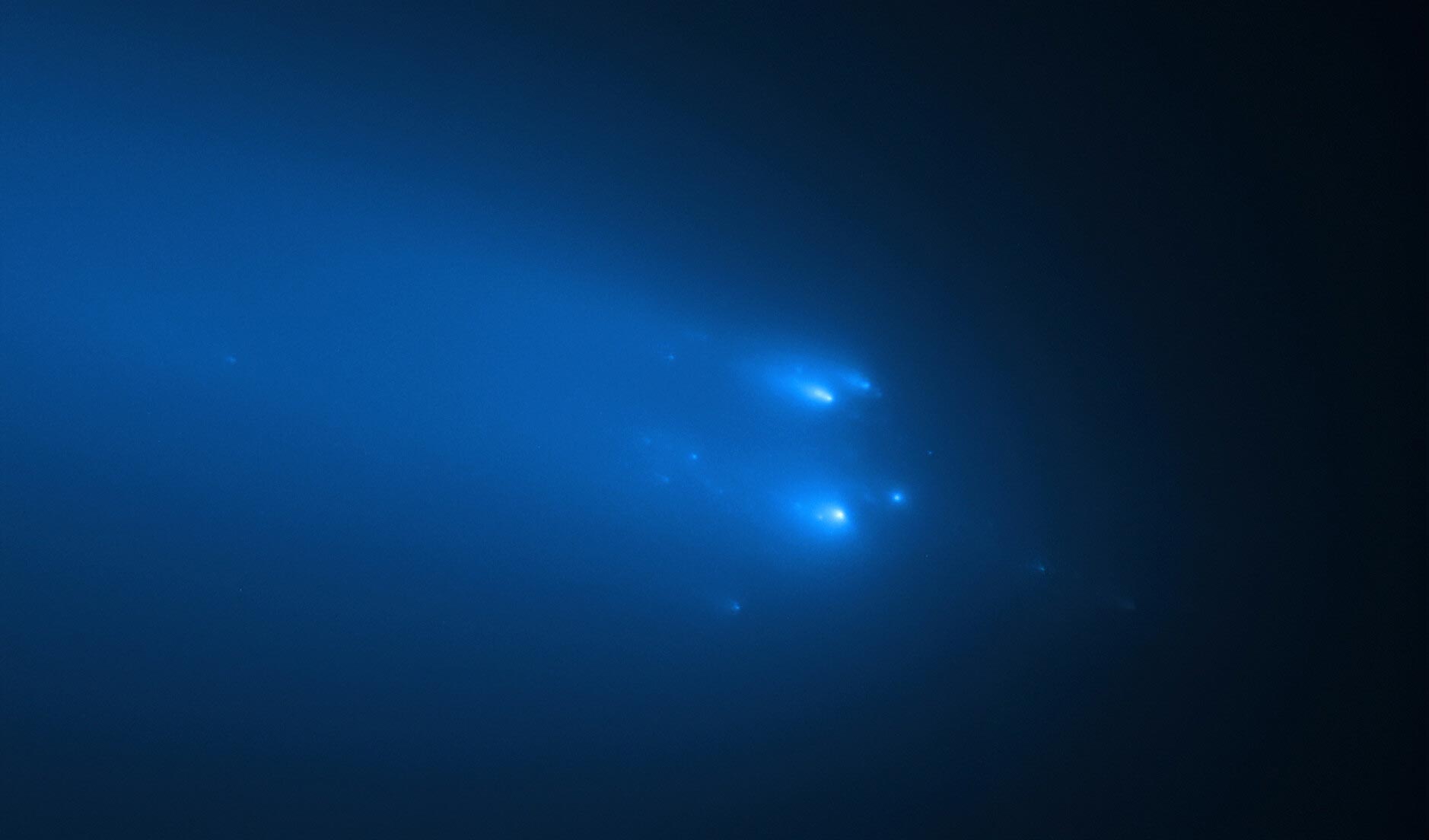
    Hubble Observation of ATLAS Comet on April 20, 2020
    The NASA/ESA Hubble Space Telescope has provided astronomers with the sharpest view yet of the breakup of Comet C/2019 Y4 (ATLAS). The telescope resolved roughly 30 fragments of the comet on April 20. The comet was first discovered in December 2019 by the ATLAS (Asteroid Terrestrial-impact Last Alert System) and its fragmentation was confirmed in April 2020. Credit: NASA, ESA, D. Jewitt (UCLA), Q. Ye (University of Maryland)

    The comet was first discovered in December 2019 by the ATLAS (Asteroid Terrestrial-impact Last Alert System) robotic astronomical survey system in Hawaiʻi, USA. It brightened quickly until mid-March, and some astronomers initially anticipated that it might be visible to the naked eye in May to become one of the most spectacular comets seen in the last two decades. However, the comet abruptly began to get dimmer, leading astronomers to speculate that the icy core may be fragmenting, or even disintegrating. ATLAS’s fragmentation was confirmed by amateur astronomer Jose de Queiroz, who photographed around three pieces of the comet on 11 April. 

    The Hubble Space Telescope’s new observations of the comet’s breakup on April 20 and 23 reveal that the broken fragments are all enveloped in a sunlight-swept tail of cometary dust. These images provide further evidence that comet fragmentation is probably common and might even be the dominant mechanism by which the solid, icy nuclei of comets die. 

    “Their appearance changes substantially between the two days, so much so that it’s quite difficult to connect the dots,” said David Jewitt of UCLA, leader of one of two teams who imaged the doomed comet with Hubble. “I don’t know whether this is because the individual pieces are flashing on and off as they reflect sunlight, acting like twinkling lights on a Christmas tree, or because different fragments appear on different days.”

    “This is really exciting — both because such events are super cool to watch and because they do not happen very often. Most comets that fragment are too dim to see. Events at such scale only happen once or twice a decade,” said the leader of the second Hubble observing team, Quanzhi Ye, of the University of Maryland.
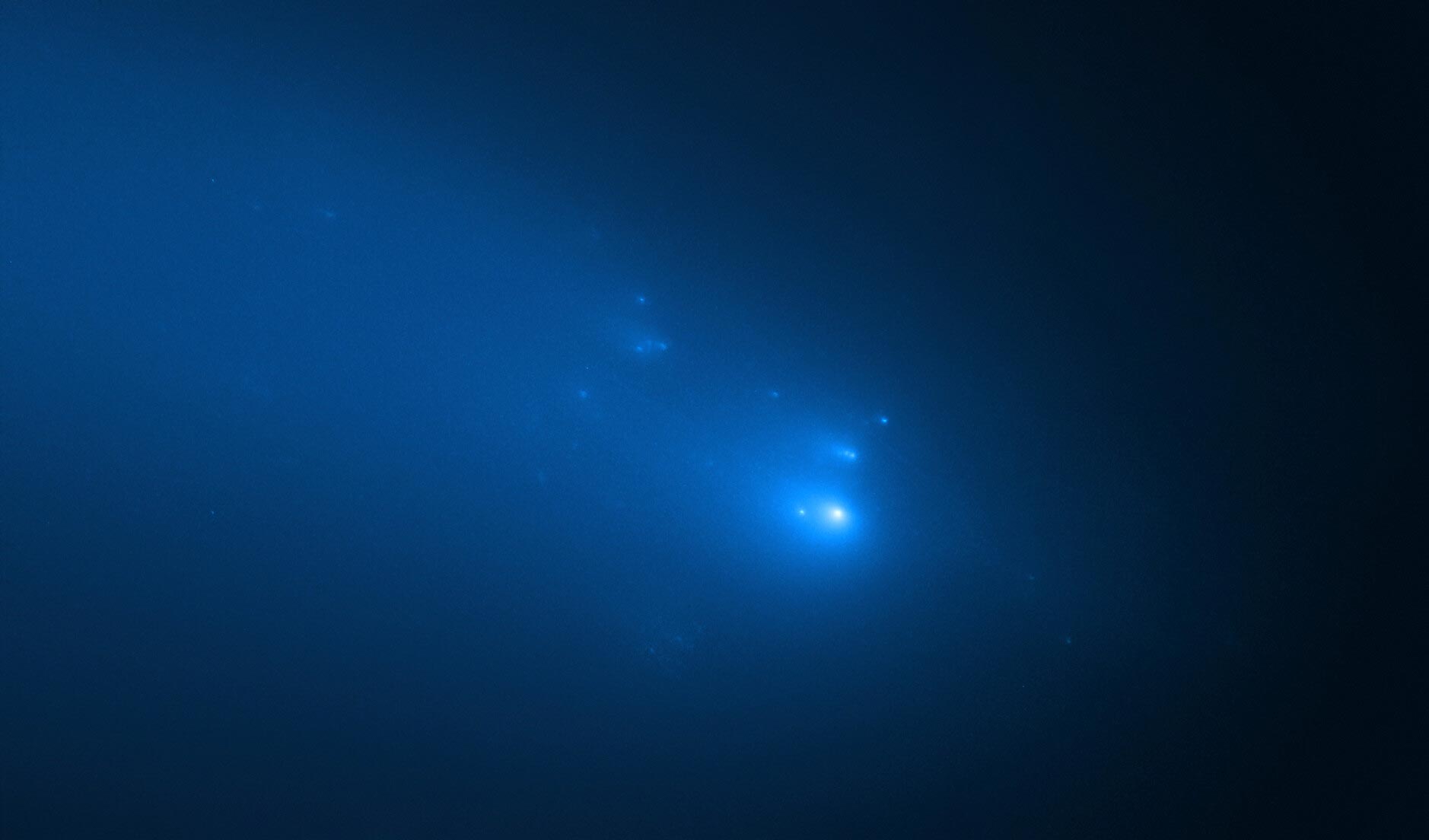
    Hubble Observation of ATLAS Comet on April 23, 2020
    The NASA/ESA Hubble Space Telescope has provided astronomers with the sharpest view yet of the breakup of Comet C/2019 Y4 (ATLAS). The telescope resolved roughly 25 fragments of the comet on April 23. Credit: NASA, ESA, D. Jewitt (UCLA), Q. Ye (University of Maryland)

    Because comet fragmentation happens quickly and unpredictably, reliable observations are rare. Therefore, astronomers remain largely uncertain about the cause of fragmentation. One suggestion is that the original nucleus spins itself into pieces because of the jet action of outgassing from sublimating ices. As this venting is likely not evenly dispersed across the comet, it enhances the breakup. “Further analysis of the Hubble data might be able to show whether or not this mechanism is responsible,” said Jewitt. “Regardless, it’s quite special to get a look with Hubble at this dying comet.”

    Hubble’s crisp images may yield new clues to the breakup. The telescope has distinguished pieces as small as the size of a house. Before the breakup, the entire nucleus may have been no more than the length of two football fields.

    The disintegrating ATLAS comet is currently located inside the orbit of Mars, at a distance of approximately 145 million kilometers from Earth when the latest Hubble observations were taken. The comet will make its closest approach to Earth on 23 May at a distance of approximately 115 million kilometers, and eight days later it will skirt within 37 million kilometers of the Sun.

    Read Hubble Watches Comet ATLAS Disintegrate for more on this research.

    Never miss a breakthrough: Join the SciTechDaily newsletter.
    Follow us on Google and Google News.

    Astronomy Comet European Space Agency Hubble Space Telescope NASA
    Share. Facebook Twitter Pinterest LinkedIn Email Reddit

    Related Articles

    This Nearby Galaxy Shows How Frozen Clouds Ignite Into Stars

    This Chaotic Spiral Galaxy Is Still Recovering From a Cosmic Collision

    This Strange Spiral Galaxy Is Hiding a Massive Black Hole

    Hubble Zooms In on a Galaxy That Maps the Universe’s Expansion

    Hubble Captures a Dazzling Spiral Galaxy Alive With Birth and Destruction

    Hubble Spots a Glowing “Ring of Fire” in a Distant Spiral Galaxy

    Hubble Reveals a Rare Interstellar Comet Racing at 130,000 MPH Through Our Solar System

    Dust, Light & Ancient Collisions: The Sombrero Galaxy Like You’ve Never Seen It

    Star Formation in Motion: Hubble Reveals Spiraling Stars and Sculpted Nebulae

    Leave A Reply Cancel Reply

    • Facebook
    • Twitter
    • Pinterest
    • YouTube

    Don't Miss a Discovery

    Subscribe for the Latest in Science & Tech!

    Trending News

    Collapsing Plasma May Hold the Key to Cosmic Magnetism

    This Breakthrough Solar Panel Generates Power From Both Sunlight and Raindrops

    Scientists Uncover New Metabolic Effects Beyond Weight Loss of Mounjaro

    Scientists Discover Cancer Tumors Are “Addicted” to This Common Antioxidant

    1,800 Miles Down: Scientists Uncover Mysterious Movements at the Edge of Earth’s Core

    Scientists Discover Hidden “Good Fats” in Green Rice That Could Transform Nutrition

    Your Child’s Clothes Could Contain Toxic Lead, Study Finds

    Researchers Break a 150-Year-Old Math Law With a Surprising Donut Discovery

    Follow SciTechDaily
    • Facebook
    • Twitter
    • YouTube
    • Pinterest
    • Newsletter
    • RSS
    SciTech News
    • Biology News
    • Chemistry News
    • Earth News
    • Health News
    • Physics News
    • Science News
    • Space News
    • Technology News
    Recent Posts
    • The Biggest Volcanic Event in Earth’s History Transformed an Entire Oceanic Plate
    • Scientists Warn: Humanity Has Pushed the Planet Past Its Limits
    • Stronger Flu Shot Linked to Nearly 55% Lower Alzheimer’s Risk, Study Finds
    • Researchers Say That Eating Mango With Avocado Offers Surprising Heart Benefits
    • Are You Drinking Plastic? Study Raises Concerns About Bottled Water
    Copyright © 1998 - 2026 SciTechDaily. All Rights Reserved.
    • Science News
    • About
    • Contact
    • Editorial Board
    • Privacy Policy
    • Terms of Use

    Type above and press Enter to search. Press Esc to cancel.