
Close Menu
    Facebook X (Twitter) Instagram
    SciTechDaily
    • Biology
    • Chemistry
    • Earth
    • Health
    • Physics
    • Science
    • Space
    • Technology
    Facebook X (Twitter) Pinterest YouTube RSS
    SciTechDaily
    Home»Space»Hubble Watches Comet ATLAS Disintegrate – Identified Months Ago by Planetary Defense System
    Space

    Hubble Watches Comet ATLAS Disintegrate – Identified Months Ago by Planetary Defense System

    By NASA/Goddard Space Flight CenterApril 28, 2020No Comments4 Mins Read
    Facebook Twitter Pinterest Telegram LinkedIn WhatsApp Email Reddit
    Share
    Facebook Twitter LinkedIn Pinterest Telegram Email Reddit
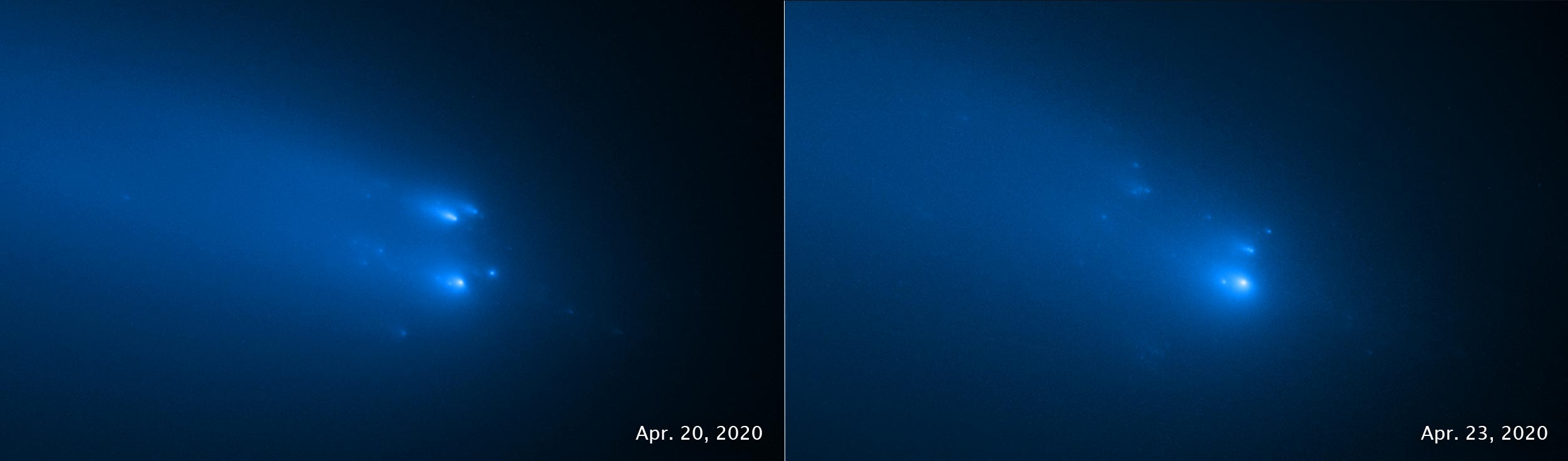
    Comet C/2019 Y4 ATLAS Disintegrates
    These two Hubble Space Telescope images of comet C/2019 Y4 (ATLAS), taken on April 20 (left) and April 23, 2020, provide the sharpest views yet of the breakup of the solid nucleus of the comet. Hubble’s eagle-eye view identifies as many as 30 separate fragments. Hubble distinguishes pieces that are roughly the size of a house. Before the breakup, the entire nucleus of the comet may have been the length of one or two football fields. Astronomers aren’t sure why this comet broke apart. The comet was approximately 91 million miles (146 million kilometers) from Earth when the images were taken. Credit: NASA, ESA, STScI and D. Jewitt (UCLA)

    These two Hubble Space Telescope images of comet C/2019 Y4 (ATLAS), taken on April 20 and 23, 2020, provide the sharpest views yet of the breakup of the fragile comet.

    Hubble identified about 30 fragments on April 20, and 25 pieces on April 23. They are all enveloped in a sunlight-swept tail of cometary dust. “Their appearance changes substantially between the two days, so much so that it’s quite difficult to connect the dots,” said David Jewitt, professor of planetary science and astronomy at UCLA, Los Angeles, and leader of one of two teams that photographed the doomed comet with Hubble. “I don’t know whether this is because the individual pieces are flashing on and off as they reflect sunlight, acting like twinkling lights on a Christmas tree, or because different fragments appear on different days.”

    “This is really exciting — both because such events are super cool to watch and because they do not happen very often. Most comets that fragment are too dim to see. Events at such scale only happen once or twice a decade,” said the leader of a second Hubble observing team, Quanzhi Ye, of the University of Maryland, College Park.

    The results are evidence that comet fragmentation is actually fairly common, say researchers. It might even be the dominant mechanism by which the solid, icy nuclei of comets die. Because this happens quickly and unpredictably, astronomers remain largely uncertain about the cause of fragmentation. Hubble’s crisp images may yield new clues to the breakup. Hubble distinguishes pieces as small as the size of a house. Before the breakup, the entire nucleus may have been no more than the length of two football fields.

    One idea is that the original nucleus spun itself into pieces because of the jet action of outgassing from sublimating ices. Because such venting is probably not evenly dispersed across the comet, it enhances the breakup. “Further analysis of the Hubble data might be able to show whether or not this mechanism is responsible,” said Jewitt. “Regardless, it’s quite special to get a look with Hubble at this dying comet.”

    The comet was discovered on December 29, 2019, by the ATLAS (Asteroid Terrestrial-impact Last Alert System) robotic astronomical survey system based in Hawaii. This NASA-supported survey project for Planetary Defense operates two autonomous telescopes that look for Earth-approaching comets and asteroids.

    The comet brightened quickly until mid-March, and some astronomers anticipated that it might be visible to the naked eye in May to become one of the most spectacular comets seen in the last 20 years.

    However, the comet abruptly started to get dimmer instead of brighter. Astronomers speculated that the icy core may be fragmenting, or even disintegrating. ATLAS’ fragmentation was confirmed by amateur astronomer Jose de Queiroz, who was able to photograph around three pieces of the comet on April 11.

    The disintegrating comet was approximately 91 million miles (146 million kilometers) from Earth when the latest Hubble observations were taken. If any of it survives, the comet will make its closest approach to Earth on May 23 at a distance of about 72 million miles (116 million kilometers), and eight days later it will skirt past the Sun at 25 million miles (40 million kilometers).

    For more on this story, read Spectacular Disintegration of Comet ATLAS Captured by Hubble Space Telescope.

    The Hubble Space Telescope is a project of international cooperation between NASA and ESA (European Space Agency). NASA’s Goddard Space Flight Center in Greenbelt, Maryland, manages the telescope. The Space Telescope Science Institute (STScI) in Baltimore conducts Hubble science operations. STScI is operated for NASA by the Association of Universities for Research in Astronomy in Washington, D.C.

    Never miss a breakthrough: Join the SciTechDaily newsletter.
    Follow us on Google and Google News.

    Astronomy Comet Hubble Space Telescope NASA NASA Goddard Space Flight Center Planetary Defense
    Share. Facebook Twitter Pinterest LinkedIn Email Reddit

    Related Articles

    Hubble Confirms Largest Comet Nucleus Ever Seen – A Staggering 500 Trillion Tons Headed This Way

    Doomed Celestial Visitor May Have Been Piece of Prehistoric Comet

    Mysterious Visitor From the Depths of Space Swings Past Sun

    First Confirmed Interstellar Comet Observed by Hubble [Video]

    Mystery As Hubble Finds Milky Way Raids Intergalactic ‘Bank Accounts’

    Hubble Reveals Multiple Jets Sprouting from Comet C/2013 A1

    Hubble Captures a New Image of Comet ISON

    Time-Lapse Video Captures Comet ISON Heading Toward the Sun

    Hubble Captures Close-Up View of Comet ISON

    Leave A Reply Cancel Reply

    • Facebook
    • Twitter
    • Pinterest
    • YouTube

    Don't Miss a Discovery

    Subscribe for the Latest in Science & Tech!

    Trending News

    New Study Reveals Why Ozempic Works Better for Some People Than Others

    Climate Change Is Altering a Key Greenhouse Gas in a Way Scientists Didn’t Expect

    New Study Suggests Gravitational Waves May Have Created Dark Matter

    Scientists Discover Why the Brain Gets Stuck in Schizophrenia

    Scientists Engineer “Tumor-Eating” Bacteria That Devour Cancer From Within

    Even “Failed” Diets May Deliver Long-Term Health Gains, Study Finds

    NIH Scientists Discover Powerful New Opioid That Relieves Pain Without Dangerous Side Effects

    Collapsing Plasma May Hold the Key to Cosmic Magnetism

    Follow SciTechDaily
    • Facebook
    • Twitter
    • YouTube
    • Pinterest
    • Newsletter
    • RSS
    SciTech News
    • Biology News
    • Chemistry News
    • Earth News
    • Health News
    • Physics News
    • Science News
    • Space News
    • Technology News
    Recent Posts
    • Household Cats Could Hold the Secret to Fighting Breast Cancer
    • Scientists Say This Natural Hormone Reverses Obesity by Targeting the Brain
    • This 15,000-Year-Old Discovery Changes What We Know About Early Human Creativity
    • 35-Million-Year-Old Mystery: Strange Arachnid Discovered Preserved in Amber
    • Revolutionary Gas Turbine Generates Power Without Air Compression
    Copyright © 1998 - 2026 SciTechDaily. All Rights Reserved.
    • Science News
    • About
    • Contact
    • Editorial Board
    • Privacy Policy
    • Terms of Use

    Type above and press Enter to search. Press Esc to cancel.