
Close Menu
    Facebook X (Twitter) Instagram
    SciTechDaily
    • Biology
    • Chemistry
    • Earth
    • Health
    • Physics
    • Science
    • Space
    • Technology
    Facebook X (Twitter) Pinterest YouTube RSS
    SciTechDaily
    Home»Space»Hubble Reveals Multiple Jets Sprouting from Comet C/2013 A1
    Space

    Hubble Reveals Multiple Jets Sprouting from Comet C/2013 A1

    By J.D. Harrington, NASAMarch 28, 2014No Comments3 Mins Read
    Facebook Twitter Pinterest Telegram LinkedIn WhatsApp Email Reddit
    Share
    Facebook Twitter LinkedIn Pinterest Telegram Email Reddit
    Hubble Spots Mars Bound Comet Sprout Multiple Jets
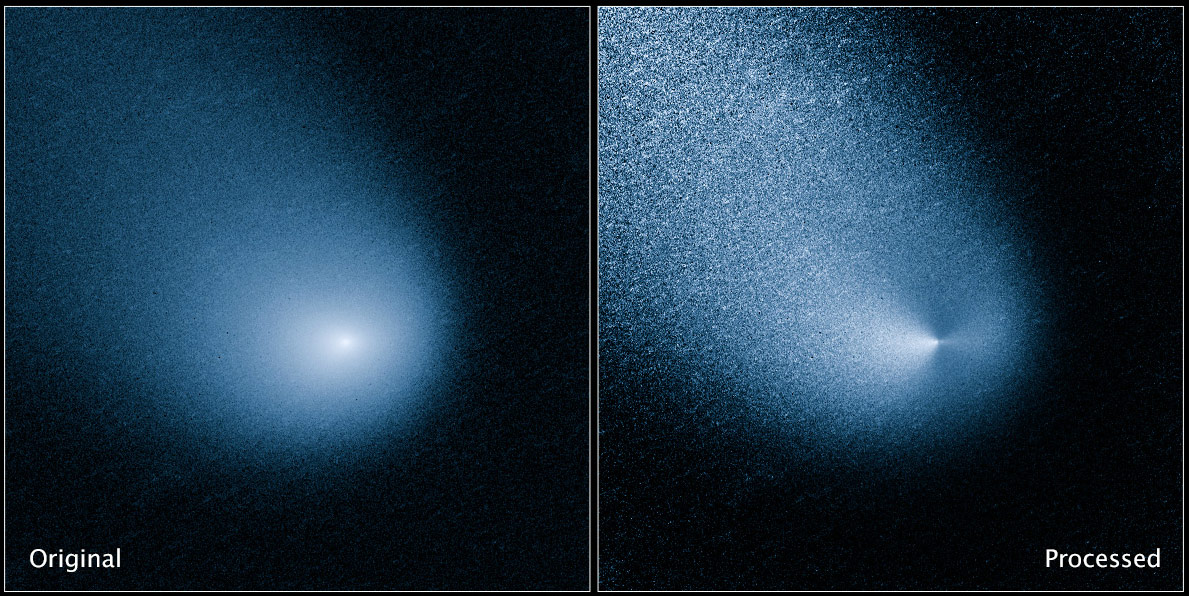
    The images above show – before and after filtering – comet C/2013 A1, also known as Siding Spring, as captured by Wide Field Camera 3 on NASA’s Hubble Space Telescope. Credit: NASA, ESA, and J.-Y. Li (Planetary Science Institute)

    This newly released Hubble image of comet C/2013 A1 reveals what appears to be two jets of dust coming off the location of the nucleus in opposite directions.

    NASA released Thursday an image of a comet that, on October 19, will pass within 84,000 miles (135,000 kilometers) of Mars – less than half the distance between Earth and our moon.

    The image on the left, captured March 11 by NASA’s Hubble Space Telescope, shows comet C/2013 A1, also called Siding Spring, at a distance of 353 million miles (568 million kilometers) from Earth. Hubble can’t see Siding Spring’s icy nucleus because of its diminutive size. The nucleus is surrounded by a glowing dust cloud, or COMA, that measures roughly 12,000 miles (19,300 kilometers) across.

    The right image shows the comet after image processing techniques were applied to remove the hazy glow of the coma revealing what appear to be two jets of dust coming off the location of the nucleus in opposite directions. This observation should allow astronomers to measure the direction of the nucleus’s pole, and axis of rotation.

    Hubble also observed Siding Spring on January 21 as Earth was crossing its orbital plane, which is the path the comet takes as it orbits the sun. This positioning of the two bodies allowed astronomers to determine the speed of the dust coming off the nucleus.

    “This is critical information that we need to determine whether, and to what degree, dust grains in the coma of the comet will impact Mars and spacecraft in the vicinity of Mars,” said Jian-Yang Li of the Planetary Science Institute in Tucson, Arizona.

    Discovered in January 2013 by Robert H. McNaught at Siding Spring Observatory, the comet is falling toward the sun along a roughly 1 million-year orbit and is now within the radius of Jupiter’s orbit. The comet will make its closest approach to our sun on October 25, at a distance of 130 million miles (210 million kilometers) – well outside of Earth’s orbit. The comet is not expected to become bright enough to be seen by the naked eye.

    The Hubble Space Telescope is a project of international cooperation between NASA and the European Space Agency. NASA’s Goddard Space Flight Center in Greenbelt, Maryland, manages the telescope. The Space Telescope Science Institute (STScI) in Baltimore conducts Hubble science operations. STScI is operated for NASA by the Association of Universities for Research in Astronomy, Inc., in Washington.

    Never miss a breakthrough: Join the SciTechDaily newsletter.
    Follow us on Google and Google News.

    Astronomy Comet Hubble Space Telescope NASA
    Share. Facebook Twitter Pinterest LinkedIn Email Reddit

    Related Articles

    Hubble Reveals a Rare Interstellar Comet Racing at 130,000 MPH Through Our Solar System

    Wayward Comet Makes a Temporary Stop Near Jupiter’s Asteroids

    Spectacular Disintegration of Comet ATLAS Captured by Hubble Space Telescope

    Hubble Watches Comet ATLAS Disintegrate – Identified Months Ago by Planetary Defense System

    Mysterious Visitor From the Depths of Space Swings Past Sun

    First Confirmed Interstellar Comet Observed by Hubble [Video]

    Hubble Captures a New Image of Comet ISON

    Time-Lapse Video Captures Comet ISON Heading Toward the Sun

    Hubble Captures Close-Up View of Comet ISON

    Leave A Reply Cancel Reply

    • Facebook
    • Twitter
    • Pinterest
    • YouTube

    Don't Miss a Discovery

    Subscribe for the Latest in Science & Tech!

    Trending News

    Breakthrough Bowel Cancer Trial Leaves Patients Cancer-Free for Nearly 3 Years

    Natural Compound Shows Powerful Potential Against Rheumatoid Arthritis

    100,000-Year-Old Neanderthal Fossils in Poland Reveal Unexpected Genetic Connections

    Simple “Gut Reset” May Prevent Weight Gain After Ozempic or Wegovy

    2.8 Days to Disaster: Scientists Warn Low Earth Orbit Could Suddenly Collapse

    Common Food Compound Shows Surprising Power Against Superbugs

    5 Simple Ways To Remember More and Forget Less

    The Atomic Gap That Could Cost the Semiconductor Industry Billions

    Follow SciTechDaily
    • Facebook
    • Twitter
    • YouTube
    • Pinterest
    • Newsletter
    • RSS
    SciTech News
    • Biology News
    • Chemistry News
    • Earth News
    • Health News
    • Physics News
    • Science News
    • Space News
    • Technology News
    Recent Posts
    • After 37 Years, the World’s Longest-Running Soil Warming Experiment Uncovers a Startling Climate Secret
    • NASA Satellite Captures First-Ever High-Res View of Massive Pacific Tsunami
    • ADHD Isn’t Just a Deficit: Study Reveals Powerful Hidden Strengths
    • Scientists Uncover “Astonishing” Hidden Property of Light
    • Scientists Discover Stem Cells That Could Regrow Teeth and Bone
    Copyright © 1998 - 2026 SciTechDaily. All Rights Reserved.
    • Science News
    • About
    • Contact
    • Editorial Board
    • Privacy Policy
    • Terms of Use

    Type above and press Enter to search. Press Esc to cancel.