
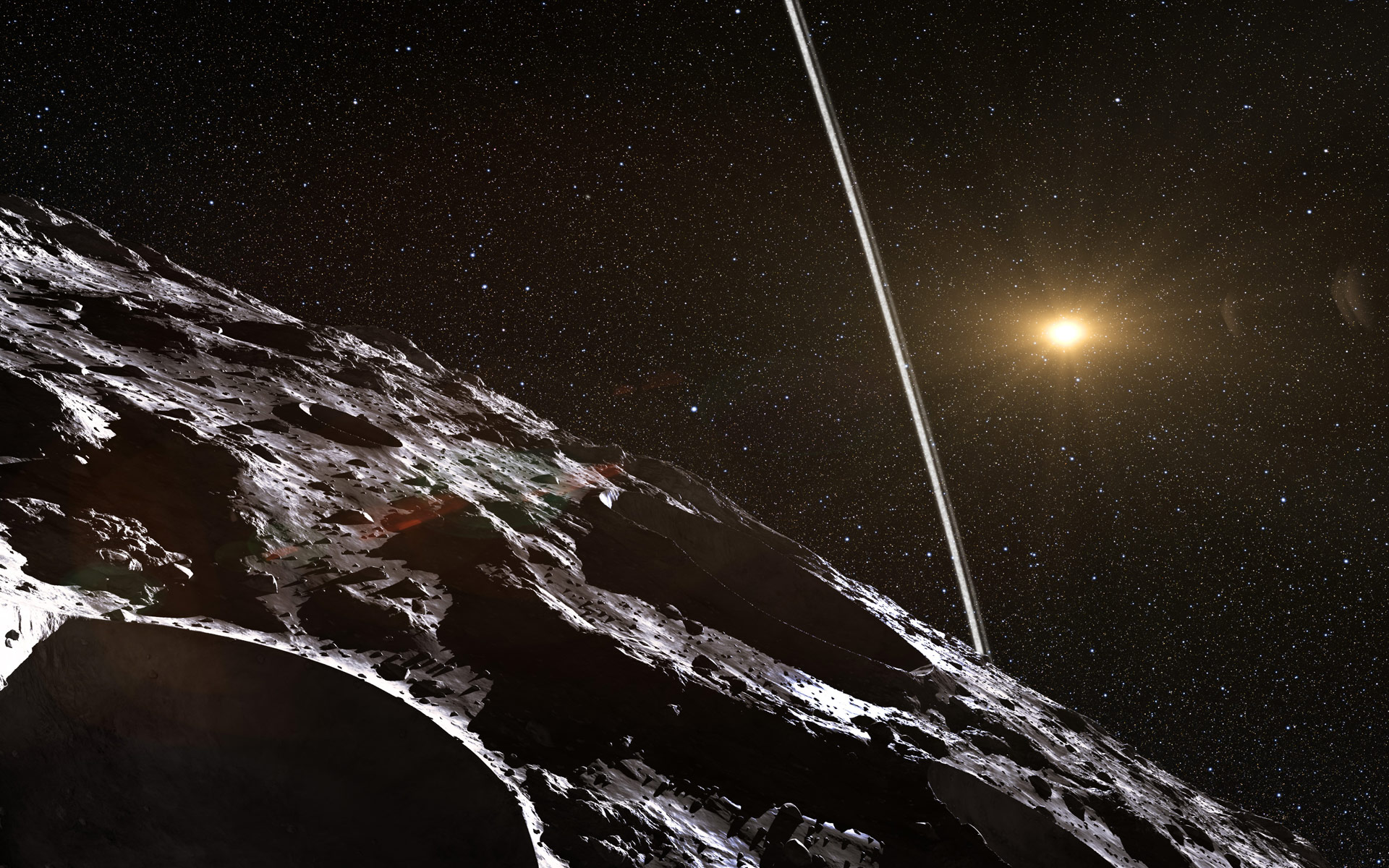
A surprise discovery shows that the remote asteroid Chariklo is surrounded by two dense and narrow rings, making it the smallest object discovered to have rings and only the fifth body in our solar system.
The asteroid Chariklo, which circles the Sun between the orbits of Saturn and Uranus, is surrounded by two thin rings of ice particles. It is thus the fifth body in the Solar System known to exhibit such a ring system – next to the giant planets Jupiter, Saturn, Uranus, and Neptune – and the first rocky body. This result was obtained by an international observational campaign to which scientists from the Max Planck Institute for Solar System Research (MPS) in Germany contributed. The researchers benefited from a rare occultation on 3 June 2013, when the asteroid passed before a star concealing it for several seconds.
“Sometimes in astronomy you get lucky,” says Colin Snodgrass from the MPS looking back on the chance discovery. Snodgrass was part of the research team led by Felipe Braga-Ribas from the Observatório Nacional in Rio de Janeiro (Brazil) that planned to use the occultation on 3 June 2013 to measure the size of asteroid Chariklo. In such a configuration, the asteroid covers the star causing it to disappear briefly – similar to the way the Moon conceals the Sun during a solar eclipse. From the time between the star’s vanishing to its reappearance scientists can deduce the asteroid’s size.
To this end, seven observatories in South America pointed their telescopes to the rare alignment on 3 June 2013. However, to everyone’s surprise, the star did not just disappear once. In addition, a few seconds before and afterward its brightness dropped abruptly. Even observatories located outside the viewing-range of the actual occultation observed this effect.
This ESOcast shows how observations at many sites in South America, including ESO’s La Silla Observatory, have made the surprise discovery that the remote asteroid Chariklo is surrounded by two dense and narrow rings. This is the smallest object by far found to have rings and only the fifth body in the Solar System — after the much larger planets Jupiter, Saturn, Uranus, and Neptune — to have this feature. The origin of these rings remains a mystery, but they may be the result of a collision that created a disc of debris. Credit: ESO
“The analysis of all observational data revealed a surprising result”, says Snodgrass. “Chariklo must be surrounded by a ring.” So far, only four bodies with this striking feature are known in the Solar System: the four gas giant planets Jupiter, Saturn, Uranus, and Neptune. With a diameter of only approximately 250 kilometers (155 miles), Chariklo is significantly smaller. The asteroid belongs to a group of small bodies called Centaurs that circle the Sun beyond the orbit of Jupiter.
The measurements performed with the Danish 1.54-meter telescope of the European Southern Observatory in La Silla (Chile) rendered especially precise results: the data show a ring system, which consists of two distinct structures. “Both rings are very thin, almost filigree from an astronomical point of view,” says Snodgrass, who analyzed this data. A gap of only nine kilometers separates the inner ring with a width of seven kilometers and the outer ring with a width of three kilometers. The inner ring is clearly brighter.
The new results now offer an explanation for earlier, confusing observations of Chariklo. While some researchers had found signatures of frozen water, others were not able to confirm this. “Apparently, the ice is found in the ring system, rather than on the surface,” says Snodgrass. Depending on how the body is inclined as seen from the Earth at the observation time, this ring system produces a weak or a strong signal. “The situation is similar to looking at a sheet of paper from the side”, explains Snodgrass. “If you hold it exactly horizontally at the level of your eyes, it is hard to see. Tilt it slightly and it becomes visible.”
How Chariklo’s ring systems originated, however, is still unclear. The researchers believe that it may have formed from the debris of an earlier collision. Also to be determined is whether Chariklo is one of a kind. Within the asteroid belt between the orbits of Mars and Jupiter, which is densely populated by probably more than one million smaller and larger chunks, researchers deem the existence of a be-ringed asteroid as unlikely. “Compared to the gas planets, these small bodies have only a minimal gravitational field binding the components of the rings”, Snodgrass points out. Another body passing nearby could destabilize the entire system. Beyond Jupiter, however, the Solar System is a rather deserted place. “Maybe in years to come we will discover other Centaurs like Chariklo”, speculates Snodgrass.
This video shows what happened when the asteroid Chariklo passed in front of a star. As well as the expected drop in brightness when the asteroid blocked the light of the star two smaller dips were seen, before and afterward, caused by the presence of a double ring. Credit: ESO/Felipe Braga Ribas/M. Kornmesser
Reference: “A ring system detected around the Centaur (10199) Chariklo” by F. Braga-Ribas, B. Sicardy, J. L. Ortiz, C. Snodgrass, F. Roques, R. Vieira-Martins, J. I. B. Camargo, M. Assafin, R. Duffard, E. Jehin, J. Pollock, R. Leiva, M. Emilio, D. I. Machado, C. Colazo, E. Lellouch, J. Skottfelt, M. Gillon, N. Ligier, L. Maquet, G. Benedetti-Rossi, A. Ramos Gomes, P. Kervella, H. Monteiro, R. Sfair, M. El Moutamid, G. Tancredi, J. Spagnotto, A. Maury, N. Morales, R. Gil-Hutton, S. Roland, A. Ceretta, S.-h. Gu, X.-b. Wang, K. Harpsøe, M. Rabus, J. Manfroid, C. Opitom, L. Vanzi, L. Mehret, L. Lorenzini, E. M. Schneiter, R. Melia, J. Lecacheux, F. Colas, F. Vachier, T. Widemann, L. Almenares, R. G. Sandness, F. Char, V. Perez, P. Lemos, N. Martinez, U. G. Jørgensen, M. Dominik, F. Roig, D. E. Reichart, A. P. LaCluyze, J. B. Haislip, K. M. Ivarsen, J. P. Moore, N. R. Frank and D. G. Lambas, 26 March 2014, Nature.
DOI: 10.1038/nature13155
PDF
Never miss a breakthrough: Join the SciTechDaily newsletter.
Follow us on Google and Google News.