
Close Menu
    Facebook X (Twitter) Instagram
    SciTechDaily
    • Biology
    • Chemistry
    • Earth
    • Health
    • Physics
    • Science
    • Space
    • Technology
    Facebook X (Twitter) Pinterest YouTube RSS
    SciTechDaily
    Home»Space»VLT Maps Out the Shattered Remains of an Asteroid Around a White Dwarf
    Space

    VLT Maps Out the Shattered Remains of an Asteroid Around a White Dwarf

    By European Southern ObservatoryNovember 11, 2015No Comments5 Mins Read
    Facebook Twitter Pinterest Telegram LinkedIn WhatsApp Email Reddit
    Share
    Facebook Twitter LinkedIn Pinterest Telegram Email Reddit
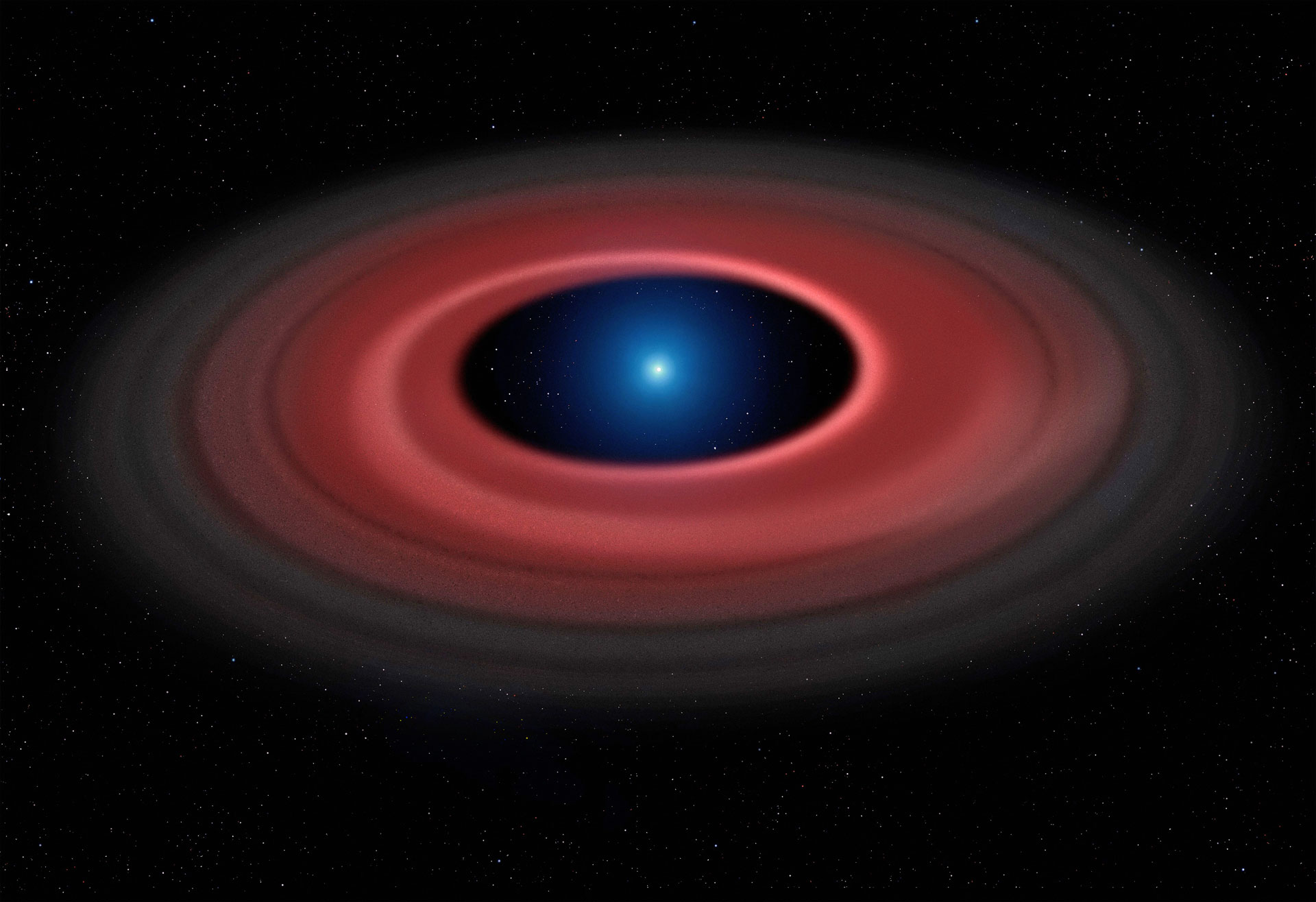
    Researchers View a Glowing Disc of Material Around White Dwarf SDSS J1228+1040
    This artist’s impression shows how an asteroid torn apart by the strong gravity of a white dwarf has formed a ring of dust particles and debris orbiting the Earth-sized burnt out stellar core SDSS J1228+1040. Gas produced by collisions within the disc is detected in observations obtained over twelve years with ESO’s Very Large Telescope, and reveal a narrow glowing arc. Credit: Mark Garlick and University of Warwick/ESO

    Using the Very Large Telescope, an international team of astronomers has studied in detail for the first time the remains of a fatal interaction between a dead star and an asteroid. This gives a glimpse of the far-future fate of the Solar System.

    Led by Christopher Manser, a Ph.D. student at the University of Warwick in the United Kingdom, the team used data from ESO’s Very Large Telescope (VLT) and other observatories to study the shattered remains of an asteroid around a stellar remnant — a white dwarf called SDSS J1228+1040.

    Using several instruments, including the Ultraviolet and Visual Echelle Spectrograph (UVES) and X-shooter, both attached to the VLT, the team obtained detailed observations of the light coming from the white dwarf and its surrounding material over an unprecedented period of twelve years between 2003 and 2015. Observations over periods of years were needed to probe the system from multiple viewpoints.

    “The image we get from the processed data shows us that these systems are truly disc-like, and reveals many structures that we cannot detect in a single snapshot,” explained lead author Christopher Manser.

    The team used a technique called Doppler tomography — similar in principle to medical tomographic scans of the human body — which allowed them to map out in detail the structure of the glowing gaseous remains of the dead star’s meal orbiting J1228+1040 for the first time.


    Artist’s impression of the glowing disc of material around the white dwarf SDSS J1228+1040

    While large stars — those more massive than around ten times the mass of the Sun — suffer a spectacularly violent climax as a supernova explosion at the ends of their lives, smaller stars are spared such dramatic fates. When stars like the Sun come to the ends of their lives they exhaust their fuel, expand as red giants and later expel their outer layers into space. The hot and very dense core of the former star — a white dwarf — is all that remains.

    But would the planets, asteroids, and other bodies in such a system survive this trial by fire? What would be left? The new observations help to answer these questions.

    It is rare for white dwarfs to be surrounded by orbiting discs of gaseous material — only seven have ever been found. The team concluded that an asteroid had strayed dangerously close to the dead star and been ripped apart by the immense tidal forces it experienced to form the disc of material that is now visible.

    The orbiting disc was formed in similar ways to the photogenic rings seen around planets closer to home, such as Saturn. However, while J1228+1040 is more than seven times smaller in diameter than the ringed planet, it has a mass over 2500 times greater. The team learned that the distance between the white dwarf and its disc is also quite different — Saturn and its rings could comfortably sit in the gap between them.
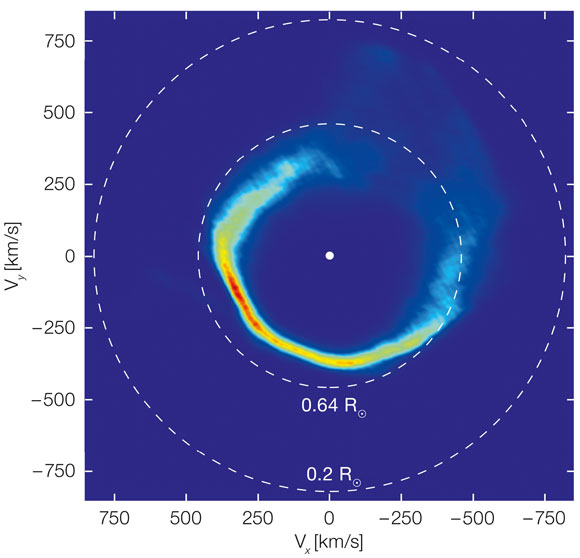
    The Motions of the Material Around the White Dwarf SDSS J1228+1040
    This plot is an unusual type of image, showing the velocities of the gas in the disc around the white dwarf SDSS J1228+1040, rather than its position. It was mapped out from Very Large Telescope observations over a period of twelve years and by applying a method called Doppler tomography. The dashed circles correspond to material in circular orbits at two different distances from the star. This appears “inside out” because material moves faster in close-in orbits. Credit: University of Warwick/C. Manser/ESO

    The new long-term study with the VLT has now allowed the team to watch the disc precess under the influence of the very strong gravitational field of the white dwarf. They also find that the disc is somewhat lopsided and has not yet become circular.

    “When we discovered this debris disc orbiting the white dwarf back in 2006, we could not have imagined the exquisite details that are now visible in this image, constructed from twelve years of data — it was definitely worth the wait,” added Boris Gänsicke, a co-author of the study.

    Remnants such as J1228+1040 can provide key clues to understanding the environments that exist as stars reach the ends of their lives. This can help astronomers to understand the processes that occur in exoplanetary systems and even forecast the fate of the Solar System when the Sun meets its demise in about seven billion years.

    Reference: “Doppler-imaging of the planetary debris disc at the white dwarf SDSS J122859.93+104032.9” by Christopher J. Manser, Boris T. Gaensicke, Thomas R. Marsh, Dimitri Veras, Detlev Koester, Elmé Breedt, Anna F. Pala, Steven G. Parsons and John Southworth, 6 November 2015, MNRAS.
    DOI: 10.1093/mnras/stv2603
    arXiv:1511.02230

    Never miss a breakthrough: Join the SciTechDaily newsletter.
    Follow us on Google and Google News.

    Asteroid Astronomy Astrophysics Cosmology European Southern Observatory Very Large Telescope White Dwarf
    Share. Facebook Twitter Pinterest LinkedIn Email Reddit

    Related Articles

    “We Found Something Never Seen Before” – Mysterious Shock Wave Around Dead Star Surprises Astronomers

    ESO Views Star-Forming Region Lupus 3, Most Detailed Image to Date (4K UHD Video)

    ESO’s VLT Views Stars Born in Winds from Supermassive Black Holes

    Detailed Images of the Hypergiant Star VY Canis Majoris

    ESO Image of the Week: SPHERE Reveals Spiral Disc Around Nearby Star

    VLT/SPHERE Reveal a Star Giving Birth to a Butterfly-Like Planetary Nebula

    VLT Views a Gas Cloud Being Ripped Apart by a Black Hole

    Sodium Levels in Stars Helps Predict How Their Lives Will End

    Planetary Nebula Fleming 1 Likely Has Two White Dwarfs Circling Each Other at Its Center

    Leave A Reply Cancel Reply

    • Facebook
    • Twitter
    • Pinterest
    • YouTube

    Don't Miss a Discovery

    Subscribe for the Latest in Science & Tech!

    Trending News

    Tyrannosaurus Tooth Found Embedded in Dinosaur Skull Reveals Brutal Prehistoric Attack

    This Supervolcano Is Refilling With Magma After 7,300 Years

    New Study Reveals Hidden Trade-Off in Popular Weight Loss Treatments

    Scientists “Bottle the Sun” With Revolutionary Liquid Battery

    This Ancient Ape Fossil Could Change Where Humans Came From

    This Simple Eating Habit May Help You Lose More Weight

    “Hulk Lizards” Are Wiping Out Millions of Years of Evolution

    Vitamin B2’s Dark Side: The Nutrient That May Help Cancer Cells Survive

    Follow SciTechDaily
    • Facebook
    • Twitter
    • YouTube
    • Pinterest
    • Newsletter
    • RSS
    SciTech News
    • Biology News
    • Chemistry News
    • Earth News
    • Health News
    • Physics News
    • Science News
    • Space News
    • Technology News
    Recent Posts
    • Scientists Finally Capture Elusive Lipids in Action Inside Cells
    • Scientists Track Bees in 3D and Discover Remarkable Secret Navigation Skills
    • “Super Bizarre” – Neuroscientists Discover That Adult Brain Is Filled With Millions of “Silent Synapses”
    • New Carbon Nanotube Coating Could Supercharge 6G Technology
    • Scientists Smash Superconductivity Record at Normal Pressure
    Copyright © 1998 - 2026 SciTechDaily. All Rights Reserved.
    • Science News
    • About
    • Contact
    • Editorial Board
    • Privacy Policy
    • Terms of Use

    Type above and press Enter to search. Press Esc to cancel.