
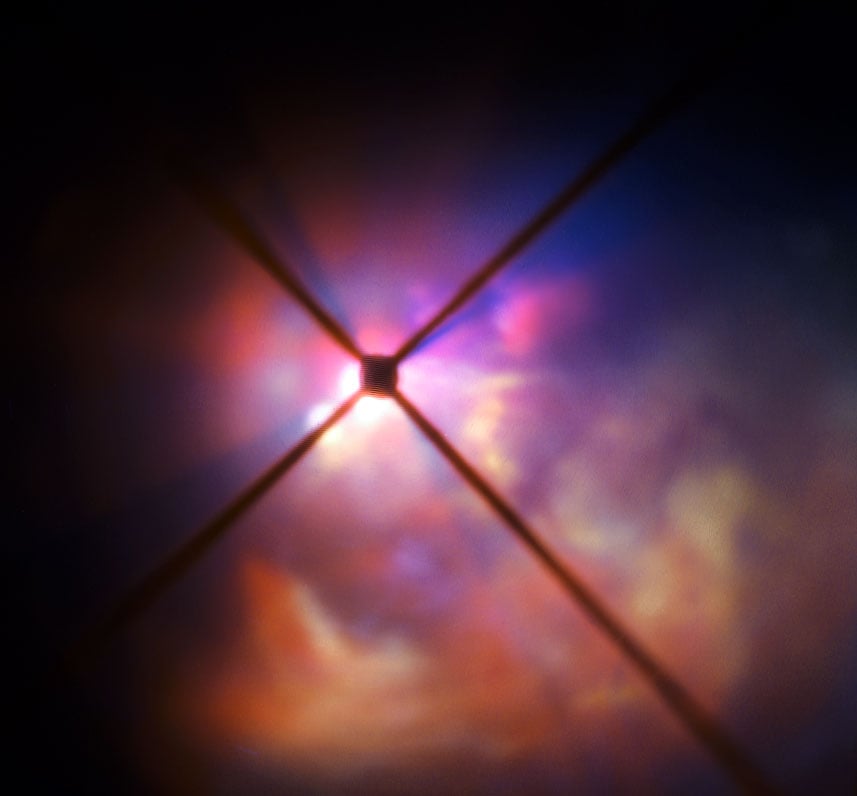
Using ESO’s Very Large Telescope, a team of astronomers has captured the most detailed images ever of the hypergiant star VY Canis Majoris. These new observations show how the unexpectedly large size of the particles of dust surrounding the star enable it to lose an enormous amount of mass as it begins to die. This process, understood now for the first time, is necessary to prepare such gigantic stars to meet explosive demises as supernovae.
VY Canis Majoris is a stellar goliath, a red hypergiant, one of the largest known stars in the Milky Way. It is 30–40 times the mass of the Sun and 300,000 times more luminous. In its current state, the star would encompass the orbit of Jupiter, having expanded tremendously as it enters the final stages of its life.
The new observations of the star used the SPHERE instrument on the VLT. The adaptive optics system of this instrument corrects images to a higher degree than earlier adaptive optics systems. This allows features very close to bright sources of light to be seen in great detail. SPHERE clearly revealed how the brilliant light of VY Canis Majoris was lighting up clouds of material surrounding it.
And by using the ZIMPOL mode of SPHERE, the team could not only peer deeper into the heart of this cloud of gas and dust around the star, but they could also see how the starlight was scattered and polarized by the surrounding material. These measurements were key to discovering the elusive properties of the dust.
Careful analysis of the polarization results revealed these grains of dust to be comparatively large particles, 0.5 micrometers across, which may seem small, but grains of this size are about 50 times larger than the dust normally found in interstellar space.
This video sequence takes you on a voyage from a broad vista of the sky into a close-up look at one of the biggest stars in the Milky Way, VY Canis Majoris. The final image comes from the SPHERE instrument on ESO’s Very Large Telescope in Chile.
Throughout their expansion, massive stars shed large amounts of material — every year, VY Canis Majoris sees 30 times the mass of the Earth expelled from its surface in the form of dust and gas. This cloud of material is pushed outwards before the star explodes, at which point some of the dust is destroyed, and the rest cast out into interstellar space. This material is then used, along with the heavier elements created during the supernova explosion, by the next generation of stars, which may make use of the material for planets.
Until now, it had remained mysterious how the material in these giant stars’ upper atmospheres is pushed away into space before the host explodes. The most likely driver has always seemed to be radiation pressure, the force that starlight exerts. As this pressure is very weak, the process relies on large grains of dust, to ensure a broad enough surface area to have an appreciable effect.
“Massive stars live short lives,” says the lead author of the paper, Peter Scicluna, of the Academia Sinica Institute for Astronomy and Astrophysics, Taiwan. “When they near their final days, they lose a lot of mass. In the past, we could only theorize about how this happened. But now, with the new SPHERE data, we have found large grains of dust around this hypergiant. These are big enough to be pushed away by the star’s intense radiation pressure, which explains the star’s rapid mass loss.”
The large grains of dust observed so close to the star mean that the cloud can effectively scatter the star’s visible light and be pushed by the radiation pressure from the star. The size of the dust grains also means much of it is likely to survive the radiation produced by VY Canis Majoris’ inevitable dramatic demise as a supernova. This dust then contributes to the surrounding interstellar medium, feeding future generations of stars and encouraging them to form planets.
Reference: “Large dust grains in the wind of VY Canis Majoris” by P. Scicluna, R. Siebenmorgen, R. Wesson, J. A. D. L. Blommaert, M. Kasper, N. V. Voshchinnikov and S. Wolf, 2 December 2015, Astronomy & Astrophysics.
DOI: 10.1051/0004-6361/201527563
arXiv:1511.07624
Never miss a breakthrough: Join the SciTechDaily newsletter.
Follow us on Google and Google News.
4 Comments
Since VY CMa would extend beyond the orbit of Jupiter if placed in our solar system and centered where the sun is, then VY CMa is approximately one billion miles across.
VY CMa will make a spendid supernova someday. It should be visible during the daytime.
Hmmm. Is this not a planetary nova in the making?
VY Canis Major is not a nova but a super giant star very much greater than our Sun ,Sirius,Aldeberan,Rigel and so on. It is truly a hyper giant star. This star is in a dying stage, by exhausting all its nuclear fuel. The same fate will our Sun meet in the end stage when the Sun will grow enormously big and its plumes will devolve all its children planets upto Jupiter. Thank You.