
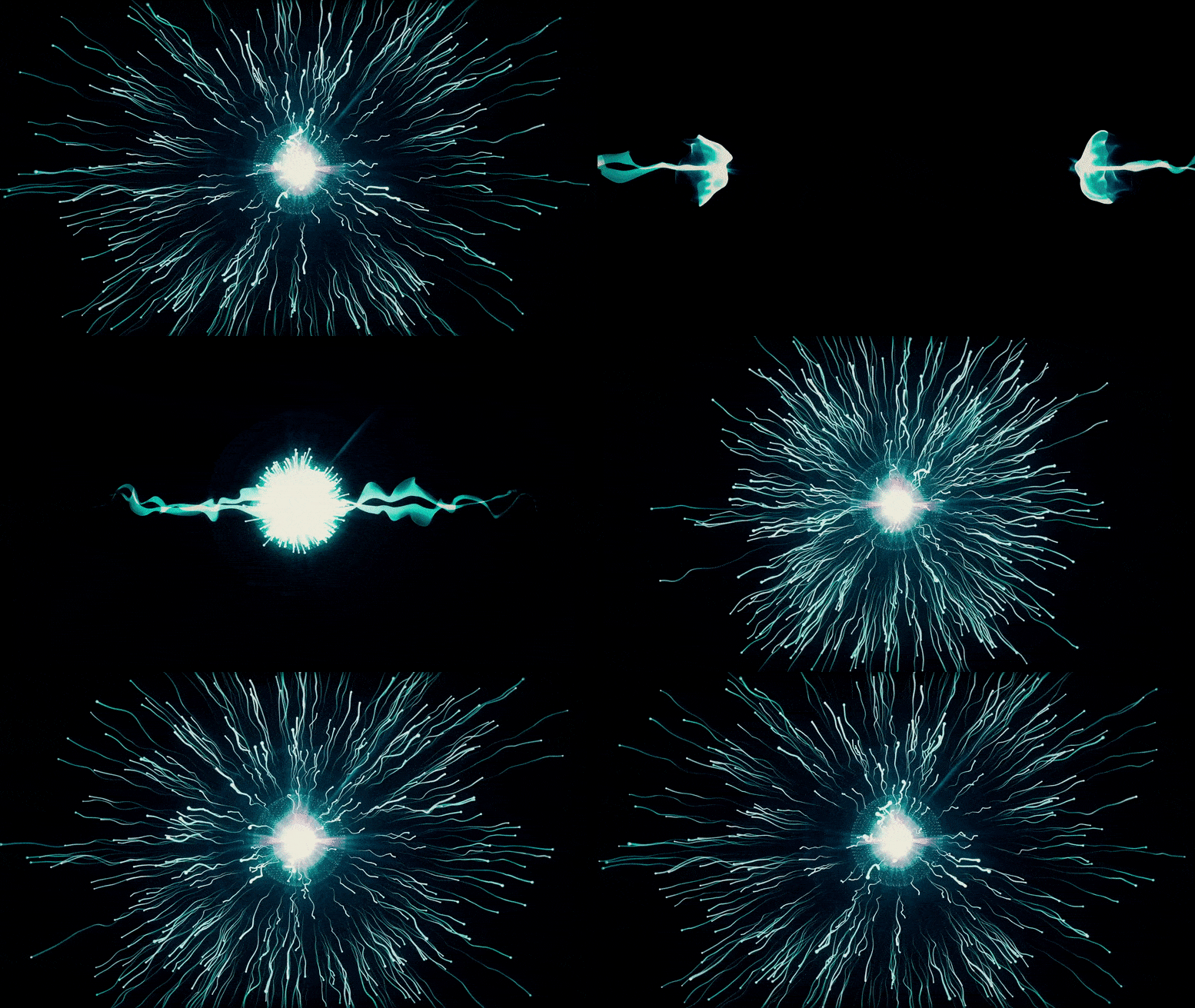
A research team led by Harvard University physicists has measured the magnetic moment of single particles of matter and antimatter with unprecedented precision.
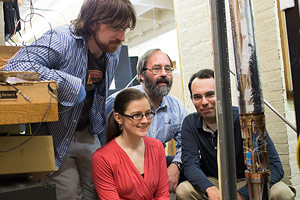
As described in a March 25 paper in Physical Review Letters, the team — led by Gerald Gabrielse, the George Vasmer Leverett Professor of Physics, and including postdoctoral fellows Stephan Ettenauer and Eric Tardiff and graduate students Jack DiSciacca, Mason Marshall, Kathryn Marable, and Rita Kalra — was able to capture individual protons and antiprotons in a “trap” created by electric and magnetic fields. By tracking the oscillations of each particle, the team was able to measure the magnetism of a proton 1,000 times more accurately than any proton had been measured before. Similar tests with antiprotons produced a 680-fold increase in accuracy in the size of the magnet in an antiproton.
“That is a spectacular jump in precision for any fundamental quality,” Gabrielse said. “That’s a leap that we don’t often see in physics, at least not in a single step.”
Such measurements, Gabrielse said, could one day help scientists answer a question that might seem more suited for the philosophy classroom than the physics lab: Why are we here?
“One of the great mysteries in physics is why our universe is made of matter,” he said. “According to our theories, the same amount of matter and antimatter was produced during the Big Bang. When matter and antimatter meet, they are annihilated. As the universe cools down, the big mystery is: Why didn’t all the matter find the antimatter and annihilate all of both? There’s a lot of matter and no antimatter left, and we don’t know why.”
Making precise measurements of protons and antiprotons, Gabrielse explained, could begin to answer those questions, by potentially shedding light on whether the CPT (charge conjugation, parity transformation, time reversal) theorem is correct. An outgrowth of the standard model of particle physics, CPT states that the protons and antiprotons should be virtually identical — with the same magnitude of charge and mass — yet with opposite charges.
The predictions of CPT have been verified by experiments measuring the charge-to-mass ratio of protons and antiprotons, but further investigation is needed, Gabrielse said, because the standard model does not account for all forces in the universe.
“What we wanted to do with these experiments was to say, ‘Let’s take a simple system — a single proton and a single antiproton — and let’s compare their predicted relationships, and see if our predictions are correct,’” Gabrielse said. “Ultimately, whatever we learn might give us some insight into how to explain this mystery.”
While researchers were able to capture and measure protons with relative ease, antiprotons are only produced by high-energy collisions that take place at the extensive tunnels of the CERN laboratory in Geneva, which created a dilemma.
“Last year, we published a report showing that we could measure a proton much more accurately than ever before,” Gabrielese said. “Once we had done that, however, we had to make a decision. Did we want to take the risk of moving our people and our entire apparatus — crates and crates of electronics and a very delicate trap apparatus — to CERN and try to do the same thing with antiprotons? Antiprotons would only be available till mid-December and then not again for a year and a half.
“We decided to give it a shot, and by George, we pulled it off,” he continued. “Ultimately, we argued that we should attempt it, because even if we failed, that failure would teach us something.” In what Gabrielse described as a “gutsy” choice, DiSciacca agreed to use the attempt to conclude his thesis research, and new grad students Marshall and Marable signed on to help.
Though the results still fit within the predictions made by the standard model, more accurate measurements of the characteristics of matter and antimatter may advance our understanding of how the universe works.
“What’s also very exciting about this breakthrough is that it now prepares us to continue down this road,” Gabrielse said. “I’m confident that, given this start, we’re going to be able to increase the accuracy of these measurements by another factor of 1,000, or even 10,000.”
Reference: “One-Particle Measurement of the Antiproton Magnetic Moment” by J. DiSciacca, M. Marshall, K. Marable, G. Gabrielse, S. Ettenauer, E. Tardiff, R. Kalra, D. W. Fitzakerley, M. C. George, E. A. Hessels, C. H. Storry, M. Weel, D. Grzonka, W. Oelert, and T. Sefzick (ATRAP Collaboration), 25 March 2013, Physical Review Letters.
DOI: 10.1103/PhysRevLett.110.130801
Never miss a breakthrough: Join the SciTechDaily newsletter.
Follow us on Google and Google News.
4 Comments
if there isnt any antimatter left, wouldnt that mean that it clumped together faster than matter did? or if there is anti matter left but its too far away to see, that would probably mean it was alot smaller and didnt clump together, but if neither of those are the case and they attract eachother, wouldnt that mean antimatter and matter are interchangable and can nullify differant types of eachother with differant reactions because of tolerance between the molecules?
or couldnt it be possible that the reactions between them are still going on and theyre so large we didnt even think about it? for example, a sun seems to have the right characteristics of a possible reaction between antimatter and matter, atleast it seems so to me, a big burst of energy, and when its done theres still something left thats trying to obtain matter
“While researchers were able to capture and measure protons with relative ease, antiprotons are only produced by high-energy collisions that take place at the extensive tunnels of the CERN laboratory in Geneva, which created a dilemma.”
There is no such thing as antimatter. Any “particle” that has been “discovered” during particle accelerator experiments are not particles. If they were particles they would not decay so quickly. They would be able to exist on there own, especially if these things were supposed to have existed at the time of their Big Bong—which actually never happened.
Matter and antimatter produced by s strange electreron spin and pole axis diffentiated as the deflecting force acting along unidirectional parallel forces may differ by its opposite merger for a ttion retpulsion and such a collspse may emit matter and antimatter as the spin direction with clockwise and anticlockwise by a frequency selective squeeze as if to have an asymmetry in betwrrm particles with electron spin is varied along pole axis pi/2 shifted must have a meaning in matter and antimatter dealing with contraction and expansion of universe.But a collspse may generate huge energy.