
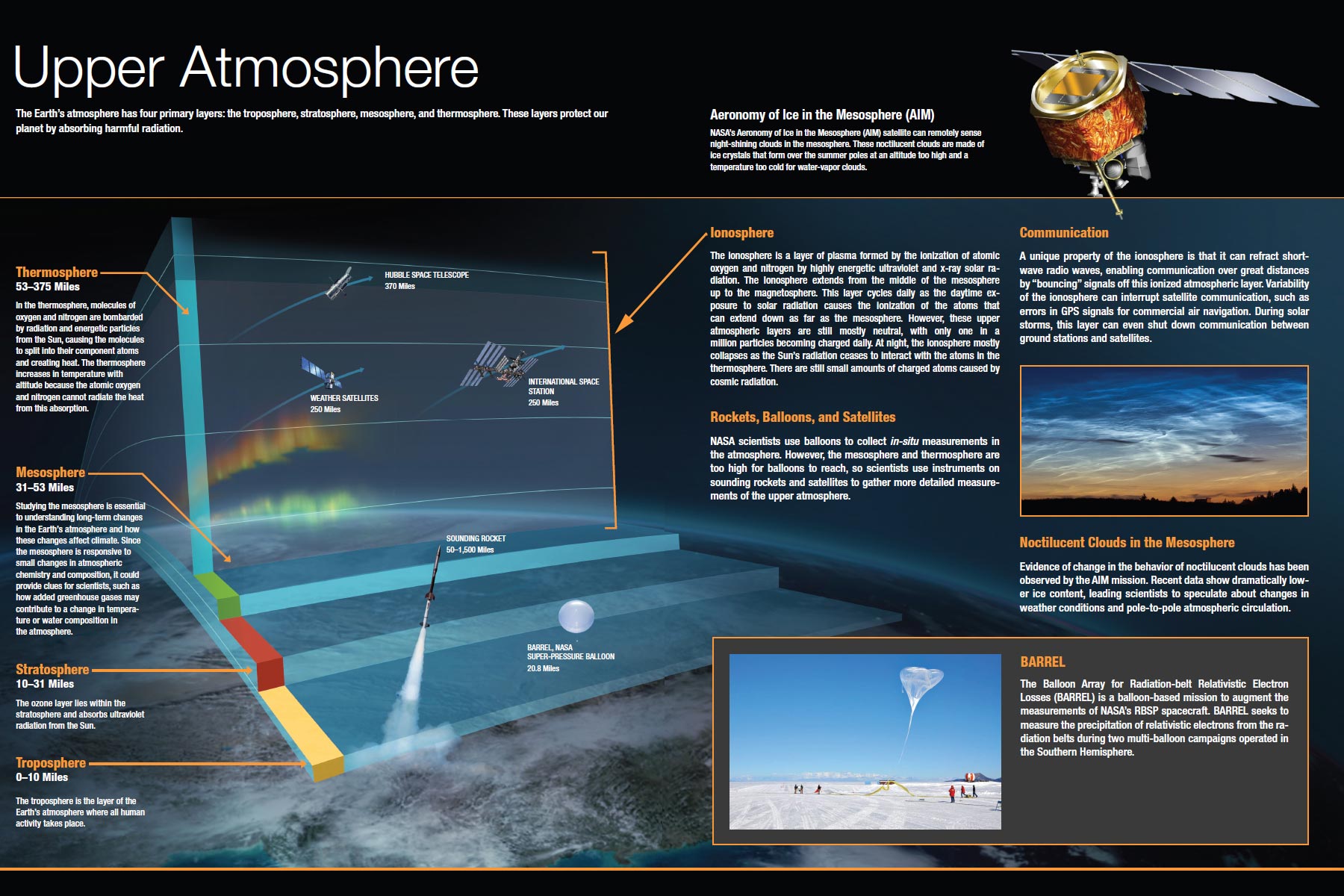
The Earth’s atmosphere has four primary layers: the troposphere, stratosphere, mesosphere, and thermosphere. These layers protect our planet by absorbing harmful radiation.
Thermosphere 53–375 Miles (85-604 kilometers) – In the thermosphere, molecules of oxygen and nitrogen are bombarded by radiation and energetic particles from the Sun, causing the molecules to split into their component atoms and create heat. The thermosphere increases in temperature with altitude because the atomic oxygen and nitrogen cannot radiate the heat from this absorption.
Mesosphere 31–53 Miles (50-85 kilometers) – Studying the mesosphere is essential to understanding long-term changes in the Earth’s atmosphere and how these changes affect climate. Since the mesosphere is responsive to small changes in atmospheric chemistry and composition, it could provide clues for scientists, such as how added greenhouse gases may contribute to a change in temperature or water composition in the atmosphere.
Stratosphere 10–31 Miles (16-50 kilometers) – The ozone layer lies within the stratosphere and absorbs ultraviolet radiation from the Sun.
Troposphere 0–10 Miles (0-16 kilometers) – The troposphere is the layer of the Earth’s atmosphere where all human activity takes place.
Ionosphere – The ionosphere is a layer of plasma formed by the ionization of atomic oxygen and nitrogen by highly energetic ultraviolet and x-ray solar radiation. The Ionosphere extends from the middle of the mesosphere up to the magnetosphere. This layer cycles daily as the daytime exposure to solar radiation causes the ionization of the atoms that can extend down as far as the mesosphere. However, these upper atmospheric layers are still mostly neutral, with only one in a million particles becoming charged daily. At night, the ionosphere mostly collapses as the Sun’s radiation ceases to interact with the atoms in the thermosphere. There are still small amounts of charged atoms caused by cosmic radiation.
Communication – A unique property of the ionosphere is that it can refract shortwave radio waves, enabling communication over great distances by “bouncing” signals off this ionized atmospheric layer. Variability of the ionosphere can interrupt satellite communication, such as errors in GPS signals for commercial air navigation. During solar storms, this layer can even shut down communication between ground stations and satellites.
Rockets, Balloons, and Satellites – NASA scientists use balloons to collect in-situ measurements in the atmosphere. However, the mesosphere and thermosphere are too high for balloons to reach, so scientists use instruments on sounding rockets and satellites to gather more detailed measurements of the upper atmosphere.
Noctilucent Clouds in the Mesosphere – Evidence of change in the behavior of noctilucent clouds has been observed by the AIM mission. Recent data show dramatically lower ice content, leading scientists to speculate about changes in weather conditions and pole-to-pole atmospheric circulation.
Aeronomy of Ice in the Mesosphere (AIM) – NASA’s AIM satellite can remotely sense night-shining clouds in the mesosphere. These noctilucent clouds are made of ice crystals that form over the summer poles at an altitude too high and a temperature too cold for water-vapor clouds.
BARREL – The Balloon Array for Radiation-belt Relativistic Electron Losses (BARREL) is a balloon-based mission to augment the measurements of NASA’s RBSP spacecraft. BARREL seeks to measure the precipitation of relativistic electrons from the radiation belts during two multi-balloon campaigns operated in the Southern Hemisphere.
Never miss a breakthrough: Join the SciTechDaily newsletter.
Follow us on Google and Google News.