
Enjoy this two-minute flight through the universe animation, which includes close to 400,000 galaxies, and the accompanying first public release of data from the Baryon Oscillation Spectroscopic Survey.
This animated flight through the universe was made by Miguel Aragon of Johns Hopkins University with Mark Subbarao of the Adler Planetarium and Alex Szalay of Johns Hopkins. There are close to 400,000 galaxies in the animation, with images of the actual galaxies in these positions (or in some cases their near cousins in type) derived from the Sloan Digital Sky Survey (SDSS) Data Release 7. Vast as this slice of the universe seems, its most distant reach is to redshift 0.1, corresponding to roughly 1.3 billion light-years from Earth. SDSS Data Release 9 from the Baryon Oscillation Spectroscopic Survey (BOSS), led by Berkeley Lab scientists, includes spectroscopic data for well over half a million galaxies at redshifts up to 0.8 — roughly 7 billion light-years distant — and over a hundred thousand quasars to redshift 3.0 and beyond.
First Public Data Release from BOSS
The Third Sloan Digital Sky Survey (SDSS-III) has issued Data Release 9 (DR9), the first public release of data from the Baryon Oscillation Spectroscopic Survey (BOSS). In this release BOSS, the largest of SDSS-III’s four surveys, provides spectra for 535,995 newly observed galaxies, 102,100 quasars, and 116,474 stars, plus new information about objects in previous Sloan surveys (SDSS-I and II).
“This is just the first of three data releases from BOSS,” says David Schlegel of the U.S. Department of Energy’s Lawrence Berkeley National Laboratory (Berkeley Lab), an astrophysicist in the Lab’s Physics Division and BOSS’s principal investigator. “By the time BOSS is complete, we will have surveyed more of the sky, out to a distance twice as deep, for a volume more than five times greater than SDSS has surveyed before – a larger volume of the universe than all previous spectroscopic surveys combined.”
Spectroscopy yields a wealth of information about astronomical objects including their motion (called redshift and written “z”), their composition, and sometimes also the density of the gas and other material that lies between them and observers on Earth. The BOSS spectra are now freely available at http://sdss3.org to a public that includes amateur astronomers, astronomy professionals who are not members of the SDSS-III collaboration, and high-school science teachers and their students.
The new release lists spectra for galaxies with redshifts up to z = 0.8 (roughly 7 billion light-years away) and quasars with redshifts between z = 2.1 and 3.5 (from 10 to 11.5 billion light-years away). When BOSS is complete it will have measured 1.5 million galaxies and at least 150,000 quasars, as well as many thousands of stars and other “ancillary” objects for scientific projects other than BOSS’s main goal.
The key to the history of the universe
BOSS is designed to measure baryon acoustic oscillation (BAO), the large-scale clustering of matter in the universe. BAO began as rippling fluctuations (“sound waves”) in the hot, dense soup of matter and radiation that made up the early universe. As the universe expanded it cooled. Finally, atoms formed and radiation went its own way; the density ripples left their marks as temperature variations in the cosmic microwave background (CMB), where they can be detected today.
The CMB came into being 380,000 years after the Big Bang, over 13.6 billion years ago, and continues to stretch across the entire sky as the universe expands. Peaks in CMB temperature variation occur about half a billion light-years apart, at the same angle, viewed from Earth, as peaks in the large-scale galactic structure that evolved billions of years later. The regions of higher density in the CMB were in fact the sources of galaxy formation; they correspond to regions where galaxies cluster, along with intergalactic gas and concentrations of much more massive underlying dark matter. The natural “standard ruler” marking peaks in clustering can be applied not only across the sky but in all three dimensions, backward in time to the CMB.
Distant quasars provide another way of measuring BAO and the distribution of matter in the universe. Quasars are the brightest objects in the distant universe, whose spectra bristle with individually shifted absorption lines, a “Lyman-alpha forest” unique to each that reveals the clumping of intergalactic gas and underlying dark matter between the quasar and Earth.
Marks on the cosmic ruler
Schlegel has called BAO “an inconveniently sized ruler,” requiring “a huge volume of the universe just to fit the ruler inside,” but it’s a precision tool for tracking the universe’s expansion history, and for probing the nature of gravity and the mysterious dark energy that’s causing expansion to accelerate.
To fill the huge volume, BOSS had to find more and fainter objects in the sky at greater distances than SDSS had attempted before. The camera system and spectrographs of the 2.5-meter (8.2-foot) Sloan Foundation Telescope at the Apache Point Observatory in New Mexico had to be completely rebuilt.
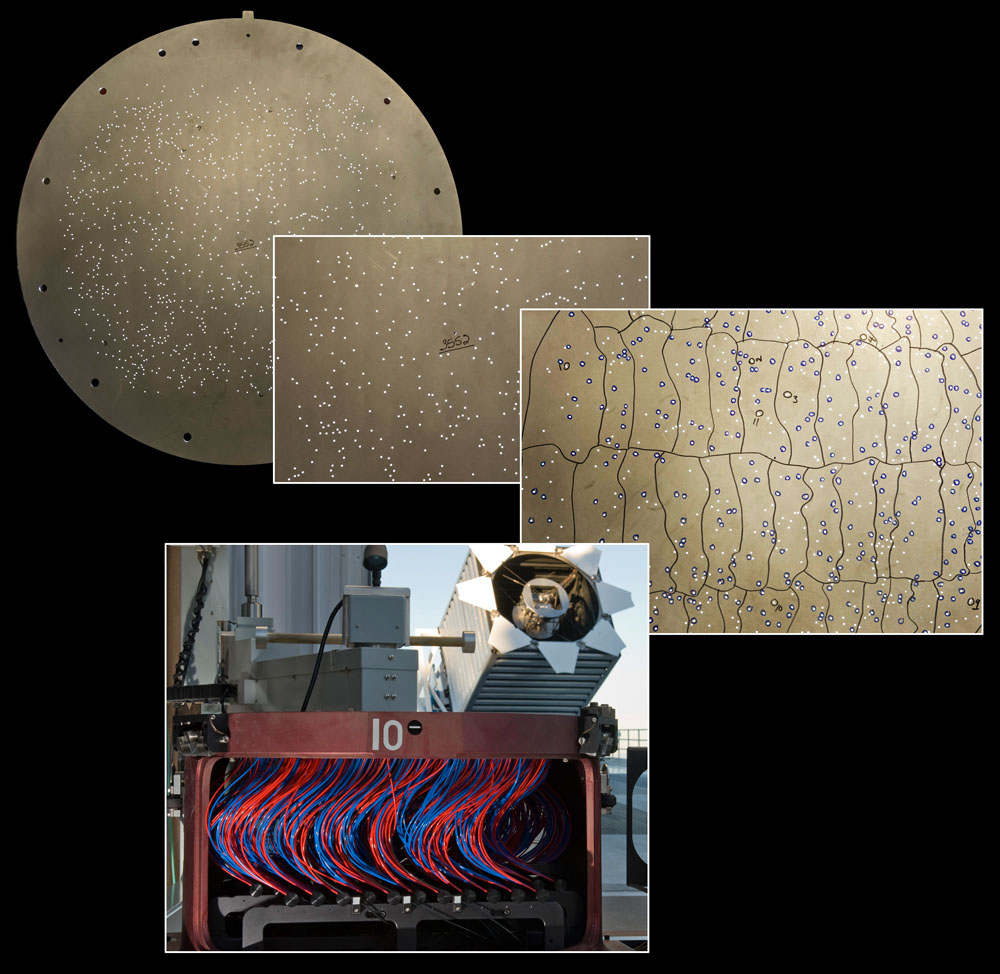
SDSS uses “plug plates” at the telescope’s focal plane, aluminum disks with holes drilled to match the precise position of previously imaged target objects. SDSS-I and II plug plates had only 640 holes apiece, each covering three arcseconds; BOSS is using 2,000 plug plates with 1,000 holes apiece, each covering a tight two arcseconds to reduce light that’s not from the target.
Optical fibers are plugged into the holes every day by hand, to guide the light from each target to a spectrograph. While weather conditions vary night to night, observations on the best nights use up to nine plug plates. For BOSS, the spectrographs were rebuilt with new optics and new CCD detectors designed and fabricated at Berkeley Lab.
“Light from distant galaxies arrives at Earth redshifted into the infrared,” says Natalie Roe, director of Berkeley Lab’s Physics Division and BOSS’s instrument scientist, who led construction of the spectrographs. “We optimized the BOSS spectrographs for mapping exactly these galaxies.”
Working with Schlegel and Adam Bolton at the University of Utah, Berkeley Lab’s Stephen Bailey is in charge of daily “extraction pipeline” operations that convert raw data from the telescope into useful spectra and quantities derived from them, ready for scientific analysis. Data storage and the extraction pipeline run on the Riemann Linux cluster of Berkeley Lab’s High-Performance Computing Services Group; the data is copied from Riemann to the University of Utah, New York University, Johns Hopkins University, and the National Energy Research Scientific Computing Center (NERSC) at Berkeley Lab. The Lab also hosts the SDSS-III website, http://sdss3.org, from which the data can be downloaded.
“Data releases are a proud tradition for SDSS, and the first BOSS data greatly increase the SDSS store of information,” Bailey says. “Members of the SDSS-III collaboration get first crack at it – with barely enough time to write up their results – but three times as many papers based on the data are published by scientists outside the collaboration.”
Says Schlegel, “SDSS-III is already the most used of all surveys from any telescope in the world, including the Keck telescopes and the Hubble Space Telescope. With DR9, BOSS contributes a huge information increase for all kinds of scientific investigations, from quasars to how stars evolve to really odd objects like galaxy-scale strong gravitational lenses. Meanwhile the BOSS BAO survey is over two-thirds finished, and ahead of schedule – we’re well on our way to the best measure of BAO that will be made for a long time. All the data BOSS collects will be available to anyone who can use it.”
Never miss a breakthrough: Join the SciTechDaily newsletter.
Follow us on Google and Google News.