
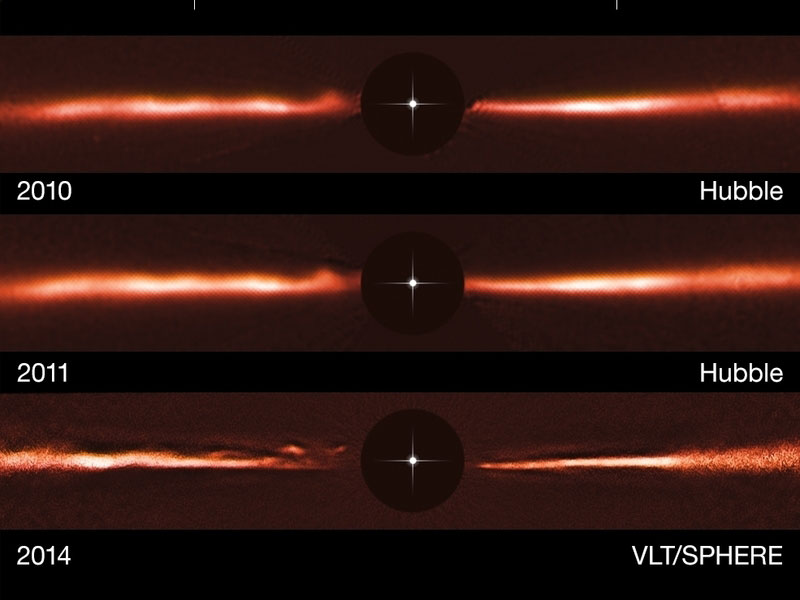
Using Hubble data and new images from SPHERE, astronomers have identified sub-structures and tracked changes within the debris disk that surrounds AU Microscopii.
Like many other stars, AU Microscopii is surrounded by a dust disk. Now researchers – including scientists from the Max Planck Institute for Astronomy in Heidelberg – have discovered unusual structures in this disk, which change over time. The scientists are still puzzling what this phenomenon, which had previously never been observed before, could be. Is it connected with the eruptions of the star AU Mic? Or possibly even with as of yet undetected planets circling within the dust disk?
The star AU Mic (“AU Microscopii”) in the Southern constellation Microscope, which is less than 33 light-years from Earth, is surrounded by a sizable disk made of dust, which observers on Earth can see directly edge-on. Now, the has been imaged in great detail using SPHERE, the newly installed exoplanet-and-disks imaging machine at ESO’s Very Large Telescope, and previous data from the Hubble Space Telescope. For the first time, astronomers could not only identify sub-structures, but also reliably track changes within the disk: fast-moving, wave-like features that move outwards within the disk.
When the instrument team for SPHERE chose targets for their initial observations, AU Mic was a natural candidate. MPIA director Thomas Henning, who is part of the team that studied the disk, explains: “Right away, we noticed detailed structures in the disk – if you had told me a few years ago that we would be able to image disks in such detail, I wouldn’t have believed you. We compared these structures with images taken by a number of colleagues and myself using the Hubble Space Telescope in 2010 and 2011.”
Henning continues: “We were in for a surprise: Yes, we were able to identify reliably a considerable number of structures in both the SPHERE and the Hubble images. But within those few years, the features had moved away from the star. For the first time, we had observed not only the structure or the spectral features of stellar debris disks – we were watching the disk change!”
Images from ESO’s Very Large Telescope and the NASA/ESA Hubble Space Telescope have revealed unique and totally unexpected structures in the dusty disc around the star AU Microscopii. These fast-moving wave-like dust features are unlike anything ever observed, or even predicted, before now.
According to a preliminary analysis, which will need to be confirmed by future observations, some of the matter observed might even be on its way out of the disk altogether, with sufficient speed to leave the stellar system behind.
There is, at this moment, no complete explanation for the disk dynamics observed by the combination of SPHERE and Hubble images. AU Mic, a red dwarf star (of type M1 Ve) a little over half the diameter of the Sun, is a rather young star with an age of around 12 million years, compared to our Sun’s age of 5 billion years. As is not uncommon for such young stars, AU Mic is very active, and frequently produces sizable flares: Eruptions involving the star’s magnetic field, which catapult stellar plasma at high speed into the star’s surroundings. It is possible that the moving features in the dust disk are caused by such stellar activity.
Another tantalizing possibility is that the changes could be tell-tale signs of the presence of one or more giant planets in the debris disk. In that case, the motion would be due to disturbances caused by one or more planets’ gravitational pull as it moves through the disk. So far, no planets around AU Mic have been detected – but this could change as search and imaging techniques improve.
In total, the surprising observations of disk changes around AU Mic provide for a whole program of additional observations. If the researchers are very lucky, they might even be able to detect proto-planets – smaller bodies busily gathering sufficient mass for planethood – within the disk. More generally, extending observations such as these should allow for detailed comparison with simulations of such objects – and could shed light on processes of planet formation, which might have left tell-tale traces on the disk.
Reference: “Fast-Moving Structures in the Debris Disk Around AU Microscopii” by Anthony Boccaletti, Christian Thalmann, Anne-Marie Lagrange, Markus Janson, Jean-Charles Augereau, Glenn Schneider, Julien Milli, Carol Grady, John Debes, Maud Langlois, David Mouillet, Thomas Henning, Carsten Dominik, Anne-Lise Maire, Jean-Luc Beuzit, Joseph Carson, Kjetil Dohlen, Natalia Engler, Markus Feldt, Thierry Fusco, Christian Ginski, Julien H. Girard, Dean Hines, Markus Kasper, Dimitri Mawet, François Ménard, Michael R. Meyer, Claire Moutou, Johan Olofsson, Timothy Rodigas, Jean-Francois Sauvage, Joshua Schlieder, Hans Martin Schmid, Massimo Turatto, Stephane Udry, Farrokh Vakili, Arthur Vigan, Zahed Wahhaj & John Wisniewski, 7 October 2015, Nature.
DOI: 10.1038/nature15705
Never miss a breakthrough: Join the SciTechDaily newsletter.
Follow us on Google and Google News.