
Comet Atlas May Have Been a Blast From the Past
When our very early ancestors were colonizing the Nile River Valley, 5,000 years ago at the dawn of civilization, it’s likely a brilliant comet appeared in the predawn sky. There is no direct evidence for this visitor because the start of recorded history was still a few centuries away.
The belief is that comet at least split into two pieces, which would not return to the Sun along the same orbital track until 5,000 years later. This forensic evidence can be linked to the great comet of 1844 that was nearly as bright as the brightest naked-eye star, Sirius. The second fragment, called comet ATLAS, appeared near the beginning of 2020.
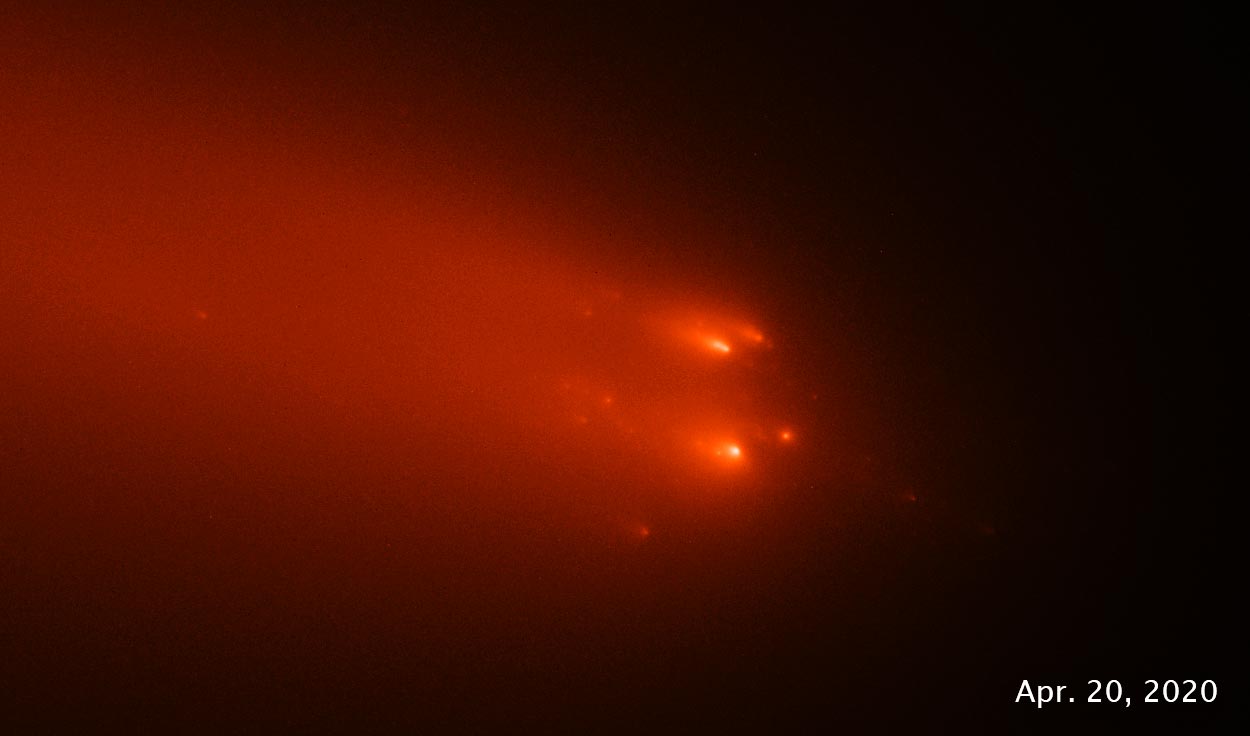
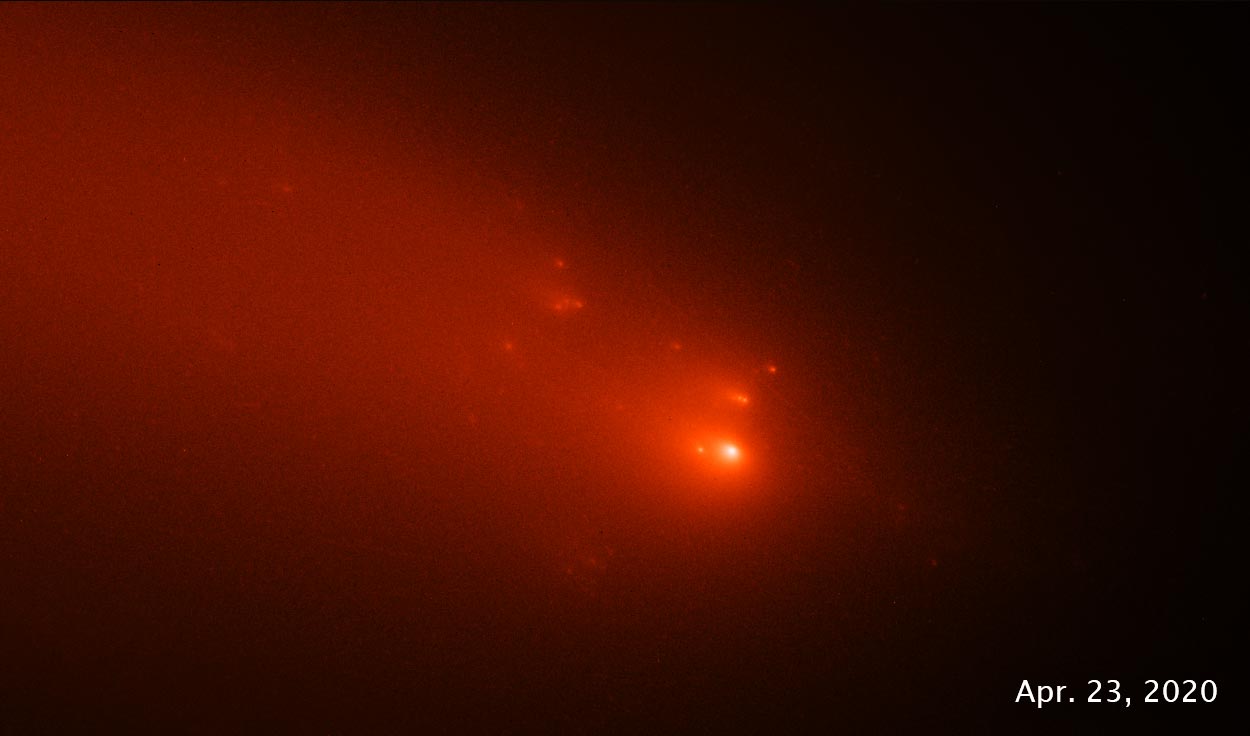
Unlike its sibling that survived passing around the Sun in 1844, ATLAS met an untimely death while it was still 100 million miles (160 million kilometers) from the Sun. It completely disintegrated as photographed by the Hubble Space Telescope.
It’s suspected that about 5,000 years ago a comet swept within 23 million miles (37 million kilometers) of the Sun, closer than the innermost planet Mercury. The comet might have been a spectacular sight to civilizations across Eurasia and North Africa at the end of the Stone Age.
However, this nameless space visitor is not recorded in any known historical account. So how do astronomers know that there was such an interplanetary intruder?
Enter comet ATLAS (C/2019 Y4), which first appeared near the beginning of 2020.
Clues from the Fragments
Comet ATLAS, first detected by the Asteroid Terrestrial-impact Last Alert System (ATLAS), operated by the University of Hawaii, quickly met an untimely death in mid-2020 when it disintegrated into a cascade of small icy pieces.
In a new study using observations from NASA’s Hubble Space Telescope, astronomer Quanzhi Ye of the University of Maryland in College Park, reports that ATLAS is a broken-off piece of that ancient visitor from 5,000 years ago. Why? Because ATLAS follows the same orbital “railroad track” as that of a comet seen in 1844. This means the two comets are probably siblings from a parent comet that broke apart many centuries earlier. The link between the two comets was first noted by amateur astronomer Maik Meyer.
Such comet families are common. The most dramatic visual example was in 1994 when the doomed comet Shoemaker-Levy 9 (SL9) was pulled into a string of pieces by Jupiter’s gravitational pull. This “comet train” was short-lived. It fell piece by piece into Jupiter in July 1994.
But comet ATLAS is just “weird,” says Ye, who observed it with Hubble about the time of the breakup. Unlike its hypothesized parent comet, ATLAS disintegrated while it was farther from the Sun than Earth, at a distance of over 100 million miles. This was much farther than the distance where its parent passed the Sun. “This emphasizes its strangeness,” said Ye.
“If it broke up this far from the Sun, how did it survive the last passage around the Sun 5,000 years ago? This is the big question,” said Ye. “It’s very unusual because we wouldn’t expect it. This is the first time a long-period comet family member was seen breaking up before passing closer to the Sun.”
Observing the breakup of the fragments offers clues to how the parent comet was put together. The conventional wisdom is that comets are fragile agglomerations of dust and ice. And, they may be lumpy, like raisin pudding.
In a new paper in the Astronomical Journal, after one year of analysis Ye and co-investigators report that one fragment of ATLAS disintegrated in a matter of days, while another piece lasted for weeks. “This tells us that part of the nucleus was stronger than the other part,” he said.
Theories Behind ATLAS’s Collapse
One possibility is that streamers of ejected material may have spun up the comet so fast that centrifugal forces tore it apart. An alternative explanation is that it has so-called super-volatile ices that just blew the piece apart like an exploding aerial firework. “It is complicated because we start to see these hierarchies and evolution of comet fragmentation. Comet ATLAS’s behavior is interesting but hard to explain.”
Comet ATLAS’s surviving sibling won’t return until the 50th century.
Reference: “Disintegration of Long-period Comet C/2019 Y4 (ATLAS). I. Hubble Space Telescope Observations” by Quanzhi Ye, David Jewitt, Man-To Hui, Qicheng Zhang, Jessica Agarwal, Michael S. P. Kelley, Yoonyoung Kim, Jing Li, Tim Lister, Max Mutchler, and Harold A. Weaver, 21 July 2021, The Astronomical Journal.
DOI: 10.3847/1538-3881/abfec3
Never miss a breakthrough: Join the SciTechDaily newsletter.
Follow us on Google and Google News.
1 Comment
“Comet ATLAS’s surviving sibling won’t return until the 50th century.
” … I think this should read the 70th century