
Close Menu
    Facebook X (Twitter) Instagram
    SciTechDaily
    • Biology
    • Chemistry
    • Earth
    • Health
    • Physics
    • Science
    • Space
    • Technology
    Facebook X (Twitter) Pinterest YouTube RSS
    SciTechDaily
    Home»Space»New Insights About Pulsar Glitches Uncovered by Astronomers
    Space

    New Insights About Pulsar Glitches Uncovered by Astronomers

    By OzGravApril 28, 2020No Comments3 Mins Read
    Facebook Twitter Pinterest Telegram LinkedIn WhatsApp Email Reddit
    Share
    Facebook Twitter LinkedIn Pinterest Telegram Email Reddit
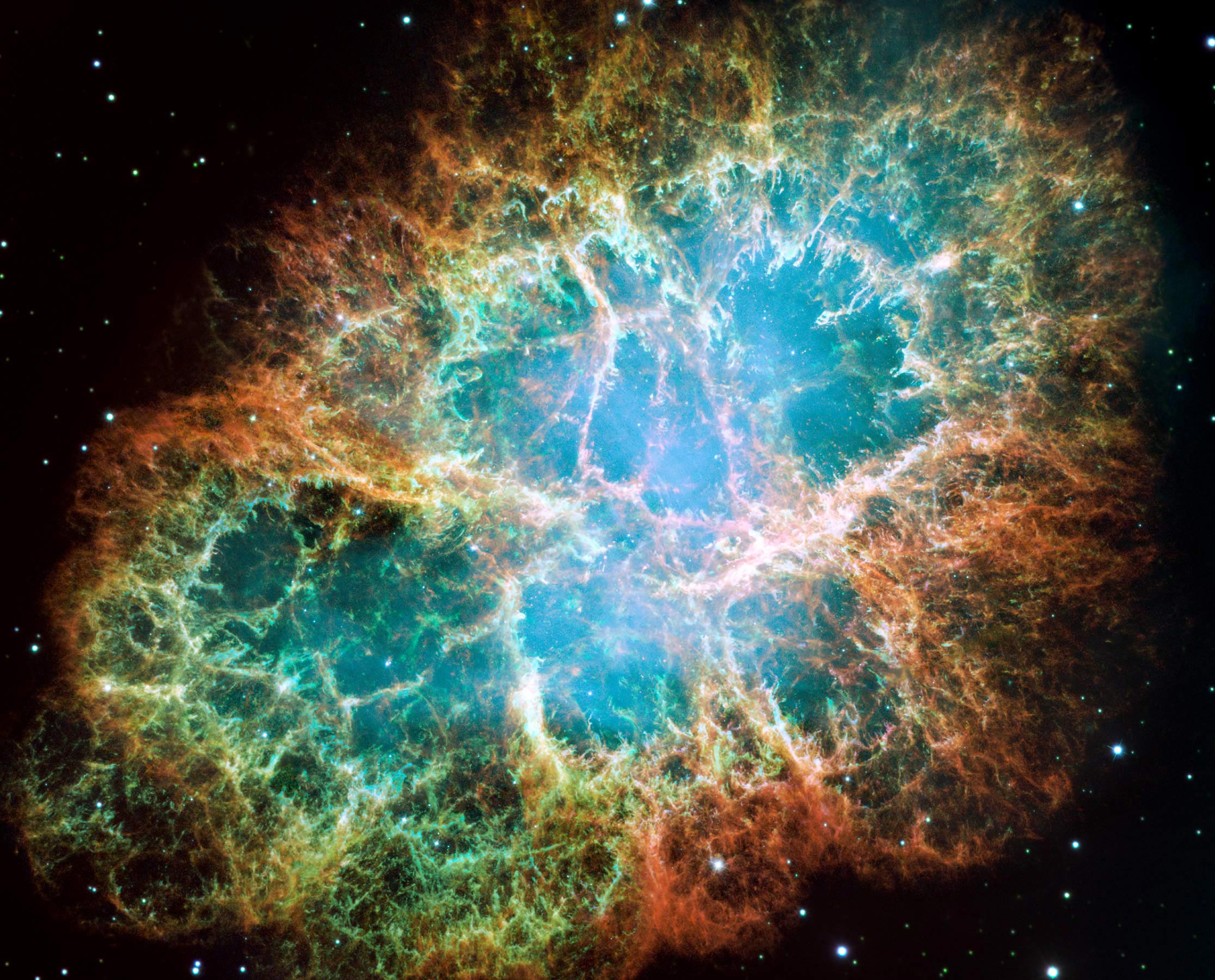
    Crab Nebula Messier 1
    Multi-wavelength image of the Crab nebula, which hosts a glitching pulsar at its heart. Credit: NASA, ESA, J. Hester and A. Loll (Arizona State University)

    Pulsars are dead stars that spin remarkably steadily – they are some of the most regularly ticking clocks in the Universe! However, every few years some pulsars ‘glitch’, and speed up a tiny amount almost instantaneously. Understanding what causes these glitches may unveil what’s really happening inside these super-dense dead stars.

    Detailed theoretical and computer models are hard to connect to real observations, so instead Ph.D. student Julian Carlin and Chief Investigator Andrew Melatos, from the ARC Centre of Excellence for Gravitational Wave Discovery (OzGrav), built a ‘meta-model’ in a paper recently published in the Monthly Notices of the Royal Astronomical Society.

    The meta-model relies on the idea that ‘stress’ builds up inside the pulsar until it reaches a threshold, and then some of this stress is released as a glitch. The interesting thing about this meta-model is that the stress increases by taking a ‘random walk’ upwards: like an intoxicated person returning home from the pub who might take two steps forward, one step back, then three steps forward. The randomness in how the stress builds is supported by some theoretical models, as well as a recent study of a glitch-in-action led by OzGrav researchers Greg Ashton, Paul Lasky, and others.

    Meta-models make predictions about what we should see in the long term from glitching pulsars.

    ‘This meta-model predicts that there should always be a correlation between big glitches and the time until the next glitch: if a lot of stress is released, it takes longer on average for the pulsar to build up enough stress for another glitch,’ explains Carlin.

    Using this prediction, Carlin and Melatos tried to falsify the meta-model, asking the question: ‘Are there long-term observations that can’t be explained?’ The answer depends on the pulsar. Some are well-explained by the meta-model, while others don’t quite match the predictions.

    ‘We need to see more glitches before this question can be answered for certain, but this work shows a way to answer it for many theoretical models, all at the same time,’ says Carlin.

    References:

    “Long-term statistics of pulsar glitches triggered by a Brownian stress accumulation process” by J B Carlin and A Melatos, 8 April 2020, Monthly Notices of the Royal Astronomical Society.
    DOI: 10.1093/mnras/staa935

    “Rotational evolution of the Vela pulsar during the 2016 glitch” by Gregory Ashton, Paul D. Lasky, Vanessa Graber and Jim Palfreyman, 12 August 2019, Nature Astronomy.
    DOI: 10.1038/s41550-019-0844-6

    Never miss a breakthrough: Join the SciTechDaily newsletter.
    Follow us on Google and Google News.

    Astronomy Astrophysics OzGrav Popular Pulsars
    Share. Facebook Twitter Pinterest LinkedIn Email Reddit

    Related Articles

    Searching for Elusive Continuous Gravitational Waves From the Densest Objects in the Universe

    Mysterious Giant Radio Pulses From Pulsars Are Hundreds of Times More Energetic Than Previously Believed

    Student Astronomer Uses Ingenious Method to Find Galactic Missing Matter

    Bizarre, Never-Seen-Before Activity Spotted From One of the Strongest Magnets in the Universe

    Massive Stellar Triples Leading to Sequential Binary Black-Hole Mergers

    Gravitational Wave Search Finds Tantalizing New Clue: Unexplained Fluctuations in Space-Time

    Milky Way’s Dark Side Revealed by Measurements of Pulsar Acceleration

    Galactic “Mystery Source” of Gamma Rays Identified: Record-Setting “Black Widow” Pulsar

    Ripples in the Fabric of Space and Time Offer New Clues to the Shape of Black Holes

    Leave A Reply Cancel Reply

    • Facebook
    • Twitter
    • Pinterest
    • YouTube

    Don't Miss a Discovery

    Subscribe for the Latest in Science & Tech!

    Trending News

    One of the Universe’s Largest Stars May Be Getting Ready To Explode

    Scientists Discover Enzyme That Could Supercharge Ozempic-Like Weight Loss Drugs

    Popular Sweetener Linked to DNA Damage – “It’s Something You Should Not Be Eating”

    Ancient “Rock” Microbes May Reveal How Complex Life Began

    Researchers Capture Quantum Interference in One of Nature’s Rarest Atoms

    “A Plague Is Upon Us”: The Mass Death That Changed an Ancient City Forever

    Scientists Discover Game-Changing New Way To Treat High Cholesterol

    This Small Change to Your Exercise Routine Could Be the Secret to Living Longer

    Follow SciTechDaily
    • Facebook
    • Twitter
    • YouTube
    • Pinterest
    • Newsletter
    • RSS
    SciTech News
    • Biology News
    • Chemistry News
    • Earth News
    • Health News
    • Physics News
    • Science News
    • Space News
    • Technology News
    Recent Posts
    • Scientists Rethink Extreme Warming After Surprising Ocean Discovery
    • The Surprising Role of Asteroids in the Origin of Life
    • Scientists Raise Concerns Over Newly Recognized Pollutant Found Everywhere in the Air
    • New Study Challenges 40-Year Puzzle About Childhood Body Fat
    • 20-Year Study Finds Daily Multivitamins Don’t Extend Lifespan
    Copyright © 1998 - 2026 SciTechDaily. All Rights Reserved.
    • Science News
    • About
    • Contact
    • Editorial Board
    • Privacy Policy
    • Terms of Use

    Type above and press Enter to search. Press Esc to cancel.