
Close Menu
    Facebook X (Twitter) Instagram
    SciTechDaily
    • Biology
    • Chemistry
    • Earth
    • Health
    • Physics
    • Science
    • Space
    • Technology
    Facebook X (Twitter) Pinterest YouTube RSS
    SciTechDaily
    Home»Space»Hubble Captures Close-Up View of Comet ISON
    Space

    Hubble Captures Close-Up View of Comet ISON

    By Space Telescope Science InstituteApril 24, 2013No Comments2 Mins Read
    Facebook Twitter Pinterest Telegram LinkedIn WhatsApp Email Reddit
    Share
    Facebook Twitter LinkedIn Pinterest Telegram Email Reddit
    Hubble Provides a Cose Up Look of Comet ISON
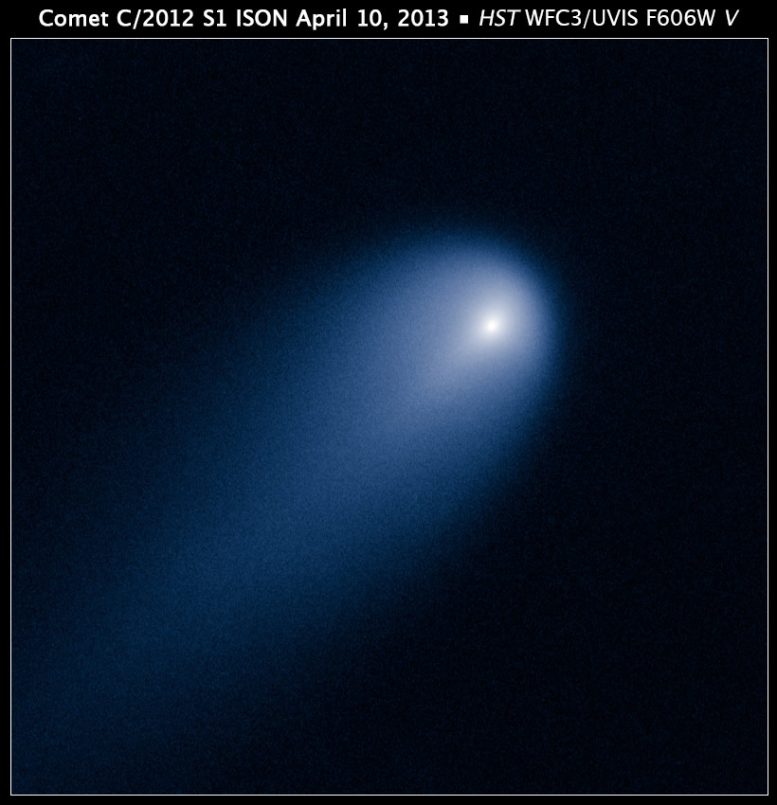
    NASA’s Hubble Space Telescope provides a close-up look of Comet ISON (C/2012 S1), as photographed on April 10, when the comet was slightly closer than Jupiter’s orbit at a distance of 386 million miles from the sun. Credit:NASA, ESA, J.-Y. Li (Planetary Science Institute), and the Hubble Comet ISON Imaging Science Team

    NASA’s Hubble telescope captured close-up images of Comet ISON in early April, providing scientists with images to measure the activity level of the comet.

    This NASA Hubble Space Telescope image of Comet (C/2012 S1) ISON was photographed on April 10, when the comet was slightly closer than Jupiter’s orbit at a distance of 386 million miles (621 million kilometers) from the Sun (394 million miles 634 million kilometers from Earth).

    Even at that great distance the comet is already active as sunlight warms the surface and causes frozen volatiles to sublimate. A detailed analysis of the dust coma surrounding the solid, icy nucleus reveals a strong, jet-blasting dust particles off the sunward-facing side of the comet’s nucleus.

    Preliminary measurements from the Hubble images suggest that the nucleus of ISON is no larger than three or four miles across. This is remarkably small considering the high level of activity observed in the comet so far, said researchers. Astronomers are using these images to measure the activity level of this comet and constrain the size of the nucleus, in order to predict the comet’s activity when it skims 700,000 miles (1.1 million kilometers) above the sun’s roiling surface on November 28.

    The comet’s dusty coma, or head of the comet, is approximately 3,100 miles (5,000 miles) across, or 1.2 times the width of Australia. A dust tail extends more than 57,000 miles (92,000 kilometers), far beyond Hubble’s field of view.

    More careful analysis is currently underway to improve these measurements and to predict the possible outcome of the sungrazing perihelion passage of this comet.

    This image was taken in visible light. The blue false color was added to bring out details in the comet structure.

    ISON stands for International Scientific Optical Network, a group of observatories in ten countries that have organized to detect, monitor, and track objects in space. ISON is managed by the Keldysh Institute of Applied Mathematics, part of the Russian Academy of Sciences.

    Never miss a breakthrough: Join the SciTechDaily newsletter.
    Follow us on Google and Google News.

    Astronomy Comet Hubble Space Telescope NASA Space Telescope Science Institute
    Share. Facebook Twitter Pinterest LinkedIn Email Reddit

    Related Articles

    Hubble Confirms Largest Comet Nucleus Ever Seen – A Staggering 500 Trillion Tons Headed This Way

    Doomed Celestial Visitor May Have Been Piece of Prehistoric Comet

    Wayward Comet Makes a Temporary Stop Near Jupiter’s Asteroids

    Hubble Ultra Deep Field: Looking Out Into Space, Looking Back Into Time [Video]

    New Horizons Spacecraft Data Shows There Are Far Fewer Galaxies in the Universe Than Previously Thought

    Hubble Captures Unprecedented Fading of Stingray Nebula – “This Is Very, Very Dramatic, and Very Weird”

    ULLYSES: Hubble Embarks on Largest Observing Program of Its Career

    Hubble Spots Giant Space “Pumpkin” [Video]

    Hubble Observes Spectacular Supernova Time-Lapse – “No Earthly Fireworks Display Can Compete”

    Leave A Reply Cancel Reply

    • Facebook
    • Twitter
    • Pinterest
    • YouTube

    Don't Miss a Discovery

    Subscribe for the Latest in Science & Tech!

    Trending News

    Scientists Say This Natural Hormone Reverses Obesity by Targeting the Brain

    35-Million-Year-Old Mystery: Strange Arachnid Discovered Preserved in Amber

    Is AI Really Just a Tool? It Could Be Altering How You See Reality

    JWST Reveals a “Forbidden” Planet With a Baffling Composition

    The Protein “Sabotaging” Aging Muscle Recovery Could Be Key to Surviving Aging

    This Diet–Gut Interaction Could Transform Fat Into a Calorie-Burning Machine

    Scientists Discover Hidden Virus Linked to Colorectal Cancer

    Scientists Discover 132-Million-Year-Old Dinosaur Tracks on South Africa’s Coast

    Follow SciTechDaily
    • Facebook
    • Twitter
    • YouTube
    • Pinterest
    • Newsletter
    • RSS
    SciTech News
    • Biology News
    • Chemistry News
    • Earth News
    • Health News
    • Physics News
    • Science News
    • Space News
    • Technology News
    Recent Posts
    • 500 Million Years Ago, Life Changed Forever: Scientists Reveal the DNA Changes That Helped Animals Move Onto Land
    • Surprise RNA Discovery Challenges Long-Held Beliefs About How Genes Work
    • Your IQ at 23 Could Predict Your Wealth at 27, Study Finds
    • 320 Light-Years Away, a Planet Confirms a Fundamental Cosmic Assumption
    • Astronomers Solve Decades-Long Mystery About Saturn’s Spin – “Something Strange Was Happening”
    Copyright © 1998 - 2026 SciTechDaily. All Rights Reserved.
    • Science News
    • About
    • Contact
    • Editorial Board
    • Privacy Policy
    • Terms of Use

    Type above and press Enter to search. Press Esc to cancel.