
Close Menu
    Facebook X (Twitter) Instagram
    SciTechDaily
    • Biology
    • Chemistry
    • Earth
    • Health
    • Physics
    • Science
    • Space
    • Technology
    Facebook X (Twitter) Pinterest YouTube RSS
    SciTechDaily
    Home»Space»Time-Lapse Video Captures Comet ISON Heading Toward the Sun
    Space

    Time-Lapse Video Captures Comet ISON Heading Toward the Sun

    By Ray Villard / Zolt Levay, Space Telescope Science Institute; NASAJuly 3, 2013No Comments2 Mins Read
    Facebook Twitter Pinterest Telegram LinkedIn WhatsApp Email Reddit
    Share
    Facebook Twitter LinkedIn Pinterest Telegram Email Reddit

    This short time-lapse video shows the comet ISON as it zooms toward the Sun at 48,000 mph (77,000 kph)..

    This July Fourth the solar system is showing off some fireworks of its own. Superficially resembling a skyrocket, comet ISON is hurtling toward the sun presently at a whopping 48,000 mph (77,000 kph).

    Its swift motion is captured in this time-lapse movie made from a sequence of pictures taken May 8, 2013, by NASA’s Hubble Space Telescope. At the time the images were taken, the comet was 403 million miles from Earth, between the orbits of Mars and Jupiter.

    The movie shows a sequence of Hubble observations taken over a 43-minute span and compresses this into just five seconds. The comet travels 34,000 miles (55,000 kilometers) in this brief video, or 7 percent of the distance between Earth and the moon. The deep-space visitor streaks silently against the background stars.

    Unlike a firework, the comet is not combusting, but in fact is pretty cold. Its skyrocket-looking tail is really a streamer of gas and dust bleeding off the icy nucleus, which is surrounded by a bright star-like-looking coma. The pressure of the solar wind sweeps the material into a tail, like a breeze blowing a windsock.

    As the comet warms as it moves closer to the sun, its rate of sublimation (a process similar to evaporation in which solid matter transitions directly into gas) will increase. The comet will get brighter and its tail will grow longer. The comet is predicted to reach naked-eye visibility in November.

    The comet is named after the organization that discovered it, the Russia-based International Scientific Optical Network.
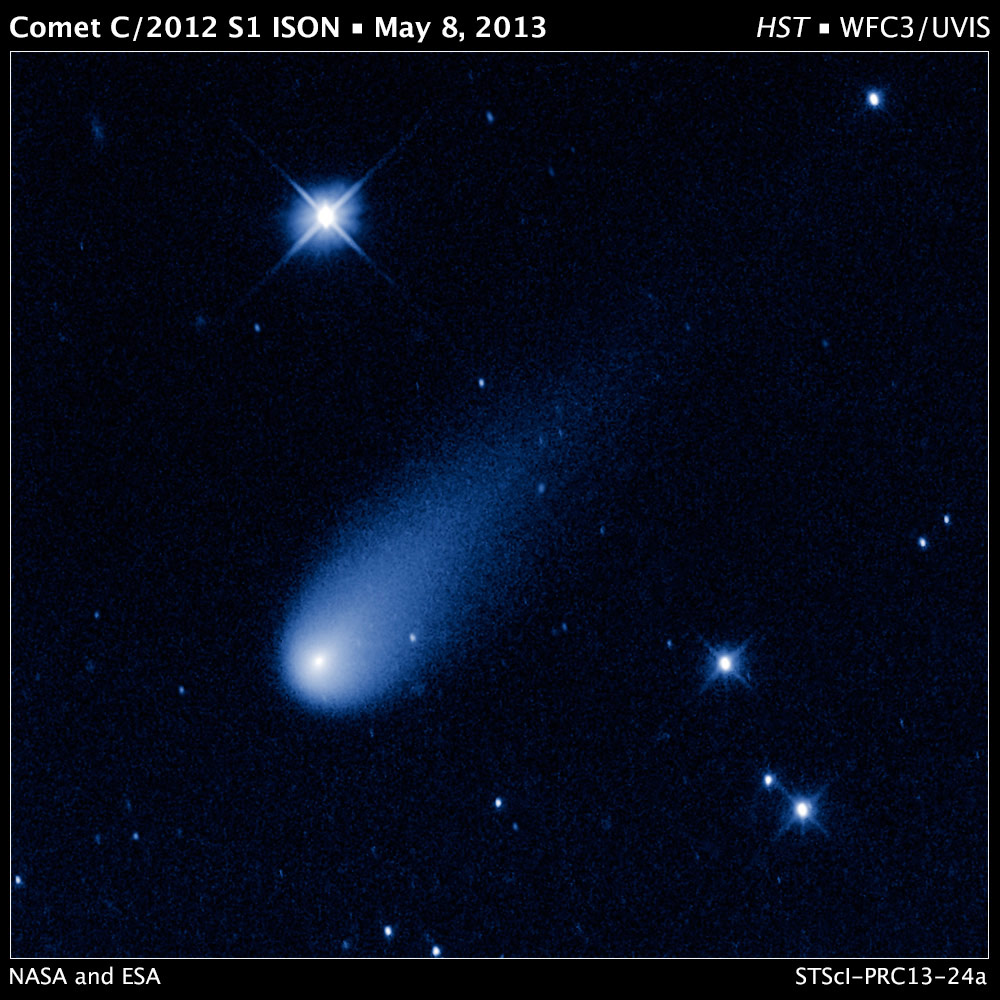
    Hubble Image of Comet ISON
    Image of Comet ISON Captured by Hubble. Credit: NASA, ESA, and the Hubble Heritage Team (STScI/AURA)

    This false-color, visible-light image was taken with Hubble’s Wide Field Camera 3.

    The Hubble Space Telescope is a project of international cooperation between NASA and the European Space Agency. NASA’s Goddard Space Flight Center in Greenbelt, Md., manages the telescope. The Space Telescope Science Institute in Baltimore, Md., conducts Hubble science operations. STScI is operated by the Association of Universities for Research in Astronomy Inc., in Washington, D.C.


    Never miss a breakthrough: Join the SciTechDaily newsletter.
    Follow us on Google and Google News.

    Astronomy Comet Hubble Space Telescope ISON NASA
    Share. Facebook Twitter Pinterest LinkedIn Email Reddit

    Related Articles

    Hubble Reveals a Rare Interstellar Comet Racing at 130,000 MPH Through Our Solar System

    Hubble Watches Comet ATLAS Disintegrate – Identified Months Ago by Planetary Defense System

    Mysterious Visitor From the Depths of Space Swings Past Sun

    First Confirmed Interstellar Comet Observed by Hubble [Video]

    Hubble Reveals Multiple Jets Sprouting from Comet C/2013 A1

    Hubble Captures a New Image of Comet ISON

    Spitzer Views Gas Emissions From Comet ISON

    Comet ISON’s Journey Toward the Sun

    Hubble Captures Close-Up View of Comet ISON

    Leave A Reply Cancel Reply

    • Facebook
    • Twitter
    • Pinterest
    • YouTube

    Don't Miss a Discovery

    Subscribe for the Latest in Science & Tech!

    Trending News

    New Study Reveals Why Ozempic Works Better for Some People Than Others

    Climate Change Is Altering a Key Greenhouse Gas in a Way Scientists Didn’t Expect

    New Study Suggests Gravitational Waves May Have Created Dark Matter

    Scientists Discover Why the Brain Gets Stuck in Schizophrenia

    Scientists Engineer “Tumor-Eating” Bacteria That Devour Cancer From Within

    Even “Failed” Diets May Deliver Long-Term Health Gains, Study Finds

    NIH Scientists Discover Powerful New Opioid That Relieves Pain Without Dangerous Side Effects

    Collapsing Plasma May Hold the Key to Cosmic Magnetism

    Follow SciTechDaily
    • Facebook
    • Twitter
    • YouTube
    • Pinterest
    • Newsletter
    • RSS
    SciTech News
    • Biology News
    • Chemistry News
    • Earth News
    • Health News
    • Physics News
    • Science News
    • Space News
    • Technology News
    Recent Posts
    • This 15,000-Year-Old Discovery Changes What We Know About Early Human Creativity
    • 35-Million-Year-Old Mystery: Strange Arachnid Discovered Preserved in Amber
    • Revolutionary Gas Turbine Generates Power Without Air Compression
    • Is AI Really Just a Tool? It Could Be Altering How You See Reality
    • JWST Reveals a “Forbidden” Planet With a Baffling Composition
    Copyright © 1998 - 2026 SciTechDaily. All Rights Reserved.
    • Science News
    • About
    • Contact
    • Editorial Board
    • Privacy Policy
    • Terms of Use

    Type above and press Enter to search. Press Esc to cancel.