

Close Menu
    Facebook X (Twitter) Instagram
    SciTechDaily
    • Biology
    • Chemistry
    • Earth
    • Health
    • Physics
    • Science
    • Space
    • Technology
    Facebook X (Twitter) Pinterest YouTube RSS
    SciTechDaily
    Home»Space»Historic First: Stunning Close-Up of a Dying Star Beyond the Milky Way
    Space

    Historic First: Stunning Close-Up of a Dying Star Beyond the Milky Way

    By European Southern Observatory (ESO)November 21, 20241 Comment6 Mins Read
    Facebook Twitter Pinterest Telegram LinkedIn WhatsApp Email Reddit
    Share
    Facebook Twitter LinkedIn Pinterest Telegram Email Reddit
    Dying Star WOH G64
    This image shows an artist’s reconstruction of the star WOH G64, the first star outside our galaxy to be imaged in close-up. It is located at a staggering distance of over 160,000 light-years away in the Large Magellanic Cloud. This artistic impression showcases its main features: an egg-shaped cocoon of dust surrounding the star and a ring or torus of dust. The existence and shape of the latter require more observations to be confirmed. Credit: ESO/L. Calçada

    Astronomers captured an unprecedented image of WOH G64, a red supergiant star in its final life stages, using advanced technology from the ESO’s VLTI.

    This observation marks the first detailed look at a dying star outside our galaxy and offers insights into its structural changes and dimming, potentially due to material loss or another star’s influence.

    Breakthrough in Stellar Observation

    “For the first time, we have succeeded in taking a zoomed-in image of a dying star in a galaxy outside our own Milky Way,” says Keiichi Ohnaka, an astrophysicist from Universidad Andrés Bello in Chile. The star, WOH G64, lies an astonishing 160,000 light-years away and was imaged using the exceptional precision of the European Southern Observatory’s Very Large Telescope Interferometer (ESO’s VLTI). These observations reveal the star in its final stages, ejecting gas and dust as it approaches its transformation into a supernova.

    “We discovered an egg-shaped cocoon closely surrounding the star,” Ohnaka explains. He is the lead author of a study on the findings, published today (November 21) in Astronomy & Astrophysics. “We are excited because this may be related to the drastic ejection of material from the dying star before a supernova explosion.”
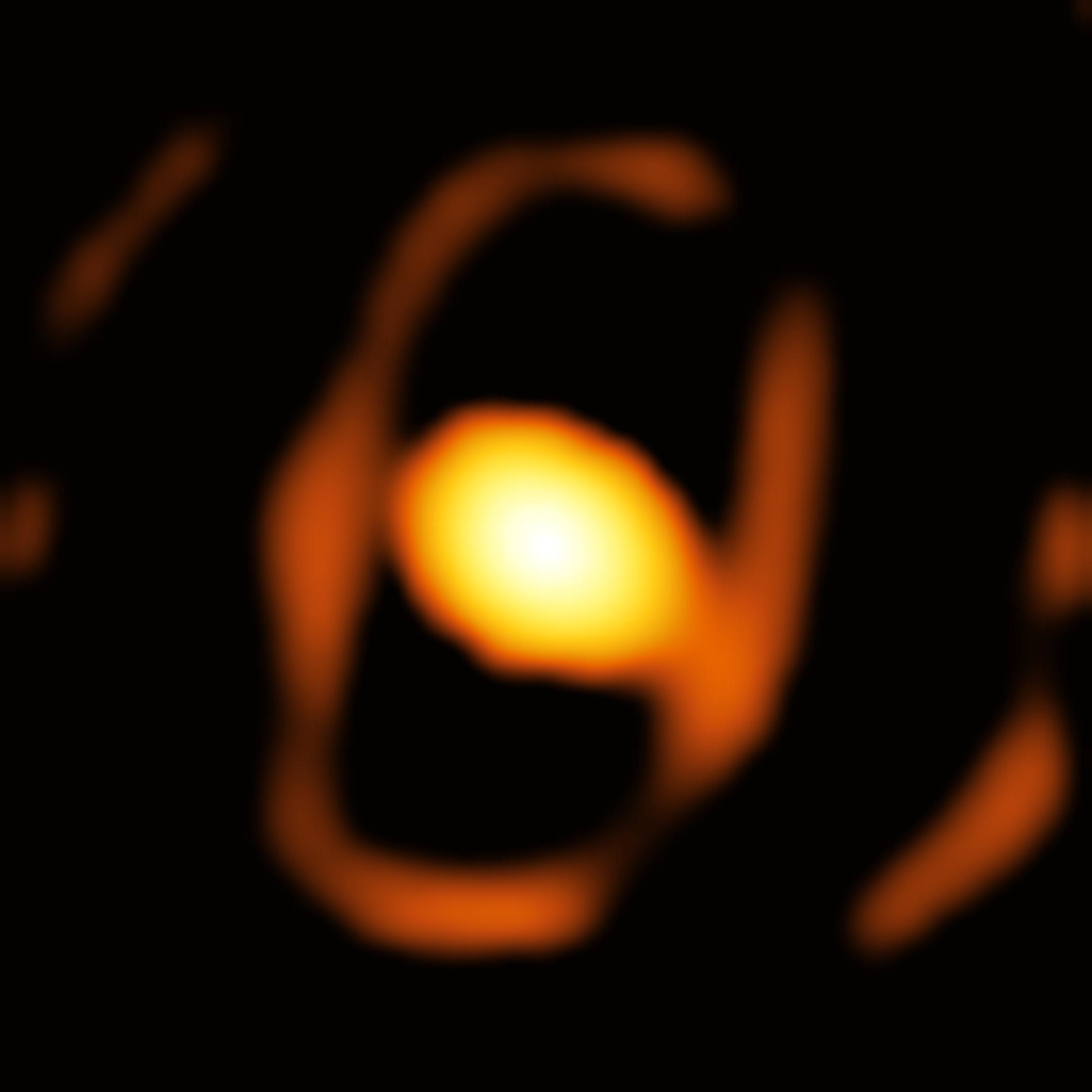
    WOH G64
    This is an image of the star WOH G64, taken by the GRAVITY instrument on the European Southern Observatory’s Very Large Telescope Interferometer (ESO’s VLTI). This is the first close-up picture of a star outside our own galaxy, the Milky Way. The star is located in the Large Magellanic Cloud, over 160,000 light-years away. The bright oval at the center of this image is a dusty cocoon that enshrouds the star. A fainter elliptical ring around it could be the inner rim of a dusty torus, but more observations are needed to confirm this feature. Credit: ESO/K. Ohnaka et al.

    Challenges in Galactic Astronomy

    Until now, astronomers had only obtained close-up images of stars within the Milky Way, revealing key details about their properties. Observing stars in distant galaxies has posed immense challenges due to their vast distances. This breakthrough changes that, offering a rare glimpse into the life of a star far beyond our own galaxy.

    The newly imaged star, WOH G64, lies within the Large Magellanic Cloud, one of the small galaxies that orbits the Milky Way. Astronomers have known about this star for decades and have appropriately dubbed it the ‘behemoth star’. With a size roughly 2000 times that of our Sun, WOH G64 is classified as a red supergiant.

    Technological Advances in Astronomy

    Ohnaka’s team had long been interested in this behemoth star. Back in 2005 and 2007, they used ESO’s VLTI in Chile’s Atacama Desert to learn more about the star’s features, and carried on studying it in the years since. But an actual image of the star had remained elusive.

    For the desired picture, the team had to wait for the development of one of the VLTI’s second-generation instruments, GRAVITY. After comparing their new results with other previous observations of WOH G64, they were surprised to find that the star had become dimmer over the past decade.
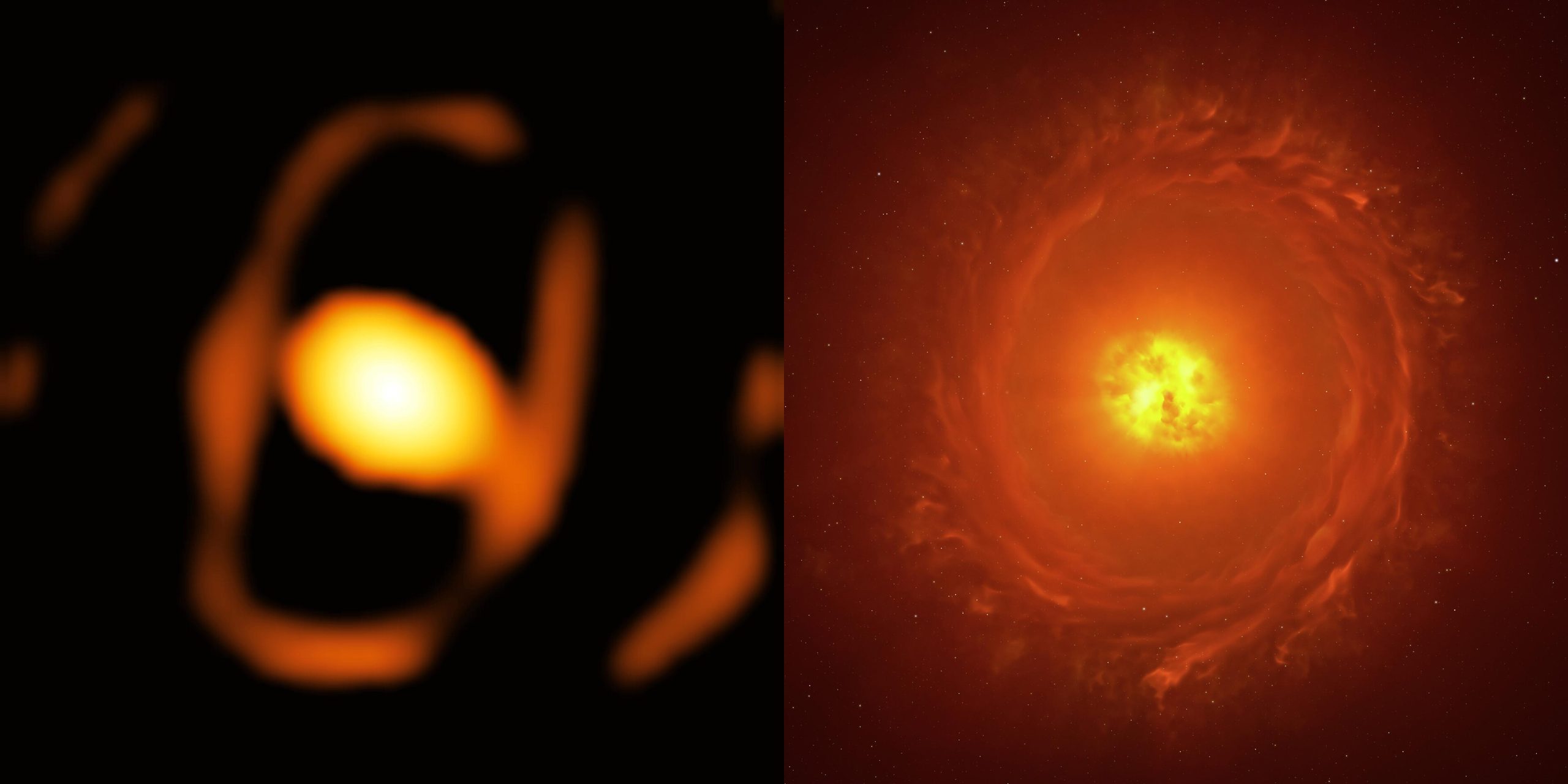
    WOH G64 Image vs Reconstruction
    Located in the Large Magellanic Cloud, at a staggering distance of over 160,000 light-years from us, WOH G64 is a dying star roughly 2000 times the size of the Sun. This image of the star (left) is the first close-up picture of a star outside our galaxy. The image on the right shows an artist’s impression reconstructing the geometry of the structures around the star, including the bright oval envelope and a fainter dusty torus. Confirming the presence and shape of this torus will require additional observations. Credit: ESO/K. Ohnaka et al., L. Calçada

    Observing Stellar Evolution in Real Time

    “We have found that the star has been experiencing a significant change in the last 10 years, providing us with a rare opportunity to witness a star’s life in real-time,” says Gerd Weigelt, an astronomy professor at the Max Planck Institute for Radio Astronomy in Bonn, Germany and a co-author of the study. In their final life stages, red supergiants like WOH G64 shed their outer layers of gas and dust in a process that can last thousands of years. “This star is one of the most extreme of its kind, and any drastic change may bring it closer to an explosive end,” adds co-author Jacco van Loon, Keele Observatory Director at Keele University, UK, who has been observing WOH G64 since the 1990s.

    The team thinks that these shed materials may also be responsible for the dimming and for the unexpected shape of the dust cocoon around the star. The new image shows that the cocoon is stretched out, which surprised scientists, who expected a different shape based on previous observations and computer models. The team believes that the cocoon’s egg-like shape could be explained by either the star’s shedding or by the influence of a yet-undiscovered companion star.


    This video zooms into WOH G64, a dying star in the Large Magellanic Cloud, 160,000 light-years from us. This is the first close-up image of a star outside our galaxy.

    As the star becomes fainter, taking other close-up pictures of it is becoming increasingly difficult, even for the VLTI. Nonetheless, planned updates to the telescope’s instrumentation, such as the future GRAVITY+, promise to change this soon. “Similar follow-up observations with ESO instruments will be important for understanding what is going on in the star,” concludes Ohnaka.

    Reference: “Imaging the innermost circumstellar environment of the red supergiant WOH G64 in the Large Magellanic Cloud” by K. Ohnaka, K.-H. Hofmann, G. Weigelt, J. Th. van Loon, D. Schertl and S. R. Goldman, 21 November 2024, Astronomy & Astrophysics.
    DOI: 10.1051/0004-6361/202451820

    Never miss a breakthrough: Join the SciTechDaily newsletter.
    Follow us on Google and Google News.

    Astronomy European Southern Observatory Popular Stars Very Large Telescope
    Share. Facebook Twitter Pinterest LinkedIn Email Reddit

    Related Articles

    Surprise Planet Discovered Around Extreme Star Pair

    A Cosmic Mystery: Disappearance of a Massive Star Surprises Astronomers

    VLT Views a Gas Cloud Being Ripped Apart by a Black Hole

    Sodium Levels in Stars Helps Predict How Their Lives Will End

    Astronomers View the Aftermath of Supernova SN 1999em and Its Host Galaxy

    Planetary Nebula Fleming 1 Likely Has Two White Dwarfs Circling Each Other at Its Center

    ESO’s New Image of Spiral Galaxy NGC 1187

    VLT Reveals That O Stars, Which Drive the Evolution of Galaxies, Don’t Live Alone

    Scientists Detect Dark Galaxies for the First Time

    1 Comment

    1. Boba on November 21, 2024 1:05 pm

      Yeah, that “artist rendition”? Not even close.

      Reply
    Leave A Reply Cancel Reply

    • Facebook
    • Twitter
    • Pinterest
    • YouTube

    Don't Miss a Discovery

    Subscribe for the Latest in Science & Tech!

    Trending News

    Monster Storms on Jupiter Unleash Lightning Beyond Anything on Earth

    Scientists Create “Liquid Gears” That Spin Without Touching

    The Simple Habit That Could Help Prevent Cancer

    Millions Take These IBS Drugs, But a New Study Finds Serious Risks

    Scientists Unlock Hidden Secrets of 2,300-Year-Old Mummies Using Cutting-Edge CT Scanner

    Bread Might Be Making You Gain Weight Even Without Eating More Calories

    Scientists Discover Massive Magma Reservoir Beneath Tuscany

    Europe’s Most Active Volcano Just Got Stranger – Here’s Why Scientists Are Rethinking It

    Follow SciTechDaily
    • Facebook
    • Twitter
    • YouTube
    • Pinterest
    • Newsletter
    • RSS
    SciTech News
    • Biology News
    • Chemistry News
    • Earth News
    • Health News
    • Physics News
    • Science News
    • Space News
    • Technology News
    Recent Posts
    • Scientists Discover a New Meteor Shower From a Mysterious Crumbling Asteroid
    • This Simple Fruit Wash Could Make Produce Safer and Last Days Longer
    • These Tiny Robots 50x Smaller Than a Hair Can Hunt and Move Bacteria
    • Simple Blood Test May Predict Alzheimer’s Years Before Brain Scans Show Signs
    • Scientists Say Adding This Unusual Seafood to Your Diet Could Reverse Signs of Aging
    Copyright © 1998 - 2026 SciTechDaily. All Rights Reserved.
    • Science News
    • About
    • Contact
    • Editorial Board
    • Privacy Policy
    • Terms of Use

    Type above and press Enter to search. Press Esc to cancel.