
Close Menu
    Facebook X (Twitter) Instagram
    SciTechDaily
    • Biology
    • Chemistry
    • Earth
    • Health
    • Physics
    • Science
    • Space
    • Technology
    Facebook X (Twitter) Pinterest YouTube RSS
    SciTechDaily
    Home»Space»Centaurus a Hides a Gaseous Spiral at Its Core
    Space

    Centaurus a Hides a Gaseous Spiral at Its Core

    By Harvard-Smithsonian Center for AstrophysicsOctober 22, 20123 Comments4 Mins Read
    Facebook Twitter Pinterest Telegram LinkedIn WhatsApp Email Reddit
    Share
    Facebook Twitter LinkedIn Pinterest Telegram Email Reddit
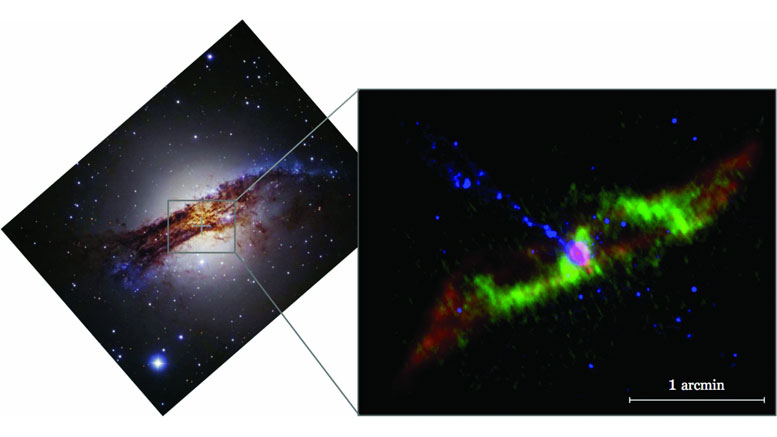
    Centaurus A Hides a Gaseous Spiral at its Core
    Left: optical image of Centaurus A, showing its prominent dust lane (ESO/IDA/Danish 1.5 m/R. Gendler, J.-E. Ovaldsen, & S. Guisard, ESO). Right: the molecular gas as traced by our SMA CO(2–1) observation (green), PAH and dust emission at 8 μm observed by Spitzer (red; Quillen et al. 2006), and the Chandra X-ray observations of the jet (blue, NASA/CXC/M. Karovska et al.). Note that the spiral and the 8 μm emission in this panel are within the optical dust lane visible in the left panel. The most prominent features of the 12CO(2–1) emission are consistent with those of the 8 μm emission, but the CO shows the spiral arms. There is a CO absorption feature toward the unresolved compact continuum component located toward the AGN (Espada et al. 2010). Note that the jet is nearly perpendicular to the circumnuclear molecular gas at the base of the spiral arms, but not to the outer component. Credit: ESO

    Scientists at the National Astronomical Observatory of Japan & Harvard-Smithsonian Center for Astrophysics discovered that elliptical galaxy Centaurus A also shows signs of a spiral galaxy.

    Most big galaxies fit into one of two camps: pinwheel-shaped spiral galaxies and blobby elliptical galaxies. Spirals like the Milky Way are hip and happening places, with plenty of gas and dust to birth new stars. Ellipticals are like cosmic retirement villages, full of aging residents in the form of red giant stars. Now, astronomers have discovered that one well-known elliptical has a split personality. Centaurus A is hiding a gassy spiral in its center.

    “No other elliptical galaxy is known to have spiral arms,” said lead author Daniel Espada (National Astronomical Observatory of Japan & Harvard-Smithsonian Center for Astrophysics). “Centaurus A may be an old galaxy, but it’s still very young at heart.”

    Centaurus A isn’t your typical elliptical to begin with. Its most striking feature is a dark dust lane across its middle – a sign that it swallowed a spiral galaxy about 300 million years ago.

    Centaurus A slurped that galaxy’s gases down, forming a disk that we see nearly edge on. From our point of view, any features in that disk have been hidden by the intervening dust.

    To tease out the disk’s structure, Espada and his colleagues used the sharp vision of the Smithsonian’s Submillimeter Array. This radio telescope can see through dust to pick up signals from naturally occurring carbon monoxide gas. By mapping the gas, the team unveiled two distinct spiral arms within the galaxy’s core.

    These gaseous tendrils have sizes and shapes similar to spiral arms in galaxies like the Milky Way. Also like the Milky Way’s spiral arms, they are forming new generations of stars.

    “Centaurus A has been given a new lease on life by that past merger,” said Espada.

    Computer simulations suggest that the spiral features might endure for hundreds of millions of years to come.

    Although Centaurus A is the first elliptical galaxy found to have spiral arms, it may not be the last. Since it’s only 12 million light-years away, it’s relatively nearby and easy to study. The Atacama Large Millimeter/submillimeter Array (ALMA) potentially can find more split-personality galaxies with its improved radio “vision.”

    “We definitely will use ALMA to search for other objects that are similar to Centaurus A,” added Espada.

    These findings were published in The Astrophysical Journal Letters.

    Reference: “Disentangling the Circumnuclear Environs of Centaurus A: Gaseous Spiral Arms in a Giant Elliptical Galaxy” by D. Espada, S. Matsushita, A. B. Peck, C. Henkel, F. Israel and D. Iono, 9 August 2012, The Astrophysical Journal Letters.
    DOI: 10.1088/2041-8205/756/1/L10

    Headquartered in Cambridge, Massachusetts, the Harvard-Smithsonian Center for Astrophysics (CfA) is a joint collaboration between the Smithsonian Astrophysical Observatory and the Harvard College Observatory. CfA scientists, organized into six research divisions, study the origin, evolution and ultimate fate of the universe.

    Never miss a breakthrough: Join the SciTechDaily newsletter.
    Follow us on Google and Google News.

    Astronomy Astrophysics European Southern Observatory Galaxy Galaxy Evolution Harvard-Smithsonian Center for Astrophysics Popular
    Share. Facebook Twitter Pinterest LinkedIn Email Reddit

    Related Articles

    VISTA Survey Telescope Discovers Massive Galaxies in the Early Universe

    SMA Reveals New Insights Into How Cosmic Seeds Grow Into Massive Stars

    12 Billion Year Old Explosion Illuminates a Galaxy from the Dark Ages

    ALMA Reveals the Mystery of Missing Massive Galaxies

    New Computer Simulations Help Reveal How Spiral Galaxies Get Their Arms

    Examining the Dust Absorption of Active Galactic Nuclei

    Using Infrared Images from Hubble & Spitzer, Scientists Discover 25 Distant Galaxies

    Origins of Type Ia Supernovae

    Ancient Galactic Collision Created Stellar Swirls of NGC 5907

    3 Comments

    1. William Goltz on August 1, 2017 2:51 pm

      This article is incorrectly titled: the article refers to Cen A not M87

      Reply
      • Staff on August 1, 2017 7:21 pm

        This post was from 2012….Not sure why there was a mistake in the title, but it has been corrected. Thanks!

        Reply
    2. John Bayer on November 15, 2025 8:46 pm

      The dual nature of Centaurus A has been noted since the last century.

      Reply
    Leave A Reply Cancel Reply

    • Facebook
    • Twitter
    • Pinterest
    • YouTube

    Don't Miss a Discovery

    Subscribe for the Latest in Science & Tech!

    Trending News

    Breakthrough Bowel Cancer Trial Leaves Patients Cancer-Free for Nearly 3 Years

    Natural Compound Shows Powerful Potential Against Rheumatoid Arthritis

    100,000-Year-Old Neanderthal Fossils in Poland Reveal Unexpected Genetic Connections

    Simple “Gut Reset” May Prevent Weight Gain After Ozempic or Wegovy

    2.8 Days to Disaster: Scientists Warn Low Earth Orbit Could Suddenly Collapse

    Common Food Compound Shows Surprising Power Against Superbugs

    5 Simple Ways To Remember More and Forget Less

    The Atomic Gap That Could Cost the Semiconductor Industry Billions

    Follow SciTechDaily
    • Facebook
    • Twitter
    • YouTube
    • Pinterest
    • Newsletter
    • RSS
    SciTech News
    • Biology News
    • Chemistry News
    • Earth News
    • Health News
    • Physics News
    • Science News
    • Space News
    • Technology News
    Recent Posts
    • Alzheimer’s May Begin Decades Earlier Than You Think, New Mayo Clinic Study Finds
    • The Hidden Risk of Taking Breaks From Weight-Loss Drugs Like Ozempic
    • Total Solar Eclipse Made Cities Go Eerily Quiet Beneath the Surface
    • This Common Plant Could Be an Unexpected New Source of Protein
    • Birds in Cities Fear Women More Than Men and Scientists Don’t Know Why
    Copyright © 1998 - 2026 SciTechDaily. All Rights Reserved.
    • Science News
    • About
    • Contact
    • Editorial Board
    • Privacy Policy
    • Terms of Use

    Type above and press Enter to search. Press Esc to cancel.