
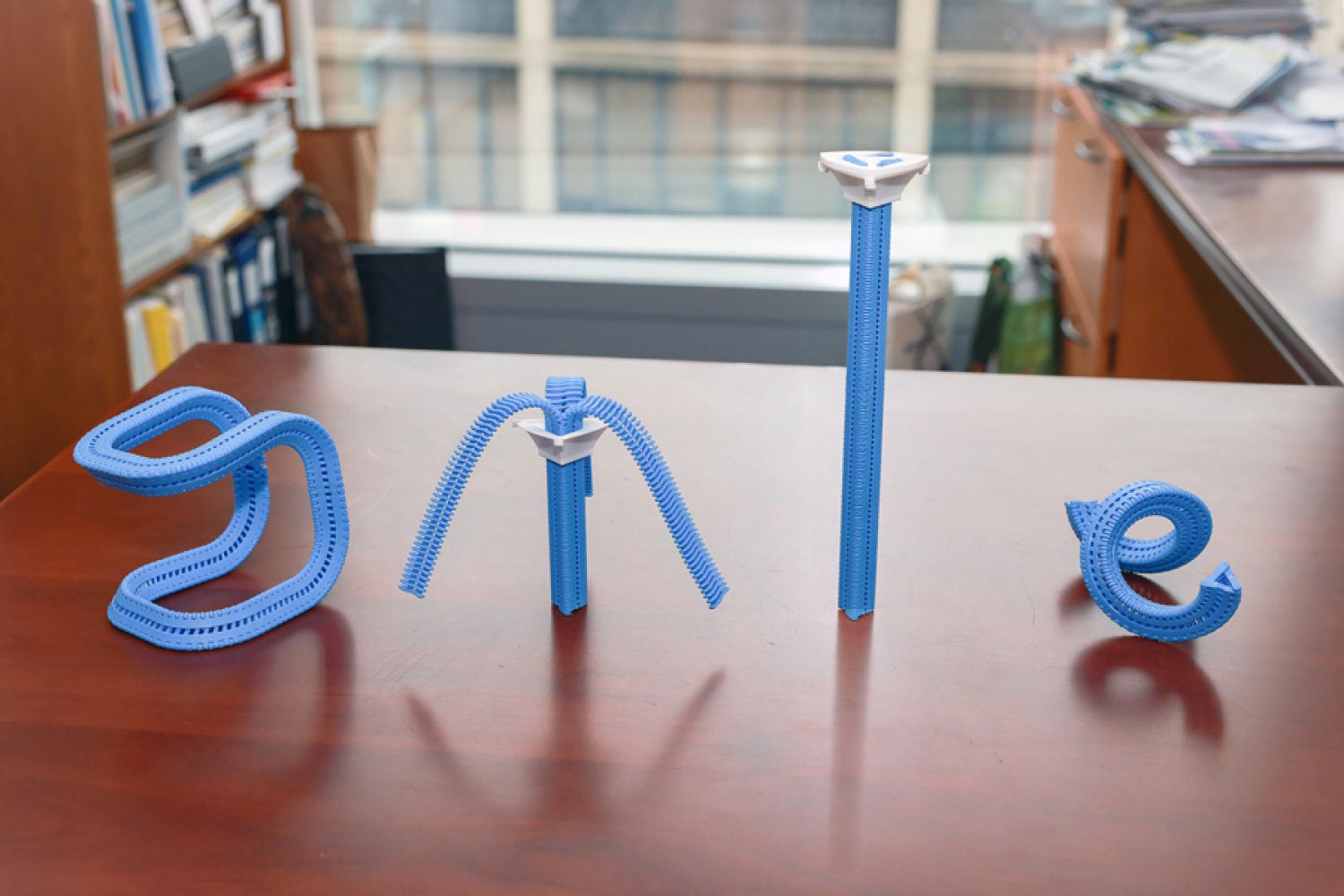
A decades-old patent from MIT Professor Bill Freeman inspired the new “Y-zipper,” a three-sided fastener that can snap gear, robots, and art into shape with the push of a button.
Long before shape-shifting robots and self-assembling structures became engineering goals, one MIT professor had already imagined a zipper that could transform floppy materials into rigid forms on demand. The problem? In 1985, the technology needed to build it simply didn’t exist.
That year, the Innovative Design Fund placed an ad in Scientific American offering up to $10,000 for inventive ideas in clothing, textiles, and home design. William Freeman PhD ’92 — then an electrical engineer at Polaroid and now an MIT professor — responded with an unusual concept: a three-sided zipper that could make objects instantly switch between soft and stiff states. Instead of fastening jackets or pants, Freeman envisioned it helping items like tents, chairs, and bags collapse flat for transport and then lock themselves into sturdy 3D structures when zipped together.
His prototype looked like a triangular version of a conventional zipper. Three flexible strips lined with narrow wooden “teeth” could be drawn together by a sliding mechanism, forming a rigid triangular tube. The idea was rejected, but Freeman patented the invention and stored the prototype in his garage, convinced it might someday find a purpose.
Nearly four decades later, researchers at MIT’s Computer Science and Artificial Intelligence Laboratory (CSAIL) returned to the idea as they looked for ways to create objects with “tunable stiffness.” Earlier methods for changing stiffness were either difficult to reverse or required assembly by hand. CSAIL responded by creating both an automated design tool and an adaptable fastener called the “Y-zipper.”
The software lets users design customized three-sided zippers, which are then fabricated automatically with plastics in a 3D printer. The resulting fasteners can be attached to or built into camping equipment, medical devices, robots, and art installations to make assembly easier.
“A regular zipper is great for closing up flat objects, like a jacket, but Freeman ideated something more dynamic. Using current fabrication technology, his mechanism can transform more complex items,” says MIT postdoc and CSAIL researcher Jiaji Li, who is a lead author on an open-access paper presenting the project. “We’ve developed a process that builds objects you can rapidly shift from flexible to rigid, and you can be confident they’ll work in the real world.”
Y-Zipper: 3D Printing Flexible-Rigid Transitions in One Click. Credit: MIT
Why zippers?
In CSAIL’s software, users can decide what the fastener will look like once it is closed. They can set the length of each strip and choose the direction and angle of its bends. They can also select from four basic motion patterns that determine the closed shape: straight, bent like an arch, coiled like a spring, or twisted like screws.
The finished Y zipper appears to change shape in the physical world. When open, it can spread out like a squid with three extended tentacles. When zipped shut, it pulls into a tighter structure (like a rod, for instance). That flexibility could be useful for travel and outdoor gear. Pitching a tent alone can take up to six minutes, but with help from the Y zipper, the process took one minute and 20 seconds. Each arm attaches to a side of the tent, supporting the structure from above so the fastener effectively snaps the canopy into place.
That smooth shift between soft and rigid states could also help create more adjustable wearables, especially for medical use. The team wrapped a Y zipper around a wrist cast so the wearer could loosen it during the day and close it at night to help prevent further injury. In that setup, a device that normally feels rigid can become more adaptable to a patient’s comfort and needs.
The system can also help build technology that moves with the press of a button. After fabrication, a motor can be attached to the Y zipper to automate the closing process. The researchers used this approach to make an adaptive robotic quadruped. Such a robot could one day change the length of its legs, pulling itself into taller limbs or opening the fastener to stay closer to the ground. Fast shape changes like these could help robots move across uneven environments such as canyons or forests. Motor-driven Y zippers can also create moving art installations. In one example, the team built a long winding flower that “bloomed” when a stationary motor zipped the device closed.
Mastering the material
Li and his colleagues saw many possible uses for the Y zipper, but they still needed to test whether it could hold up under repeated use.
The team began with stress tests. They compared polylactic acid (PLA) and thermoplastic polyurethane (TPU), two plastics commonly used in 3D printing. A machine bent the Y zippers downward, showing that PLA could carry heavier loads, while TPU was more flexible.
In a separate test, CSAIL researchers used an actuator to repeatedly open and close the fastener until it failed. The Y zipper finally broke after about 18,000 cycles. According to 3D simulations, its durability comes from its elastic structure, which spreads stress more evenly under heavy loads.
Even with those results, Li sees room for a stronger version made from tougher materials such as metal. The team may also scale the zippers up for larger projects, although their current 3D printing system cannot yet produce that size.
Li also points to uses that remain largely unexplored. In space exploration, Y zipper arms could be integrated into a spacecraft and used to collect nearby rock samples. Similar fasteners could also be built into structures designed for rapid assembly, helping relief teams quickly deploy shelters or medical tents after disasters or during rescue operations.
“Reimagining an everyday zipper to tackle 3D morphological transitions is a brilliant approach to dynamic assembly,” says Zhejiang University assistant professor Guanyun Wang, who wasn’t involved in the paper. “More importantly, it effectively bridges the gap between soft and rigid states, offering a highly scalable and innovative fabrication approach that will greatly benefit the future design of embodied intelligence.”
Reference: “Y-zipper: 3D Printing Flexible–Rigid Transition Mechanism for Rapid and Reversible Assembly” by Jiaji Li, Xiang Chang, Mingming Li, Dingning Cao, Maxine Perroni-Scharf, Jeremy Mrzyglocki, Takumi Yamamoto, William Freeman and Stefanie Mueller, 13 April 2026, CHI ’26: Proceedings of the 2026 CHI Conference on Human Factors in Computing Systems.
DOI: 10.1145/3772318.3790723
Supported, in part, by a postdoctoral research fellowship from Zhejiang University and the MIT-GIST Program.
Disclosure: The researchers’ work was presented at the ACM’s Computer-Human Interaction (CHI) conference on Human Factors in Computing Systems in April.
Never miss a breakthrough: Join the SciTechDaily newsletter.
Follow us on Google and Google News.
2 Comments
thanks for this
Brilliant idea, so many applications, a game changer