
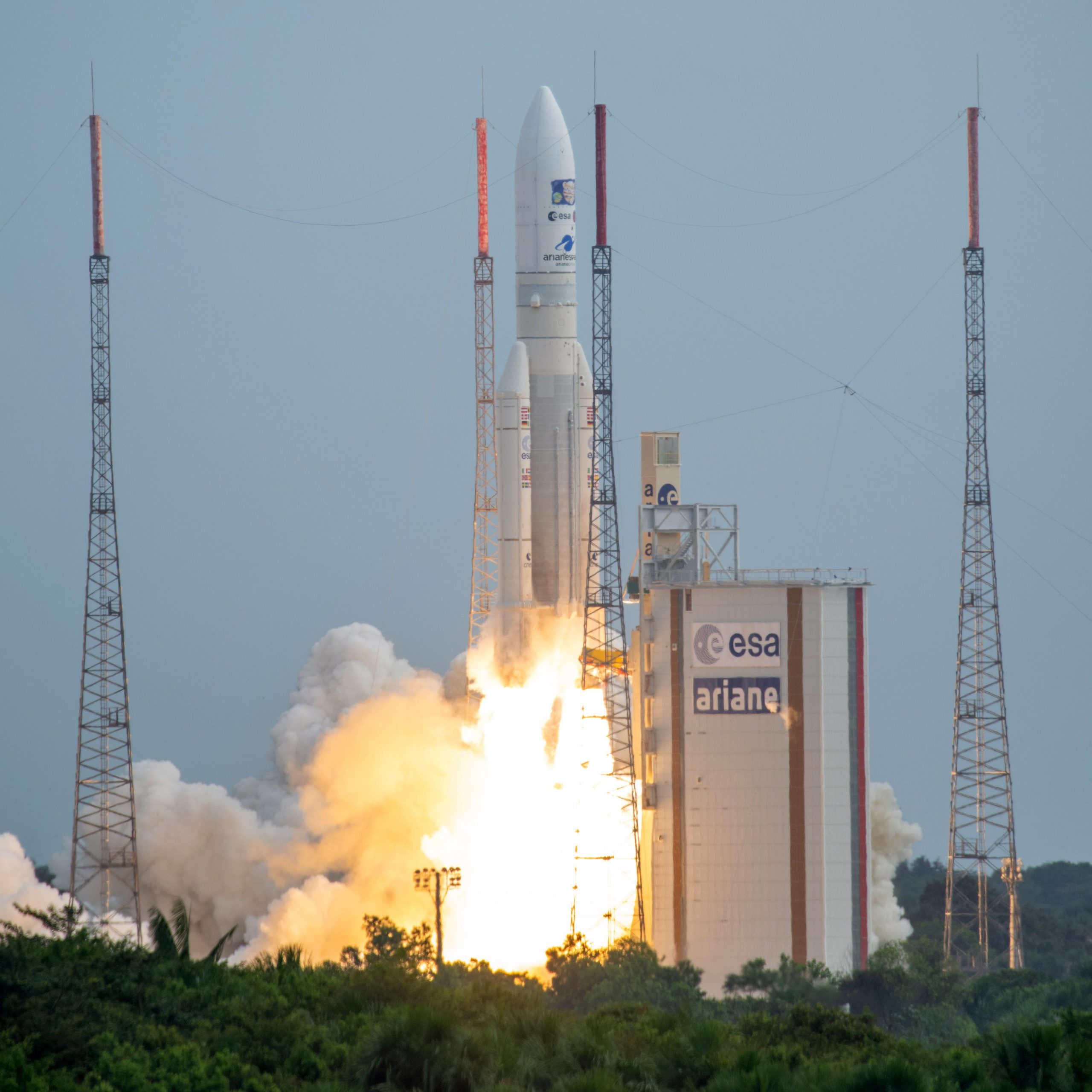
ESA’s Jupiter Icy Moons Explorer (Juice) lifted off on an Ariane 5 rocket from Europe’s Spaceport in French Guiana at 9:04 a.m. EDT on April 14. The successful launch marks the beginning of an ambitious voyage to uncover the secrets of the ocean worlds around giant planet Jupiter.
Following launch and separation from the rocket, ESA’s European Space Operations Centre (ESOC) in Darmstadt, Germany, confirmed acquisition of signal via the New Norcia ground station in Australia at 9:04 a.m. EDT (15:04 CEST). The spacecraft’s vast 27 meter (88 foot) long solar arrays unfurled into their distinctive cross shapes at 9:33 a.m. EDT (15:33 CEST), ensuring Juice can travel to the outer Solar System. The completion of this critical operation marked the launch a success.
“ESA, with its international partners, is on its way to Jupiter,” says ESA Director General Josef Aschbacher. “Juice’s spectacular launch carries with it the vision and ambition of those who conceived the mission decades ago, the skill and passion of everyone who has built this incredible machine, the drive of our flight operations team, and the curiosity of the global science community. Together, we will keep pushing the boundaries of science and exploration in order to answer humankind’s biggest questions.”
ESA’s latest interplanetary mission, Juice, lifted off on an Ariane 5 rocket from Europe’s Spaceport in French Guiana, at 14:14 CEST on April 14, 2023, to begin its eight-year journey to Jupiter, where it will study in detail the gas giant planet’s three large ocean-bearing moons: Ganymede, Callisto and Europa. Flight VA260 is the final Ariane 5 flight to carry an ESA mission to space. Credit: ESA/CNES/Arianespace
“It is thanks to the leadership of ESA and the effort and commitment of hundreds of European industries and scientific institutions that the Juice mission has become a reality,” says Giuseppe Sarri, ESA’s Juice Project Manager. “Together with our partners NASA, the Japan Aerospace Exploration Agency, and the Israel Space Agency, who have also contributed hardware or scientific instrumentation, we have reached this much-awaited launch milestone.”
From Galileo to Juice
Jupiter, shining brightly in the night sky, has sparked fascination ever since our ancient ancestors first looked up. Astronomer Galileo Galilei brought Jupiter into focus in 1610, observing the planet through a telescope for the first time and discovering its orbiting moons. His observations overturned the long-held idea that everything in the heavens revolved around Earth. Centuries later, Juice – which carries a commemorative plaque in honor of Galileo’s discoveries – will see Jupiter and its moons in a way that Galileo couldn’t even have dreamt of.
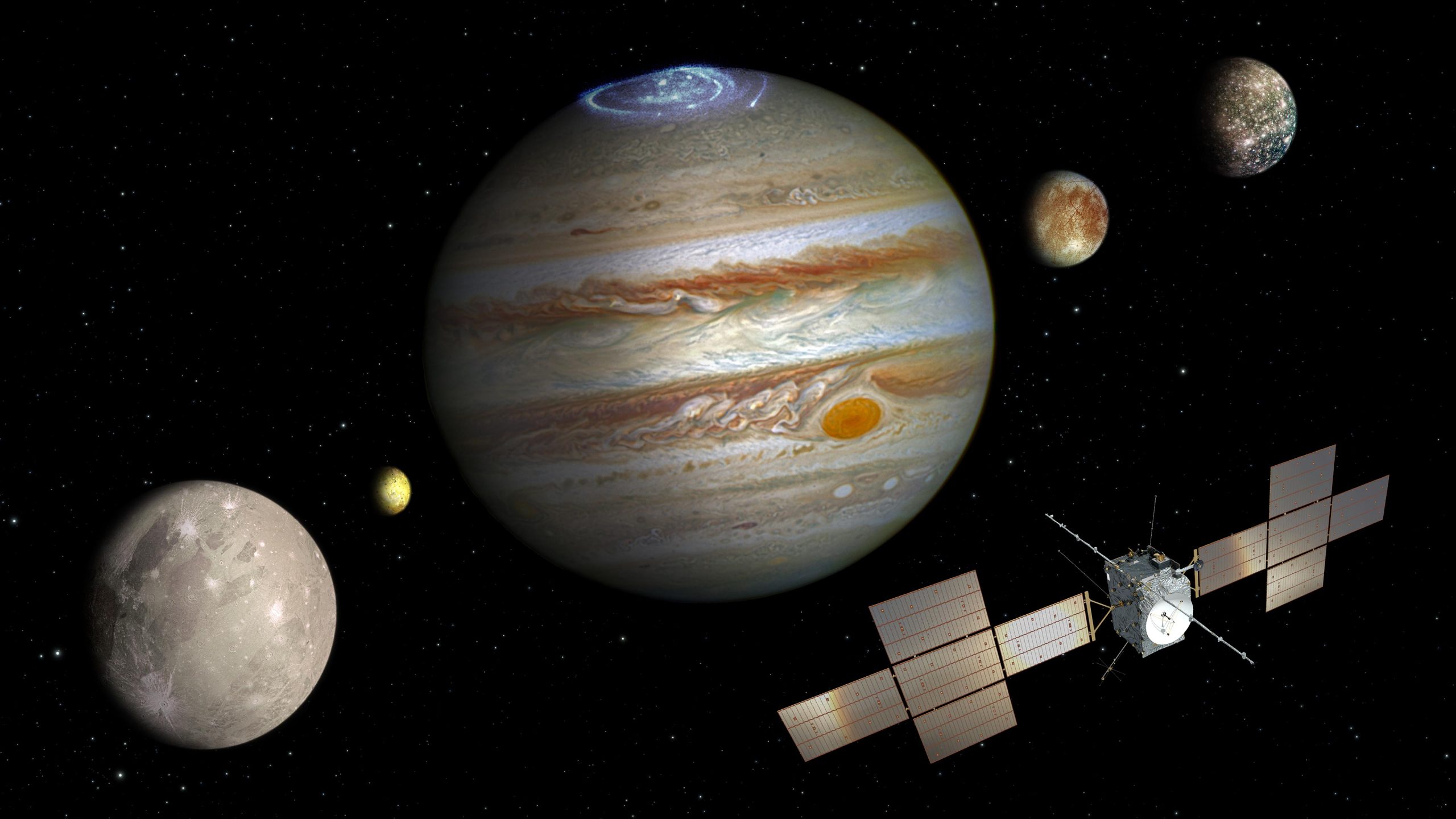
Thanks to the legacy of previous Jupiter missions (see infographic below) we know that three of the planet’s largest moons – Europa, Ganymede, and Callisto – hold quantities of water buried under their surfaces in volumes far greater than in Earth’s oceans. These planet-sized moons offer us tantalizing hints that conditions for life could exist other than here on our ‘pale blue dot’, and Juice is equipped to bring us one step closer to answering this alluring question.

On the left of the timeline are spacecraft designed to orbit the gas giant, with the stated date range from arrival at Jupiter to end of mission. On the right of the timeline are spacecraft that have flown by Jupiter on their way to the more distant reaches of the Solar System; the stated dates show the year that the spacecraft flew past the gas giant.
ESA’s Jupiter Icy Moons Explorer (Juice) mission launched on April 14, 2023, to make detailed observations of the giant gas planet and its three large ocean-bearing moons – Ganymede, Callisto and Europa – with a suite of remote sensing, geophysical and in situ instruments. Juice will characterize these moons as both planetary objects and possible habitats, explore Jupiter’s complex environment in depth, and study the wider Jupiter system as an archetype for gas giants across the Universe.
The first person to view Jupiter and its largest moons through a telescope was Galileo Galilei in 1609. Over 400 years later and humanity’s ever-long desire to look up and explore worlds beyond our own lives on; Juice will carry a commemorative plaque, as a tribute to the Italian astronomer.
Credit: ESA (Acknowledgement: work performed by ATG under contract to ESA), CC BY-SA 3.0 IGO
“Over 400 years ago, Galileo discovered moons orbiting Jupiter – news that shocked the Renaissance world and revolutionized humankind’s understanding of our place in the Universe,” says Carole Mundell, ESA’s Director of Science. “Today, we have sent a suite of ground-breaking science instruments on a journey to those moons that will give us an exquisite close-up view that would have been unimaginable to previous generations. Juice carries the dreams of anyone who’s ever gazed up at Jupiter shining brightly in the night sky and wondered about our origins.
“The treasure trove of data that ESA Juice will provide will enable the science community worldwide to dig in and uncover the mysteries of the jovian system, explore the nature and habitability of oceans on other worlds, and answer questions yet unasked by future generations of scientists.”
A grand odyssey of exploration is about to begin. Humankind’s next bold mission to the outer Solar System, ESA’s Jupiter Icy Moons Explorer, Juice, is poised to explore the giant planet Jupiter and its largest moons. These intriguing worlds have piqued our curiosity ever since Galileo first raised his telescope to the planet and discovered its four largest moons: Io, Europa, Ganymede, and Callisto, three of which are thought to harbor underground oceans. Credit: Produced by ESA/ATG medialab
Journey to Jupiter
Juice is the last ESA space science mission to launch on an Ariane 5, in a long legacy (see infographic below) dating back to 1999 with the launch of XMM-Newton, which is still in operation today, and most recently, the NASA/ESA/CSA James Webb Space Telescope in 2021.
“What a magnificent demonstration of Europe’s capacity to dream big and deliver results to match,” says Daniel Neuenschwander, ESA’s Director of Space Transportation. “We can all be proud of Ariane 5 for making possible missions like Juice and setting such a high standard for our new generation of launch systems.”
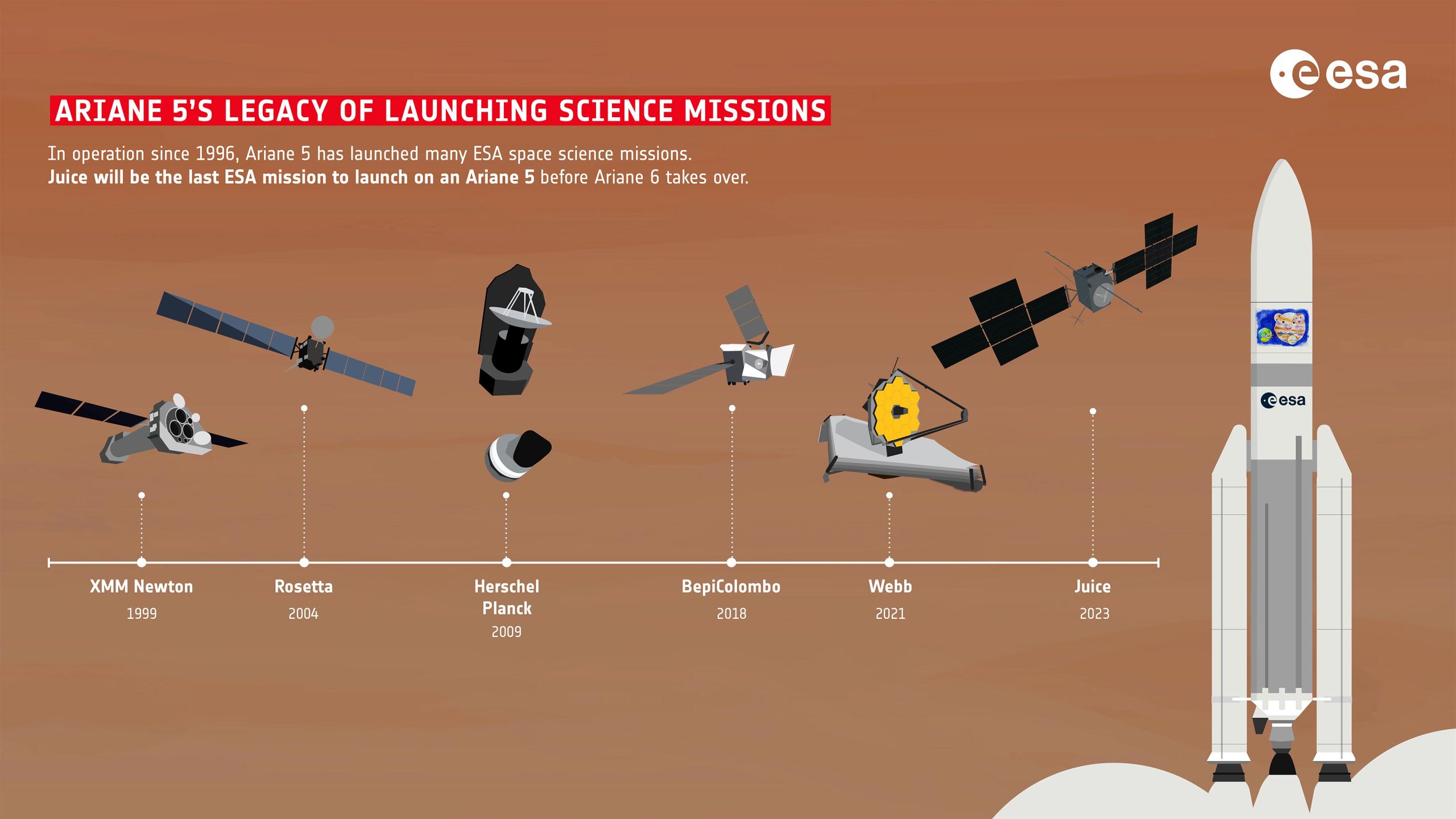
The Jupiter Icy Moons Explorer (Juice) will be the last ESA mission to launch on an Ariane 5 before Ariane 6 takes over. Credit: ESA (Acknowledgment: work performed by ATG under contract to ESA), CC BY-SA 3.0 IGO
Over the next two-and-half weeks (see infographic below) Juice will deploy its various antennas and instrument booms, including the 16 m long radar antenna, 10.6 m long magnetometer boom, and various other instruments that will study the environment of Jupiter and the subsurface of the icy moons.
An eight-year cruise with four gravity-assist flybys at Earth and Venus will slingshot the spacecraft toward the outer Solar System. The first flyby in April 2024 will mark a space exploration first: Juice will perform a lunar-Earth gravity-assist – a flyby of the Moon followed 1.5 days later by one of Earth.
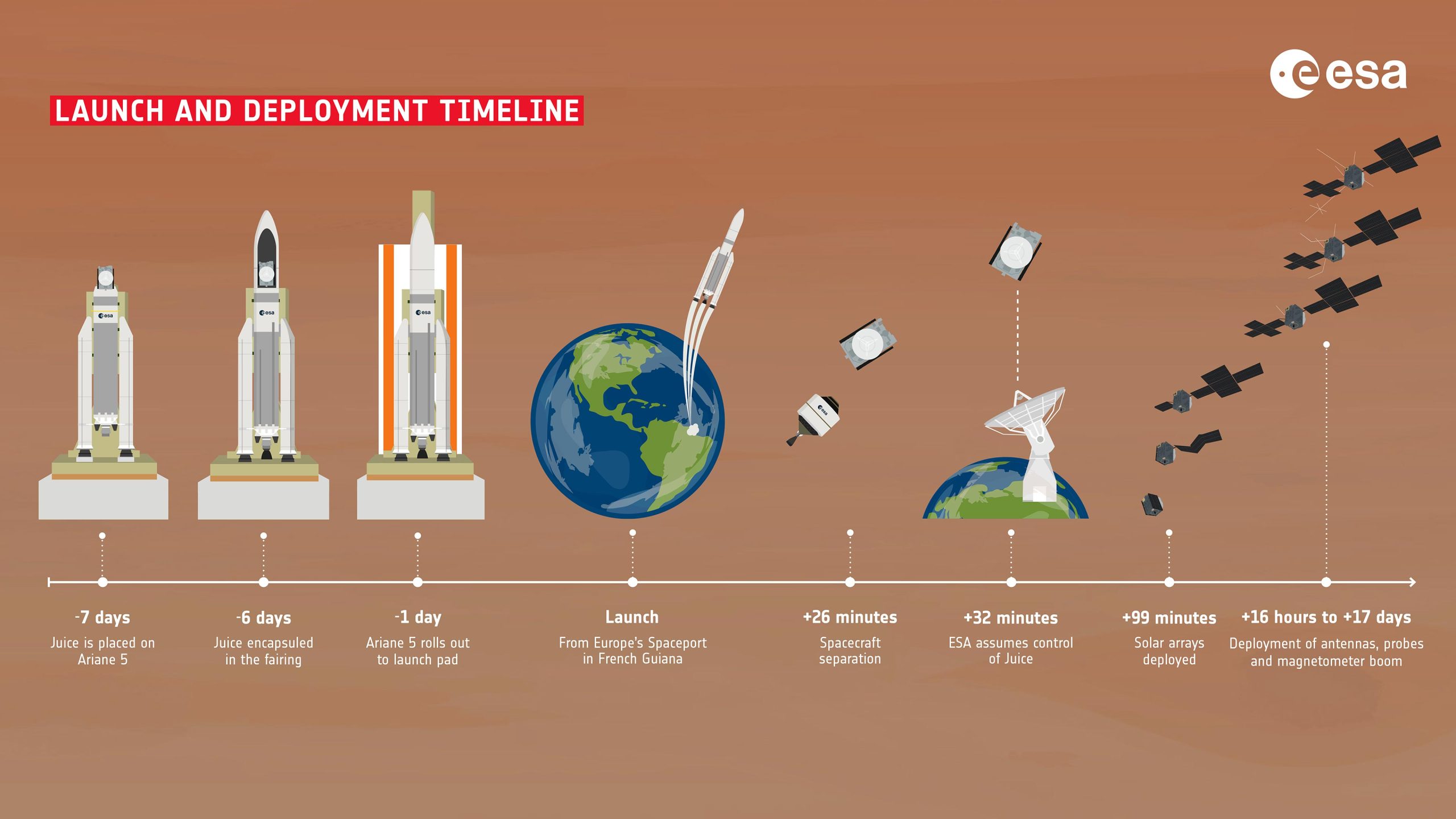
ESA (Acknowledgment: work performed by ATG under contract to ESA), CC BY-SA 3.0 IGO
ESA’s spacecraft operators, technology engineers, and mission analysts have worked exhaustively to prepare for the challenges that lie ahead on this adventurous mission.
Shields will protect the spacecraft’s sensitive electronics from the monstrous levels of radiation in the Jupiter system. Multi-layered insulation will keep internal temperatures stable while externally they may reach more than 250ºC during the Venus flyby and -230ºC at Jupiter.
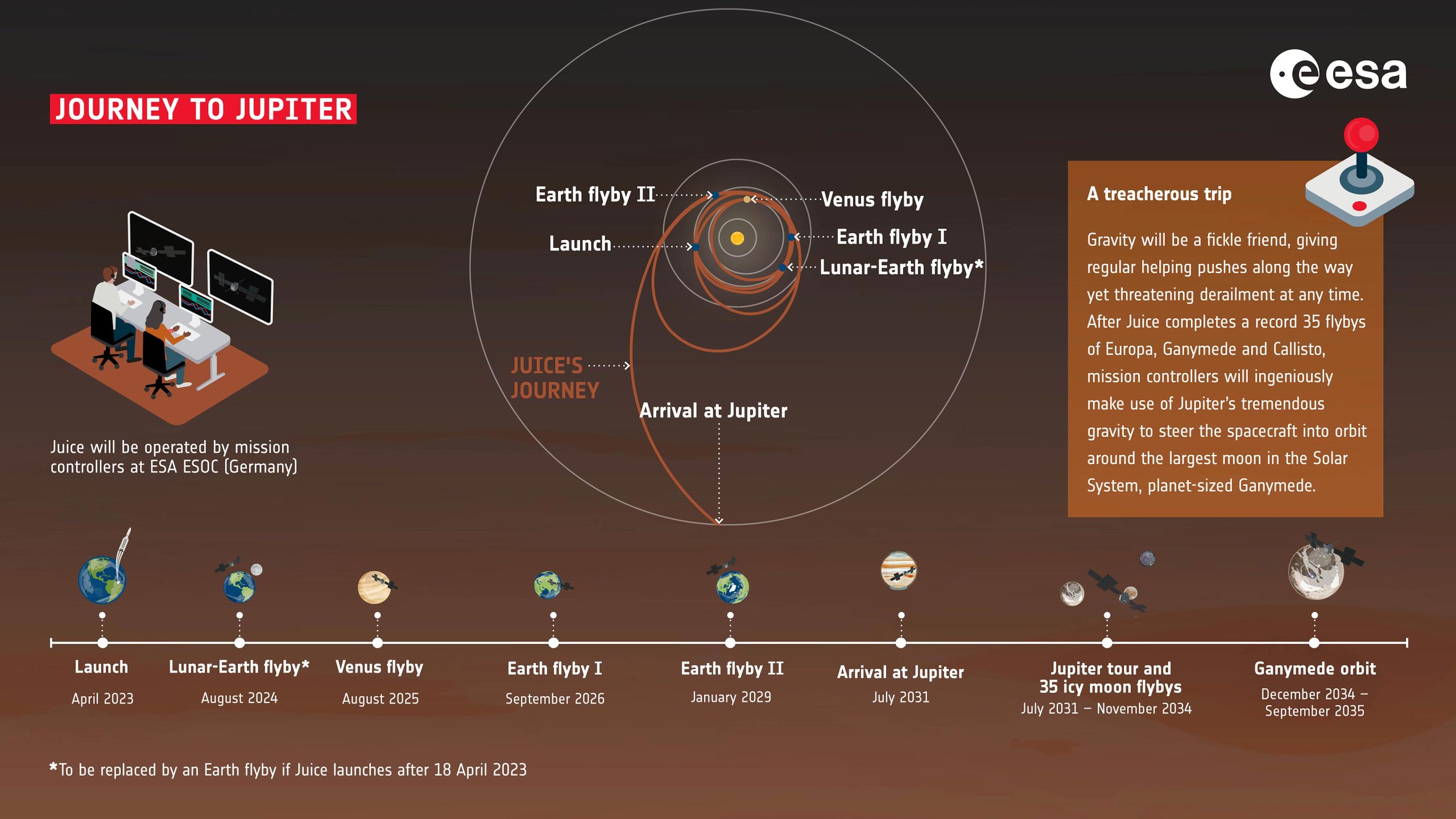
On its journey, Juice will make a series of flybys of Earth, the Earth-Moon system and Venus to set it on course for its July 2031 rendezvous in the Jovian system.
Juice will make three Earth flybys during its cruise: one of the Earth-Moon system in August 2024, one of Earth in September 2026, and once again one of Earth in January 2029.
In total Juice will spend approximately eight years cruising to Jupiter. It will reach Jupiter in July 2031, but will already begin making scientific observations six months before entering orbit around Jupiter. Juice will go on to spend many months orbiting Jupiter, making 35 flybys of icy moons Europa, Ganymede and Callisto, and finally conducting an orbital tour of Ganymede.
Credit: ESA (Acknowledgment: work performed by ATG under contract to ESA), CC BY-SA 3.0 IGO
“Hundreds of millions of kilometers from Earth and powered by just a sliver of sunlight, we will guide Juice through 35 flybys of Jupiter’s ocean moons in order to gather the data needed to bring scientists closer than ever to these compelling destinations,” says Ignacio Tanco, ESA’s Juice spacecraft operations manager.
“To fly such a complex path from such an enormous distance – and vitally, to get Juice’s valuable data home to Earth – will require precise navigation techniques, reliant on ESA’s deep space antennas in Spain, Argentina and Australia, all controlled remotely from ESOC.”
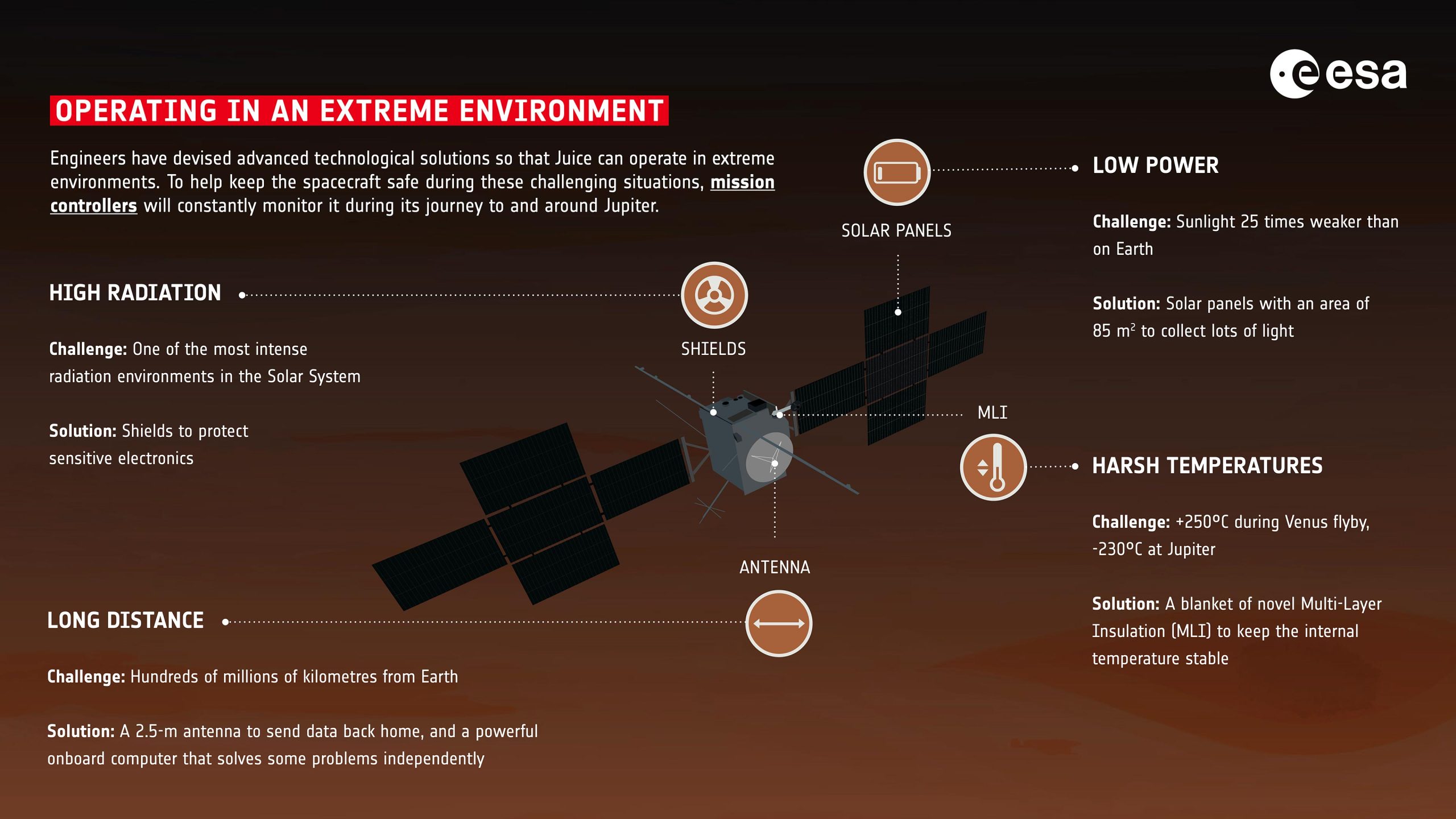
Juice has been specially designed to overcome all these challenges and many more. For example, shields have been built to protect the spacecraft’s sensitive electronics, large solar panels will enable it to collect lots of sunlight, Multi-Layer Insulation will keep it at a stable temperature, a large antenna will help it communicate with engineers on Earth, and a powerful onboard computer – Juice’s ‘brain’ – will help it to solve some problems independently, without needing to contact Earth at all.
Credit: ESA (Acknowledgment: work performed by ATG under contract to ESA), CC BY-SA 3.0 IGO
“We are ready to steer one of the most complex missions ESA has ever flown to adventures in the jovian system,” says Angela Dietz, deputy spacecraft operations manager. “From flybys of Jupiter’s moons over a period of two-and-a-half years, to the immense challenge of switching orbits from massive Jupiter to orbiting Ganymede, we’ll be solving challenges at mission control that have never been done before.”
Discover the top five mysteries that ESA’s Jupiter Icy Moons Explorer (Juice) mission will solve. Jupiter, its magnetic environment, and its moons form one of the most intriguing systems in the Solar System. Juice, planned for launch in 2023 and arrival at Jupiter in 2031, will reveal more about this fascinating planet and its natural satellites. Credit: ESA – European Space Agency
Explore farther
Ganymede, which is larger than the planet Mercury, is Juice’s primary scientific target; it will spend around nine months observing the moon closely from orbit. Ganymede has a particularly intriguing characteristic besides its hidden ocean: it is the only moon in the Solar System to generate its own magnetic field. Only two other solid bodies generate a field like Ganymede’s – Mercury and Earth.
The effect is a mini ‘magnetic bubble’ sitting within Jupiter’s larger one, and the two interact in highly complex ways. Juice will reveal more about the interior structure of Ganymede and in doing so will be able to determine how its core is able to generate and maintain a magnetic field. This will be key to understanding how the moon evolved, and the consequences for habitability.
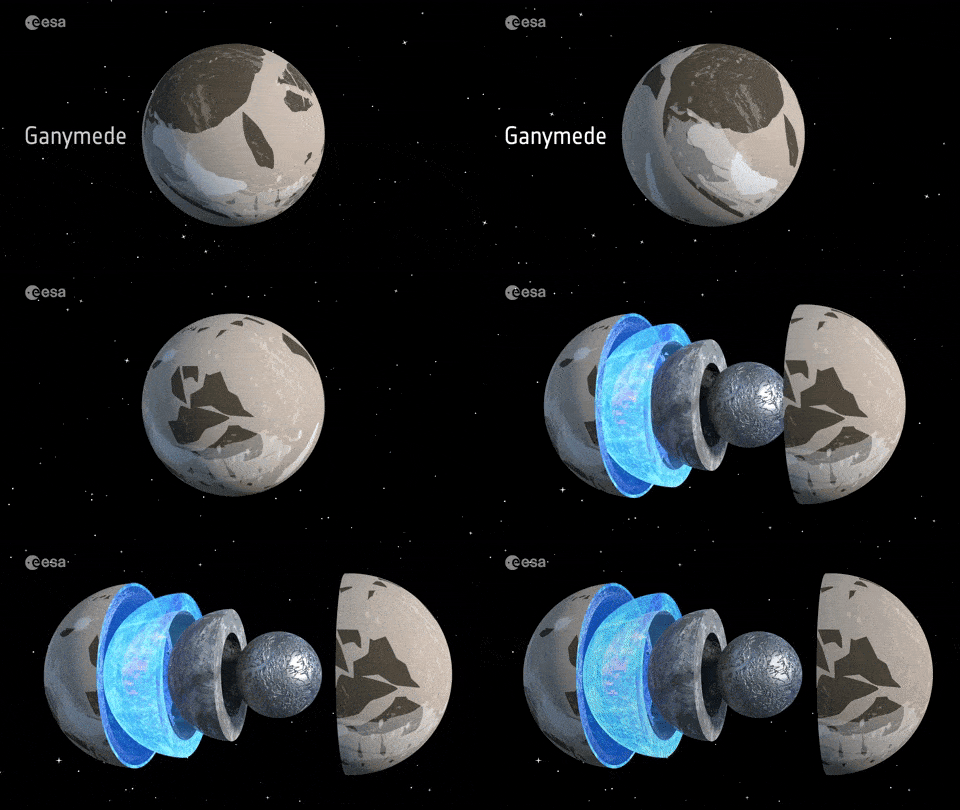
Understanding the state of the moon’s interior, and in particular, if it hosts liquid water, will help answer important questions about the habitability potential of the moon, and of similar exoplanet systems elsewhere in our Universe.
Credit: ESA/ATG Medialab
Ganymede also displays a wide range of surface ages and features, offering a geological record spanning several billion years. This complements its ‘siblings’ – ancient Callisto, which may hold clues to early conditions in the jovian system, and young and active Europa, which vents water into space.
“The scientific treasure that will be returned will undoubtedly have far-reaching implications on how we understand our Solar System and if there are potentially habitable locations beyond Earth – not just in our own cosmic neighborhood but also well beyond in the vast number of exoplanet systems populating our Universe,” says Olivier Witasse, ESA’s Juice project scientist. “In turn, this knowledge will make us richer beings, learning more about ourselves, our origins, and our place in the Universe.”
About Juice
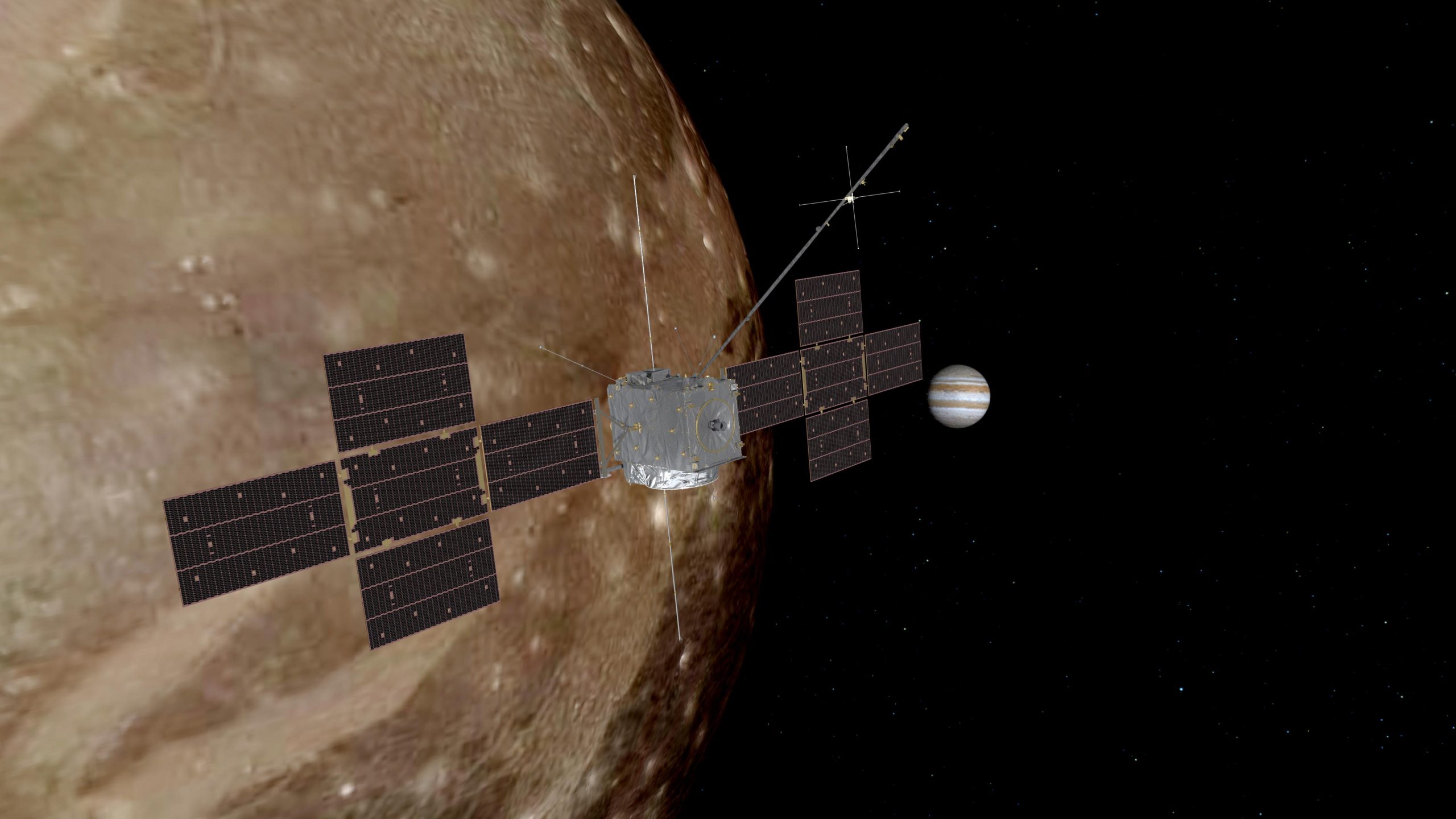
ESA’s Jupiter Icy Moons Explorer, ‘Juice’, is humankind’s next bold mission to the outer Solar System. It will make detailed observations of gas giant Jupiter and its three large ocean-bearing moons – Ganymede, Callisto and Europa. This ambitious mission will characterize these moons with a powerful suite of remote sensing, geophysical, and in situ instruments to discover more about these compelling destinations as potential habitats for past or present life. Juice will monitor Jupiter’s complex magnetic, radiation, and plasma environment in depth and its interplay with the moons, studying the Jupiter system as an archetype for gas giant systems across the Universe.
Juice launches on an Ariane 5 from Europe’s Spaceport in Kourou in April 2023. It has an eight-year cruise with flybys of Earth and Venus to slingshot it to Jupiter. It will make 35 flybys of the three large moons while orbiting Jupiter, before changing orbits to Ganymede.
Juice is a mission under ESA leadership with contributions from NASA, JAXA, and the Israel Space Agency. It is the first Large-class mission in ESA’s Cosmic Vision program.
Never miss a breakthrough: Join the SciTechDaily newsletter.
Follow us on Google and Google News.