
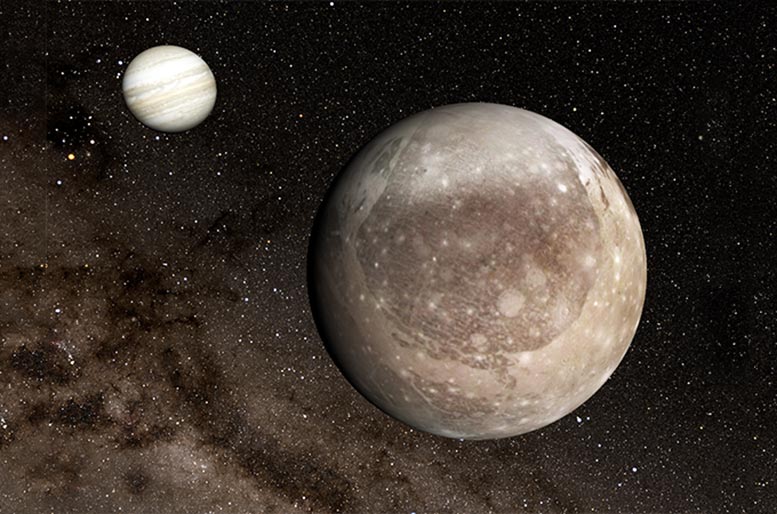
Researchers from Kobe University and the National Institute of Technology, Oshima College have conducted a detailed reanalysis of image data from Voyager 1, 2 and Galileo spacecraft in order to investigate the orientation and distribution of the ancient tectonic troughs found on Jupiter’s moon Ganymede. They discovered that these troughs are concentrically distributed across almost the entire surface of the satellite. This global distribution indicates that these troughs may be actually part of one giant crater covering Ganymede.
Based on the results of a computer simulation conducted using the “PC Cluster” computers at the National Astronomical Observatory of Japan (NAOJ), it is speculated that this giant crater could have resulted from the impact of an asteroid with a radius of 150 km (93 mi). If so, the structure is the largest impact structure identified in the solar system so far.
The European Space Agency’s JUICE (Jupiter Icy Moon Explorer) mission, which will be launched in 2022 and arrive in Jupiter’s system in 2029, aims to increase our knowledge regarding Jupiter’s satellites, including Ganymede. It is hoped that this exploration will confirm the results of this study and further advance our understanding of the formation and evolution of Jupiter’s satellites.
The research team consisted of Kobe University Graduate School of Science’s Assistant Professor HIRATA Naoyuki and Professor OHTSUKI Keiji (both of the Department of Planetology), and Associate Professor SUETSUGU Ryo of National Institute of Technology, Oshima College. The paper for this study was published online in Icarus on July 15.
Main Points
- Many furrows, or trough formations, have been previously observed on the surface of Ganymede, one of Jupiter’s moons.
- The research group comprehensively reanalyzed image data of Ganymede’s surface obtained by NASA’s Voyager 1, Voyager 2 and Galileo spacecraft.
- The results revealed that almost all of these furrows on the surface of Ganymede appear to be in concentric rings centered at a single point, indicating that this global multiring structure may be the remains of a giant crater.
- The radial extent of the multiring measured along the satellite’s surface is 7,800 km (4,800 mi). Therefore, if it is actually formed by an impact, it is the largest vestigial impact crater discovered in the solar system so far.
- The results of the numerical impact simulation indicated that an asteroid with a radius of 150 km (93 mi) impacting Ganymede at a speed of 20 km/s (12 mi/s) would explain the observed structures on the satellite’s surface.
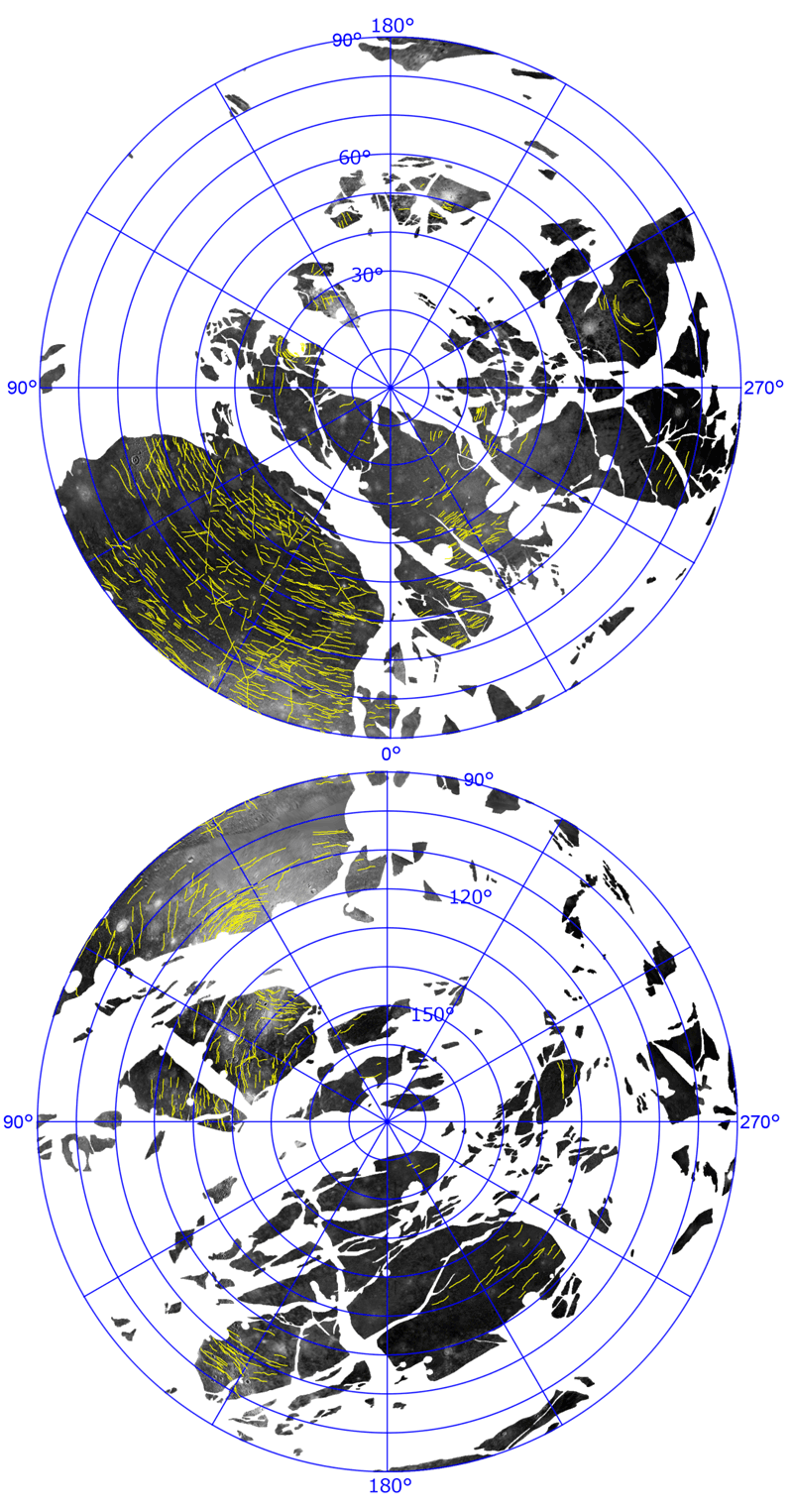
Above: Azimuthal equidistant map centered at 20° south 180° west showing Ganymede’s Dark Terrain and furrows (indicated by yellow lines).
Below: Azimuthal equidistant map of Ganymede’s surface centered at 20° north and 0° west. This shows the opposite hemisphere of Ganymede to the top image. The white areas indicate Bright Terrain. Credit: NASA
Research Findings
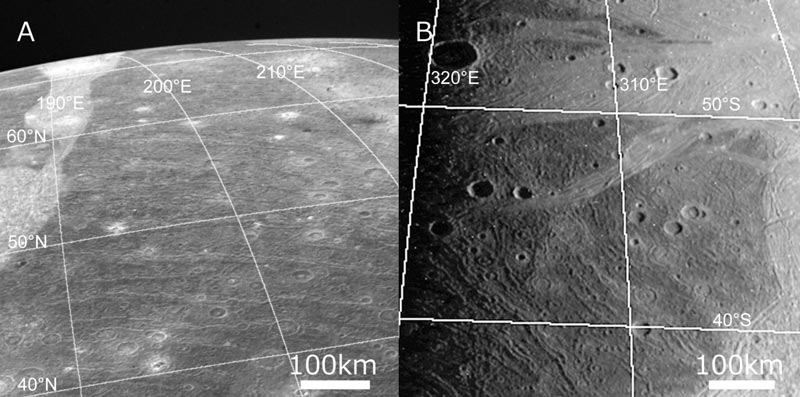
Ganymede’s surface is categorized into areas of Dark Terrain and Bright Terrain. Dark Terrain is extremely old and has many remaining craters, as well as trough formations (Figure 1). Bright Terrain is comparatively recent, with hardly any craters. These two types of terrain are not coherently arranged and are randomly distributed over Ganymede’s entirety. Furrows are believed to be Ganymede’s oldest geological features because they are only found on Dark Terrain and many impact craters[1] have been formed on top of them later on.
This study reanalyzed the distribution of these trough formations over Ganymede’s entire surface, revealing for the first time that almost all of these furrows are concentrically aligned around a single point (Figure 2). The study showed that these furrows form giant, concentric rings over the entire satellite. From this, it can be assumed that there was a giant multiring impact crater which covered the entire surface of Ganymede before the formation of the Bright Terrain areas. A similar ring structure known as the Valhalla Crater remains on the surface of Callisto, another satellite of Jupiter. Until now, the Valhalla Crater has been the largest identified multiring crater[2] in the solar system, with a radius of approximately 1,900 km (1,180 mi). However, the multiring crater on Ganymede has a radial extent of 7,800 km (4,800 mi) measured along the satellite’s surface.
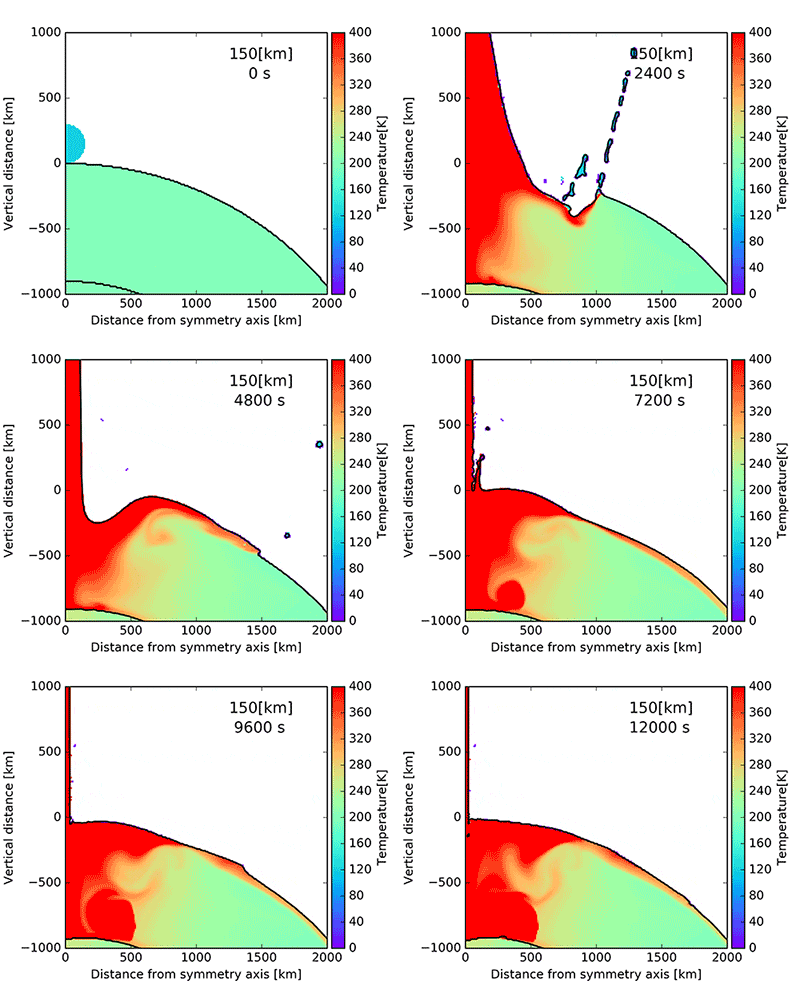
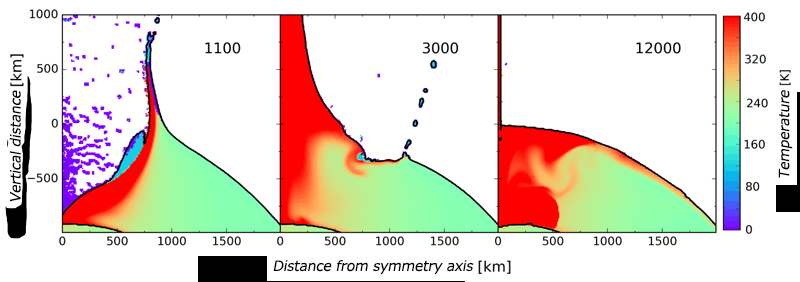
The research team conducted a simulation to estimate the scale of the impact that formed this giant crater. This was carried out using the “PC Cluster” at the National Astronomical Observatory of Japan (NAOJ). The results indicated that an asteroid with a radius of 150km impacting Ganymede at a speed of 20 km/s (12 mi/s) would be sufficient to form the observed structures on the satellite’s surface (Figure 3). It is believed that such an impact occurred around 40 billion years ago.
Further Developments
The discovery that the aftermath of a large-scale impact remains on Ganymede’s surface is greatly significant in terms of the satellite’s formation process and evolution. For example, Jupiter’s satellite Callisto is around the same size as Ganymede, however, it is believed that it doesn’t have an internal structure composed of differentiated layers. On the other hand, Ganymede is thought to be composed of a differentiated layer structure consisting of rock, iron, and ice. An enormous amount of heat is necessary to form these differentiated layers. It is possible that the aforementioned large-scale impact could have been the source of this heat.
This study’s discovery will also have substantial significance for the Ganymede exploration programs scheduled in the coming decades. The image data from both Voyager and Galileo missions only provide partial views of the satellite’s surface. It is hoped that future explorations will be able to confirm or test this study’s results by conducting detailed investigations into the multiring formations and whether or not there are any other remains of large-scale impacts. Hopefully, this will result in a deeper understanding of the origins and evolution of Ganymede as well as Jupiter’s other moons.
Glossary
- Impact crater – A circular depression that occurs as the result of an asteroid or comet crashing into the surface.
- Multiring crater – These multiple-ring structures form around the vicinity of impact craters.
Reference: “A global system of furrows on Ganymede indicative of their creation in a single impact event” by Naoyuki Hirata, Ryo Suetsugu and Keiji Ohtsuki, 15 July 2020, Icarus.
DOI: 10.1016/j.icarus.2020.113941
Never miss a breakthrough: Join the SciTechDaily newsletter.
Follow us on Google and Google News.
2 Comments
Great article, but I think your estimate of impact at 40 billion years ago needs to be reined in to about 40 Million years ago, yes?
Really?! I thought maybe Spongebob blew an enormous bubble. We need scientists to tell us a crater was formed by an impact? Good Lord!