
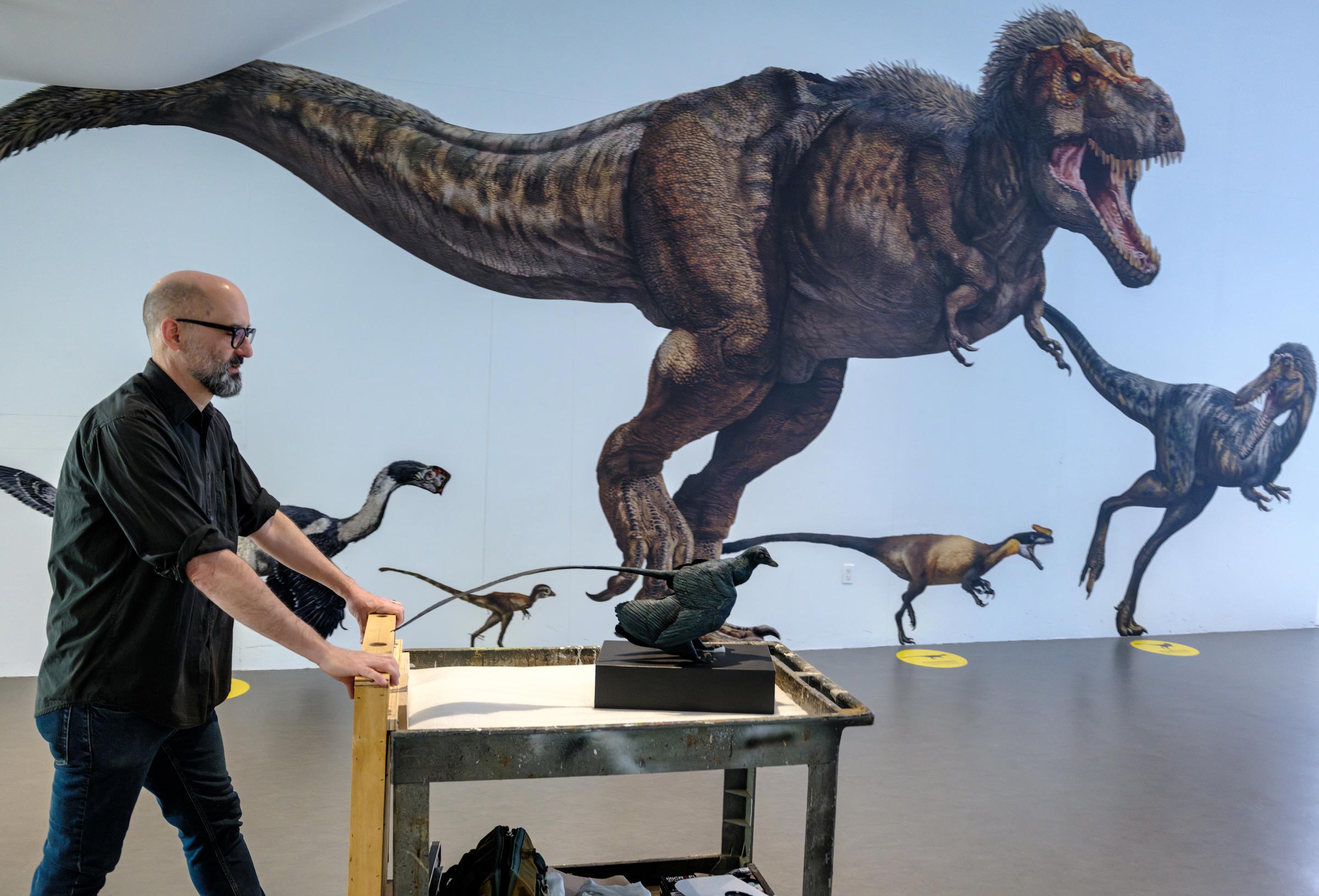
For all their astonishing diversity, dinosaurs seem to have hit one evolutionary limit: they almost never became truly tiny.
Tiny animals are everywhere in modern ecosystems, from mice and shrews to hummingbirds and geckos, yet dinosaurs seem to have left much of that miniature world unexplored.
A new study suggests this missing miniature world cannot be explained simply by dinosaur physiology. Instead, the researchers argue that dinosaurs may have faced an ecological barrier, with early mammals and other small vertebrates already occupying many of the niches available to animals at the lower end of the size spectrum.
The finding turns a familiar story about dinosaur dominance on its head. Dinosaurs are often credited with keeping Mesozoic mammals small. The new research proposes that the relationship may have worked both ways.
“Everyone loves a giant dinosaur,” said study co-author Roger Benson, the Macaulay Curator of Dinosaur Paleobiology at the American Museum of Natural History. “But we decided to look at the other end of the scale. The absence of tiny dinosaurs may be just as interesting as the existence of giant ones. We already knew that dinosaurs prevented mammals from evolving to large sizes before the end-Cretaceous mass extinction. Here we suggest that mammals in turn prevented dinosaurs from evolving to small sizes.”
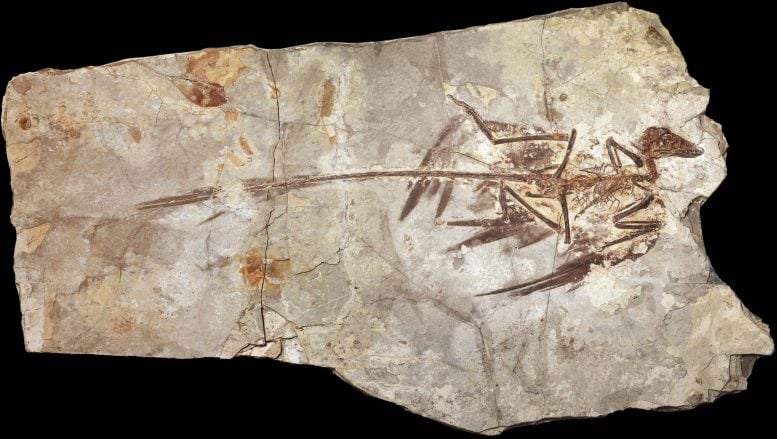
Why Dinosaurs Had a Surprisingly High Size Floor
The contrast becomes clearer when dinosaur size is compared with the range seen among living animals.
Some dinosaurs exceeded 80 tons, yet the smallest known non-bird dinosaurs weighed close to one pound (approximately 450 grams). That may sound tiny beside Tyrannosaurus rex, but by vertebrate standards it is remarkably large.
The bee hummingbird, the smallest living bird, weighs about 1.75 grams (0.06 ounces). The Etruscan shrew, among the smallest mammals, weighs roughly 1.8 grams (0.06 ounces), while the dwarf gecko can weigh only about 0.15 grams (0.005 ounces).
In fact, roughly three quarters of living mammal species and 90 percent of living bird species fall below the body mass of the smallest known non-bird dinosaurs. Almost all living lizard species are smaller as well.
“Small animals dominate modern ecosystems,” said Stephanie Lechki, the study’s lead author and a postdoctoral fellow at Princeton University. “If we want to understand how today’s biodiversity evolved, we need to understand why tiny dinosaurs appear to have been missing.”
Could Tiny Dinosaur Fossils Be Missing?
That raises an obvious possibility: perhaps the tiniest dinosaurs existed but have simply vanished from the fossil record.
Small skeletons are certainly difficult to preserve. Their bones are fragile, easy to scatter, and easier for paleontologists to overlook than the massive remains of large dinosaurs. But there is a problem with that explanation.
The same fossil deposits that contain dinosaurs also preserve much smaller mammals, amphibians, lizards, and other vertebrates. Paleontologists can recover animals well below the apparent dinosaur minimum. If mouse sized dinosaurs had been common, researchers argue that at least some should have turned up alongside those other tiny creatures.
The simplest interpretation is therefore a more intriguing one: extremely small non-avian dinosaurs may genuinely have been rare or absent.
Testing Dinosaur Body Size With Evolutionary Models
Lechki and Benson approached the mystery using mathematical models designed to predict which body sizes should be favored by natural selection.
At the center of the analysis is a basic evolutionary tradeoff. Animals must acquire energy, use some of it to maintain and grow their bodies, and ultimately invest energy in reproduction. Because those processes scale differently with body size, there may be sizes at which an animal can convert available energy into offspring especially efficiently.
The researchers tested whether those energetic relationships could reproduce the body size distributions seen across major vertebrate groups.
Their dataset included thousands of living species, among them more than 9,000 birds, more than 4,000 mammals, and more than 6,000 lizards, as well as body mass estimates for 515 non-avian dinosaurs.
Why Physiology Could Not Explain Dinosaur Size
For mammals, birds, and turtles, the models did a reasonably good job of predicting observed patterns. They performed much more poorly for lizards, snakes, and crocodilians.
Dinosaurs posed an even bigger challenge.
The researchers explored a broad range of plausible physiological assumptions, including characteristics spanning living vertebrate groups. Yet the models still failed to explain why the dinosaur size distribution was shifted so far upward. Non-avian dinosaurs remained much larger than their energetic biology alone predicted.
That failure is scientifically useful. It indicates that the answer probably lies outside physiology.
How Ecological Competition May Have Limited Dinosaurs
An animal cannot evolve in isolation from everything else around it. Even if a particular body size is physiologically possible, that does not mean there is an open ecological role waiting for an animal of that size.
Tiny animals need food, shelter, territory, and ways to avoid predators. If other species already exploit those resources efficiently, entering the same niche can be difficult.
During the age of dinosaurs, small mammals were already occupying many of those miniature ecological roles. Dinosaurs therefore may have encountered what amounted to an ecological floor. Becoming smaller could have pushed them into increasingly crowded territory rather than opening up a new evolutionary opportunity.
This idea creates an unusually symmetrical picture of Mesozoic ecosystems. Large dinosaurs may have helped keep mammals from expanding into bigger body sizes, while mammals and other small vertebrates may have made it harder for dinosaurs to move in the opposite direction.
Competition is unlikely to have been the only factor. Predation, available food, habitat, reproductive biology, and the number of accessible ecological niches could also have shaped the sizes dinosaurs were able to reach. One branch of the dinosaur family tree offers an important clue.
How Flight Allowed Birds to Break the Dinosaur Size Barrier
Birds are living dinosaurs, which makes their size distribution especially revealing.
Modern birds include some of the smallest warm-blooded vertebrates alive, yet their non-avian dinosaur relatives never approached those extremes. During the origin of birds, body size moved sharply downward, producing forms far smaller than the typical dinosaurs that came before them. The new modeling indicates that this transition also cannot be explained simply by a change in energetic physiology.
The researchers propose that flight may have changed the evolutionary equation.
Why Tiny Birds Became Possible
Once early birds gained powered flight, they could exploit resources and habitats unavailable to dinosaurs confined to the ground. Trees, aerial prey, new escape strategies, and other opportunities associated with life above the ground could have opened ecological niches where being exceptionally small was advantageous.
“The ability to fly may have opened entirely new ways of life,” Lechki said. “Once birds entered those new ecological niches, they were free to evolve body sizes that had simply not been possible for other dinosaurs.”
What Dinosaur Size Reveals About Evolution
Seen this way, the evolution of tiny birds was not merely a matter of shrinking a dinosaur body. Flight may have allowed one dinosaur lineage to escape ecological constraints that had persisted for millions of years.
Evolution does not necessarily produce every body form that an organism could theoretically support. Which possibilities are actually realized can depend on what other species are already present and which ecological opportunities remain open.
“We have this unusual situation where the ancestors of dinosaurs could be tiny. The living descendants of dinosaurs—birds—they can be tiny. But dinosaurs themselves seemed to be forbidden from being tiny,” Benson said. “And we don’t really understand that yet, but it’s a question we should continue to explore if we really want to understand dinosaurs and their fascinating biology.”
Reference: “The explanatory power of energetic fitness models across living amniotes and extinct non-avian dinosaurs” by Stephanie C Lechki and Roger B J Benson, 5 August 2026, Evolution.
DOI: 10.1093/evolut/qpag117
Never miss a breakthrough: Join the SciTechDaily newsletter.
Follow us on Google and Google News.
2 Comments
They went underground, that’s how they survived. Does anyone at SciTechDaily watch Nova or Nature?
Bit of a mistake to compare vertibrate sizes between dinosaurs and modern animals. We are either still in a post ice age mass extinction or coming out of the end of one, and that generally selects smaller survivors.