
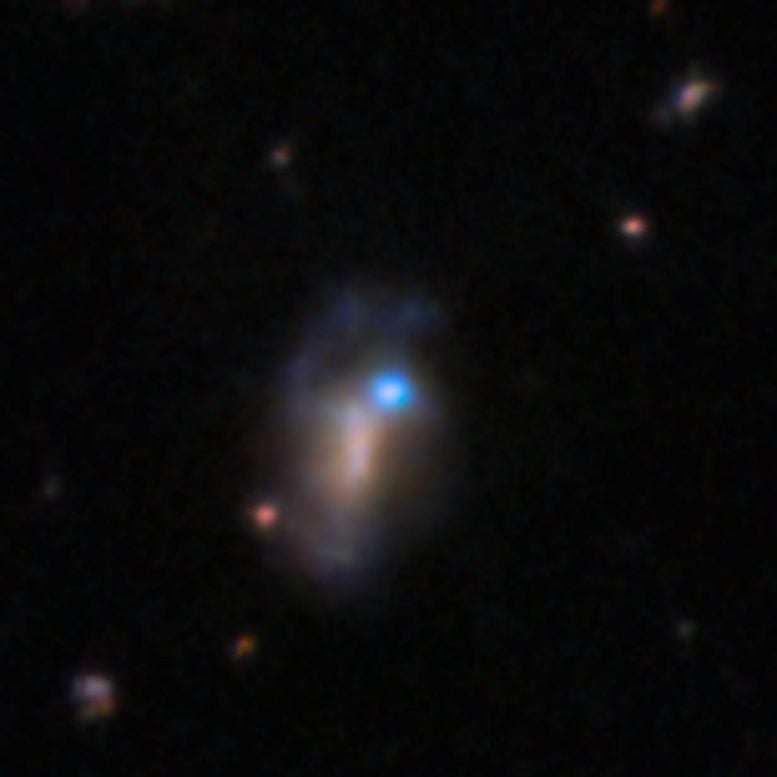
Astronomers witnessed a star’s death almost from the instant it began, catching an extraordinarily rare X-ray flash as a supernova erupted 500 million light-years away.
Astronomers rarely get to watch a star die from the beginning. Usually, a supernova is discovered only after the explosion is already well underway.
SN 2026gzf was different.
On March 21, 2026, the Einstein Probe detected a fleeting pulse of soft X-rays from a galaxy about 500 million light-years away. The signal, EP260321a, lasted only briefly, but it appeared to capture one of the most elusive moments in stellar astronomy: the instant an explosion broke through the surface of a dying star.
A Supernova Caught at the Very Beginning
Less than an hour later, telescopes on Earth were already watching the same region. What they saw was a supernova rapidly growing brighter.
That alone made the event unusual. What came next made it stranger.
The explosion looked like the kind of powerful supernova often associated with gamma-ray bursts and jets of matter moving close to the speed of light. Yet astronomers found neither.
Two independent teams, led by Brendan O’Connor of Carnegie Mellon University and Jillian Rastinejad of the University of Maryland, College Park, studied the event using observatories around the world. Their results, published in The Astrophysical Journal Letters (O’Connor et al., Rastinejad et al.), offer an unusually detailed look at both the explosion and the turbulent final stages of the star that produced it.
CTIO/NOIRLab/DOE/NSF/AURA
The Elusive Flash of a Shock Breakout
Both teams independently identified EP260321a as a “shock breakout,” the moment when the powerful shock wave from a stellar explosion bursts through the star’s surface and releases the first light of a supernova.
A shock breakout is effectively the opening flash of a supernova. After a massive star’s core collapses, an enormous shock wave races outward through the star. When that shock finally reaches material near the surface, radiation can suddenly escape into space.
Shock breakouts may remain visible for only seconds to hours, while the optical supernova that follows can shine for weeks or months. Astronomers therefore have a much larger window in which to discover the later explosion than its first flash.
A Rare X-Ray Signal Reveals More
That helps explain why clear detections are so uncommon. During the past two decades, only one other X-ray shock breakout has been confidently identified.
EP260321a provided something even more valuable: astronomers detected the opening X-ray flash and then followed the same explosion across multiple wavelengths as the supernova developed.
The supernova itself, SN 2026gzf, was classified as a broad-lined Type Ic (Ic-BL) supernova.
A Powerful Supernova With Something Missing
Type Ic supernovae come from stars that have already lost their outer hydrogen and helium layers before exploding. The “broad-lined” designation refers to unusually broad features in their spectra, produced by material expanding at tremendous speeds.
Ic-BL explosions are particularly interesting because some are connected to gamma-ray bursts, extraordinarily powerful flashes of high-energy radiation. In those cases, the collapsing star can launch narrow relativistic jets that punch outward at close to the speed of light.
SN 2026gzf seemed to belong in that family, but an expected piece of the picture was missing.
Despite the supernova’s resemblance to energetic Ic-BL explosions previously associated with gamma-ray bursts, sensitive searches found no gamma-ray burst, relativistic jet, or lingering afterglow.
The Mystery of the Missing Gamma-Ray Burst
At the same time, its X-ray shock breakout was the faintest ever associated with an Ic-BL supernova. The supernova itself, however, was not comparably weak.
That combination challenges a simple picture in which similarly energetic stellar explosions produce similar outcomes.
“SN 2026gzf looks remarkably similar to other energetic supernovae that have been previously linked to gamma-ray bursts. Yet multi-wavelength follow-up observations using the most sensitive facilities found no evidence for a relativistic jet or an afterglow, which are typically seen in those events,” says O’Connor. “One possibility is that the jet was ‘choked,’ either by the surface of the star or by circumstellar material surrounding the star.”
Clues From the Star Before It Died
A choked jet could begin forming deep inside the exploding star but fail to escape. In that case, much of its energy would remain trapped instead of producing the bright gamma-ray signal astronomers can detect across vast cosmic distances.
The observations do not simply raise questions about what happened during the explosion. They also reveal what the star was doing before it died.
Rastinejad’s team concluded that the progenitor was a Wolf-Rayet star, born with about 20 times the mass of the Sun.
A Massive Star Stripped Bare
Wolf-Rayet stars represent a late stage in the lives of some massive stars. They are extremely hot and can lose enormous quantities of material before their final collapse.
In the case of SN 2026gzf, the star appears to have gone through irregular episodes of mass loss that eventually removed all of its hydrogen and helium. By the time it exploded, what remained was a stripped star made mostly of carbon and oxygen.
The expelled material did not simply disappear into space. It accumulated around the star, preserving a physical record of its final years.
Debris Reveals a Violent Final Chapter
Researchers reconstructed at least two distinct structures. A compact, relatively low-mass shell close to the star produced the initial X-ray signal, while a larger and non-symmetric shell farther out contributed to the optical emission seen as the supernova expanded into its surroundings.
“Our observations allowed us to study the physics of three pieces of this explosion: the X-ray shock breakout, the accompanying supernova, and the interaction of the supernova with material previously cast out by the dying star,” says Rastinejad. “With this information we were able to map out the structure of the material surrounding the star and understand the star’s violent lifestyle before it collapsed.”
That surrounding debris matters because astronomers cannot directly watch the final centuries or years of a star located hundreds of millions of light-years away. The material it sheds before death can instead serve as a fossil record of its behavior.
A Fossil Record of Stellar Mass Loss
For SN 2026gzf, that record points to an unstable and violent end.
“This is the first time we’ve mapped out the pre-explosion environment of a star that has been stripped of hydrogen and helium,” says Gokul Srinivasaragavan, a recent PhD graduate from the University of Maryland, a member of Rastinejad’s team, and second author on the paper. “Going forward, I’m excited to observe more shock breakout events in similar detail to test if all stripped stars have a similar ‘lifestyle’ prior to collapse and what, if any, differences we see.”
Researchers received an especially rare bonus when they searched older observations of the galaxy.
Astronomers Find the Star in Older Images
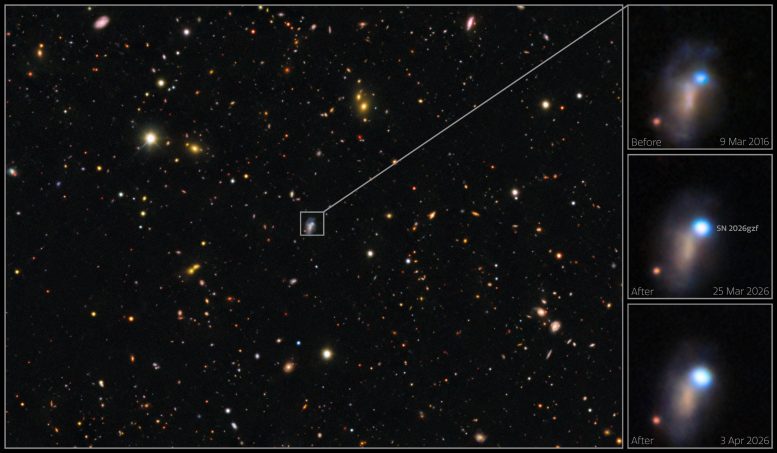
Images taken with the 570-megapixel DOE-fabricated Dark Energy Camera (DECam) roughly a decade before the explosion showed a blue source at the same location.
Those archival images provide a glimpse of the progenitor system and its environment before the supernova occurred, allowing astronomers to compare the system before and after the star’s destruction.
O’Connor’s team also used DECam on the NSF Víctor M. Blanco 4-meter Telescope (13-foot) at Cerro Tololo Inter-American Observatory (CTIO) in Chile to follow the supernova as it brightened toward maximum luminosity.
Rubin Observatory Tracks the Aftermath
Another fortunate circumstance placed SN 2026gzf inside the NSF–DOE Vera C. Rubin Observatory’s COSMOS Deep Drilling Field, an area designed for repeated, sensitive observations.
Public commissioning data distributed through the Rubin alert broker Babamul helped trace the supernova across multiple wavelength bands. The observations also revealed signs that the progenitor system had been active shortly before the explosion.
That is particularly valuable for astronomers trying to connect a star’s final behavior with the type of explosion it eventually produces.
Rubin is also expected to continue observing the region, potentially giving researchers a years-long record of how the fading supernova and its surroundings change.
A Global Telescope Network Follows the Explosion
No single observatory could have reconstructed the entire event.
The Dark Energy Spectroscopic Instrument (DESI), installed on the NSF Nicholas U. Mayall 4-meter Telescope (13-foot) at Kitt Peak National Observatory (KPNO), obtained repeated spectra through its spare-fiber transient program.
DESI normally observes many astronomical targets at once using thousands of optical fibers. Fibers not assigned to the survey’s primary targets can instead be directed toward transient objects such as supernovae, turning otherwise unused observing capacity into a way to track rapidly changing events.
DESI Captures a Supernova in Motion
Those repeated spectra allowed astronomers to watch SN 2026gzf change and helped establish its Ic-BL classification.
“DESI’s spare-fiber program gave us the opportunity to return to SN 2026gzf repeatedly and follow how its spectrum changed as the explosion evolved,” says Xander Hall, graduate student at Carnegie Mellon University, member of O’Connor’s team, and second author of the paper. “This sequence of observations demonstrates the power of using DESI’s spare fibers for rapid transient follow-up and classification as Rubin continues to ramp up its transient alert stream over the next decade.”
O’Connor’s group also drew on NASA’s Chandra X-ray Observatory, the National Radio Astronomy Observatory’s Very Large Array (VLA), Wendelstein Observatory, Palomar Observatory, the Hobby-Eberly Telescope, and the Southern African Large Telescope (SALT).
Rapid Alerts Transform Supernova Astronomy
Rastinejad’s team independently assembled observations from Gemini North in Hawai‘i, Gemini South and the SOAR Telescope in Chile, Rubin Observatory, Palomar Observatory, and the VLA. Together, those measurements covered wavelengths from X-rays to radio emission and helped rule out a relativistic jet.
The broad coverage also illustrates a major change in how astronomers study fleeting cosmic events. A space telescope can discover something that lasts only minutes, automated alerts can spread the news almost immediately, and telescopes on several continents can begin gathering complementary observations before the object has dramatically changed.
For phenomena such as shock breakouts, that speed can determine whether scientists witness the critical first stage or miss it forever.
A Powerful Explosion Without the Expected Afterglow
EP260321a and SN 2026gzf occupy an unusual place among stellar explosions.
The event had an exceptionally faint X-ray shock breakout and no detected relativistic outflow, yet the supernova itself resembled the energetic Ic-BL explosions associated with some gamma-ray bursts. That makes it a potential bridge between relatively ordinary supernova shock breakouts and the more extreme stellar deaths that generate low-luminosity gamma-ray bursts.
More importantly, it suggests that an energetic Ic-BL supernova does not automatically imply a successful relativistic jet, gamma-ray burst, or long-lived afterglow.
References:
“EP260321a/SN 2026gzf: The Faintest Shock Breakout Associated with a Broad-lined Supernova” by Brendan O’Connor, Xander J. Hall, Malte Busmann, Daniel Gruen, Alberto Floris, Tomás Cabrera, Ziyuan Zhu, Antonella Palmese, Dylan Green, John Banovetz, Julius Gassert, Christopher L. Fryer, Roberto Ricci, Eleonora Troja, Surya Shivaprasad, Gregory R. Zeimann, Ariel J. Amsellem, Stephen Bailey, Segev BenZvi, Simone Dichiara, Hendrik van Eerten, Jeremy Hare, Lei Hu, Christopher M. Irwin, Keerthi Kunnumkai, Konstantin Malanchev, Mitra Maleki, Michael J. Moss, Adam D. Myers, Dheeraj Pasham, Christoph Ries, Geoffrey Ryan, David Schlegel, Michael Schmidt, Silona Wilke and Yu-Han Yang, 14 July 2026, The Astrophysical Journal Letters.
DOI: 10.3847/2041-8213/ae84ba
“A Multi-Wavelength View of the First Type Ic-BL Supernova with an Einstein Probe X-ray Shock Breakout” by Jillian C. Rastinejad, Gokul Srinivasaragavan, Nikhil Sarin, Tanner O’Dwyer, S. Bradley Cenko, James K. Leung, Anya E. Nugent, Daniel A. Perley, Genevieve Schroeder, Shreya Anand, Tomas Ahumada, Igor Andreoni, Aleksandra Bochenek, Alessandra Corsi, Christoffer Fremling, Anna Y. Q. Ho, Mansi M. Kasliwal, Geoffrey Mo, Anirudh Salgundi, Kendall I. Sippy, J. Sollerman, Eric C. Bellm, Tracy X. Chen, Michael W. Coughlin, Michael C. Davis, Fabio De Colle, Danielle Frostig, Christopher L. Fryer, Michael J. Graham, Xander J. Hall, K. -R. Hinds, Luca Izzo, Wynn Jacobson-Galan, Nathan P. Lourie, Keiichi Maeda, Josiah Purdum, Ben Rusholme, Avinash Singh and Robert Stein, July 14, 2026, arXiv.
DOI: 2606.10011
Never miss a breakthrough: Join the SciTechDaily newsletter.
Follow us on Google and Google News.
4 Comments
“Comparing the 74-femtosecond optical switching experiment with the choked-jet supernova SN 2026gzf (The Astrophysical Journal Letters) demonstrates how the same physical law plays out across vastly different scales.
The phrase ‘wave-medium interactions across physical domains’ is the precise, universally recognized nomenclature that unifies these fields in academic physics, allowing even the layman to follow along.
Ultrafast Optics (Micro Scale): Light pulse vectors are altered in real time when the background medium’s dielectric properties shift faster than a single optical cycle.
Astrophysics / SN 2026gzf (Macro Scale): An explosive relativistic jet is ‘choked’ and its gamma-ray signature smothered because it encounters dense, asymmetric circumstellar medium layers surrounding the progenitor star.
In both cases, mainstream physics often focuses solely on the isolated energy source, but the actual observational signature is dictated by how that energy couples with the background medium.
If science is to achieve a truly unified theory, it must break down academic silos and adopt a shared nomenclature. The Torsion Hill framework was devised and designed specifically to provide this universal translation layer—interpreting energy propagation, boundary impedance, and continuous field geometry consistently across oncology, optics, plasma physics, and cosmology, and as many as there are experimental / theoretical fields in science.”
Observational Predictions for SN 2026gzf
Secondary Radiative Spikes: Rather than a smooth, monotonic decay, radio and X-ray light curves will exhibit distinct re-brightening phases as the expanding shock front strikes outer, higher-density circumstellar shells.
High Spectropolarimetric Asymmetry: The lateral redirection of “choked” jet energy inside the inner envelope will manifest as high linear polarization (1–3%+) and shifting polarization angles, confirming an elongated, non-spherical expansion geometry.
Shock-Induced Dust Nucleation: Mid-to-far-infrared monitoring (e.g., JWST) will detect an infrared excess/thermal echo within 300–600 days, driven by rapid dust formation in the high-impedance collision layer between the shock front and pre-ejected material.
“The shock breakout and choked-jet dynamics of SN 2026gzf (The Astrophysical Journal Letters) highlight a fundamental mechanism: when a massive core collapses under extreme conditions, the surrounding background medium directly controls how outbound kinetic energy is redistributed. Under the right initial conditions, a high-mass stripped progenitor doesn’t merely explode—its core undergoes complete gravitational collapse into a central black hole. Rather than acting solely as a point of destruction, the formation of this central gravitational node releases high-energy shock waves and choked jets that compress and thermalize the surrounding circumstellar gas and dust.Macro Scale (Astrophysics): The outbound shock vector compresses outer gas layers into high-density filaments, seeding rapid star formation and assembling early dust chemistry around the newly created black hole node.Micro Scale (Plasma/Optics): The same structural mechanics apply where localized energy nodes compress and reorganize local background field boundaries rather than dissipating into free space.Across all scales, the formation of a central collapsed node and its interaction with surrounding high-impedance boundaries can serve as the primary catalyst—seeding and shaping the architecture of an entirely new galactic system from compressed particle dust and ejected field energy.”
“The real-time detection of SN 2026gzf (The Astrophysical Journal Letters) underscores a massive leap in observational physics: wide-field optical awareness and automated X-ray alerting (via the Einstein Probe) have drastically reduced response time—allowing astronomers to pinpoint exact boundary-transition moments within a vast field brimming with transient anomalies.By capturing these transient events at the instant of onset, modern alerting systems allow us to map wave-medium mechanics, boundary impedance, and continuous field dynamics as they unfold across the cosmos.”